

The DOI matches its Crossref record; 4 of the 4 references it cites were found in a registry or an index.
Effects of a Community-based Follow-up Program for Parents with Premature Infants on Parenting Stress, Parenting Efficacy, and Coping
Open accessAbstract
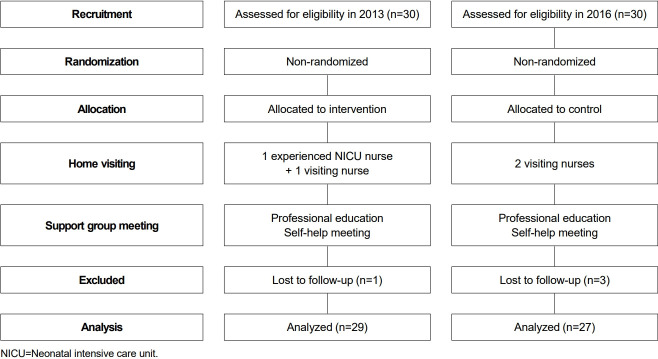
Purpose: This study was conducted to evaluate the efficacy of a community-based follow-up program on parenting stress, parenting efficacy, and coping among parents with premature infants.Methods: A non-equivalent control group pre-post quasi-experimental design was used. This program consisted of structured home visits and self-help group meetings for 6 months. The experimental group (n=29) received visits by an experienced neonatal intensive care unit (NICU) nurse and the control group (n=27) was visited by a visiting nurse. Data were analyzed using the x2 test, t-test, and analysis of covariance.Results: Parents' coping behavior significantly differed in the experimental group compared to the control group (t=3.14, p=.003). In particular, coping subscale I, for maintaining the family situation (t=2.63, p=.011), and subscale III, for understanding the infant's medical situation (t=4.30, p<.001), showed significant differences in the experimental group. There were no significant between-group differences in parenting stress or parenting efficacy.Conclusion: The findings of this study suggest that home visits by an experienced NICU nurse provided through a community-based follow-up program were an effective intervention to improve coping behavior among parents with premature infants.
Overview
The claims and statistics of this paper haven’t been checked yet.
Run the check — free, no account needed. It reads the open-access text and checks the sources it cites.
Integrity signals
Registry
Cites
Statistics
Figures
Verification
Claims the paper makes
The claims and statistics of this paper haven’t been checked yet.
Run the check — free, no account needed. It reads the open-access text and checks the sources it cites.
Claims other papers make about this one
Each is checked against this paper’s own text: does it say what the citing paper says it does?
The cited source says what the claim attributes to it.
In the citing paper
“Parental coping behaviors were higher in the intervention group compared to the control group (Ji & Shim, 2020).”
From Scoping review of interventions to support families with preterm infants post-NICU discharge (2022) · cites this paper as Ji & Shim, 2020
Self-check
Percentages, sums and reported differences re-computed from the paper’s own numbers.
The self-check needs the paper’s full text.
Citations
Cites
Faul, F., Erdfelder, E., Lang, A.-G., & Buchner, A. (2007) · Behavior Research Methods · doi:10.3758/bf03193146 · Cited by 65,971
Effectiveness of home visiting in improving child health and reducing child maltreatment
Avellar, S. A., & Supplee, L. H. (2013) · Pediatrics · doi:10.1542/peds.2013-1021g · Cited by 273
Discharge and beyond. A longitudinal study comparing stress and coping in parents of preterm infants
Rowe, J., & Jones, L. (2010) · Journal of Neonatal Nursing · doi:10.1016/j.jnn.2010.07.018 · Cited by 49 · cited 4×
“As mothers typically have the primary responsibility for both parenting and family health, coping strategies are extremely important to help mothers adjust to parenting stress and gain confidence in resolving difficult situations [10].”
BackgroundInfluentialCaring for late preterm infants: public health nurses’ experiences
Currie, G., Dosani, A., Premji, S. S., Reilly, S. M., Lodha, A. K., & Young, M. (2018) · BMC Nursing · doi:10.1186/s12912-018-0286-y · Cited by 20
Research works printed but not linked: 16
- 10.3928/19382359-20180325-02 · DOI
- 10.4040/jkan.2016.46.1.79 · DOI
- 10.12799/jkachn.2017.28.4.397 · DOI
- Greta, 2021, Transition of premature infants from hospital to home life, 207
- Meijssen, 2011, Parenting stress in mothers after very preterm birth and the effect of the infant behavioral assessment and intervention program, 195
- 10.4094/chnr.2013.19.1.39 · DOI
- 10.4094/chnr.2013.19.2.120 · DOI
- 10.4094/chnr.2013.19.3.207 · DOI
- 10.2307/351514 · DOI
- Shin, 1997, Effects of stress, social support and efficacy on mothers' parenting behaviors
- 10.1542/peds.2016-1274 · DOI
- 10.4094/jkachn.2010.16.4.344 · DOI
- 10.1080/1461673031000108504 · DOI
- Perricone, 2014, Coping and parental role competence of mothers of preterm infant, 177
- 10.1542/peds.2013-0077 · DOI
- 10.11111/jkana.2011.17.1.44 · DOI
Cited by
Sorted by citations
Scoping review of interventions to support families with preterm infants post-NICU discharge
Griffith, T., Singh, A., Naber, M., Hummel, P., Bartholomew, C., Amin, S., White-Traut, R., & Garfield, L. (2022) · Journal of Pediatric Nursing · doi:10.1016/j.pedn.2022.08.014 · Cited by 76
Metadata
- Authors
- Ji, E. S., & Shim, K. K.
- Affiliations
- Sangmyung University (KR)
- Corresponding author
- Shim, Ka Ka
- Venue
- Child Health Nursing Research
- Published
- 2020-07-31
- Volume
- 26
- Issue
- 3
- Pages
- 366-375
- ISSN
- 2287-9110 (ISSN-L)
- 2287-9129
- PMC
- PMC8650968
- OpenAlex
- W3046837655
- Cited by
- 21
- References
- 4
- Citations by year
- 2026: 7 · 2025: 2 · 2024: 1 · 2023: 6 · 2022: 5
- FWCI
- 2.64
- Type
- journal article
- Language
- en
- Open access
- gold
- doi.org
- Licence
- Locations
- Child Health Nursing Research (publishedVersion, cc-by-nc)
- PubMed Central (publishedVersion, cc-by-nc)
- PubMed (publishedVersion)
- DOAJ (DOAJ: Directory of Open Access Journals) (submittedVersion, cc-by-sa)
- Funders
- Konkuk University
- Topics
- Health Sciences › Medicine › Pediatrics, Perinatology and Child Health › Infant Development and Preterm Care
- Social Sciences › Psychology › Clinical Psychology › Family and Disability Support Research
- Health Sciences › Nursing › Research and Theory › Nursing care and research
- Keywords
- preterm infants, parental stress, parental self-efficacy, coping, home visits, self-help groups, parents of preterm infants, neonatal intensive care
About these checks
Registry, retraction, Cites and statistics results are computed, not judged, with one exception: a printed reference that no index lists is read once by a model before it counts as a citation error. Claims are extracted by a model and kept only when their quote appears verbatim in the text; each cited source is then checked, with a model’s help, for whether it says what the claim relies on. Those verdicts can be wrong — read the claim’s quote and the cited source before relying on one.
Statistics and arithmetic are recomputed, not judged.
Confidence bands are shown only for fields calibrated on our annotated test set. None is calibrated yet, so no band is shown.
What counts as a claim ›How we measure confidence ›How we check this ›
Are you an author, or do you see a problem with this page? Request a review
