

The DOI matches its Crossref record; the references it cites are not checked yet.
Salmonella food-poisoning outbreak linked to the National School Nutrition Programme, North West province, South Africa
Open accessAbstract
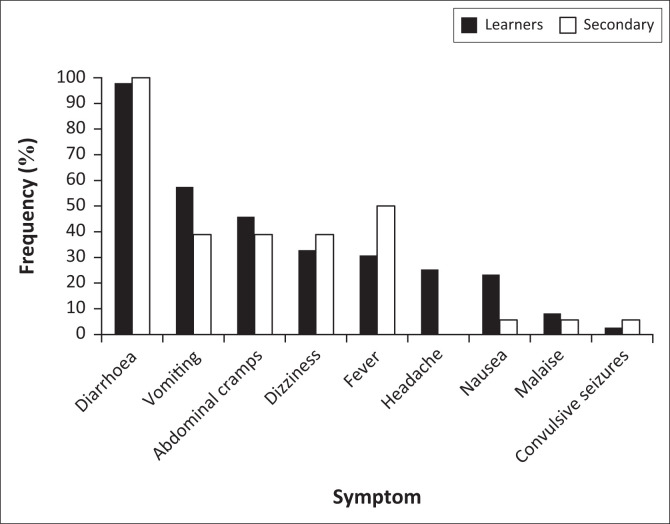
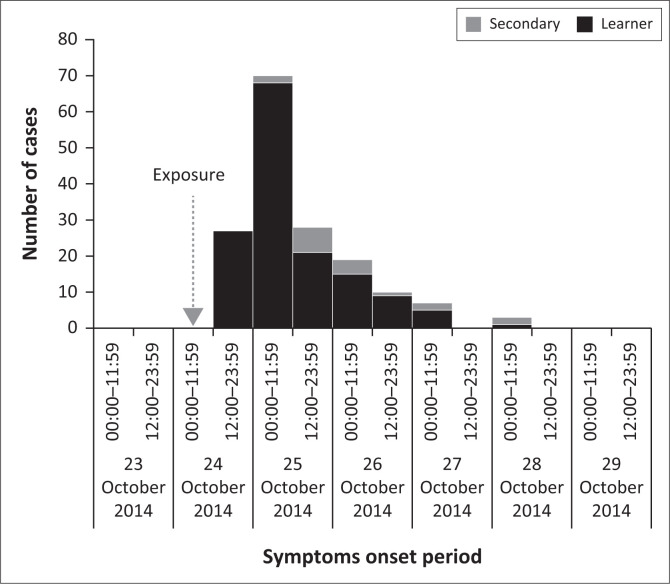
Background: Salmonella enterica , with more than 2500 diverse typhoidal and non-typhoidal serotypes (NTS), are foodborne bacterial pathogens of global public health concern. NTS are the most commonly reported causes of foodborne acute gastroenteritis (AGE). Contaminated food products (meat, poultry, eggs and dairy) have been reported to be a source of more than 95% NTS infections. An outbreak of food poisoning occurred among schoolchildren exposed to food provided by the government-sponsored National School Nutrition Programme (NSNP) at a local public primary day school in North West province, South Africa. An epidemiological, environmental and microbiological investigation was conducted to establish the existence and extent of the outbreak, identify the source(s) and causative agent(s) and institute appropriate control and preventive measures. Methods: An epidemiological investigation was conducted, including a review of the clinical records of the persons exposed, laboratory testing of the pathological specimens collected, environmental testing of the food samples and food preparation areas. Results: A total of 164 children developed clinical symptoms of AGE following ingestion of processed maize meal, beans and vegetables. Salmonella enterica serovar Heidelberg ( S. Heidelberg) was the causative agent for this AGE outbreak in 92.0% of the cases. The median duration of illness was 2 days with a case fatality rate (CFR) of 0.6%. The main food product that was contaminated was samp (processed maize meal) that had been poorly stored and prepared (53.4%). Conclusion: A timeously-initiated epidemiological, environmental and microbiological an investigation led to the conclusion that the etiologic agent of this outbreak was S. Heidelberg, and the most probable food vehicle of transmission was cooked samp served to learners within the NSNP.
Overview
The claims and statistics of this paper haven’t been checked yet.
Run the check — free, no account needed. It reads the open-access text and checks the sources it cites.
Integrity signals
Registry
Cites
Statistics
Figures
Verification
Claims the paper makes
The claims and statistics of this paper haven’t been checked yet.
Run the check — free, no account needed. It reads the open-access text and checks the sources it cites.
Claims other papers make about this one
Each is checked against this paper’s own text: does it say what the citing paper says it does?
The check wasn’t confident either way, so it gives no verdict — never disputed.
In the citing paper
“There is usually no running water, so food handlers wash their hands and dishes in bowls or buckets, occasionally without soap15,16.”
From Food handling practices and sanitary conditions of charitable food assistance programs in eThekwini District, KwaZulu-Natal, South Africa (2024) · cites this paper as [16]
Experimental — accuracy not yet measured
Self-check
Percentages, sums and reported differences re-computed from the paper’s own numbers.
The self-check needs the paper’s full text.
Citations
The citation lists haven’t been fetched yet
References 30 · Cited by 16
Research works printed but not linked: 29
- Gal-Mor, 2014, Front Microbiol, 5, 1
- 10.1016/S0140-6736(11)61752-2 · DOI
- 10.3201/eid1908.121511 · DOI
- Nazzal, 2012, J Community Med Health Educ, 2, 1
- 10.11648/j.ijnfs.20130202.13 · DOI
- Van Velsen, 2014, BMC Public Health, 14, 1
- Varga, 2013, BMC Infect Dis, 13, 1
- Cummings, 2012, Salmonella – A dangerous foodborne pathogen [homepage on the Internet]
- Parry, 2013, BMC Infect Dis, 13, 1
- 10.1086/650733 · DOI
- Al-Ayed, 2014, Int J Curr Microbiol Appl Sci, 3, 103
- 10.3382/ps/peu060 · DOI
- 10.1016/j.mjafi.2013.01.005 · DOI
- Shariat, 2013, BMC Microbiol, 13, 1
- 10.3201/eid2106.140999 · DOI · Paper page
- Qila, 2014, Mediterr J Soc Sci, 5, 381
- Rendall-Mkosi, 2019, Case study of the National School Nutrition Programme (NSNP) in South Africa [homepage on the Internet]
- 10.2807/ese.17.47.20321-en · DOI
- Hrivniaková, 2011, Euro Surveill, 16, 19952, 10.2807/ese.16.34.19952-en · DOI
- Von Wissmann, 2012, Euro Surveill, 17, 20076, 10.2807/ese.17.06.20076-en · DOI
- Badrinath, 2004, BMC Public Health, 4, 1
- Wadl, 2010, BMC Infect Dis, 10, 1
- Mizoguchi, 2011, Acta Med Okayama, 65, 63
- World Health Organization, 2008, Foodborne disease outbreaks: Guidelines for investigation and control
- 10.1017/S0950268811002305 · DOI
- 10.3961/jpmph.2014.47.3.177 · DOI
- 10.1128/genomeA.00004-12 · DOI
- 10.1089/fpd.2013.1630 · DOI
- U.S. National Library of Medicine, 2019, MedlinePlus – Baking powder overdose [homepage on the Internet]
Metadata
- Authors
- Motladiile, T. W., Tumbo, J. M., Malumba, A., Adeoti, B., Masekwane, N. J., Mokate, O. M. R., & Sebekedi, O. C.
- Affiliations
- National Institute for Communicable Diseases (ZA)
- Sefako Makgatho Health Sciences University (ZA)
- Corresponding author
- Motladiile, Thejane W.
- Venue
- Southern African Journal of Infectious Diseases
- Publisher
- AOSIS
- Published
- 2019-12-04
- Volume
- 34
- Issue
- 1
- Pages
- 124-124
- ISSN
- 2312-0053 (ISSN-L)
- 2313-1810
- PMC
- PMC8378002
- OpenAlex
- W2993281003
- Cited by
- 16
- References
- 30
- Citations by year
- 2026: 1 · 2025: 2 · 2024: 3 · 2023: 5 · 2022: 2 · 2021: 2 · 2020: 1
- FWCI
- 0.96
- Type
- journal article
- Language
- en
- Open access
- gold
- doi.org
- Locations
- Southern African Journal of Infectious Diseases (publishedVersion, cc-by)
- PubMed Central (publishedVersion, cc-by)
- PubMed (publishedVersion)
- DOAJ (DOAJ: Directory of Open Access Journals) (submittedVersion, cc-by-sa)
- Funders
- Centers for Disease Control and Prevention
- Topics
- Life Sciences › Agricultural and Biological Sciences › Food Science › Salmonella and Campylobacter epidemiology
- Life Sciences › Agricultural and Biological Sciences › Food Science › Food Safety and Hygiene
- Life Sciences › Agricultural and Biological Sciences › Food Science › Listeria monocytogenes in Food Safety
- Keywords
- Salmonella Heidelberg, non-typhoidal Salmonella, foodborne outbreak, acute gastroenteritis, elementary school students, SAMP, corn meal, food contamination, food poisoning, North West Province
About these checks
Registry, retraction, Cites and statistics results are computed, not judged, with one exception: a printed reference that no index lists is read once by a model before it counts as a citation error. Claims are extracted by a model and kept only when their quote appears verbatim in the text; each cited source is then checked, with a model’s help, for whether it says what the claim relies on. Those verdicts can be wrong — read the claim’s quote and the cited source before relying on one.
Statistics and arithmetic are recomputed, not judged.
Confidence bands are shown only for fields calibrated on our annotated test set. None is calibrated yet, so no band is shown.
What counts as a claim ›How we measure confidence ›How we check this ›
Are you an author, or do you see a problem with this page? Request a review
How to cite
Cite CoChat for the checks on this page, and the paper for its own findings.
- This page
- CoChat. (2026). Citation check: Salmonella food-poisoning outbreak linked to the National School Nutrition Programme, North West province, South Africa. https://app.cochat.ai/papers/10.4102/sajid.v34i1.124
- The paper
- Motladiile, T. W., Tumbo, J. M., Malumba, A., Adeoti, B., Masekwane, N. J., Mokate, O. M. R., & Sebekedi, O. C. (2019). Salmonella food-poisoning outbreak linked to the National School Nutrition Programme, North West province, South Africa. Southern African Journal of Infectious Diseases. https://doi.org/10.4102/sajid.v34i1.124
