

The DOI matches its Crossref record; 17 of the 17 references it cites were found in a registry or an index.
Perceived heat stress and health effects on construction workers
Open accessAbstract
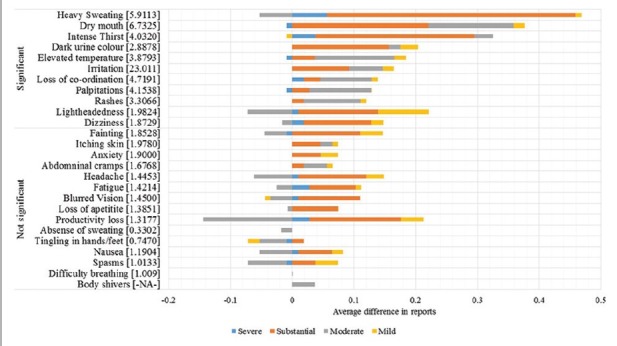
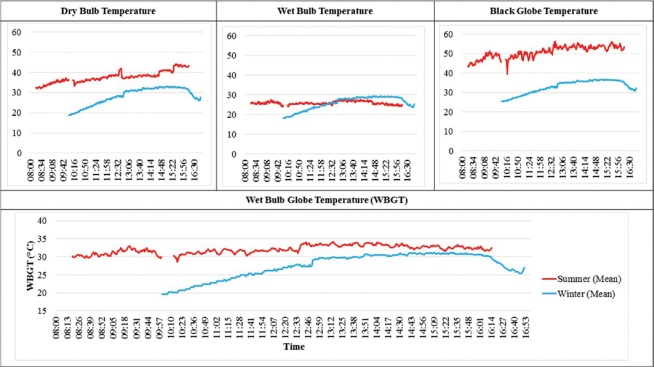
INTRODUCTION: Increasing heat waves-particularly in urban areas where construction is most prevalent, highlight a need for heat exposure assessment of construction workers. This study aims to characterize the effects of heat on construction workers from a site in Gandhinagar. MATERIALS AND METHODS: This study involved a mixed methods approach consisting of a cross sectional survey with anthropometric measurements (n = 219) and four focus groups with construction workers, as well as environmental measurements of heat stress exposure at a construction site. Survey data was collected in two seasons i.e., summer and winter months, and heat illness and symptoms were compared between the two time periods. Thematic coding of focus group data was used to identify vulnerability factors and coping mechanisms of the workers. Heat stress, recorded using a wet bulb globe temperature monitor, was compared to international safety standards. RESULTS: The survey findings suggest that heat-related symptoms increased in summer; 59% of all reports in summer were positive for symptoms (from Mild to Severe) as compared to 41% in winter. Focus groups revealed four dominant themes: (1) Non-occupational stressors compound work stressors; (2) workers were particularly attuned to the impact of heat on their health; (3) workers were aware of heat-related preventive measures; and (4) few resources were currently available to protect workers from heat stress. Working conditions often exceed international heat stress safety thresholds. Female workers and new employees might be at increased risk of illness or injury. CONCLUSION: This study suggests significant health impacts on construction workers from heat stress exposure in the workplace, showed that heat stress levels were higher than those prescribed by international standards and highlights the need for revision of work practices, increased protective measures, and possible development of indigenous work safety standards for heat exposure.
Overview
The claims and statistics of this paper haven’t been checked yet.
Run the check — free, no account needed. It reads the open-access text and checks the sources it cites.
Integrity signals
Registry
Cites
Statistics
Figures
Verification
Claims the paper makes
The claims and statistics of this paper haven’t been checked yet.
Run the check — free, no account needed. It reads the open-access text and checks the sources it cites.
Claims other papers make about this one
Each is checked against this paper’s own text: does it say what the citing paper says it does?
The cited source says what the claim attributes to it.
In the citing paper
“Many were from regions in India, such as Gujarat, Tamil Nadu, and Maharastra, where mean WBGT values ranging from 28.7 to 34.1°C have been reported for outdoor construction worksites (Maiti, 2008; Dutta et al., 2015; Venugopal et al., 2016).”
From Assessment of Heat Stress Exposure among Construction Workers in the Hot Desert Climate of Saudi Arabia (2019) · cites this paper as Dutta et al., 2015
Self-check
Percentages, sums and reported differences re-computed from the paper’s own numbers.
The self-check needs the paper’s full text.
Citations
Cites
Christensen, J. H., Hewitson, B. C., Busuioc, A., Chen, A., Gao, X., Held, R., Jones, R., Kolli, R. K., Kwon, W., Laprise, R., et al. (2007) · Helmholtz-Zentrum für Polar-und Meeresforschung (Alfred-Wegener-Institut) · Cited by 3,177
Factors affecting safety performance on construction sites
Sawacha, E., Naoum, S. G., & Fong, D. (1999) · International Journal of Project Management · doi:10.1016/s0263-7863(98)00042-8 · Cited by 682
Modeling the Wet Bulb Globe Temperature Using Standard Meteorological Measurements
Liljegren, J. C., Carhart, R. A., Lawday, P., Tschopp, S., & Sharp, R. (2008) · Journal of Occupational and Environmental Hygiene · doi:10.1080/15459620802310770 · Cited by 404 · cited 1×
“[17] The measurements were automatically recorded at one minute intervals and the instruments were kept in an open space.”
Azhar, G. S., Mavalankar, D., Nori-Sarma, A., Rajiva, A., Dutta, P., Jaiswal, A., Sheffield, P., Knowlton, K., Hess, J. J., & on behalf of the Ahmedabad HeatClimate Study Group (2014) · PLoS ONE · doi:10.1371/journal.pone.0091831 · Cited by 325
Self-citationMohan, M., & Kandya, A. (2014) · The Science of The Total Environment · doi:10.1016/j.scitotenv.2014.11.006 · Cited by 247
Knowlton, K., Kulkarni, S., Azhar, G., Mavalankar, D., Jaiswal, A., Connolly, M., Nori-Sarma, A., Rajiva, A., Dutta, P., Deol, B., et al. (2014) · International Journal of Environmental Research and Public Health · doi:10.3390/ijerph110403473 · Cited by 203
Self-citationSymptoms of Musculoskeletal Disorders Among Apprentice Construction Workers
Merlino, L. A., Rosecrance, J. C., Anton, D. C., & Cook, T. M. (2003) · Applied Occupational and Environmental Hygiene · doi:10.1080/10473220301391 · Cited by 163
Kjellstrom, T. E., Gabrysch, S., Lemke, B., & Dear, K. B. G. (2009) · Global Health Action · doi:10.3402/gha.v2i0.2082 · Cited by 147
Occupational Health Research in India.
Saiyed, H. N., & Tiwari, R. R. (2004) · Industrial Health · doi:10.2486/indhealth.42.141 · Cited by 113
Tran, K., Azhar, G. S., Nair, R., Knowlton, K., Jaiswal, A., Sheffield, P. E., Mavalankar, D. V., & Hess, J. J. (2013) · International Journal of Environmental Research and Public Health · doi:10.3390/ijerph10062515 · Cited by 95
Self-citation
Research works printed but not linked: 2
- Ministry of Finance, Quarterly Review 2013-14 (April-June). Government of India, Department Of Economic Affairs, Economic Division, 2013.
- ACGIH. 2013 TLVs ® and BEIs ® - Based on the Documentation of the Threshold Limit Values for Chemical Substances and Physical Agents and Biological Exposure Indices. Cincinnati: American Conference of Governmental Industrial Hygienists; 2013.
Cited by
Sorted by citations
Flouris, A. D., Dinas, P. C., Ioannou, L. G., Nybo, L., Havenith, G., Kenny, G. P., & Kjellstrom, T. (2018) · The Lancet Planetary Health · doi:10.1016/s2542-5196(18)30237-7 · Cited by 579
Gender equality in science, medicine, and global health: where are we at and why does it matter?
Shannon, G. D., Jansen, M., Williams, K., Cáceres, C. F., Motta, A., Odhiambo, A., Eleveld, A., & Mannell, J. (2019) · The Lancet · doi:10.1016/s0140-6736(18)33135-0 · Cited by 589
Are workers at risk of occupational injuries due to heat exposure? A comprehensive literature review
Varghese, B. M., Hansen, A., Bi, P., & Pisaniello, D. (2018) · Safety Science · doi:10.1016/j.ssci.2018.04.027 · Cited by 198
Vulnerability to heatwaves and implications for public health interventions – A scoping review
Mayrhuber, E. A.-S., Dückers, M., Wallner, P., Arnberger, A., Allex, B., Wiesböck, L., Wanka, A., Kolland, F., Eder, R., Hutter, H., et al. (2018) · Environmental Research · doi:10.1016/j.envres.2018.05.021 · Cited by 161
Al-Bouwarthan, M., Quinn, M. M., Kriebel, D., & Wegman, D. H. (2019) · Annals of Work Exposures and Health · doi:10.1093/annweh/wxz033 · Cited by 158
Metadata
- Authors
- Dutta, P., Rajiva, A., Andhare, D., Azhar, G., Tiwari, A., Sheffield, P., & Ahmedabad Heat and Climate Study Group
- Affiliations
- Indian Institute of Public Health Gandhinagar (IN)
- Corresponding author
- Dutta, Priya
- Venue
- Indian Journal of Occupational and Environmental Medicine
- Publisher
- Medknow
- Published
- 2015
- Volume
- 19
- Issue
- 3
- Pages
- 151
- ISSN
- 0019-5278 (ISSN-L)
- 0973-2284
- PMC
- PMC4765254
- OpenAlex
- W2235278500
- Cited by
- 145
- References
- 17
- Citations by year
- 2026: 14 · 2025: 10 · 2024: 15 · 2023: 11 · 2022: 13 · 2021: 49 · 2020: 7 · 2019: 12 · 2018: 9 · 2017: 3 · 2016: 1
- FWCI
- 3.19
- Type
- journal article
- Language
- en
- Open access
- hybrid
- doi.org
- Licence
- cc-by-nc-sa
- Locations
- Indian Journal of Occupational and Environmental Medicine (publishedVersion, cc-by-nc-sa)
- PubMed Central (publishedVersion, cc-by-nc-sa)
- PubMed (publishedVersion)
- Funders
- National Institute of Environmental Health Sciences (K23ES024127, P30ES023515)
- Topics
- Health Sciences › Medicine › Physiology (medical) › Thermoregulation and physiological responses
- Health Sciences › Medicine › Public Health, Environmental and Occupational Health › Occupational Health and Safety in Workplaces
- Social Sciences › Safety Research › Occupational Health and Safety Research
- Keywords
- heat stress, construction workers, occupational heat exposure, heat-related illness, heat-related symptoms, wet bulb globe temperature, seasonal variation, coping strategies, occupational safety standards, female workers, new employees, heat waves, Gandhinagar
About these checks
Registry, retraction, Cites and statistics results are computed, not judged, with one exception: a printed reference that no index lists is read once by a model before it counts as a citation error. Claims are extracted by a model and kept only when their quote appears verbatim in the text; each cited source is then checked, with a model’s help, for whether it says what the claim relies on. Those verdicts can be wrong — read the claim’s quote and the cited source before relying on one.
Statistics and arithmetic are recomputed, not judged.
Confidence bands are shown only for fields calibrated on our annotated test set. None is calibrated yet, so no band is shown.
What counts as a claim ›How we measure confidence ›How we check this ›
Are you an author, or do you see a problem with this page? Request a review
