

The DOI matches its Crossref record; 32 of the 32 references it cites were found in a registry or an index.
Evaluation of efficacy of non-invasive ventilation in Non-COPD and non-trauma patients with acute hypoxemic respiratory failure: A systematic review and meta-analysis
Open accessAbstract
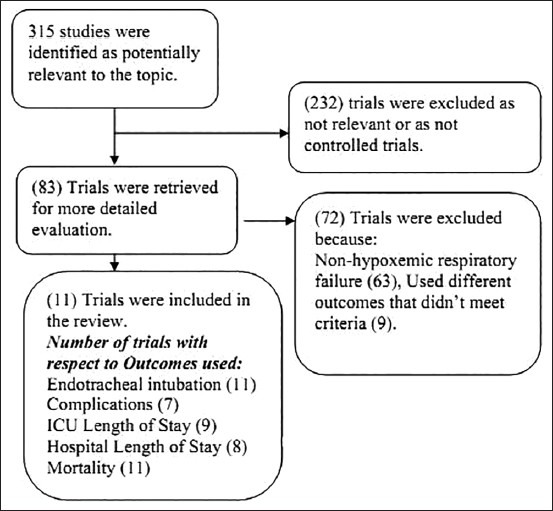
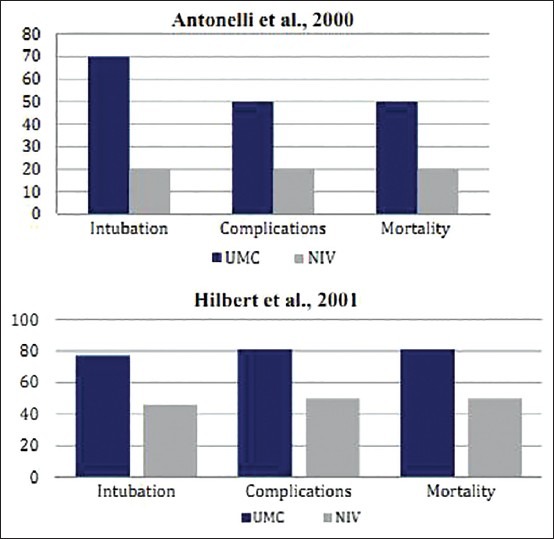
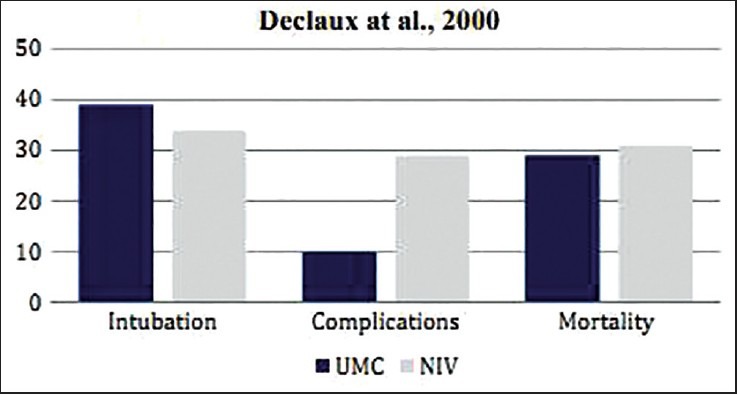
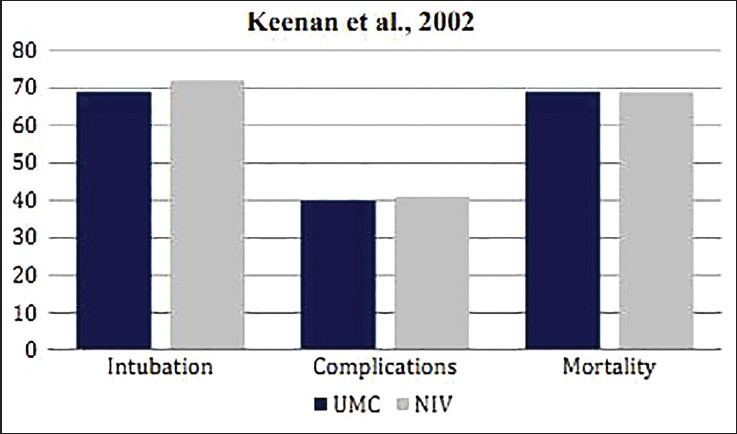
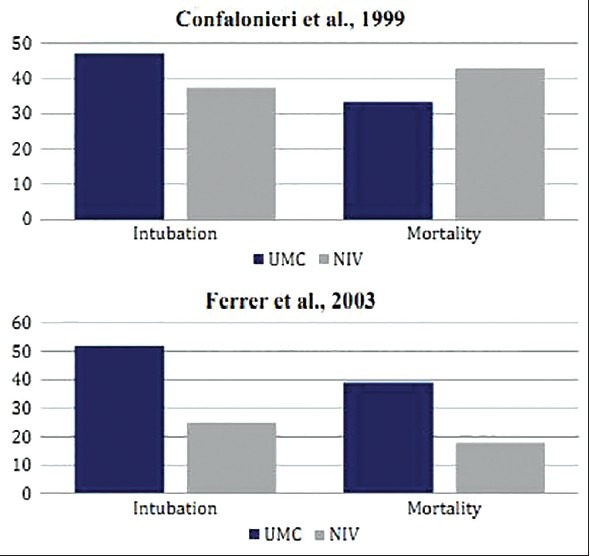
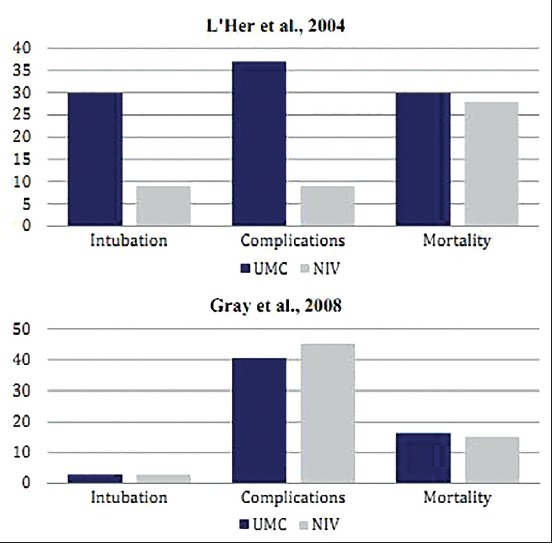
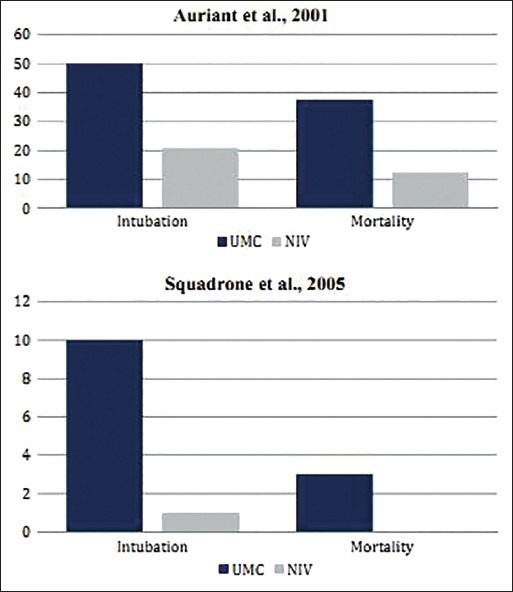
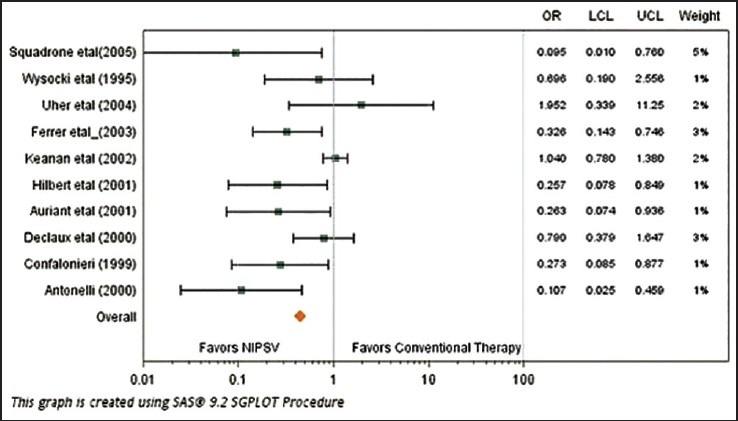
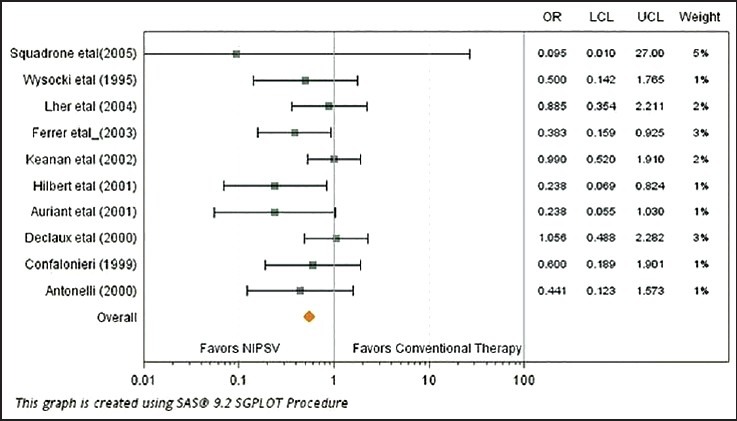
Non-invasive ventilation (NIV) has been widely supported in the past two decades as an effective application in avoiding the need for endotracheal intubation (ETI) and reducing associated mortality in acute hypoxemic respiratory failure (AHRF) patients. However, the efficacy of NIV in AHRF patients, non-related to chronic obstructive pulmonary disease (COPD) and trauma is still controversial in the field of medical research. This retrospective study aimed to evaluate the efficacy of NIV as an adjunctive therapy in non-COPD and non-traumatic AHRF patients. Data of 11 randomized control trials (RCTs), which were conducted between 1990 and 2010 to determine the efficacy of NIV in non-COPD and non-traumatic AHRF patients, were reviewed from the PUBMED, MEDLINE, Cochrane Library, and EMBASE databases. Parameters monitored in this study included the ETI rate, fatal complications, mortality rate of patients, and their ICU and hospital duration of stay. Overall results showed a statistically significant decrease in the rate of ETI, mortality, and fatal complications along with reduced ICU and hospital length of stay in non-COPD and non-trauma AHRF patients of various etiologies. This systematic review suggests that non-COPD and non-trauma AHRF patients can potentially benefit from NIV as compared with conventional treatment methods. Observations from various cohort studies, observational studies, and previously published literature advocate on the efficacy of NIV for treating non-COPD and non-traumatic AHRF patients. However, considering the diversity of studied populations, further studies and more specific trials on less heterogeneous AHRF patient groups are needed to focus on this aspect.
Overview
The claims and statistics of this paper haven’t been checked yet.
Run the check — free, no account needed. It reads the open-access text and checks the sources it cites.
Integrity signals
Registry
Cites
Statistics
Figures
Verification
Claims the paper makes
The claims and statistics of this paper haven’t been checked yet.
Run the check — free, no account needed. It reads the open-access text and checks the sources it cites.
Claims other papers make about this one
Each is checked against this paper’s own text: does it say what the citing paper says it does?
The check wasn’t confident either way, so it gives no verdict — never disputed.
In the citing paper
“For patients with chronic stable hypercapnic COPD, the use of nocturnal NIV in addition to usual care is recommended (18,19).”
From Promoting Acceptance and Adherence to Noninvasive Ventilation in Chronic Obstructive Pulmonary Disease: A Randomized Controlled Trial. (2022) · cites this paper as [18]
Experimental — accuracy not yet measured
Self-check
Percentages, sums and reported differences re-computed from the paper’s own numbers.
The self-check needs the paper’s full text.
Citations
Cites
Moher, D., Cook, D. J., Eastwood, S., Olkin, I., Rennie, D., & Stroup, D. F. (1999) · The Lancet · doi:10.1016/s0140-6736(99)04149-5 · Cited by 4,826
Hilbert, G., Gruson, D., Vargas, F., Valentino, R., Gbikpi-Benissan, G., Dupon, M., Reiffers, J. J., & Cardinaud, J. P. (2001) · New England Journal of Medicine · doi:10.1056/nejm200102153440703 · Cited by 1,047
Noninvasive Positive-Pressure Ventilation for Respiratory Failure after Extubation
Esteban, A., Frutos–Vivar, F., Ferguson, N. D., Arabi, Y. M., Apezteguía, C., Gonzalez, M. A., Epstein, S. K., Hill, N. S., Nava, S., Soares, M. A., et al. (2004) · New England Journal of Medicine · doi:10.1056/nejmoa032736 · Cited by 890
ESTEBAN, A., Anzueto, A. R., Alía, I., Gordo, F., Apezteguía, C., Pálizas, F., David, C. M., GOLDWASER, R., Soto, L., Bugedo, G. J., et al. (2000) · American Journal of Respiratory and Critical Care Medicine · doi:10.1164/ajrccm.161.5.9902018 · Cited by 769
Noninvasive Ventilation in Acute Cardiogenic Pulmonary Edema
Gray, A. J., Goodacre, S. W., Newby, D. E., Masson, M., Sampson, F. C., & Nicholl, J. P. (2008) · New England Journal of Medicine · doi:10.1056/nejmoa0707992 · Cited by 695
Continuous Positive Airway Pressure for Treatment of Postoperative Hypoxemia
Squadrone, V., Coha, M., Cerutti, E., Schellino, M. M., Biolino, P., Occella, P., Belloni, G., Vilianis, G., Fiore, G., Cavallo, F., et al. (2005) · JAMA · doi:10.1001/jama.293.5.589 · Cited by 658
Confalonieri, M., Potena, A., Carbone, G., Porta, R., Tolley, E. A., & Meduri, G. U. (1999) · American Journal of Respiratory and Critical Care Medicine · doi:10.1164/ajrccm.160.5.9903015 · Cited by 625
Noninvasive Ventilation in Severe Hypoxemic Respiratory Failure
Ferrer, M., Esquinas, A. M., Leon, M. E., González, G., Alarcón, A., & Torres, A. (2003) · American Journal of Respiratory and Critical Care Medicine · doi:10.1164/rccm.200301-072oc · Cited by 618
Antonelli, M. M., Conti, G., Esquinas, A. M., Montini, L. M., Maggiore, S. M., Bello, G., Rocco, M., Maviglia, R., Pennisi, M. A., Díaz, G. G., et al. (2006) · Critical Care Medicine · doi:10.1097/01.ccm.0000251821.44259.f3 · Cited by 530
Delclaux, C., L’Her, E., Alberti, C., Mancebo, J., Abroug, F., Conti, G., Guérin, C., Schortgen, F., Lefort, Y., Antonelli, M. M., et al. (2000) · JAMA · doi:10.1001/jama.284.18.2352 · Cited by 511
Cited by
Sorted by citations
Beasley, R. W., Chien, J., Douglas, J. A., Eastlake, L., Farah, C. S., King, G. G., Moore, R., Pilcher, J., Richards, M., Smith, S. M. S., et al. (2015) · Respirology · doi:10.1111/resp.12620 · Cited by 198
Barnett, A., Beasley, R. W., Buchan, C., Chien, J., Farah, C. S., King, G. G., McDonald, C. F., Miller, B., Munsif, M., Psirides, A. J., et al. (2022) · Respirology · doi:10.1111/resp.14218 · Cited by 38
Iosifyan, M., Schmidt, M., Hurbault, A., Mayaux, J., Delafosse, C., Mishenko, M., Nion, N., Demoule, A., & Similowski, T. (2019) · Annals of Intensive Care · doi:10.1186/s13613-019-0608-6 · Cited by 34
Volpato, E., Banfi, P., & Pagnini, F. (2022) · Psychosomatic Medicine · doi:10.1097/psy.0000000000001053 · Cited by 24
“When properly used, NIV provides significant benefits in clinical outcomes, improving QoL and life expectancy and reducing hospital admissions and length of stay (21,22).”
MethodYasuda, H., Okano, H., Mayumi, T., Nakane, M., & Shime, N. (2021) · Journal of Intensive Care · doi:10.1186/s40560-021-00539-7 · Cited by 22
Metadata
- Authors
- AlYami, M., AlAhmari, M., Alotaibi, H., AlRabeeah, S., AlBalawi, I., & Mubasher, M.
- Affiliations
- Prince Sultan Military College of Health Sciences (SA)
- King Fahd Medical City (SA)
- Venue
- Annals of Thoracic Medicine
- Published
- 2015
- Volume
- 10
- Issue
- 1
- Pages
- 16
- ISSN
- 1817-1737 (ISSN-L)
- PMC
- PMC4286839
- OpenAlex
- W1538028437
- Cited by
- 14
- References
- 32
- Citations by year
- 2023: 1 · 2022: 2 · 2021: 1 · 2019: 1 · 2018: 2 · 2017: 1 · 2016: 2 · 2015: 4
- FWCI
- 0.53
- Type
- journal article
- Language
- en
- Open access
- diamond
- doi.org
- Licence
- cc-by-nc-sa
- Locations
- Annals of Thoracic Medicine (publishedVersion, cc-by-nc-sa)
- Europe PMC (PubMed Central) (publishedVersion, cc-by-nc-sa)
- PubMed Central (publishedVersion, cc-by-nc-sa)
- PubMed (publishedVersion)
- DOAJ (DOAJ: Directory of Open Access Journals) (submittedVersion)
- Topics
- Health Sciences › Medicine › Pulmonary and Respiratory Medicine › Respiratory Support and Mechanisms
- Health Sciences › Medicine › Physiology (medical) › Obstructive Sleep Apnea Research
- Health Sciences › Medicine › Anesthesiology and Pain Medicine › Airway Management and Intubation Techniques
- Keywords
- non-invasive ventilation, acute hypoxemic respiratory failure, non-trauma patients, endotracheal intubation avoidance, mortality, ICU length of stay, length of hospital stay, fatal complication
About these checks
Registry, retraction, Cites and statistics results are computed, not judged, with one exception: a printed reference that no index lists is read once by a model before it counts as a citation error. Claims are extracted by a model and kept only when their quote appears verbatim in the text; each cited source is then checked, with a model’s help, for whether it says what the claim relies on. Those verdicts can be wrong — read the claim’s quote and the cited source before relying on one.
Statistics and arithmetic are recomputed, not judged.
Confidence bands are shown only for fields calibrated on our annotated test set. None is calibrated yet, so no band is shown.
What counts as a claim ›How we measure confidence ›How we check this ›
Are you an author, or do you see a problem with this page? Request a review
