

The DOI matches its Crossref record; the references it cites are not checked yet.
The readability of editorials in popular Indian medical journals
Open accessAbstract
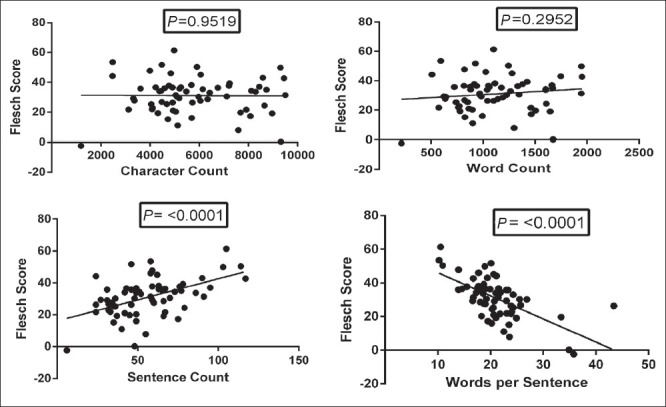
INTRODUCTION: The essence of communication is to convey a message, and readability tests have been developed to quantify this aspect of language. There is limited research on the readability tests of journal contents from India. In this study, we performed readability tests on the editorials of four popular Indian medical journals. MATERIALS AND METHODS: THE READABILITY TESTS (FLESCH SCORE, FLESCH GRADE, AND TEXT STATISTICS) WERE CALCULATED FROM THE FOLLOWING JOURNALS: Indian Journal of Endocrinology and Metabolism (IJEM), Journal of Association of Physicians of India (JAPI), Journal of Indian Medical Association (JIMA), and International Journal of Diabetes in Developing Countries (IJDDC). The editorials published in these journals over the last 2 tears were included in this analysis. RESULTS: A total of 64 editorials (IJEM - 19, JAPI - 18, JIMA - 16, IJDDC - 11) were analyzed in this study. The mean readability score was (IJEM 34.8 ± 9.5; JAPI 31.4 ± 11.4; JIMA 29.6 ± 10.1; IJDDC 26.1 ± 17.7) not different between the journals (P = 0.2666). Flesch score was less variable in IJEM an d JIMA than in JAPI and IJDDC (P = 0.0167). The editorials from IJEM and JAPI had a lower Flesch grade than the remaining two journals (P = 0.0253). The readability score was directly proportional to the sentence count and inversely proportional to the words per sentence (P < 0.0001). CONCLUSION: Our results suggest that the editorials from all the medical journals have equal readability scores. The sentence count and words per sentence are important to achieve a high readability score while writing for a journal.
Overview
The claims and statistics of this paper haven’t been checked yet.
Run the check — free, no account needed. It reads the open-access text and checks the sources it cites.
Integrity signals
Registry
Cites
Statistics
Figures
Verification
Claims the paper makes
The claims and statistics of this paper haven’t been checked yet.
Run the check — free, no account needed. It reads the open-access text and checks the sources it cites.
Claims other papers make about this one
Each is checked against this paper’s own text: does it say what the citing paper says it does?
In the citing paper
“This score was significantly higher (one-sample t-test P < 0.0001) than the average reading ease score of an editorial in Indian journals (expected ease score of 30).”
From Using ChatGPT for writing articles for patients' education for dermatological diseases: A pilot study (2023) · cites this paper as [12]
In the citing paper
“This level of text can easily be understood by a high-school student to a newly joined college (grade level 10.53 ± 0.73) student without graduation.”
From Using ChatGPT for writing articles for patients' education for dermatological diseases: A pilot study (2023) · cites this paper as [12]
Self-check
Percentages, sums and reported differences re-computed from the paper’s own numbers.
The self-check needs the paper’s full text.
Citations
The citation lists haven’t been fetched yet
References 17 · Cited by 4
Research works printed but not linked: 1
- [12]Chandalia HB International Journal of Diabetes in Developing Countries Int J Diabetes Dev Ctries 2013 33 1 4 PMC2822153 20165597
Metadata
- Authors
- Kumar, K. V. S. H., Aravinda, K., & Varadarajulu, R.
- Affiliations
- Father Muller Medical College Hospital (IN)
- Corresponding author
- Kumar, K. V. S.Hari
- ORCID
- Kumar, K. V. S.Hari
- Venue
- Indian Journal of Endocrinology and Metabolism
- Published
- 2013
- Volume
- 17
- Issue
- 7
- Pages
- 363
- ISSN
- 2230-8210 (ISSN-L)
- PMC
- PMC3830362
- OpenAlex
- W2036080008
- Cited by
- 4
- References
- 17
- Citations by year
- 2025: 1 · 2023: 2 · 2022: 1
- FWCI
- 0.00
- Type
- journal article
- Language
- en
- Open access
- diamond
- doi.org
- Licence
- cc-by-nc-sa
- Locations
- Indian Journal of Endocrinology and Metabolism (publishedVersion, cc-by-nc-sa)
- Europe PMC (PubMed Central) (publishedVersion, cc-by-nc-sa)
- PubMed Central (publishedVersion, cc-by-nc-sa)
- PubMed (publishedVersion)
- DOAJ (DOAJ: Directory of Open Access Journals) (submittedVersion, cc-by-sa)
- Topics
- Social Sciences › Library and Information Sciences › Academic Writing and Publishing
- Social Sciences › Linguistics and Language › Text Readability and Simplification
- Health Sciences › Health Professions › General Health Professions › Health Literacy and Information Accessibility
- Keywords
- readability, sentence length, medical writing, science communication
About these checks
Registry, retraction, Cites and statistics results are computed, not judged, with one exception: a printed reference that no index lists is read once by a model before it counts as a citation error. Claims are extracted by a model and kept only when their quote appears verbatim in the text; each cited source is then checked, with a model’s help, for whether it says what the claim relies on. Those verdicts can be wrong — read the claim’s quote and the cited source before relying on one.
Statistics and arithmetic are recomputed, not judged.
Confidence bands are shown only for fields calibrated on our annotated test set. None is calibrated yet, so no band is shown.
What counts as a claim ›How we measure confidence ›How we check this ›
Are you an author, or do you see a problem with this page? Request a review
How to cite
Cite CoChat for the checks on this page, and the paper for its own findings.
- This page
- CoChat. (2026). Citation check: The readability of editorials in popular Indian medical journals. https://app.cochat.ai/papers/10.4103/2230-8210.119626
- The paper
- Kumar, K. V. S. H., Aravinda, K., & Varadarajulu, R. (2013). The readability of editorials in popular Indian medical journals. Indian Journal of Endocrinology and Metabolism. https://doi.org/10.4103/2230-8210.119626
