

The DOI matches its Crossref record; 14 of the 15 references it cites were found in a registry or an index.
Academic stress, perceived parental pressure, and anxiety related to competitive entrance examinations and the general well-being among adolescents – A cross-sectional survey from Karnataka, India
Open accessAbstract
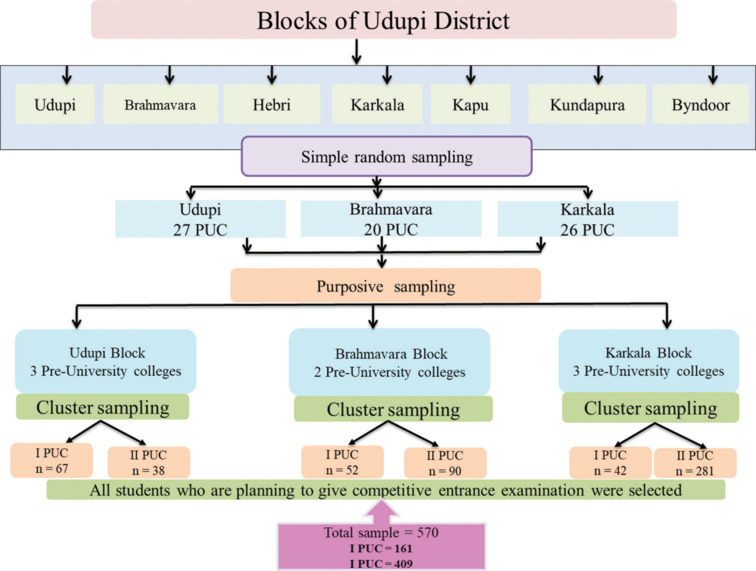
BACKGROUND: In this competitive world, students undergo various scholastic stress and mental health issues. The scholastic stress has a great impact on students’ life and results in the prevalence of several psychological consequences such as stress-related disorders, anxiety, depression, and nervousness, which disturb their academic performances. Therefore, the present study was conducted to assess academic stress, perceived parental pressure, and anxiety related to competitive entrance examinations and the general well-being among adolescents. MATERIALS AND METHODS: A cross-sectional survey was conducted in 2023 among 570 adolescents who were planning to give competitive entrance examination in Pre-University Colleges of Udupi District, Karnataka, India. The data were collected using Background Proforma, Academic Stress Scale related to Competitive Examination, Perceived Parental Academic Pressure Scale, Westside Test Anxiety Scale, and General Well-being Scale. The purposive sampling technique was used to select Pre-University Colleges, and the adolescents were selected using cluster sampling. The collected data were analysed by Jamovi 2.3.21 software using descriptive statistics. RESULTS: The results showed that the majority of adolescents, 490 (86.0%), have high academic stress, 496 (87.0%) experienced high perceived parental pressure, 163 (28.5%) had moderately high anxiety, and 351 (57.7%) have low general well-being. There was no significance difference between class of study and stream of study. CONCLUSION: The study concluded that it is essential for the health care professionals to collaborate with parents and teachers to support adolescents and give them a congenial environment that will promote the healthy physical and psychological well-being of the adolescents.
Overview
The claims and statistics of this paper haven’t been checked yet.
Run the check — free, no account needed. It reads the open-access text and checks the sources it cites.
Integrity signals
Registry
Cites
Statistics
Figures
Verification
Claims the paper makes
The claims and statistics of this paper haven’t been checked yet.
Run the check — free, no account needed. It reads the open-access text and checks the sources it cites.
Claims other papers make about this one
Each is checked against this paper’s own text: does it say what the citing paper says it does?
The cited source says what the claim attributes to it.
In the citing paper
“Studies in competitive exam cohorts likewise document high stress and high parental pressure across streams, with degraded wellbeing (20).”
From Academic stress in adolescents: findings from a school-based study in Belagavi district (2025) · cites this paper as [20]
Self-check
Percentages, sums and reported differences re-computed from the paper’s own numbers.
The self-check needs the paper’s full text.
Citations
Cites
Polanczyk, G. V., Salum, G. A., Sugaya, L. S., Caye, A., & Rohde, L. A. (2015) · Journal of Child Psychology and Psychiatry · doi:10.1111/jcpp.12381 · Cited by 3,990
Academic Stress and its Sources Among University Students
Reddy, K. J., Menon, K. R., & Thattil, A. (2018) · Biomedical & Pharmacology Journal · doi:10.13005/bpj/1404 · Cited by 611
Academic stress, parental pressure, anxiety and mental health among Indian high school students
Deb, S., Strodl, E. S., & Sun, J. (2015) · QUT ePrints (Queensland University of Technology) · Cited by 275
Academic stress and depression among adolescents: A cross-sectional study
Jayanthi, P., Thirunavukarasu, M., & Rajkumar, R. (2015) · Indian Pediatrics · doi:10.1007/s13312-015-0609-y · Cited by 209
Modified Kuppuswamy socioeconomic scale: 2022 update of India
Sood, P., & Bindra, S. (2022) · International Journal of Community Medicine and Public Health · doi:10.18203/2394-6040.ijcmph20222581 · Cited by 110
Anjum, A., Hossain, S., Hasan, M. T., Uddin, M. E., & Sikder, M. T. (2022) · PLoS ONE · doi:10.1371/journal.pone.0262716 · Cited by 38
Measuring adolescents’ perceived parental academic pressure: A scale development study
Kaynak, S., Koçak, S. S., & Kaynak, Ü. (2021) · Current Psychology · doi:10.1007/s12144-021-01347-w · Cited by 32
Datta, A., Nag, K., Ghosh, B., Karmakar, N., & Bhattacharjee, P. P. (2019) · Indian Journal of Psychiatry · doi:10.4103/psychiatry.indianjpsychiatry_415_18 · Cited by 16
Mayya, S. S., Mayya, A., Martis, M., & Lakshmi, R. V. (2022) · Journal of Education and Health Promotion · doi:10.4103/jehp.jehp_87_22 · Cited by 15
Reliability and Factor Structure of the Westside Test Anxiety Scale among University Students
Talwar, P., Matheiken, S. T., Lee, J. A. C., & Surena, B. S. (2019) · Unimas Institutional Repository (Universiti Malaysia Sarawak) · Cited by 15
Research works printed but not linked: 6
- Subramani, 2019, Sources of academic stress among Higher Secondary School students, Int Rev Soc Sci Humanit, 9, 488
- Sunita, 2018, General well being of adolescents in relation to their academic achievement motivation, Int J Mov Educ Soc Sci, 7, 973
- Sangma, 2018, Perception of students on parental and teachers’ pressure on their academic performance, IOSR J Dent Med Sci, 17, 68
- Chowdhury, 2019, Examination anxiety among secondary level students, IOSR J Humanit Soc Sci, 24, 23
- Jeyarani, 2011, Well being of adolescents in institutional care at a Higher Secondary School in Tirunelveli District – A mixed methodological perspective, IOSR J Humanit Soc Sci, 2, 72
- Rajesh, 2022, Stress, pressure and anxiety of competitive exams – an empirical study on student’s psychological approach, Int J Food Nutr Sci, 11, 1057
Cited by
Sorted by citations
Academic stress in adolescents: findings from a school-based study in Belagavi district
Haritay, S., Angolkar, M., Koparde, V., Oswal, D., & Carvalho, A. (2025) · Frontiers in Public Health · doi:10.3389/fpubh.2025.1631136 · Cited by 10
Asha, S., & Joshith, V. P. (2025) · Innovative Higher Education · doi:10.1007/s10755-025-09869-y · Cited by 3
Dayasiri, K. C., Thadchanamoorthy, V., Ranasinghe, A., Hettiarachchi, N. M., Suraweera, N., Perera, T., & Gunarathna, G. (2025) · BMJ Paediatrics Open · doi:10.1136/bmjpo-2025-003949 · Cited by 2
Sundarapandiyan, M., & Kalaiyarasan, G. (2026) · Innovare Journal of Education · doi:10.22159/ijoe.2026v14i2.58546 · Cited by 1
Tian, Q. (2026) · Frontiers in Public Health · doi:10.3389/fpubh.2026.1804527 · Cited by 1
Metadata
- Authors
- Pienyu, K., Margaret, B., & D’Souza, A.
- Affiliations
- Manipal Academy of Higher Education (IN)
- Department of Child Health Nursing, Manipal College of Nursing, Manipal, Manipal Academy of Higher Education, Manipal, Karnataka, India
- Corresponding author
- Margaret, Binu
- ORCID
- Margaret, Binu
- Venue
- Journal of Education and Health Promotion
- Published
- 2024-12
- Volume
- 13
- Issue
- 1
- Pages
- 474-474
- ISSN
- 2277-9531 (ISSN-L)
- 2319-6440
- PMC
- PMC11756657
- OpenAlex
- W4405859005
- Cited by
- 19
- References
- 15
- Citations by year
- 2026: 15 · 2025: 4
- FWCI
- 14.83
- Type
- journal article
- Language
- en
- Open access
- gold
- doi.org
- Licence
- Locations
- Journal of Education and Health Promotion (publishedVersion, cc-by-nc-sa)
- PubMed Central (publishedVersion, cc-by-nc-sa)
- PubMed (publishedVersion)
- DOAJ (DOAJ: Directory of Open Access Journals) (submittedVersion, cc-by-sa)
- Topics
- Social Sciences › Psychology › Developmental and Educational Psychology › Student Stress and Coping
- Health Sciences › Health Professions › General Health Professions › Healthcare professionals’ stress and burnout
- Social Sciences › Psychology › Clinical Psychology › Child and Adolescent Psychosocial and Emotional Development
- Keywords
- academic stress, test anxiety, competitive entrance examinations, general well-being, adolescent mental health, pre-university students
About these checks
Registry, retraction, Cites and statistics results are computed, not judged, with one exception: a printed reference that no index lists is read once by a model before it counts as a citation error. Claims are extracted by a model and kept only when their quote appears verbatim in the text; each cited source is then checked, with a model’s help, for whether it says what the claim relies on. Those verdicts can be wrong — read the claim’s quote and the cited source before relying on one.
Statistics and arithmetic are recomputed, not judged.
Confidence bands are shown only for fields calibrated on our annotated test set. None is calibrated yet, so no band is shown.
What counts as a claim ›How we measure confidence ›How we check this ›
Are you an author, or do you see a problem with this page? Request a review
