

Catastrophic impact of 1947 partition of India on people's health
Open accessThe DOI matches its Crossref record; 23 of the 25 references it cites were found in a registry or an index, and 1 are not checked yet; 1 of the 11 sources its claims cite were checked for support.
Abstract
Introduction: The partition of India on the dissolution of British Raj into two dominions is known to have been violent, polarizing and caused large-scale loss of life (about two million) and an unprecedented migration of 14 million people between the two dominions, India and Pakistan. It is not known how well the then scientific community covered this man-made disaster, and the response of the international community with aid. Methodology: A systematic review was conducted using different electronic databases of PubMed, Econlit, United Nations resolutions, Government of India websites, and Google Scholar for the period January 1947 to December 1951 on the impact of the partition of the Indian sub-continent, and to identify the international response toward this humanitarian crisis. Result: We could locate only twenty-four publications. Partition not only caused monumental humanitarian suffering, but also contributed to food deficits, adverse impact on trade and industries, national income and harmed public health. In contrast, no significant attention was expressed by the international scientific community or the United Nations, or aid provided during this catastrophic event. Conclusion: The review demonstrates the apathy by the contemporary international scientific research community on the social as well as economic damage caused by the partition of India. We suggest that the international scientific and research community should play the role of vigilante and fact finder to unearth the facets of mass human tragedy and its long-term consequences so that global consciousness is awakened, and help and aid flows when it is most needed.
Verified 2026-11-22 · 1 reference not checked yet
Overview
CoChat Summary
## TL;DR
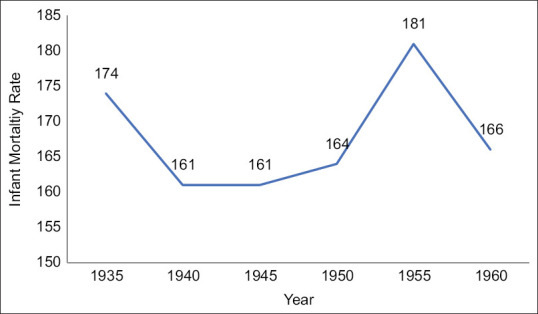
This systematic review argues that the 1947 Partition of India caused severe humanitarian, economic, and public-health damage, while receiving little attention or aid from the international scientific community and UN. The authors found only 24 publications from 1947–1951 and highlight reported declines in health and economy, including a 10.36% rise in infant mortality rate (1950–55) and a 16.36% GDP decrease (1946–48).
## Key findings
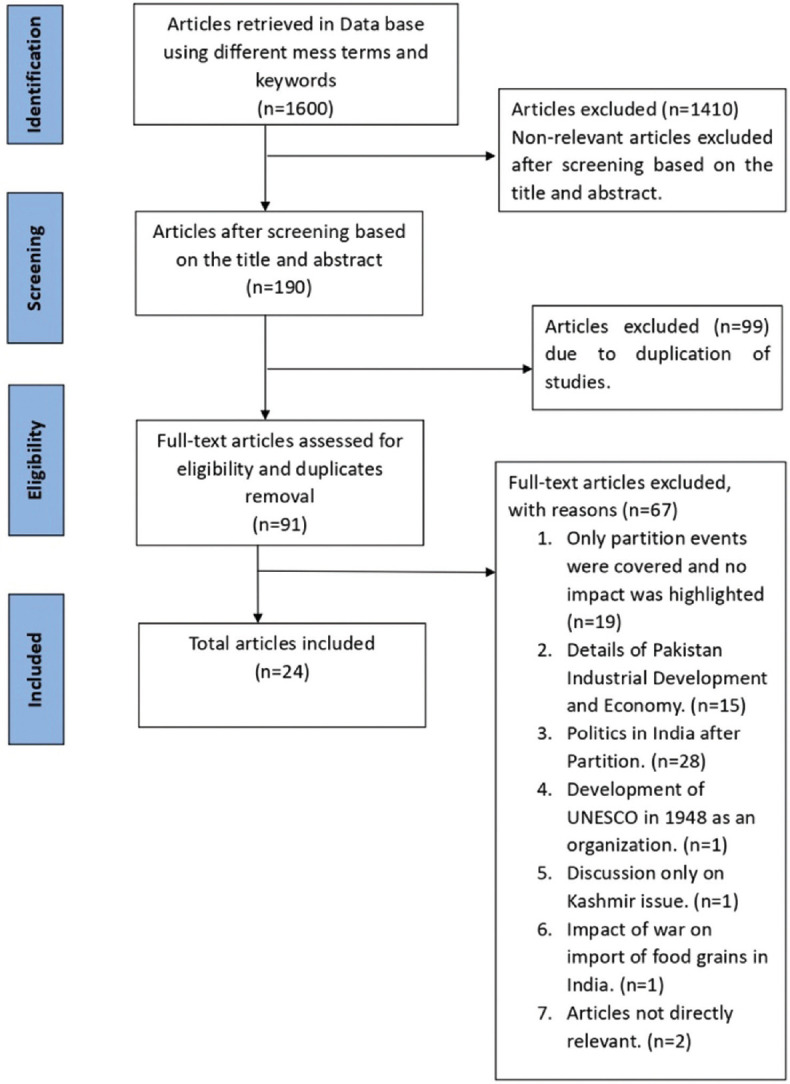
- The review located only 24 publications on the partition’s impact from 1947 to 1951, despite searching multiple sources and initially finding 1600 articles.
- The paper reports that partition caused about two million deaths, 14 million or more displaced people, and around 75,000 women raped and abducted.
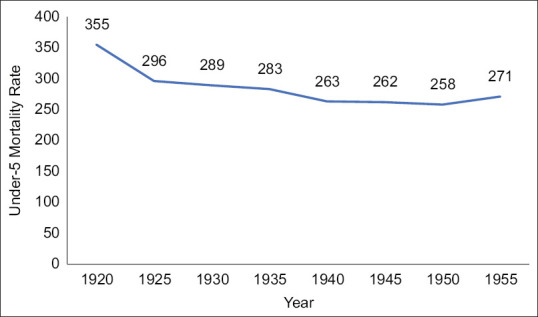
- It states that India’s infant mortality rate increased by 10.36% in the 1950s, from 164 per 1000 live births in 1950 to 181 per 1000 in 1955, and under-5 mortality increased by 4.8% from 258 to 271 per 1000 live births.
- The authors report a 16.36% decrease in India’s GDP during 1946–48, and note that only one reviewed article reflected on partition’s impact on health.
## Methods
- The study is a systematic review following PRISMA guidelines.
- The authors searched PubMed, Econlit, United Nations resolutions, Government of India websites, and Google Scholar for English-language material from January 1947 to December 1951; they also did an additional Google search on international response.
- They screened 1600 articles, excluded duplicates and irrelevant records, and synthesized the remaining literature on partition’s effects on migration, food, trade, industry, economy, connectivity, health, and international aid.
## Limitations
- The paper itself states that it found only 24 publications, suggesting a very small evidence base for drawing conclusions about the period.
- The text makes evident that the review is limited to English-language sources and to the period January 1947 to December 1951; this may miss relevant non-English or later analyses (text-evident limitation).
- The paper’s own results show that some sections, such as “Impact on agriculture” and “Impact on health,” are sparsely supported in the reviewed literature, with only one article on health and no detailed agricultural subsection text, which constrains the strength of those conclusions (text-evident limitation).
Model-written summary. Check it against the paper before relying on it.
Integrity signals
Registry
Cites
Statistics
Figures
Verification
Claims the paper makes
1 Valid · 3 Not valid · 13 Not checked · 18 Own results and interpretations
A result the paper states — it cites no source for it, so there is none to check. The quote shows it is in the paper.
In the paper
“Partition not only caused monumental humanitarian suffering, but also contributed to food deficits, adverse impact on trade and industries, national income and harmed public health.”
§ Catastrophic impact of 1947 partition of India on people’s health > Abstract > Result:
plainstates a cause- Asserted: passes — The authors put it forward as true.
- Checkable: passes — It can be checked against evidence.
- Load-bearing: passes — The paper’s conclusions depend on it.
- Based: passes — The paper gives a reason why it holds.
A result the paper reports from its own data — it cites no other source for it, so there is none to check. The quote shows it is in the paper.
In the paper
“only one among the reviewed articles reflected on the impact of partition on health.”
§ Catastrophic impact of 1947 partition of India on people’s health > Results > International response to the partition of the Indian sub-continent
plain- Asserted: passes — The authors put it forward as true.
- Checkable: passes — It can be checked against evidence.
- Load-bearing: passes — The paper’s conclusions depend on it.
- Based: passes — The paper gives a reason why it holds.
In the paper
“necessitating reliance on, food imports to alleviate the shortage.[20212529]”
§ Catastrophic impact of 1947 partition of India on people’s health > Results > Impact on agriculture Post-partition, India and Pakistan were divided with a large, disproportionate distribution of population to land. In lieu of partition, India received 82.55% of the total population and 77.10% of the land whereas Pakistan got 17.44% of the population and 22.89% of the land.[18] A major shortage of raw jute and raw cotton producing land in India was one of the serious consequences of partition.[19] Before partition, cotton was the primary agricultural product for export, but post-partition the irrigated lands of canal colonies producing American cotton were no longer a part of India and consequently cotton had to be imported.[18] There was an increase in demand for cash crops, thereby, putting pressure on land and aggravating the imbalance between the availability of cultivable land and the demand for food and commercial crops in India.[19] Kosambi and Raghavachari in their article stated the unlikelihood of growing sufficient food in India after its separation from Pakistan.[21] Post-partition, water distribution issues arose as Pakistan accused India of taking excessive water.[22] While crop production was already declining due to World War II, it further dropped from 53 million tonnes per year in Pre-World War II period to 46 million tonnes in 1946.[25] The loss of Punjab and Sind to Pakistan, which were prime food grain-producing regions, coupled with India’s high population density lead to the food deficit in India, necessitating reliance on, food imports to alleviate the shortage.[20212529] Thus, food deficit was aggravated by partition.[25]
What the sources say
- Not matchedcites [20212529]
This doesn’t read as a citation we can look up.
plainstates a cause- Asserted: passes — The authors put it forward as true.
- Checkable: passes — It can be checked against evidence.
- Load-bearing: unclear — It is unclear whether the paper’s conclusions depend on it.
- Based: passes — The paper gives a reason why it holds.
- Not matched
A result the paper states — it cites no source for it, so there is none to check. The quote shows it is in the paper.
In the paper
“In contrast, no significant attention was expressed by the international scientific community or the United Nations, or aid provided during this catastrophic event.”
§ Catastrophic impact of 1947 partition of India on people’s health > Abstract > Result:
plain- Asserted: passes — The authors put it forward as true.
- Checkable: passes — It can be checked against evidence.
- Load-bearing: unclear — It is unclear whether the paper’s conclusions depend on it.
- Based: passes — The paper gives a reason why it holds.
A result the paper states — it cites no source for it, so there is none to check. The quote shows it is in the paper.
In the paper
“Despite the widespread communal violence and high death toll reaching millions, there was minimal support from international agencies for such a significant humanitarian crisis.”
§ Catastrophic impact of 1947 partition of India on people’s health > Results > International response to the partition of the Indian sub-continent
plain- Asserted: passes — The authors put it forward as true.
- Checkable: passes — It can be checked against evidence.
- Load-bearing: unclear — It is unclear whether the paper’s conclusions depend on it.
- Based: passes — The paper gives a reason why it holds.
15 more claims
Create a free account to see all 35 claims and every source verdict.
- It may state two separate claims as one. 7
- Probably not a substantial claim. 8
- The quote only partly states this claim. 1
Citations
Cites
Preferred reporting items for systematic reviews and meta-analyses: The PRISMA statement
Moher, D., Liberati, A., Tetzlaff, J., & Altman, D. G. (2010) · International Journal of Surgery · doi:10.1016/j.ijsu.2010.02.007 · Cited by 12,156
Holland, R. (1947) · International Journal Canada s Journal of Global Policy Analysis · doi:10.1177/002070204700200301 · Cited by 84 · cited 2×
“[9] Lambert’s article in the Middle East Journal echoed with the findings of Robert Holland (1947) on communal conflicts and displacement of population.”
BackgroundDisplacement and development: Long term impacts of population transfer in India
Bharadwaj, P., & Ali Mirza, R. (2019) · Explorations in Economic History · doi:10.1016/j.eeh.2019.05.001 · Cited by 29
Developments in the Field of Health in India
Raja, K. C. K. E. (1950) · BMJ · doi:10.1136/bmj.1.4650.387 · Cited by 15
Post-war government and politics of India
Ehrmann, W. W. (1947) · The Journal of Politics · doi:10.2307/2125736 · Cited by 14
Seasonal variation in the Indian birth-rate
KOSAMBI, D. D., & RAGHAVACHARI, S. (1951) · Annals of Eugenics · doi:10.1111/j.1469-1809.1951.tb02470.x · Cited by 12
Agricultural Problems of India
Nishimura, M. (1951) · Japanese Journal of Human Geography · doi:10.4200/jjhg1948.3.3_78 · Cited by 11
Kumar, R. (2019) · Journal of Family Medicine and Primary Care · doi:10.4103/jfmpc.jfmpc_674_19 · Cited by 7
Some Problems of Water Distribution between East and West Punjab
Fowler, F. J. (1950) · Geographical Review · doi:10.2307/211104 · Cited by 6 · cited 1×
“[22] While crop production was already declining due to World War II, it further dropped from 53 million tonnes per year in Pre‑World War II period to 46 million tonnes in 1946.”
BackgroundReligion, economics, and violence in Bengal: background of the minorities agreement
Lambert, R. D. (1950) · The Middle East Journal · doi:10.2307/4322191 · Cited by 5 · cited 2×
“[8,12,13,17] The division of the Indian sub‑continent worsened the existing ill‑feelings and religious strife among the people.”
Background
Research works printed but not linked: 14
- Samanta S The final transfer of power in India, 1937-1947: A closer look. Graduate Theses and Dissertations University of Arkansas 2011 258
- Dalrymple W The great divide: The violent legacy of Indian partition The New Yorker 2015 29 60 9
- C. H. D. UNESCO in 1948: An impartial assessment The World Today 1949 5 115 23 doi: https://www.jstor.org/stable/40392212
- Gautam RS [Review of the Book Adha Gaon, by M. Raza]. Resisting Partition: Home as nation in Rahi Masoom Reza's AdhaGaon New Delhi Sage Publications India 2017
- Prasad R India divided Penguin Books India 2010
- T. S. A. The economic outlook in India The World Today 1949 5 397 405
- Walker WAM The growth of the jute industry in India and Pakistan J R Soc Arts 1949 97 409 20
- J. W. T. The economic viability of Pakistan The World Today 1949 5 123 31
- Condliffe JB International trade and economic nationalism Int Concil 1951 29 549 52
- Bhat R India's 1947 partition through the eyes of women: Gender, politics, and nationalism Dissertation Ohio University 2018
- Butalia U The other side of silence: Voices from the partition of India London Penguin UK 2017
- Maddison A Historical statistics of the world economy: 1-2008 AD University of Groningen 2010
- Brahmananda PR The impact on India of population transfers in 1947 and after Thomas B Economics of International Migration. International Economic Association Conference Volumes London Palgrave Macmillan 1958 283 94
- ICRCs Activities on the Indian Subcontinent following Partition. International Review of the Red Cross. 1998 June Available from: https://international-review.icrc. org/articles/icrcs-activities-indian-subcontinent-followingpartition-1947-1949
Cited by
Intergenerational Trauma and Mental Health Disability in the South Asian Context
Shah, M. H., Roy, S., & Ahluwalia, A. (2024) · Springer eBooks · doi:10.1007/978-3-031-40858-8_292-1 · Cited by 9
Akram, H. (2025) · Qeios · doi:10.32388/omkvsw.3 · Cited by 3
1947 Partition of India and its lessons
Gupta, H. (2024) · Journal of Family Medicine and Primary Care · doi:10.4103/jfmpc.jfmpc_398_24
Akram, H. (2025) · Qeios · doi:10.32388/omkvsw · Cited by 4
Akram, H. (2025) · Qeios · doi:10.32388/omkvsw.2
Metadata
- Authors
- Tanveer, T., Mathur, N., & Sarwal, R.
- Affiliations
- Ministry of Minority Affairs (IN)
- Ministry of Home Affairs (IN)
- Corresponding author
- Sarwal, Rakesh
- ORCID
- Sarwal, Rakesh
- Venue
- Journal of Family Medicine and Primary Care
- Published
- 2024-02
- Volume
- 13
- Issue
- 2
- Pages
- 401-408
- ISSN
- 2249-4863 (ISSN-L)
- 2278-7135
- PMC
- PMC11006024
- OpenAlex
- W4392455588
- Cited by
- 8
- References
- 25
- Citations by year
- 2026: 2 · 2025: 4 · 2024: 2
- FWCI
- 0.72
- Type
- journal article
- Language
- en
- Open access
- gold
- doi.org
- Licence
- cc-by-nc-sa
- Locations
- Journal of Family Medicine and Primary Care (publishedVersion, cc-by-nc-sa)
- PubMed Central (publishedVersion, cc-by-nc-sa)
- PubMed (publishedVersion)
- DOAJ (DOAJ: Directory of Open Access Journals) (submittedVersion, cc-by-sa)
- Topics
- Health Sciences › Health Professions › General Health Professions › Health and Conflict Studies
- Social Sciences › Arts and Humanities › History › South Asian Studies and Diaspora
- Social Sciences › Political Science and International Relations › South Asian Studies and Conflicts
- Keywords
- Partition of India, public health impact, humanitarian crisis, mass migration, refugee health, foreign aid, international scientific community, food shortages, economic damage, long-term effects
About these checks
Registry, retraction, Cites and statistics results are computed, not judged, with one exception: a printed reference that no index lists is read once by a model before it counts as a citation error. Claims are extracted by a model and kept only when their quote appears verbatim in the text; each cited source is then checked, with a model’s help, for whether it says what the claim relies on. Those verdicts can be wrong — read the claim’s quote and the cited source before relying on one.
The claim verdicts this report counts are experimental: their accuracy is not yet measured.
A language model drew the claims from the paper on 2026-10-11, under version 3 of the claim definition (model deepseek-v4.1-flash, prompt extract-v3).
A second model labelled each claim on 2026-10-11 (model jev-1.13-20260917, definition revision gold-guideline-v0.2).
Statistics and arithmetic are recomputed, not judged.
Confidence bands are shown only for fields calibrated on our annotated test set. None is calibrated yet, so no band is shown.
What counts as a claim ›How we measure confidence ›How we check this ›
Are you an author, or do you see a problem with this page? Request a review
How to cite
Cite CoChat for the checks on this page, and the paper for its own findings.
- This page
- CoChat. (2026). Citation check: Catastrophic impact of 1947 partition of India on people's health. https://app.cochat.ai/papers/10.4103/jfmpc.jfmpc_985_23
- The paper
- Tanveer, T., Mathur, N., & Sarwal, R. (2024). Catastrophic impact of 1947 partition of India on people's health. Journal of Family Medicine and Primary Care. https://doi.org/10.4103/jfmpc.jfmpc_985_23
Data sources
Bibliographic data: Semantic Scholar, OpenAlex, Crossref.
Contains information from the Semantic Scholar Academic Graph Datasets, made available under the ODC Attribution License (ODC-BY 1.0).
Semantic Scholar’s data is described in: Kinney, R., et al. (2023). The Semantic Scholar Open Data Platform. arXiv:2301.10140.
