

The DOI matches its Crossref record; the references it cites are not checked yet.
Recurrent Glioblastomas Exhibit Higher Expression of Biomarkers with Stem-like Properties
Open accessAbstract
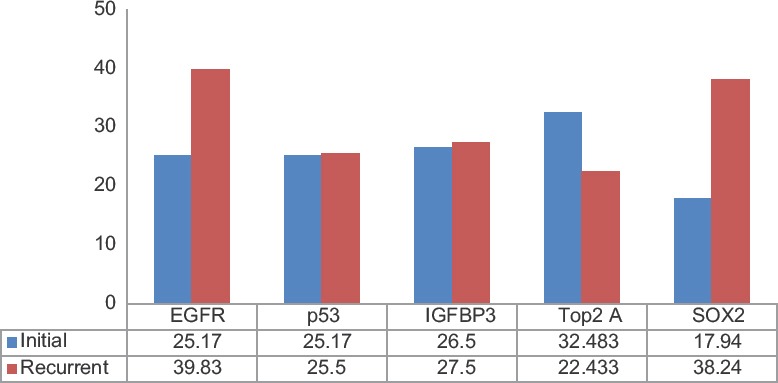
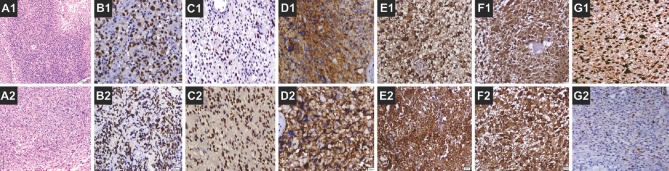
Background: Despite advances in the treatment of glioblastoma (GBM), the prognosis of patients continues to remain dismal. This unfavorable prognosis is mainly attributed to the tumor's propensity for progression and recurrence, which in turn is due to the highly aggressive nature of the persisting GBM cells that actively egress from the main tumor mass into the surrounding normal brain tissue. Such a recurrent tumor described to have a more malignant potential is highly invasive and resistant to current therapies, probably due to increased stemness and preferential selection of therapy-resistant clones of tumor cells. However, there is a paucity of literature on the expression of biomarkers in the recurrent GBM tumors that could have a role in conferring this aggressiveness. Aim: To identify the differences in the expression pattern of selected biomarkers in paired tissue samples of GBM. Material and Methods: A retrospective study on 30 paired samples of GBM (newly diagnosed/primary and recurrent) archived in the Department of Neuropathology, NIMHANS (2006–2009), was carried out. After obtaining clinical and demographic details, tumors were characterized histomorphologically and immunohistochemically on formalin-fixed paraffin-embedded tissues with reference to expression of biomarkers such as p53, epidermal growth factor receptor (EGFR), insulin-like growth factor binding protein 3 (IGFBP-3), sex determining region Y-box 2 (SOX2), and topoisomerase 2 A (Top2A). The results were statistically analyzed. Results: It was observed that while p53 and IGFBP-3 expression remained unaltered in paired samples, a significant increase in the expression of EGFR (P < 0.01) was noted in the recurrent tumors. Among the other biomarkers, SOX2 expression was higher in the recurrent tumors when compared to the primary tumors (P < 0.01). Conversely, the expression of Top2A was reduced in recurrent tumors (P = 0.05). Mild elevation in the expression of IGFBP-3 was observed in recurrent tumors but was not statistically significant. Conclusion: A significant increase in the expression of SOX2 in recurrent tumors probably indicates the presence of undifferentiated cells with stem-like properties in these tumors. EGFR is known to mediate SOX2 expression thereby resulting in stemness of the glioma cancer cells, which could further explain its overexpression in recurrent GBMs. Furthermore, a decreased expression of TOP2A observed in the recurrent tumors could probably be due to reduction in chemosensitivity to temozolomide, which has been shown in earlier studies. We also noted that p53 expression remained unaltered in the recurrent tumors when compared to the primary, suggesting the absence of preferential clonal expansion of p53 mutant cells following exposure to radiochemotherapy. Our study reiterates the fact that GBM recurrences are associated with molecular alterations that probably contribute to radiochemoresistance, increased invasiveness, therapeutic efficacy, and stemness.
Overview
The claims and statistics of this paper haven’t been checked yet.
Run the check — free, no account needed. It reads the open-access text and checks the sources it cites.
Integrity signals
Registry
Cites
Statistics
Figures
Verification
Claims the paper makes
The claims and statistics of this paper haven’t been checked yet.
Run the check — free, no account needed. It reads the open-access text and checks the sources it cites.
Claims other papers make about this one
Each is checked against this paper’s own text: does it say what the citing paper says it does?
The cited source says what the claim attributes to it.
In the citing paper
“TP53 expression has been compared in newly diagnosed patients and recurrent tumors with inconsistent results as to whether expression is altered upon recurrence [16,17,18].”
From The p53 Pathway in Glioblastoma (2018) · cites this paper as [16]
Self-check
Percentages, sums and reported differences re-computed from the paper’s own numbers.
The self-check needs the paper’s full text.
Citations
The citation lists are queued
They are fetched later and appear here then.
References 42 · Cited by 21
Metadata
- Authors
- Nandeesh, B. N., Naskar, S., Shashtri, A. H., Arivazhagan, A., & Santosh, V.
- Affiliations
- National Institute of Mental Health and Neurosciences (IN)
- Corresponding author
- Santosh, Vani
- Venue
- Journal of Neurosciences in Rural Practice
- Publisher
- Scientific Scholar
- Published
- 2018-01
- Volume
- 09
- Issue
- 01
- Pages
- 086-091
- ISSN
- 0976-3147 (ISSN-L)
- 0976-3155
- PMC
- PMC5812166
- OpenAlex
- W2791235179
- Cited by
- 21
- References
- 42
- Citations by year
- 2026: 2 · 2025: 4 · 2024: 4 · 2023: 3 · 2022: 3 · 2021: 2 · 2020: 1 · 2019: 1 · 2018: 1
- FWCI
- 0.71
- Type
- journal article
- Language
- en
- Open access
- gold
- doi.org
- Licence
- Locations
- Journal of Neurosciences in Rural Practice (publishedVersion, cc-by-nc-nd)
- Europe PMC (PubMed Central) (publishedVersion, cc-by-nc-sa)
- PubMed Central (publishedVersion, cc-by-nc-sa)
- PubMed (publishedVersion)
- DOAJ (DOAJ: Directory of Open Access Journals) (submittedVersion)
- Topics
- Health Sciences › Medicine › Oncology › Glioma Diagnosis and Treatment
- Health Sciences › Medicine › Oncology › Cancer Cells and Metastasis
- Life Sciences › Biochemistry, Genetics and Molecular Biology › Molecular Biology › Angiogenesis and VEGF in Cancer
- Keywords
- recurrent glioblastoma, cancer stemness, SOX2, EGFR, TOP2A, p53, IGFBP-3, temozolomide resistance, tumor invasion, clonal evolution, biomarker expression, paired tumor samples, glioma stem cells
About these checks
Registry, retraction, Cites and statistics results are computed, not judged, with one exception: a printed reference that no index lists is read once by a model before it counts as a citation error. Claims are extracted by a model and kept only when their quote appears verbatim in the text; each cited source is then checked, with a model’s help, for whether it says what the claim relies on. Those verdicts can be wrong — read the claim’s quote and the cited source before relying on one.
Statistics and arithmetic are recomputed, not judged.
Confidence bands are shown only for fields calibrated on our annotated test set. None is calibrated yet, so no band is shown.
What counts as a claim ›How we measure confidence ›How we check this ›
Are you an author, or do you see a problem with this page? Request a review
How to cite
Cite CoChat for the checks on this page, and the paper for its own findings.
- This page
- CoChat. (2026). Citation check: Recurrent Glioblastomas Exhibit Higher Expression of Biomarkers with Stem-like Properties. https://app.cochat.ai/papers/10.4103/jnrp.jnrp_417_17
- The paper
- Nandeesh, B. N., Naskar, S., Shashtri, A. H., Arivazhagan, A., & Santosh, V. (2018). Recurrent Glioblastomas Exhibit Higher Expression of Biomarkers with Stem-like Properties. Journal of Neurosciences in Rural Practice. https://doi.org/10.4103/jnrp.jnrp_417_17
Data sources
Bibliographic data: Semantic Scholar, OpenAlex, Crossref.
Contains information from the Semantic Scholar Academic Graph Datasets, made available under the ODC Attribution License (ODC-BY 1.0).
Semantic Scholar’s data is described in: Kinney, R., et al. (2023). The Semantic Scholar Open Data Platform. arXiv:2301.10140.
