

Medical education and physician training in the era of artificial intelligence
Open accessThe DOI matches its Crossref record; 65 of the 65 references it cites were found in a registry or an index.
Abstract
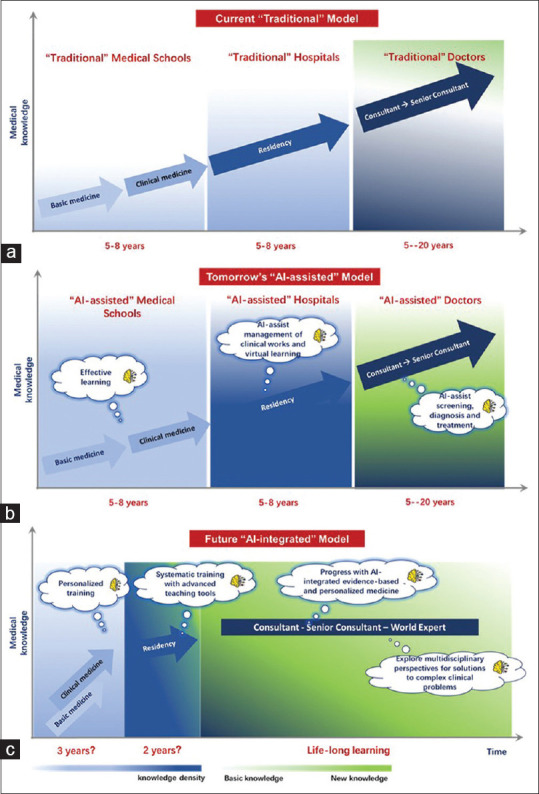
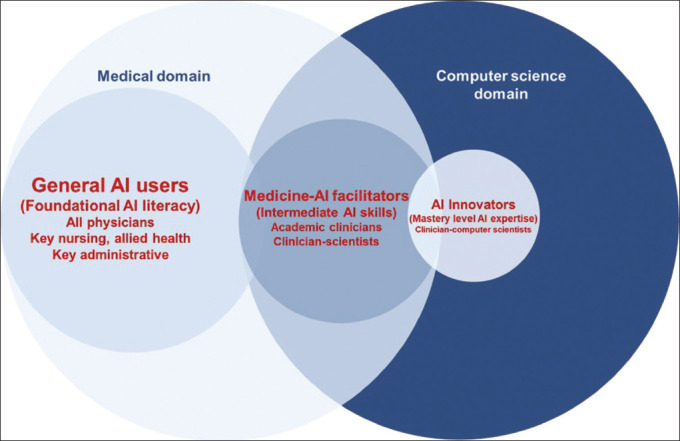
With the rise of generative artificial intelligence (AI) and AI-powered chatbots, the landscape of medicine and healthcare is on the brink of significant transformation. This perspective delves into the prospective influence of AI on medical education, residency training and the continuing education of attending physicians or consultants. We begin by highlighting the constraints of the current education model, challenges in limited faculty, uniformity amidst burgeoning medical knowledge and the limitations in ‘traditional’ linear knowledge acquisition. We introduce ‘AI-assisted’ and ‘AI-integrated’ paradigms for medical education and physician training, targeting a more universal, accessible, high-quality and interconnected educational journey. We differentiate between essential knowledge for all physicians, specialised insights for clinician-scientists and mastery-level proficiency for clinician-computer scientists. With the transformative potential of AI in healthcare and service delivery, it is poised to reshape the pedagogy of medical education and residency training.
Overview
The claims and statistics of this paper haven’t been checked yet.
Free: it reads the open-access text and checks the first 5 claims that cite a source we can check. Create a free account to check every claim.
Integrity signals
Registry
Cites
Statistics
Figures
Verification
Claims the paper makes
The claims and statistics of this paper haven’t been checked yet.
Free: it reads the open-access text and checks the first 5 claims that cite a source we can check. Create a free account to check every claim.
Claims other papers make about this one
Each is checked against this paper’s own text: does it say what the citing paper says it does?
The source backs part of the claim, not all of it — or backs it for a different population, condition or comparison.
In the citing paper
“There will likely be a need for certain physicians to take on a larger role with respect to AI innovation and integration, but the vast majority will be using AI in their everyday practice8,18.”
From Developing a Canadian artificial intelligence medical curriculum using a Delphi study (2024) · cites this paper as [18]
Experimental — accuracy not yet measuredThe cited source says what the claim attributes to it.
In the citing paper
“a lack of consensus on core competencies [5, 174, 175]”
From Artificial intelligence in undergraduate medical education: an updated scoping review (2025) · cites this paper as [174]
The cited source says what the claim attributes to it.
In the citing paper
“Challenges related to faculty members, such as the lack of AI knowledge and expertise [56, 180], resistance to adopting new technologies [5, 77, 180], and struggles with staff shortages, were also acknowledged in several studies [174].”
From Artificial intelligence in undergraduate medical education: an updated scoping review (2025) · cites this paper as [174]
Self-check
Percentages, sums and reported differences re-computed from the paper’s own numbers.
The self-check needs the paper’s full text.
Citations
Cites
1 retracted
Ahmad, S. F., Han, H., Alam, M. M., Rehmat, M. K., Irshad, M., Arraño-Muñoz, M., & Ariza-Montes, A. (2023) · Humanities and Social Sciences Communications · doi:10.1057/s41599-023-01787-8 · Cited by 338 · cited 1×
“[60] Hence, physicians need to remain at the helm of clinical decision‑making, discerning the appropriate contexts for AI, interpreting its results against established accuracy benchmarks and staying vigilant about potential biases and limitations.”
BackgroundRetractedFrenk, J., Chen, L., Bhutta, Z. A., Cohen, J., Crisp, N., Evans, T., Fineberg, H., Garcia, P., Ke, Y., Kelley, P., et al. (2010) · The Lancet · doi:10.1016/s0140-6736(10)61854-5 · Cited by 5,960
Kung, T. H., Cheatham, M., Medenilla, A., Sillos, C., De Leon, L., Elepaño, C., Madriaga, M., Aggabao, R., Diaz-Candido, G., Maningo, J., et al. (2023) · PLOS Digital Health · doi:10.1371/journal.pdig.0000198 · Cited by 4,115 · cited 1×
“[32] In this regard, LLMs can be a useful learning tool to aid in revision.”
Kung, T. H., Cheatham, M., ChatGPT, Medenilla, A., Sillos, C., De Leon, L., Elepaño, C., Madriaga, M., Aggabao, R., Diaz-Candido, G., et al. (2022) · doi:10.1101/2022.12.19.22283643 · Cited by 4,115
Large language models in medicine
Thirunavukarasu, A. J., Ting, D. S. J., Elangovan, K., Gutierrez, L., Tan, T. F., & Ting, D. S. W. (2023) · Nature Medicine · doi:10.1038/s41591-023-02448-8 · Cited by 3,944 · cited 2×
“[20,42] Transparency and patients’ acceptability should also be considered when deploying AI solutions.”
BackgroundSelf-citationRajpurkar, P., Chen, E., Banerjee, O., & Topol, E. J. (2022) · Nature Medicine · doi:10.1038/s41591-021-01614-0 · Cited by 3,212
Sallam, M. (2023) · Healthcare · doi:10.3390/healthcare11060887 · Cited by 3,126 · cited 2×
“[33] Furthermore, the use of AI could potentially lead to over‑reliance, stifling independent thinking and potentially overlooking AI’s inherent risk.”
BackgroundChatGPT: five priorities for research
van Dis, E. A. M., Bollen, J., Zuidema, W., van Rooij, R., & Bockting, C. L. (2023) · Nature · doi:10.1038/d41586-023-00288-7 · Cited by 1,842
ChatGPT: Bullshit spewer or the end of traditional assessments in higher education?
(2023) · Journal of Applied Learning & Teaching · doi:10.37074/jalt.2023.6.1.9 · Cited by 1,806
Benefits, Limits, and Risks of GPT-4 as an AI Chatbot for Medicine
Lee, P., Bubeck, S., & Petro, J. (2023) · New England Journal of Medicine · doi:10.1056/nejmsr2214184 · Cited by 1,738 · cited 2×
“[20,42] Transparency and patients’ acceptability should also be considered when deploying AI solutions.”
Background
Research works printed but not linked: 5
- Campbell J Dussault G Buchan J Pozo-Martin F Arias MG Leone C A universal truth: No health without a workforce WHO Press 2013
- Huggett KN Quesnelle KM Jeffries MB An introduction to medical teaching Switzerland Springer Cham 2022
- Institute of Medicine (US) Committee on Quality of Health Care in America. Crossing the Quality Chasm: A New Health System for the 21st Century Washington, DC The National Academies Press 2001 25057539
- Passi S Vorvoreanu M Overreliance on AI: Literature review Available at: https://www.microsoft.com/en-us/research/publication/overreliance-on-ai-literature-review/ [Last accessed on 2023 Nov 04]
- van Dis EAM Bollen J Zuidema W van Rooij R Bockting CL ChatGPT: Five priorities for research Nature 2023 614 224 226 36737653 · DOI · Paper page
Cited by
Mapping the use of artificial intelligence in medical education: a scoping review
Rincón, E. H. H., Jimenez, D., Aguilar, L. A. C., Flórez, J. M. P., Tapia, Á. E. R., & Peñuela, C. L. J. (2025) · BMC Medical Education · doi:10.1186/s12909-025-07089-8 · Cited by 145
“Existing studies have demonstrated that AI applications, such as Intelligent Tutoring Systems and virtual simulations, significantly enhance learning outcomes by providing adaptive, personalized training and reducing geographical barriers to education [23, 24, 53].”
Artificial intelligence in undergraduate medical education: an updated scoping review
Simoni, J., Urtubia-Fernandez, J., Mengual, E., Simoni, D. A., Royo, M., Egaña-Yin, D., Hertog, O. L. A., López-Ortiz, L., Muñoz-Tomás, A., Santiago-Martínez, P., et al. (2025) · BMC Medical Education · doi:10.1186/s12909-025-08188-2 · Cited by 62
“These included a lack of standard definitions for AI [38, 39], no formal guidance from oversight bodies for UGME [163], a lack of consensus on core competencies [5, 174, 175], uncertainty about AI’s real-world applicability in medicine [150] and limited space in already full curriculum [176–178].”
ChatGPT versus a customized AI chatbot (Anatbuddy) for anatomy education: A comparative pilot study
Arun, G., Perumal, V., Urias, F. P. J. B., Ler, Y. E., Tan, B. W. T., Vallabhajosyula, R., Tan, E., Ng, O., Ng, K. B., & Mogali, S. R. (2024) · Anatomical Sciences Education · doi:10.1002/ase.2502 · Cited by 58
Li, J., Yin, K., Wang, Y., Jiang, X., & Chen, D. (2025) · BMC Medical Education · doi:10.1186/s12909-025-07750-2 · Cited by 65
“It is crucial to acknowledge that GAI currently functions primarily as a complementary educational tool rather than a replacement for traditional teaching methodologies in medical education [8, 14, 40].”
Shishehgar, S., Murray‐Parahi, P., Alsharaydeh, E., Mills, S., & Liu, X. (2025) · International Nursing Review · doi:10.1111/inr.70045 · Cited by 133
Developing a Canadian artificial intelligence medical curriculum using a Delphi study
Singla, R., Pupic, N., Ghaffarizadeh, S.-A., Kim, C., Hu, R., Forster, B. B., & Hacihaliloglu, I. (2024) · npj Digital Medicine · doi:10.1038/s41746-024-01307-1 · Cited by 56
Baxmann, M., Kárpáti, K., & Baráth, Z. (2025) · BMC Oral Health · doi:10.1186/s12903-025-06070-7 · Cited by 36
“This approach improves knowledge retention and fosters a thorough understanding of advanced dental concepts [26, 30].”
InfluentialAI image generation technology in ophthalmology: Use, misuse and future applications
Phipps, B., Hadoux, X., Sheng, B., Campbell, J. P., Liu, T. Y. A., Keane, P. A., Cheung, C. Y.-L., Chung, T. Y., Wong, T. Y., & van Wijngaarden, P. (2025) · Progress in Retinal and Eye Research · doi:10.1016/j.preteyeres.2025.101353 · Cited by 22
“…of examples of a particular disease state with the aim of reducing bias present in educational material and to improve accessibility to medical students and residents without the requirement for the transfer of confidential patient data between centres (Preiksaitis and Rose, 2023; Xu et al., 2024).”
Self-citationCarriero, S., Cannella, R., Cicchetti, F., Angileri, S. A., Bruno, A., Biondetti, P., Colciago, R. R., D’Antonio, A., Pepa, G. D., Grassi, F., et al. (2025) · Journal of Medical Imaging and Radiation Oncology · doi:10.1111/1754-9485.13880 · Cited by 19
“…to personalise educational programmes, automate routine tasks, create tailored content, and enhance access to evidence-based information that could fill the gaps in resident clinical preparation, hypothetically leading to a reduction in the time needed to prepare the trainees adequately [23, 24].”
Sheikh, M. S., Thongprayoon, C., Craici, I. M., Miao, J., Qureshi, F., Mao, M. A., Hommos, M. S., Prendergast, M., Nair, S. S., KASHANI, K. B., et al. (2025) · Frontiers in Nephrology · doi:10.3389/fneph.2025.1607017 · Cited by 7
Serin, O., Yıldırım, B. F., Duman, F., Ercorumlu, K., Yavas, R., Taşar, M. A., & Celik, M. S. (2025) · International Journal of Medical Informatics · doi:10.1016/j.ijmedinf.2025.106003 · Cited by 8
Application of DeepSeek-based AI teaching assistant in teaching anesthesiology theories
Hao, F., Du, W., Yan, J., & Jiang, H. (2025) · BMC Medical Education · doi:10.1186/s12909-025-08494-9 · Cited by 6
“…Lecture-Based Learning (LBL) approach, plagued by inherent limitations such as information overload, inconsistent content quality, and difficulties in standardization [2, 3], tends to foster passive knowledge acquisition among students and fails to accommodate individualized learning needs.”
Artificial intelligence: Revolutionizing pediatric emergency care - A narrative review
Saha, A., Shukla, A., & Bhaskar, V. (2025) · International Journal of Critical Illness and Injury Science · doi:10.4103/ijciis.ijciis_24_25 · Cited by 6
“[84] ChatGPT and other LLMs have been explored in their use to train physicians in cracking clinical scenarios.”
Zhang, M., Chu, R., Liu, C., Zhang, S., & Ren, X. (2025) · Frontiers in Medicine · doi:10.3389/fmed.2025.1684035 · Cited by 7
“…not required to become programmers, they need to understand the basic principles of machine learning, the critical importance of training data sets, the meaning of performance evaluation metrics (such as sensitivity, specificity, and AUC curve), and the sources and impact of algorithmic bias (52).”
Zhou, Y., Zhao, L., Mi, L., Liu, S., Yang, Y., Wang, Q., He, H., & Long, Y. (2025) · BMC Medical Education · doi:10.1186/s12909-025-07825-0 · Cited by 8
“The ‘AI-integrated’ paradigm proposed by Xu et al. [14] suggests that physicians exposed to AI-enhanced clinical workflows are more likely to adopt these tools in teaching, aligning with our results.”
Framework for AI integration into the undergraduate medical curricula: a scoping review
Cheng, D., Chan, E. Y. S., Song, Y., Cui, A., Chang, A., & Wang, W. (2026) · BMC Medical Education · doi:10.1186/s12909-026-08620-1 · Cited by 4
“Seven studies proposed or evaluated structured, evidence-based curricular frameworks for AI in UGME [26, 27, 31, 33–36] (Table 2).”
InfluentialThe application of artificial intelligence-generated content in ophthalmology education
Wang, Y., Zhao, Y., & Li, J. (2025) · Frontiers in Medicine · doi:10.3389/fmed.2025.1617537 · Cited by 4
Theoretical evolution of AI in medical education: models, frameworks, and future directions
Abdulrahman, K. A. B., & Hefny, M. (2026) · Frontiers in Education · doi:10.3389/feduc.2026.1796632 · Cited by 4
Structural chain of thoughts for radiology education
Awasthi, A., Chung, B., Vu, A. M., Khan, S. B., Le, N., Deng, Z., Agrawal, R., Wu, C. C., & Nguyen, H. V. (2025) · Knowledge-Based Systems · doi:10.1016/j.knosys.2025.114433 · Cited by 4
“In addition, the absence of standardized training frameworks across hospitals results in inconsistent skill development [4,29].”
Are Psychiatry Faculty Prepared to Guide AI Use? A National Survey
Mercado, A. E., Ferguson, L., Chastain, J., Williams, J., Nahhas, R. W., Tripathi, S., & Grant, L. (2026) · Academic Psychiatry · doi:10.1007/s40596-026-02352-6 · Cited by 4
From Classroom to Clinic: The Impact of AI on Medical Education
Nawaz, F. A., Opriessnig, E., Usman, F. M., Agrohi, J., Arshad, Z., Kashyap, R., & Anwar, S. (2024) · Advances in medical technologies and clinical practice book series · doi:10.4018/979-8-3693-4422-4.ch004 · Cited by 4
Generative AI for Healthcare: Concepts and Applications
Abdelsalam, R. R., Refaat, Y., Ibrahim, N., Abdelaziz, M. M., Abdel-Aziz, M. H., El‐Shinawi, M., Mohamed, M. M., & Elaziz, M. A. (2024) · International Conference on Smart-Digital-Green Technologies and Artificial Intelligence Sciences (CSDGAIS) · doi:10.1109/csdgais64098.2024.11064841 · Cited by 2
Nishan, M. N. H., Sultana, S., Tithi, T. A., & Hawlader, M. D. H. (2025) · Journal of Public Health Research · doi:10.1177/22799036251369408 · Cited by 3
“27,28 Furthermore, only 1.01% of participants received comprehensive instructions on using AI tools, highlighting a significant gap in getting training and professional development.”
InfluentialMoshkin, A. S., Fedorov, M. V., Arlazarov, V. V., Gribova, V. V., Nazarenko, A., Репин, Д. А., Клевцова, О. Ю., & Romanov, A. Y. (2026) · Algorithms · doi:10.3390/a19070523 · Cited by 2
Liu, X., Pan, J., Zhang, C., Wang, X., Wan, J., & Wang, Q. (2026) · BMC Medical Education · doi:10.1186/s12909-026-09879-0 · Cited by 2
“We therefore interpret these findings as directional signals rather than definitive conclusions [31].”
Artificial Intelligence can transform formative assessment in medical education
Feldman, J., Gilchrist, C., & Leung, F. (2024) · Canadian Medical Education Journal · doi:10.36834/cmej.79759 · Cited by 2
Empowering the next generation: integrating artificial intelligence education into medical training
Tan, J. A., Ng, I. K., Hong, A., Teo, D. B. S., & Tan, L. F. (2025) · Postgraduate Medical Journal · doi:10.1093/postmj/qgaf144 · Cited by 2
Artificial intelligence and pain management: cautiously optimistic
Srinivasan, B., Venkataraman, A., & Raja, S. N. (2024) · Pain Management · doi:10.1080/17581869.2024.2392483 · Cited by 5
A Paradigm Shift on Emergence of Pharmacogenomics in the Era of Personalized Medicine
Kukreti, N., Lamba, K., Pant, P., Visht, S., & Rana, S. (2024) · Advances in medical technologies and clinical practice book series · doi:10.4018/979-8-3693-6597-7.ch001 · Cited by 1
Dickinson, S., & McIntosh, M. K. (2025) · Annual International Conference of the IEEE Engineering in Medicine and Biology Society (EMBC) · doi:10.1109/embc58623.2025.11253431 · Cited by 1
“[1] As AI and digital innovations reshape healthcare, integrating these technologies into medical curricula will be essential for training.”
Andreas, S., Pana, Z. D., Larentzakis, A. V., Kondylis, S., Maina, A. M., Ziogas, N. K., & Ntourakis, D. (2026) · Global Surgical Education - Journal of the Association for Surgical Education · doi:10.1007/s44186-025-00411-4 · Cited by 3
“At the postgraduate level, residents—especially in imaging-heavy specialties—use AI in daily workflow, receiving immediate, data-driven feed-back on diagnostic accuracy or procedural performance [41–43].”
The current status and future prospects of artificial intelligence education in residency training
Zhang, H., Qian, K., Wang, J., & Zheng, C. (2026) · Frontiers in Education · doi:10.3389/feduc.2025.1713676 · Cited by 4
“Such personalized training better prepares future physicians for the complexities of modern medical practice, where individualized patient care is increasingly essential (Xu et al., 2024).”
Zhu, J., Guan, C., Zhang, H., Wang, L., Zhang, Y., & Bian, X. (2026) · Frontiers in Medicine · doi:10.3389/fmed.2026.1817255 · Cited by 3
Luo, Y., Ge, T., Luo, X., Lin, Z., Li, M., & Ke, B. (2026) · Frontiers in Medicine · doi:10.3389/fmed.2026.1868565 · Cited by 1
“This need for faculty preparation is consistent with broader evidence that educational innovations in health professions teaching require structured faculty development, feedback, and sustained implementation support (4, 5, 37, 38).”
Open‐source large language models in medical education: Balancing promise and challenges
Ray, P. P. (2024) · Anatomical Sciences Education · doi:10.1002/ase.2484 · Cited by 1
Back to the future: Whither Psychiatry 40 years hence?
Frost, B., Mayhook‐Walker, I., & Deahl, M. (2025) · International Review of Psychiatry · doi:10.1080/09540261.2025.2549777 · Cited by 1
“In fact, AI generates questions and answers of high quality when inputting a patient history (Xu et al., 2024).”
Artificial intelligence in medicine
Choolani, M. A. (2024) · Singapore Medical Journal · doi:10.4103/singaporemedj.smj-2024-059 · Cited by 1
PhD: Distribution of heavy metals in environmental samples in the Allchar mine and its environ
Andonovska, K. B. (2013)
Teaching and Assessing Higher-Order Cognitive Skills in Fellowship Training
David, Y. N., Shah, B. J., Katzka, D. A., & DeCross, A. J. (2025) · Gastroenterology · doi:10.1053/j.gastro.2024.12.023
Practical training of AI tools in healthcare work force
Khan, S. M. (2025) · Elsevier eBooks · doi:10.1016/b978-0-443-33584-6.00023-2
Artificial intelligence in the oncology residency training curriculum
Romero-Alfaro, A. (2025) · European Journal of Cancer · doi:10.1016/j.ejca.2025.115407 · Cited by 1
Structural Chain of Thoughts for Radiology EducationPreprint
Awasthi, A., Chung, B., Vu, A. M., Khan, S. B., Le, N., Deng, Z., Agrawal, R., Wu, C. C., & Nguyen, H. V. (2025) · SSRN Electronic Journal · doi:10.2139/ssrn.5230388
Structural Chain of Thoughts for Radiology EducationPreprint
Awasthi, A., Chung, B., Vu, A. M., Khan, S. B., Le, N., Deng, Z., Agrawal, R., Wu, C. C., & Nguyen, H. V. (2025) · SSRN Electronic Journal · doi:10.2139/ssrn.5260983
The Application of the “Virtual-Real Integration” Teaching Model in Diagnostic Training Course
Zheng, X., & Wang, X. (2025) · International Conference on Digital Education and Information Technology (DEIT) · doi:10.1145/3732299.3732314
“In addition, in today’s society, the demand for medical professionals is increasing, and virtual simulation technology can alleviate the lack of clinical resources to a certain extent [ 5 ] .”
Teaching Techniques of the 21st Century: Simulation, Virtual Reality, and Beyond
Elmofty, D. H., Pritzlaff, S. G., Singh, N. S., Anițescu, M., & Guirguis, M. N. (2025) · International Anesthesiology Clinics · doi:10.1097/aia.0000000000000504
Utami, M. S. M., Kwok, W. H., Kotz, J., Walker, R., Wang, G., & Marriott, R. (2025) · Annual International Conference of the IEEE Engineering in Medicine and Biology Society (EMBC) · doi:10.1109/embc58623.2025.11254329 · Cited by 4
Espinel, J. C. D., Casquete, A. L. G., & Garcet, Y. B. (2025) · Revista Española de Educación Médica · doi:10.6018/edumed.685191
Ethical Considerations in AI-Enabled Healthcare
Aldemir, E., Bloom, C., Honeyman, S. I., & Vardanyan, R. (2026) · Biomedical visualization · doi:10.1007/978-3-032-06520-9_5 · Cited by 1
Exploring the Effects of Training Camp on Standard Orthodontic Education
Li, W., Zhou, C., Fang, X., Jiang, S., Xiang, Z., & Shi, J. (2026) · Journal of Dental Education · doi:10.1002/jdd.70157
Physician AI literacy: A key to unlocking AI's clinical potential
Michaeli, O., Nayot, D., Tyrrell, P. N., Shapiro, H. M., & Michaeli, J. (2026) · Reproductive BioMedicine Online · doi:10.1016/j.rbmo.2026.105640
Ha, J., Park, H., Shinn, J., & Kim, H. (2026) · Journal of Korean Medical Association · doi:10.5124/jkma.26.0013
Naffi, N., Bahlouli, Y. E., Fortier, N., Doumbouya, M. B., Shakeraneh, S., Faraj, D. A., Grégoire, J., Beaulieu, N., & Whelan, K. (2026) · Médiations et médiatisations · doi:10.52358/mm.vi25.507
Barra, F. L., Jalilian, L., Costa, A., Leuci, L., Rodella, G., & Carenzo, L. (2026) · Simulation in Healthcare The Journal of the Society for Simulation in Healthcare · doi:10.1097/sih.0000000000000933
Cheungpasitporn, W., Pesce, F., Thongprayoon, C., Miao, J., Baloch, M. Y., Soliman, K., & Iñiguez, J. S. C. (2026) · Renal Failure · doi:10.1080/0886022x.2026.2658349
“…coherent and usable frameworks [10,13]. it identifies missing steps in diagnostic reasoning and clarifies how one concept leads to the next. the model can build differential diagnoses with transparent reasoning chains that show exactly why each possibility is included or excluded [10,11,32–34].”
What and how should cardiologists learn in the era of artificial intelligence? Opinion on a problem
Shvarts, Y. G., Акимова, Н. С., Евгеньевна, К. Л., & Parkhoniuk, E. V. (2026) · Russian Journal of Cardiology · doi:10.15829/10.15829/1560-4071-2026-6903
Kızılcık, N. (2026) · Tzu Chi Medical Journal · doi:10.4103/tcmj.tcmj-d-25-00082
“Furthermore, AI-based training modules are being developed to accelerate skill acquisition for healthcare providers, offering virtual simulations that replicate real-life surgical scenarios [79].”
Artificial Intelligence in Medical Education: An Umbrella Review
Ghazi, S. E., Charef, N., Qarmiche, N., Bourkhime, H., Omari, M., Fakir, S. E., & Otmani, N. (2026) · Lecture notes in networks and systems · doi:10.1007/978-3-032-18894-6_9
Pirouz, K., Shapovalov, V. S., Tran, Q. K., Gorup, S., Hussain, A., & Pourmand, A. (2026) · World Journal of Emergency Medicine · doi:10.5847/wjem.j.1920-8642.2026.064 · Cited by 1
Let’s Talk Systems - What Do We Really Mean by a Systems Approach in AI-Enhanced Medical Education?
Surapaneni, K. M. (2026) · Medical Science Educator · doi:10.1007/s40670-026-02783-8
Vargas, N., Dullnig, A. W., Ghasemi, S., & Hamrah, D. (2026) · The American Journal of Cosmetic Surgery · doi:10.1177/07488068261439192
Yılmaz, A., Mart, H. M. E., Temelkuran, B., & Akay, B. N. (2026) · Journal of the American Academy of Dermatology · doi:10.1016/j.jaad.2026.06.089
Zhang, J., Liu, Y., & Wang, B. (2026) · Medicine · doi:10.1097/md.0000000000049849
“[5] These challenges have encouraged educators to explore technology-supported approaches to clinical training.”
Wu, Y., Li, S., Gao, T., Zhou, Y., & Zhuang, Y. (2026) · BMC Medical Education · doi:10.1186/s12909-026-10024-0
“However, their educational value depends on appropriate instructional design, active learner engagement, and the management of cognitive demands [5, 6, 8, 9].”
The road ahead: innovations and future trends in artificial intelligence medical robotics
Manoharan, G., & Nivedha, M. (2026) · Elsevier eBooks · doi:10.1016/b978-0-443-27783-2.00002-8
Artificial intelligence in medical education: a narrative review across four functional domains
Zarei, M., Mozaffari, M., & Hajiani, Y. (2026) · Currents in Pharmacy Teaching and Learning · doi:10.1016/j.cptl.2026.102752 · Cited by 1
BIBLIOMETRIC ANALYSIS OF ABSTRACTS PRESENTED AT THE NATIONAL MEDICAL EDUCATION CONGRESSES
Öksüz, A., PEKCAN, N., Uçar, R. M., Çoşkun, Ö., & Budakoğlu, I. İ. (2026) · Tıp Eğitimi Dünyası · doi:10.25282/ted.1896295
O’Donoghue, M., Weber, S., Hahn, P., Bock, M., & Lautenbach, M. (2026) · Handchirurgie · Mikrochirurgie · Plastische Chirurgie · doi:10.1055/a-2920-9458
Li, X., Lu, Y. D., Luo, H. Y., Xiong, Y. X., Li, F., Wang, Q., Cui, Y., Tan, H., Xie, J. P., & Guo, Y. (2026) · Medical Science Educator · doi:10.1007/s40670-026-02859-5
Beyond the Algorithm: A Stewardship Framework for the Hand Surgeon Adopting Artificial Intelligence
Cievet‐Bonfils, M., Burnier, M., & Locquet, V. (2026) · The Journal Of Hand Surgery · doi:10.1016/j.jhsa.2026.08.006
Wang, Y., Sun, J., Qing, J., Yang, S., Jiang, X., Yang, M., & Zhang, Z. (2026) · Renal Failure · doi:10.1080/0886022x.2026.2731711
“The future development of nephrology education will focus on emerging technological fields and the evolving needs of the profession, particularly the growing demand for experts in digital health-care and AI [108].”
Classifier-Derived Guidance for Diffusion-Based Medical Dataset Distillation
Du, S., Li, G., Togo, R., Ogawa, T., & Haseyama, M. (2026) · Bioengineering · doi:10.3390/bioengineering13101100
“Access to suitable medical datasets is often limited by restricted data availability and barriers to data sharing [3,4].”
Simoni, J., Pereira, J. L., Sánchez, S. C., Egaña-Yin, D., García-Gargallo, C., Hertog, O. L. A., Idoate, A., López-Ortiz, L., Morales-Gutiérrez, I., Romero, A., et al. (2026) · Frontiers in Digital Health · doi:10.3389/fdgth.2026.1918847
“In addition, considerations regarding their international applicability should be based on global expert consensus (6, 18, 19).”
Özdemir, Ç., Yeşil, B. M. B., & Özdemir, M. G. (2026) · Gazi Medical Journal · doi:10.12996/gmj.2026.4729
Training for Jobs That May Not Exist: Artificial Intelligence and the Future of Medical Residency
Reilly, M. J., Hasoon, J. J., & Abd-Elsayed, A. A. (2026) · Orthopedic Reviews · doi:10.52965/001c.172700
Shi, H., Huang, J., Gu, K., & Yang, J. (2026) · Nursing in Critical Care · doi:10.1111/nicc.70723
Building capacity in neurocritical care: training and education
Bhandari, S., & Shrestha, G. S. (2026) · Elsevier eBooks · doi:10.1016/b978-0-443-51365-7.00032-2
Metadata
- Authors
- Xu, Y., Jiang, Z., Ting, D. S. W., Kow, A. W. C., Bello, F., Car, J., Tham, Y.-C., & Wong, T. Y.
- Affiliations
- Tsinghua University (CN)
- Beijing Tsinghua Chang Gung Hospital (CN)
- Singapore National Eye Center (SG)
- National University of Singapore (SG)
- Nanyang Technological University (SG)
- Corresponding author
- Xu, Yueyuan
- Jiang, Zehua
- ORCID
- Venue
- Singapore Medical Journal
- Published
- 2024-03
- Volume
- 65
- Issue
- 3
- Pages
- 159-166
- ISSN
- 0037-5675 (ISSN-L)
- 2737-5935
- PMC
- PMC11060639
- OpenAlex
- W4393143419
- Semantic Scholar
- 6cf1402b9984f1346a0f7dfa2bb888c6b5f92423
- Cited by
- 76
- References
- 63
- Citations by year
- 2026: 38 · 2025: 28 · 2024: 9
- FWCI
- 7.03
- Type
- journal article
- Language
- en
- Open access
- diamond
- doi.org
- Licence
- cc-by-nc-sa
- Locations
- Singapore Medical Journal (publishedVersion, cc-by-nc-sa)
- PubMed Central (publishedVersion, cc-by-nc-sa)
- PubMed (publishedVersion)
- DOAJ (DOAJ: Directory of Open Access Journals) (submittedVersion, cc-by-sa)
- Topics
- Health Sciences › Medicine › Health Informatics › Artificial Intelligence in Healthcare and Education
- Social Sciences › Education › Innovations in Medical Education
- Social Sciences › Education › Artificial Intelligence in Education
- Keywords
- generative AI, residency training, continuing medical education, physician training, chatbots, faculty shortage, clinician-scientists, medical pedagogy
- MeSH terms
- Artificial Intelligence, Education, Continuing, Education, Medical, Humans, Physicians, Prospective Studies
About these checks
Registry, retraction, Cites and statistics results are computed, not judged, with one exception: a printed reference that no index lists is read once by a model before it counts as a citation error. Claims are extracted by a model and kept only when their quote appears verbatim in the text; each cited source is then checked, with a model’s help, for whether it says what the claim relies on. Those verdicts can be wrong — read the claim’s quote and the cited source before relying on one.
Statistics and arithmetic are recomputed, not judged.
Confidence bands are shown only for fields calibrated on our annotated test set. None is calibrated yet, so no band is shown.
What counts as a claim ›How we measure confidence ›How we check this ›
Are you an author, or do you see a problem with this page? Request a review
Data sources
Bibliographic data: Semantic Scholar, OpenAlex, Crossref.
Contains information from the Semantic Scholar Academic Graph Datasets, made available under the ODC Attribution License (ODC-BY 1.0).
Semantic Scholar’s data is described in: Kinney, R., et al. (2023). The Semantic Scholar Open Data Platform. arXiv:2301.10140.
