

Tailoring Natural Zeolites by Acid Treatments
The DOI matches its Crossref record; 3 of the 3 references it cites were found in a registry or an index.
Abstract
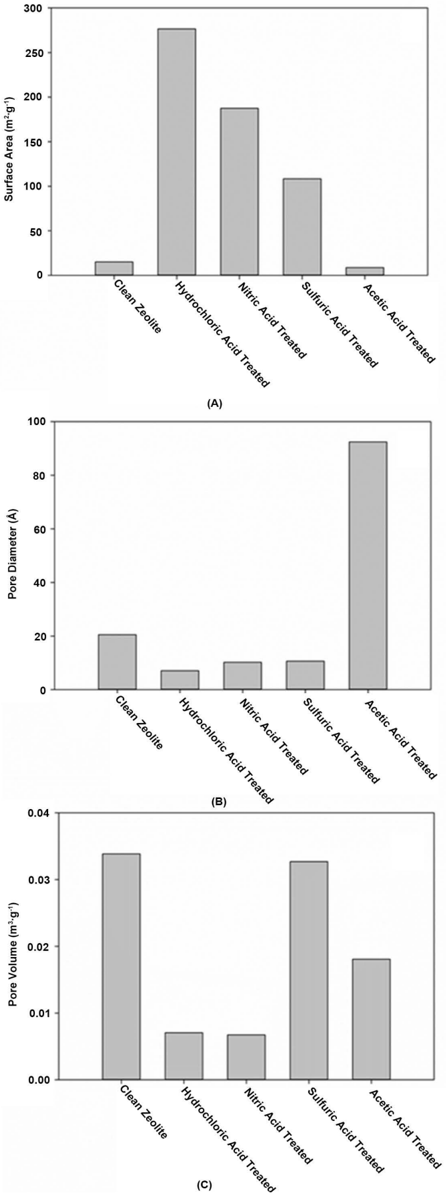
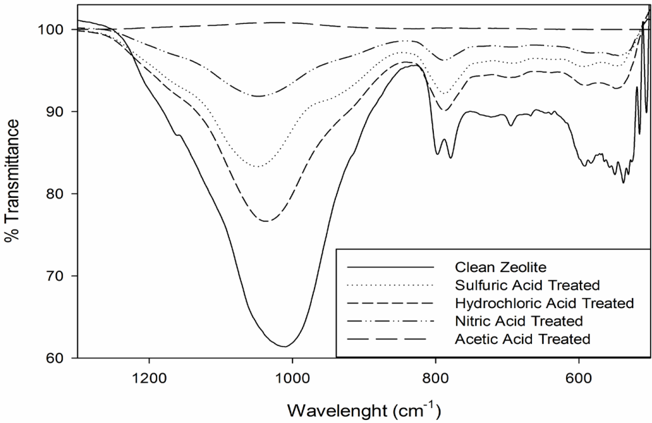
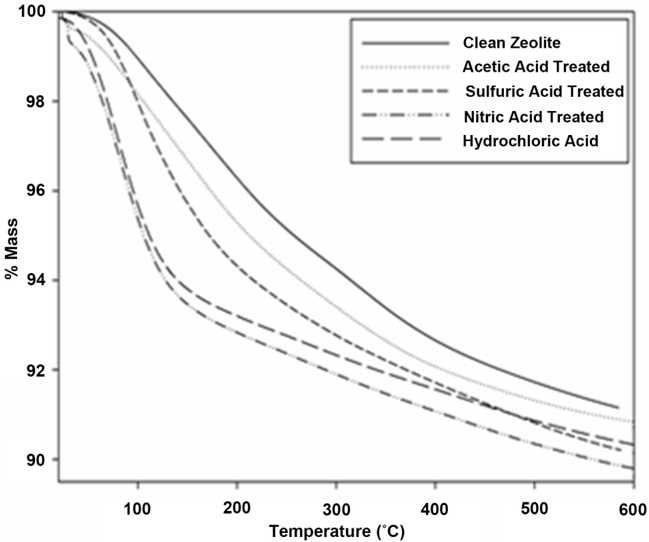
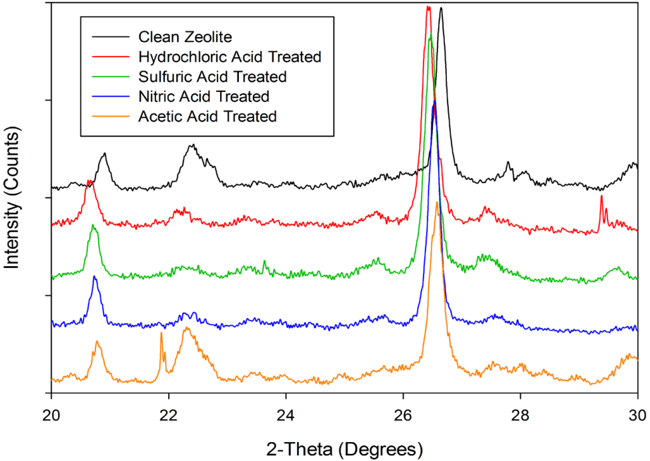
In this study, a comparison of a variety of existing acid treatment methods for zeolite based on their abilities to modify physical properties of the particles is performed. Evaluation of the effects that four different acids have on numerous properties of the zeolites including surface area, pore size, pore volume, thermal stability, IR spectra, crystallinity, and morphology is conducted and compared with the reference untreated zeolite. Furthermore, all five zeolite particles are evaluated for their adsorption properties in column mode experiments. The importance of the examined features is discussed. The results obtained in this work are compared to similar studies to examine which conditions greatly influence the zeolite modifications.
Overview
The claims and statistics of this paper haven’t been checked yet.
Free: it reads the open-access text and checks the first 5 claims that cite a source we can check. Create a free account to check every claim.
Integrity signals
Registry
Cites
Statistics
Figures
Verification
Claims the paper makes
The claims and statistics of this paper haven’t been checked yet.
Free: it reads the open-access text and checks the first 5 claims that cite a source we can check. Create a free account to check every claim.
Claims other papers make about this one
Each is checked against this paper’s own text: does it say what the citing paper says it does?
In the citing paper
“The main aim of these treatments is to remove the aluminum from the aluminosilicate framework thus increasing the Si/Al ratio and, consequently, creating more void spaces (pores) within the material, increasing the surface area and improving the adsorption efficiency”
From Fundamental properties and sustainable applications of the natural zeolite clinoptilolite (2024) · cites this paper as Silva et al. 2019
Self-check
Percentages, sums and reported differences re-computed from the paper’s own numbers.
The self-check needs the paper’s full text.
Citations
Cites
Natural zeolites as effective adsorbents in water and wastewater treatment
Wang, S., & Peng, Y. (2010) · Chemical Engineering Journal · doi:10.1016/j.cej.2009.10.029 · Cited by 2,441
Sprynskyy, M., Buszewski, B., Terzyk, A. P., & Namieśnik, J. (2006) · Journal of Colloid and Interface Science · doi:10.1016/j.jcis.2006.07.068 · Cited by 660 · cited 1×
“The surface area of untreated clinoptilolite in one study was identical to the surface area of our untreated clinoptilolite [16].”
BackgroundFavvas, E. P., Tsanaktsidis, C. G., Sapalidis, A. A., Tzilantonis, G. T., Papageorgiou, S. K., & Mitropoulos, A. C. (2016) · Microporous and Mesoporous Materials · doi:10.1016/j.micromeso.2016.01.021 · Cited by 127 · cited 1×
“Data obtained from FTIR shown in Figure 2 is very similar to spectra obtained for clinoptilolite in other studies [19] [20].”
Result
Research works printed but not linked: 23
- Koshy, N. and Singh, D.N. (2016) Fly Ash Zeolites for Water Treatment Applica- tions. Journal of Environmental Chemical Engineering, 4, 1460-1472. https://doi.org/10.1016/j.jece.2016.02.002 · DOI · Paper page
- Mohau Moshoeshoe, M.S.N.-T. and Obuseng, V. (2017) A Review of the Chemistry, Structure, Properties and Applications of Zeolites. American Journal of Materials Science, 7, 196-221.
- Widiastuti, N., et al. (2008) The Potential Application of Natural Zeolite for Grey- water Treatment. Desalination, 218, 271-280. https://doi.org/10.1016/j.desal.2007.02.022 · DOI
- Adinehvand, J., Shokuhi Rad, A. and Tehrani, A.S. (2016) Acid-Treated Zeolite (Clinoptilolite) and Its Potential to Zinc Removal from Water Sample. International Journal of Environmental Science and Technology, 13, 2705-2712. https://doi.org/10.1007/s13762-016-1105-1 · doi:10.1007/s13762-016-1105-1
- Ates, A. and Hardacre, C. (2012) The Effect of Various Treatment Conditions on Natural Zeolites: Ion Exchange, Acidic, Thermal and Steam Treatments. Journal of Colloid and Interface Science, 372, 130-140. https://doi.org/10.1016/j.jcis.2012.01.017 · DOI
- Rivera, A., et al. (2013) Natural and Sodium Clinoptilolites Submitted to Acid Treatments: Experimental and Theoretical Studies. The Journal of Physical Chemi- stry C, 117, 4079-4088. https://doi.org/10.1021/jp3115447 · DOI
- Valdiviés-Cruz, K., Lam, A. and Zicovich-Wilson, C.M. (2017) Full Mechanism of Zeolite Dealumination in Aqueous Strong Acid Medium: Ab Initio Periodic Study on H-Clinoptilolite. The Journal of Physical Chemistry C, 121, 2652-2660. https://doi.org/10.1021/acs.jpcc.6b09794 · DOI
- Pandaa, A.K., Mishra, B.G., Mishra, D.K. and Singh, R.K. (2010) Effect of Sulphuric Acid Treatment on the Physio-Chemical Characteristics of Kaolin Clay. Colloids and Surfaces A: Physiochemical Engineering Aspects, 363, 98-104. · DOI
- Apelian, M.R., et al. (1996) Dealumination of Zeolite β via Dicarboxylic Acid Treatment. The Journal of Physical Chemistry, 100, 16577-16583. https://doi.org/10.1021/jp960376s · DOI · Paper page
- Li, X., et al. (2014) Combined Modification of Ultra-Stable Y Zeolites via Citric Acid and Phosphoric Acid. Applied Petrochemical Research, 4, 343-349. https://doi.org/10.1007/s13203-014-0070-1 · doi:10.1007/s13203-014-0070-1
- Matias, P., et al. (2009) Effect of Dealumination by Acid Treatment of a HMCM-22 Zeolite on the Acidity and Activity of the Pore Systems. Applied Catalysis A: Gen- eral, 365, 207-213. https://doi.org/10.1016/j.apcata.2009.06.014 · DOI
- Lutz, W. (2014) Zeolite Y: Synthesis, Modification, and Properties-A Case Revi- sited. Advances in Materials Science and Engineering, 2014, Article ID: 724248. · DOI · Paper page
- Burris, L.E. and Juenger, M.C.G. (2016) The Effect of Acid Treatment on the Reac- tivity of Natural Zeolites Used as Supplementary Cementitious Materials. Cement and Concrete Research, 79, 185-193. https://doi.org/10.1016/j.cemconres.2015.08.007 · DOI
- Plana-Pallejà, J., et al. (2016) Effect of Zeolite Acidity and Mesoporosity on the Ac- tivity of Fischer-Tropsch Fe/ZSM-5 Bifunctional Catalysts. Applied Catalysis A: General, 515, 126-135. https://doi.org/10.1016/j.apcata.2016.02.004 · doi:10.1016/j.apcata.2016.02.004
- Sing, K.S.W. and Williams, R.T. (2004) Physisorption Hysteresis Loops and the Characterization of Nanoporous Materials. Adsorption Science & Technology, 22, 773-782. https://doi.org/10.1260/0263617053499032 · DOI · Paper page
- Fan, Y., et al. (2006) Acidity Adjustment of HZSM-5 Zeolites by Dealumination and Realumination with Steaming and Citric Acid Treatments. The Journal of Physical Chemistry B, 110, 15411-15416. https://doi.org/10.1021/jp0607566 · doi:10.1021/jp0607566
- Baghbanian, S.M., Rezaei, N. and Tashakkorian, H. (2013) Nanozeolite Clinoptilo- lite as a Highly Efficient Heterogeneous Catalyst for the Synthesis of Various M. Silva et al. DOI: 10.4236/msce.2019.72003 37 Journal of Materials Science and Chemical Engineering 2-Amino-4H-Chromene Derivatives in Aqueous Media. Green Chemistry, 15, 3446-3458. https://doi.org/10.1039/c3gc41302k · DOI
- Coloma, A., et al. (2014) Development of an Active Film with Natural Zeolite as Ethylene Scavenger. Journal of the Chilean Chemical Society, 59, 2409-2414. https://doi.org/10.4067/S0717-97072014000200003 · DOI
- Vasylechko, V.O., et al. (1999) Adsorption of Copper on Transcarpathian Clinopti- lolite. Adsorption Science & Technology, 17, 125-134. https://doi.org/10.1177/026361749901700206 · DOI
- Vasylechko, V.O., et al. (2015) A Solid-Phase Extraction Method Using Transcar- pathian Clinoptilolite for Preconcentration of Trace Amounts of Terbium in Water Samples. Chemistry Central Journal, 9, 45-45. https://doi.org/10.1186/s13065-015-0118-z · DOI
- Rakitskaya, T.L., et al. (2017) Acid-Modified Clinoptilolite as a Support for Palla- dium-Copper Complexes Catalyzing Carbon Monoxide Oxidation with Air Oxygen. Chemistry Central Journal, 11, 28. https://doi.org/10.1186/s13065-017-0256-6 · DOI
- Tsiuri Ramishvili, V.T., Chedia, R., Sanaia, E., Gabunia, V. and Kokiashvili, N. (2017) Preparation of Ultradispersed Crystallites of Modified Natural Clinoptilolite with the Use of Ultrasound and Its Application as a Catalyst in the Synthesis of Methyl Salicylate. American Journal of Nano Research and Applications, 5, 26-32.
- Bieseki, L., et al. (2013) Acid Treatments of Montmorillonite-Rich Clay for Fe Re- moval Using a Factorial Design Method. Materials Research, 16, 1122-1127. https://doi.org/10.1590/S1516-14392013005000114 · doi:10.1590/s1516-14392013005000114
Cited by
Fundamental properties and sustainable applications of the natural zeolite clinoptilolite
Grifasi, N., Ziantoni, B., Fino, D., & Piumetti, M. (2024) · Environmental Science and Pollution Research · doi:10.1007/s11356-024-33656-5 · Cited by 88
Metadata
- Authors
- Silva, M., Lecus, A., Lin, Y., & Corrao, J.
- Venue
- Journal of Materials Science and Chemical Engineering
- Publisher
- Scientific Research Publishing, Inc.
- Published
- 2019
- Volume
- 07
- Issue
- 02
- Pages
- 26-37
- ISSN
- 2327-6045
- 2327-6053
- Cited by
- 12
- References
- 3
About these checks
Registry, retraction, Cites and statistics results are computed, not judged, with one exception: a printed reference that no index lists is read once by a model before it counts as a citation error. Claims are extracted by a model and kept only when their quote appears verbatim in the text; each cited source is then checked, with a model’s help, for whether it says what the claim relies on. Those verdicts can be wrong — read the claim’s quote and the cited source before relying on one.
Statistics and arithmetic are recomputed, not judged.
Confidence bands are shown only for fields calibrated on our annotated test set. None is calibrated yet, so no band is shown.
What counts as a claim ›How we measure confidence ›How we check this ›
Are you an author, or do you see a problem with this page? Request a review
How to cite
Cite CoChat for the checks on this page, and the paper for its own findings.
- This page
- CoChat. (2026). Citation check: Tailoring Natural Zeolites by Acid Treatments. https://app.cochat.ai/papers/10.4236/msce.2019.72003
- The paper
- Silva, M., Lecus, A., Lin, Y., & Corrao, J. (2019). Tailoring Natural Zeolites by Acid Treatments. Journal of Materials Science and Chemical Engineering. https://doi.org/10.4236/msce.2019.72003
Data sources
Bibliographic data: Semantic Scholar, OpenAlex, Crossref.
Contains information from the Semantic Scholar Academic Graph Datasets, made available under the ODC Attribution License (ODC-BY 1.0).
Semantic Scholar’s data is described in: Kinney, R., et al. (2023). The Semantic Scholar Open Data Platform. arXiv:2301.10140.
