

The DOI matches its Crossref record; 18 of the 18 references it cites were found in a registry or an index.
Estimating Cognitive Load in a Mobile Personal Health Record Application: A Cognitive Task Analysis Approach
Open accessAbstract
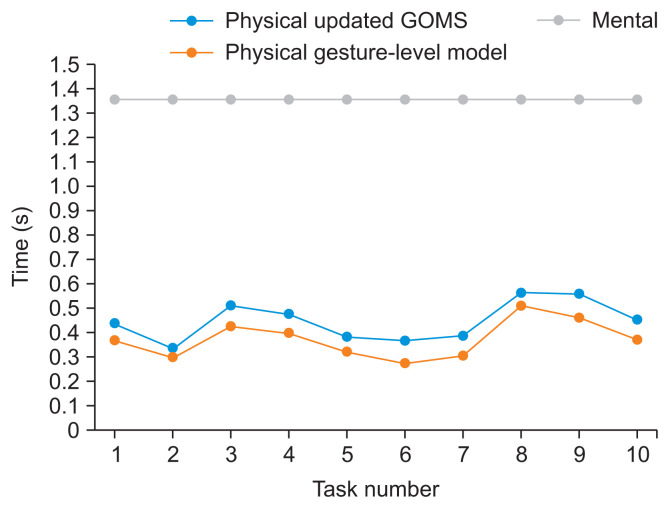
Objectives: Mobile health applications that are designed without considering usability criteria can lead to cognitive overload, resulting in the rejection of these apps. To avoid this problem, the user interface of mobile health applications should be evaluated for cognitive load. This evaluation can contribute to the improvement of the user interface and help prevent cognitive overload for the user.Methods: In this study, we evaluated a mobile personal health records application using the cognitive task analysis method, specifically the goals, operators, methods, and selection rules (GOMS) approach, along with the related updated GOMS model and gesture-level model techniques. The GOMS method allowed us to determine the steps of the tasks and categorize them as physical or cognitive tasks. We then estimated the completion times of these tasks using the updated GOMS model and gesture-level model.Results: All 10 identified tasks were split into 398 steps consisting of mental and physical operators. The time to complete all the tasks was 5.70 minutes and 5.45 minutes according to the updated GOMS model and gesture-level model, respectively. Mental operators covered 73% of the total fulfillment time of the tasks according to the updated GOMS model and 76% according to the gesture-level model. The inter-rater reliability analysis yielded an average of 0.80, indicating good reliability for the evaluation method.Conclusions: The majority of the task execution times comprised mental operators, suggesting that the cognitive load on users is high. To enhance the application's implementation, the number of mental operators should be reduced.
Overview
The claims and statistics of this paper haven’t been checked yet.
Run the check — free, no account needed. It reads the open-access text and checks the sources it cites.
Integrity signals
Registry
Cites
Statistics
Figures
Verification
Claims the paper makes
The claims and statistics of this paper haven’t been checked yet.
Run the check — free, no account needed. It reads the open-access text and checks the sources it cites.
Self-check
Percentages, sums and reported differences re-computed from the paper’s own numbers.
The self-check needs the paper’s full text.
Citations
Cites
Working Memory: Theories, Models, and Controversies
Baddeley, A. (2012) · Annual Review of Psychology · doi:10.1146/annurev-psych-120710-100422 · Cited by 4,271
The keystroke-level model for user performance time with interactive systems
Card, S. K., Moran, T. P., & Newell, A. (1980) · Communications of the ACM · doi:10.1145/358886.358895 · Cited by 1,174
Militello, L. G., & Hutton, R. J. B. (1998) · Ergonomics · doi:10.1080/001401398186108 · Cited by 607
Using GOMS for user interface design and evaluation
John, B. E., & Kieras, D. E. (1996) · ACM Transactions on Computer-Human Interaction · doi:10.1145/235833.236050 · Cited by 397
The Missing Link: Bridging The Patient–Provider Health Information Gap
Tang, P. C., & Lansky, D. J. (2005) · Health Affairs · doi:10.1377/hlthaff.24.5.1290 · Cited by 242
Assessing performance of an Electronic Health Record (EHR) using Cognitive Task Analysis
Saitwal, H., Feng, X., Walji, M. F., Patel, V. L., & Zhang, J. (2010) · International Journal of Medical Informatics · doi:10.1016/j.ijmedinf.2010.04.001 · Cited by 98
Barriers to the use of personal health records by patients: a structured review
Showell, C. (2017) · PeerJ · doi:10.7717/peerj.3268 · Cited by 72
4. Some guidelines for conducting a cognitive task analysis
Klein, G. L., & Militello, L. G. (2004) · Advances in human performance and cognitive engineering research · doi:10.1016/s1479-3601(01)01006-2 · Cited by 69
A Mobile App (BEDSide Mobility) to Support Nurses’ Tasks at the Patient's Bedside: Usability Study
Ehrler, F., Weinhold, T., Joe, J., Lovis, C., & Blondon, K. (2018) · JMIR mhealth and uhealth · doi:10.2196/mhealth.9079 · Cited by 39
Extended KLM for mobile phone interaction
Li, H., Liu, Y., Liu, J., Wang, X., Li, Y., & Rau, P. P. (2010) · CHI Conference Extended Abstracts on Human Factors in Computing Systems (CHI EA) · doi:10.1145/1753846.1754011 · Cited by 22
Research works printed but not linked: 1
- Tracy, Measuring cognitive load to test the usability of web sites, 256
Cited by
Sorted by citations
Shen, Y., Wang, S., Shen, Y., Tan, S., Dong, Y., Qin, W., & Zhuang, Y. (2024) · Healthcare · doi:10.3390/healthcare12131310 · Cited by 23
A fuzzy Kano model proposal for sustainable product design: Mobile application feature analysis
Karakurt, N. F., & Çebi, S. (2025) · Applied Soft Computing · doi:10.1016/j.asoc.2025.112824 · Cited by 18
Wen, Z., Yang, J., Sun, B., & Liu, Y. (2025) · Symmetry · doi:10.3390/sym17040502 · Cited by 14
Situational Awareness Classification Based on EEG Signals and Spiking Neural Network
Hadad, Y., Bensimon, M., Ben‐Shimol, Y., & Greenberg, S. (2024) · Applied Sciences · doi:10.3390/app14198911 · Cited by 7
Erjavec, K., & Kotnik, P. (2024) · Pielegniarstwo XXI wieku / Nursing in the 21st Century · doi:10.2478/pielxxiw-2024-0026 · Cited by 3
A hierarchical framework to evaluate the usability of smartphone health applications
Siddique, A., Sajjad, Q., Algamdi, S. A., Shahzad, B., & Hussien, J. M. (2026) · Scientific Reports · doi:10.1038/s41598-025-32910-1 · Cited by 2
Hartmann, E. M., Küper, A., Swoboda, J., Beckmann, C. L., Lodde, G. C., Livingstone, E., Schadendorf, D., & Sachweh, S. (2026) · JMIR Cancer · doi:10.2196/79294 · Cited by 1
Shimelash, N., Rutunda, S., Menon, V., Emmanuel-Fabula, M., Uwimbabazi, A., Rugege, C., Nshimiyimana, C., Rwema, I. S., Kandekwe, M., Berhe, D. F., et al. (2026) · medRxiv · doi:10.64898/2026.02.16.26346409 · Cited by 1
Coelho, V. A. C. (2024) · Portuguese National Funding Agency for Science, Research and Technology (RCAAP Project by FCT)
Nathanael, M., & Wahidiyat, M. P. (2025) · IEEE International Conference on Computing, Engineering and Design (ICCED) · doi:10.1109/icced68324.2025.11325076
SISTEMAS DE HISTORIA CLÍNICA ELECTRÓNICA Y LA PRÁCTICA PROFESIONAL DE ENFERMERÍA
Alfaro, E. F. R., Pompa, C. A. T., Campos, L. B. C., Alfaro, C. E. R., & Saavedra, E. F. C. (2026) · doi:10.56041/9786583866141
An, H.-K., Kim, M.-K., Choi, B.-C., & Seo, Y.-W. (2026) · Journal of Next-generation Convergence Information Services Technology · doi:10.29056/jncist.2026.04.02
Jeong, H., Cheong, Y. J., Ro, J., Cha, J., Choi, J., & Jung, M. (2026) · JMIR Serious Games · doi:10.2196/93468
From Alarm To Action: Deriving Design Knowledge For Epilepsy Monitoring Systems
Irnich, M., Hammer, J., Schneider, L., & Teuteberg, F. (2026) · Journal of the Association for Information Systems
Mok, K. T., Chan, D., Ong, C., Chiew, M. H., Chua, M. C., Ngien, A., Michael, N., Gupta, V., Chan, J. K. Y., Yap, F., et al. (2026) · Frontiers in Digital Health · doi:10.3389/fdgth.2026.1869210
Mo, C., Liamthaisong, K., & Polpinij, J. (2026) · Healthcare · doi:10.3390/healthcare14121785
Applying Cognitive Task Analysis to Pharmacy Practice and Research
Iqbal, A., Barber, T., & Gülpınar, G. (2026) · Elsevier eBooks · doi:10.1016/b978-0-443-26472-6.00105-4
Jull, D. (2026) · Carleton University's Institutional Repository (MacOdrum Library, Carleton University) · doi:10.22215/etd/2026-17118
Huang, K.-L., Sun, H.-J., & Lyu, X. (2026) · International Journal of Human-Computer Interaction · doi:10.1080/10447318.2026.2719174
Prototipagem de um aplicativo informacional sobre dengue sob a ótica da experiência de usuário
Geratti, L. I. (2026) · DSpace (Federal University of Santa Catarina)
Jull, D., Fournier, H., & Rajabiyazdi, F. (2026) · doi:10.2196/preprints.112398
Nintendo Switch and Steam Operating System User Interface Comparison Using Keystroke-Level Model
Sudirman, D. Z., & Athugala, R. (2026) · International Conference on Information Management and Technology (ICIMTech) · doi:10.1109/icimtech202671078.2026.11699032
Tasril, V., Rizka, A., Sulistianingsih, I., Riandari, F., & Ginting, R. (2026) · Jurnal Minfo Polgan · doi:10.33395/jmp.v15i3.16956
Metadata
- Authors
- Zayim, N., Yıldız, H., & Yüce, Y. K.
- Affiliations
- Akdeniz University (TR)
- Corresponding author
- Yıldız, Hasibe
- Venue
- Healthcare Informatics Research
- Published
- 2023-10-31
- Volume
- 29
- Issue
- 4
- Pages
- 367-376
- ISSN
- 2093-3681 (ISSN-L)
- 2093-369X
- PMC
- PMC10651402
- OpenAlex
- W4388478682
- Cited by
- 16
- References
- 18
- Citations by year
- 2026: 10 · 2025: 3 · 2024: 3
- FWCI
- 2.77
- Type
- journal article
- Language
- en
- Open access
- gold
- doi.org
- Licence
- Locations
- Healthcare Informatics Research (publishedVersion, cc-by-nc)
- PubMed Central (publishedVersion, cc-by-nc)
- PubMed (publishedVersion)
- Alanya Alaaddin Keykubat University Institutional Repository (submittedVersion, cc-by-nc-nd)
- DOAJ (DOAJ: Directory of Open Access Journals) (submittedVersion, cc-by-sa)
- Funders
- Akdeniz University Scientific Research Project Administration Division (5416)
- Topics
- Physical Sciences › Computer Science › Human-Computer Interaction › Usability and User Interface Design
- Health Sciences › Health Professions › General Health Professions › Mobile Health and mHealth Applications
- Health Sciences › Health Professions › Health Information Management › Electronic Health Records Systems
- Keywords
- cognitive load, mobile health apps, personal health records, GOMS model, usability evaluation, user interface design, task completion time, inter-rater reliability
About these checks
Registry, retraction, Cites and statistics results are computed, not judged, with one exception: a printed reference that no index lists is read once by a model before it counts as a citation error. Claims are extracted by a model and kept only when their quote appears verbatim in the text; each cited source is then checked, with a model’s help, for whether it says what the claim relies on. Those verdicts can be wrong — read the claim’s quote and the cited source before relying on one.
Statistics and arithmetic are recomputed, not judged.
Confidence bands are shown only for fields calibrated on our annotated test set. None is calibrated yet, so no band is shown.
What counts as a claim ›How we measure confidence ›How we check this ›
Are you an author, or do you see a problem with this page? Request a review
