

Efficacy and Safety of Letrozole in the Management of Constitutional Delay in Growth and Puberty: A Systematic Review and Meta-analysis
Open accessThe DOI matches its Crossref record; 24 of the 24 references it cites were found in a registry or an index; none of the 14 sources its claims cite is checked for support yet.
Abstract
No meta-analysis is available which has analysed the role of letrozole in constitutional delay in growth and puberty (CDGP). Electronic databases were searched for randomized controlled trials (RCTs) involving children with CDGP receiving letrozole. Primary outcomes were changes in predicted adult height (PAH) and pubertal progression. Secondary outcomes were alterations in bone age (BA), hormonal markers of puberty, bone mineral density and side-effects. One hundred-thirty articles were reviewed, from which seven RCTs which fulfilled all criteria were analysed. Letrozole was superior to placebo [mean difference (MD) 4.63 cm (95% confidence interval (CI): 3.90-5.36); p<0.01; I2=0%] but not testosterone [MD: 2.21 cm (95% CI: -1.71-6.16); p=0.27; I2=98%] with regards to improvement in PAH after 12-months use. Letrozole was superior to both placebo [MD: 4.80 mL (95% CI: 0.57-9.03); p=0.03] and testosterone [MD: 3.36 mL (95% CI: 0.58-6.75); p=0.02; I2=0%] with regards to improvement in testicular volume after 12-months use. Letrozole tended to be superior to testosterone [MD: -0.84 years (95% CI: 2.83-8.18); p=0.06; I2=0%] with regards to slowing in BA progression after 12-months use. Serum luteinizing hormone, follicle stimulating hormone, testosterone and inhibin-B were significantly higher after 6-months letrozole use compared to active as well as passive controls. No increased occurrence of adverse events, including spinal deformities, were noted with letrozole. Letrozole is safe and effective for improving height and pubertal outcomes in CDGP, and is better than testosterone with regards to improvement in testicular volume and may be better at delaying bone-age progression.
Overview
CoChat Summary
TL;DR
This first meta-analysis of seven RCTs found letrozole improved predicted adult height and testicular volume in children with constitutional delay in growth and puberty, with greater benefit versus placebo and comparable height but better testicular volume versus testosterone. Adverse events, vertebral deformities, and BMD changes versus placebo were not significantly increased, though evidence is limited by small trials and heterogeneity.
Key findings
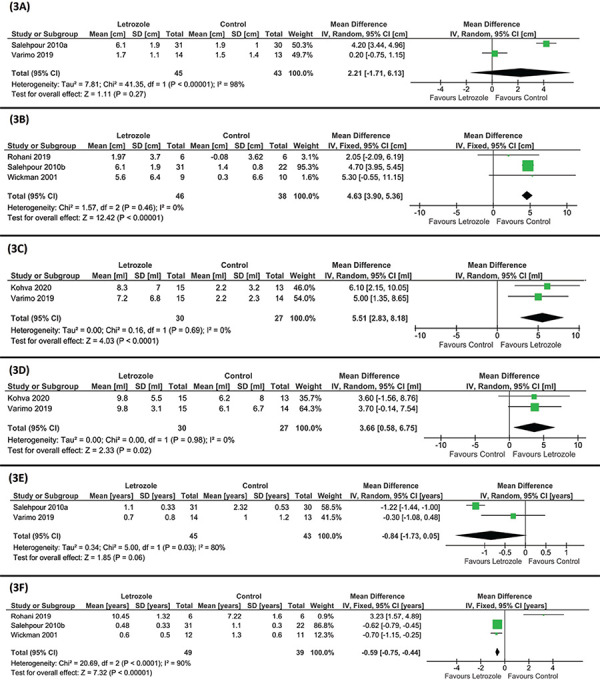
- Predicted adult height after ≥12 months: letrozole was superior to placebo [MD 4.63 cm (95% CI 3.90–5.36); p<0.01; I²=0%; high certainty] but not testosterone [MD 2.21 cm (95% CI −1.71–6.16); p=0.27; I²=98%; moderate certainty]. Height SDS improved versus placebo [MD +0.63 (95% CI 0.52–0.74); p<0.01; I²=0%] but not testosterone [MD 0.00 (95% CI −0.16–0.16); p=1.00].
- Testicular volume: letrozole was superior to testosterone at 6 months [MD 5.51 mL (95% CI 2.83–8.18); p<0.01; I²=0%] and 12 months [MD 3.36 mL (95% CI 0.58–6.75); p=0.02; I²=0%], and superior to placebo at 12 months [MD 4.80 mL (95% CI 0.57–9.03); p=0.03] but not at 18 months [MD 1.90 mL (95% CI −2.61–6.41); p=0.41].
- Bone age: versus testosterone, letrozole showed slower progression approaching significance [MD −0.84 years (95% CI 2.83–8.18); p=0.06; I²=0%; low certainty]; versus placebo, progression was similar [MD 0.06 years (95% CI −0.88–0.99); p=0.91; I²=90%]. Serum LH, FSH, testosterone, and inhibin-B were significantly higher after 6 months of letrozole versus active and passive controls.
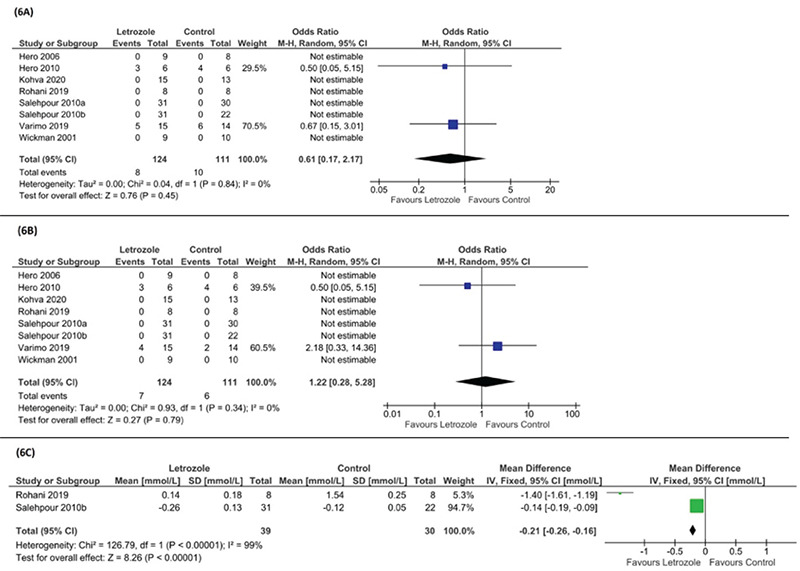
- Safety: no significant difference in total adverse events [RR 0.61 (95% CI 0.17–2.17); p=0.45] or severe adverse events [RR 1.22 (95% CI 0.28–5.28); p=0.79]; vertebral deformity [RR 0.28 (95% CI 0.01–8.42); p=0.47] and end-plate deformity [RR 0.50 (95% CI 0.05–5.15); p=0.56] were not significantly different.
Methods
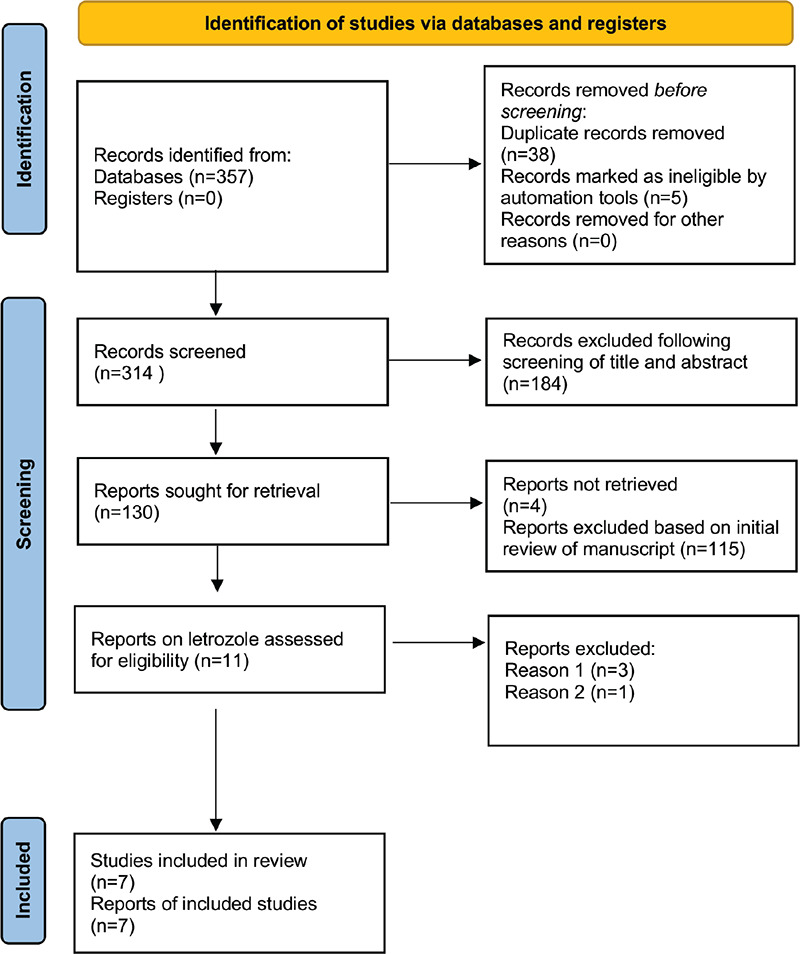
- Systematic review and meta-analysis of RCTs, registered in PROSPERO (CRD42021250345), reported per PRISMA and Cochrane Handbook; databases searched up to March 2021 included Medline/PubMed, Embase, CENTRAL, ctri.nic.in, clinicaltrials.gov, Global Health, and Google Scholar. From 357 articles found, 130 were reviewed in detail and 7 RCTs were included.
- Participants were children with CDGP; intervention was letrozole (all studies used 2.5 mg/day per discussion); controls were placebo/nothing (passive/placebo control group) or active comparator such as testosterone or oxandrolone (active control group). Primary outcomes were changes in predicted adult height and pubertal progression (testicular volume); secondary outcomes included height SDS, final height, bone age, hormonal markers, bone mineral density, body composition, and side effects.
- Data were pooled using a random-effects model; continuous outcomes were expressed as mean differences, dichotomous outcomes as risk ratios, and adverse events as post-treatment absolute risk differences. Analyses used RevMan 5.3, heterogeneity was assessed with chi² and I², risk of bias was assessed, GRADE was used for certainty of evidence, and publication bias was assessed by funnel plot.
Limitations
- The paper does not include a dedicated limitations section. Limitations evident from the text include the small number of included RCTs (7) and small samples for several analyses (e.g., 88 children for PAH versus testosterone, 84 for PAH versus placebo, 57 for testicular volume versus testosterone, 19 for testicular volume versus placebo, 17 for some LH/FSH analyses, and 235 for safety), with some outcomes derived from single studies.
- Considerable heterogeneity was present for some outcomes: PAH versus testosterone I²=98%, bone age versus placebo I²=90%, testosterone versus placebo I²=97%, and HDL-C I²=99%; certainty of evidence was moderate or low for several outcomes.
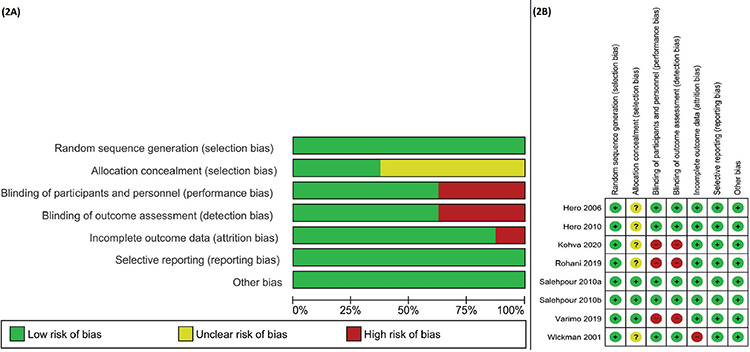
- Risk of bias was low for allocation concealment in 2/7 studies (28.57%), for performance/detection bias in 4/7 (57.14%), and for attrition bias in 6/7 (85.71%). The paper states that the mild, statistically non-significant HDL-C decline and its impact on long-term cardiovascular outcomes need further evaluation.
Model-written summary. Check it against the paper before relying on it.
Integrity signals
Registry
Cites
Statistics
Figures
Verification
Claims the paper makes
0 Valid · 0 Not valid · 21 Not checked · 43 Own results and interpretations
None of the sources cited for this claim have been checked yet.
In the paper
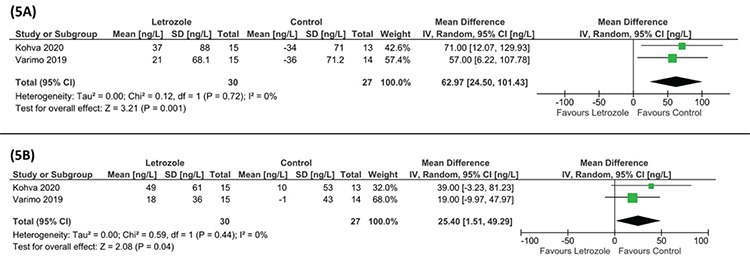
“Serum IGF-1 was significantly lower after 6 months [MD: -11.30 nmol/L (95% CI: -19.39 – -3.21); p<0.01], and 12 months [MD: -9.00 nmol/L (95% CI: -14.52 – -3.48); p<0.01] of treatment with letrozole, when compared to PCG.”
§ Efficacy and Safety of Letrozole in the Management of Constitutional Delay in Growth and Puberty: A Systematic Review and Meta-analysis > Insulin Like Growth Factor-1
plainstates a causen = 19 ·- Asserted: passes — The authors put it forward as true.
- Checkable: passes — It can be checked against evidence.
- Load-bearing: unclear — It is unclear whether the paper’s conclusions depend on it.
- Based: passes — The paper gives a reason why it holds.
A result the paper reports from its own data — it cites no other source for it, so there is none to check. The quote shows it is in the paper.
In the paper
“but not after 18 months of therapy [MD: 1.90 mL (95% CI: -2.61-6.41); p=0.41], when compared to those receiving placebo.”
§ Efficacy and Safety of Letrozole in the Management of Constitutional Delay in Growth and Puberty: A Systematic Review and Meta-analysis > Testicular Volume
plainn = 19- Asserted: passes — The authors put it forward as true.
- Checkable: passes — It can be checked against evidence.
- Load-bearing: passes — The paper’s conclusions depend on it.
- Based: passes — The paper gives a reason why it holds.
None of the sources cited for this claim have been checked yet.
In the paper
“and femoral neck BMD Z-score [MD: -2.2 (95% CI: -2.55 – -1.85); p<0.01; n=61] was noted in children receiving letrozole as compared to those receiving testosterone in the control group (ACG).”
§ Efficacy and Safety of Letrozole in the Management of Constitutional Delay in Growth and Puberty: A Systematic Review and Meta-analysis > Safety
plainstates a causen = 61 ·- Asserted: passes — The authors put it forward as true.
- Checkable: passes — It can be checked against evidence.
- Load-bearing: unclear — It is unclear whether the paper’s conclusions depend on it.
- Based: passes — The paper gives a reason why it holds.
A result the paper reports from its own data — it cites no other source for it, so there is none to check. The quote shows it is in the paper.
In the paper
“A small decline in high density lipoprotein-cholesterol (HDL-C) was noted in children receiving letrozole as compared to those receiving placebo in a cohort of 69 patients from two studies [MD: -0.77 mmol/L (95% CI: -2.00-0.47); p=0.22; I2=99% (considerable heterogeneity); Figure 6c], which was however statistically not significant.”
§ Efficacy and Safety of Letrozole in the Management of Constitutional Delay in Growth and Puberty: A Systematic Review and Meta-analysis > Safety
plainn = 69- Asserted: passes — The authors put it forward as true.
- Checkable: passes — It can be checked against evidence.
- Load-bearing: unclear — It is unclear whether the paper’s conclusions depend on it.
- Based: passes — The paper gives a reason why it holds.
A result the paper reports from its own data — it cites no other source for it, so there is none to check. The quote shows it is in the paper.
In the paper
“Serum IGF-1 was not significantly different after 12-24 months [MD: -1.24 nmol/L (95% CI: -8.70-6.22); p=0.74; I2=0% (low heterogeneity)] of treatment with letrozole, when compared to ACG.”
§ Efficacy and Safety of Letrozole in the Management of Constitutional Delay in Growth and Puberty: A Systematic Review and Meta-analysis > Insulin Like Growth Factor-1
plainn = 118- Asserted: passes — The authors put it forward as true.
- Checkable: passes — It can be checked against evidence.
- Load-bearing: unclear — It is unclear whether the paper’s conclusions depend on it.
- Based: passes — The paper gives a reason why it holds.
33 more claims
Create a free account to see all 64 claims and to verify the 14 references still open.
- It may state two separate claims as one. 16
- The quote only partly states this claim. 1
- Probably not a substantial claim. 11
Claims other papers make about this one
Each is checked against this paper’s own text: does it say what the citing paper says it does?
In the citing paper
“One recent systematic review focused mainly on formulation comparisons, while a separate meta-analysis of CDGP centered on letrozole and treated testosterone largely as an active comparator [22,23].”
From Testosterone therapy in boys with constitutional delay of growth and puberty: a PubMed-based systematic review and exploratory meta-analysis (2026) · cites this paper as [22]
In the citing paper
“Recent evidence syntheses have highlighted the same problem from a different angle: despite widespread clinical use, the testosterone evidence base in adolescent boys remains fragmented and often has a high or unclear risk of bias.”
From Testosterone therapy in boys with constitutional delay of growth and puberty: a PubMed-based systematic review and exploratory meta-analysis (2026) · cites this paper as [22]
In the citing paper
“This mechanistic framing helps explain why letrozole and testosterone can produce comparable short-term pubertal progression in some randomized trials [20], whereas letrozole tends to produce a greater testicular volume response because it preserves the gonadotropin drive [22].”
From Testosterone therapy in boys with constitutional delay of growth and puberty: a PubMed-based systematic review and exploratory meta-analysis (2026) · cites this paper as [22]
In the citing paper
“Letrozole acts by blocking the aromatase-mediated conversion of testosterone to estradiol, which has 2 simultaneous consequences: (1) endogenous serum testosterone rises approximately 2–3-fold due to reduced negative feedback at the hypothalamic-pituitary level and (2) serum estradiol falls.”
From Testosterone therapy in boys with constitutional delay of growth and puberty: a PubMed-based systematic review and exploratory meta-analysis (2026) · cites this paper as [22]
Statistics that don’t add up
Each reported p-value recomputed from its test statistic and degrees of freedom, each partial η² from its F, and each ratio, mean difference or B printed with a p checked against its own confidence interval.
Rated minor: it would not touch a result — a value no result rests on, a p-value that stays on the same side of the significance level, or a conflict that is clerical, resolved elsewhere in the paper, or outside its own findings.
In the paper
“MD: -0.84 years (95% CI: 2.83-8.18); p=0.06”
§ Efficacy and Safety of Letrozole in the Management of Constitutional Delay in Growth and Puberty: A Systematic Review and Meta-analysis > Abstract
Self-check
Percentages, sums and reported differences re-computed from the paper’s own numbers.
Each contradiction between two passages listed here was confirmed by an independent check.
Rated major: it would touch a result — a value a result rests on, reported and recomputed p-values on opposite sides of the significance level, two passages that conflict with no sign which is right, or a cited work retracted before this paper was published.
In the paper
“MD: -0.84 years (95% CI: 2.83-8.18); p=0.06”
§ Efficacy and Safety of Letrozole in the Management of Constitutional Delay in Growth and Puberty: A Systematic Review and Meta-analysis > Abstract
Reported -0.84 · recomputed 5.505
Rated major: it would touch a result — a value a result rests on, reported and recomputed p-values on opposite sides of the significance level, two passages that conflict with no sign which is right, or a cited work retracted before this paper was published.
In the paper
§ Efficacy and Safety of Letrozole in the Management of Constitutional Delay in Growth and Puberty: A Systematic Review and Meta-analysis > Discussion
“Use of letrozole in CDGP was associated with a slower progression in BA when compared to those receiving placebo or testosterone.”
§ Efficacy and Safety of Letrozole in the Management of Constitutional Delay in Growth and Puberty: A Systematic Review and Meta-analysis > Bone Age
“When compared to PCG, children receiving letrozole has similar progression in BA [MD: 0.06 years (95% CI: -0.88-0.99); p=0.91; I2=90% (considerable heterogeneity); Figure 3f].”
Rated minor: it would not touch a result — a value no result rests on, a p-value that stays on the same side of the significance level, or a conflict that is clerical, resolved elsewhere in the paper, or outside its own findings.
In the paper
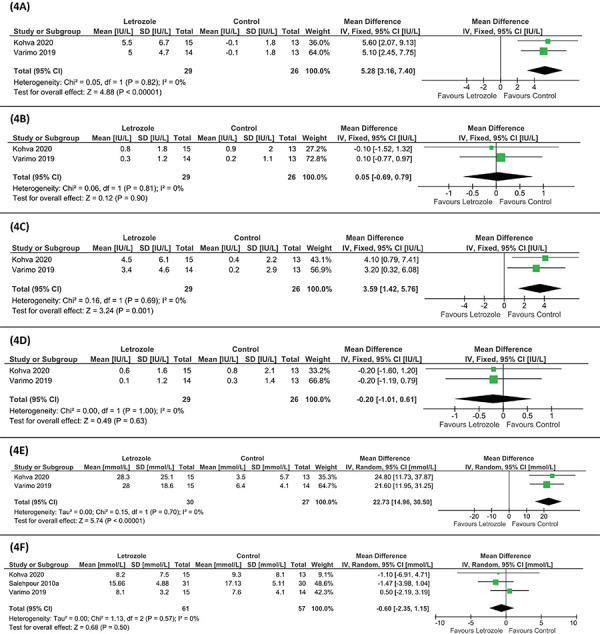
“MD: -0.20 IU/L (95% CI: -1.21-0.61); p=0.63”
§ Efficacy and Safety of Letrozole in the Management of Constitutional Delay in Growth and Puberty: A Systematic Review and Meta-analysis > Follicle Stimulating Hormone
Reported -0.2 · recomputed -0.3
Rated minor: it would not touch a result — a value no result rests on, a p-value that stays on the same side of the significance level, or a conflict that is clerical, resolved elsewhere in the paper, or outside its own findings.
In the paper
“MD: 3.36 mL (95% CI: 0.58-6.75); p=0.02”
§ Efficacy and Safety of Letrozole in the Management of Constitutional Delay in Growth and Puberty: A Systematic Review and Meta-analysis > Abstract
Reported 3.36 · recomputed 3.665
Rated minor: it would not touch a result — a value no result rests on, a p-value that stays on the same side of the significance level, or a conflict that is clerical, resolved elsewhere in the paper, or outside its own findings.
In the paper
“Following the screening of the titles, and abstracts, the search came down to 173 articles. Thirty eight duplicates were removed. One hundred and thirty articles were reviewed in details”
§ Efficacy and Safety of Letrozole in the Management of Constitutional Delay in Growth and Puberty: A Systematic Review and Meta-analysis > Results
Reported 130 · recomputed 135
3 more findings
Create a free account to see every finding of this check.
Citations
Cites
The Cochrane Collaboration's tool for assessing risk of bias in randomised trials
Higgins, J. P. T., Altman, D. G., Gotzsche, P. C., Juni, P., Moher, D., Oxman, A. D., Savovic, J., Schulz, K. F., Weeks, L., Sterne, J. A. C., et al. (2011) · BMJ · doi:10.1136/bmj.d5928 · Cited by 33,817
GRADE: an emerging consensus on rating quality of evidence and strength of recommendations
Guyatt, G. H., Oxman, A. D., Vist, G. E., Kunz, R., Falck-Ytter, Y., Alonso-Coello, P., & Schünemann, H. J. (2008) · BMJ · doi:10.1136/bmj.39489.470347.ad · Cited by 23,305 · cited 3×
“The quality of a body of evidence involves consideration of within-trial risk of bias (methodological quality), directness of evidence, heterogeneity, precision of effect estimates and risk of publication bias (11).”
BackgroundMethodLiberati, A., Altman, D. G., Tetzlaff, J., Mulrow, C., Gotzsche, P. C., Ioannidis, J. P. A., Clarke, M., Devereaux, P. J., Kleijnen, J., & Moher, D. (2009) · BMJ · doi:10.1136/bmj.b2700 · Cited by 17,648
Publication and related biases.
Song, Eastwood, Gilbody, Duley, & Sutton (2000) · Health Technology Assessment · doi:10.3310/hta4100 · Cited by 427
Wickman, S., Sipilä, I., Ankarberg-Lindgren, C., Norjavaara, E., & Dunkel, L. (2001) · The Lancet · doi:10.1016/s0140-6736(00)04895-9 · Cited by 216 · cited 1×
“One hundred and thirty articles were reviewed in details from which seven RCTs which fulfilled all inclusion and exclusion criteria were included in the meta-analysis (Figure 1) (5,6,13,14,15,16,17).”
BackgroundHero, M., Wickman, S., & Dunkel, L. (2006) · Clinical Endocrinology · doi:10.1111/j.1365-2265.2006.02499.x · Cited by 128 · cited 3×
“Data from one study [Hero et al 2006 (13)] involving 17 children with CDGP was analysed to find out the impact of letrozole on serum FSH after 6 and 12 months of treatment, when compared to those receiving placebo (PCG).”
BackgroundMethodHero, M., Toiviainen-Salo, S., Wickman, S., Mäkitie, O., & Dunkel, L. (2010) · Journal of Bone and Mineral Research · doi:10.1002/jbmr.56 · Cited by 97 · cited 1×
“Data from 3 studies (Kohva et al. Salehpour et al and Varimo et al) involving 118 children with CDGP was analysed to find out the impact of letrozole on serum IGF-1 after 12-24 months of treatment, when compared to those receiving testosterone in the control group (ACG). Serum IGF-1 was not significantly different aft…”
InfluentialRaivio, T., & Miettinen, P. J. (2019) · Best Practice & Research Clinical Endocrinology & Metabolism · doi:10.1016/j.beem.2019.101316 · Cited by 76 · cited 1×
“Constitutional delay in growth and puberty (CDGP) is perhaps the most common cause of short stature in both the sexes; and for not yet determined reasons, is much more common in boys than girls (1).”
BackgroundRecent advances in the understanding and management of delayed puberty
Wei, C. H., & Crowne, E. C. (2015) · Archives of Disease in Childhood · doi:10.1136/archdischild-2014-307963 · Cited by 75 · cited 2×
“Traditionally, low dose testosterone injections/oxandrolone and ethinyl estradiol/estradiol patches have been tried to accelerate puberty in boys and girls, respectively, for many decades now (4).”
BackgroundSalehpour, S., Alipour, P., Razzaghy-Azar, M., Ardeshirpour, L., Shamshiri, A., Monfared, M. F., & Gharib, A. (2010) · Hormone Research in Paediatrics · doi:10.1159/000315482 · Cited by 50 · cited 11×
“One hundred and thirty articles were reviewed in details from which seven RCTs which fulfilled all inclusion and exclusion criteria were included in the meta-analysis (Figure 1) (5,6,13,14,15,16,17).”
BackgroundMethodResultInfluential
Cited by
Transition of young adults with metabolic bone diseases to adult care
Ross, J. D., Bowden, M. R., Yu, C., & Diaz-Thomas, A. (2023) · Frontiers in Endocrinology · doi:10.3389/fendo.2023.1137976 · Cited by 10
Delayed Puberty Including Constitutional Delay
Harrington, J. (2024) · Endocrinology and Metabolism Clinics of North America · doi:10.1016/j.ecl.2024.01.007 · Cited by 9
GH Therapy in Non–Growth Hormone-Deficient Children
Guzzetti, C., Ibba, A., Incandela, V., & Loche, S. (2024) · Children · doi:10.3390/children12010003 · Cited by 7
Dutta, D., Mohindra, R., Kumar, M., & Sharma, M. (2022) · Indian Journal of Endocrinology and Metabolism · doi:10.4103/ijem.ijem_3_22 · Cited by 6
“[6] To date, several randomised controlled trials (RCTs) have been published, evaluating the role of AIs in managing hypogonadism related to ageing and obesity.”
BackgroundSelf-citationSoliman, A. T., Alyafei, F., Alaaraj, N., Hamed, N., Ahmed, S., Siddiq, K. A., Qusad, M., & AlKhalaf, M. (2026) · Clinical and Experimental Pediatrics · doi:10.3345/cep.2026.00675 · Cited by 3
“Five studies provided longterm followup to nearadult or adult height.”
Influential
Metadata
- Authors
- Dutta, D., Singla, R., Surana, V., & Sharma, M.
- Affiliations
- Kalpavriksh (IN)
- Corresponding author
- Dutta, Deep
- Venue
- Journal of Clinical Research in Pediatric Endocrinology
- Publisher
- Galenos Yayinevi
- Published
- 2022-06-07
- Volume
- 14
- Issue
- 2
- Pages
- 131-144
- ISSN
- 1308-5727 (ISSN-L)
- 1308-5735
- PMC
- PMC9176083
- OpenAlex
- W3197704159
- Cited by
- 19
- References
- 24
- Citations by year
- 2026: 2 · 2025: 6 · 2024: 6 · 2023: 4 · 2022: 1
- FWCI
- 0.55
- Type
- journal article
- Language
- en
- Open access
- gold
- doi.org
- Licence
- cc-by-nc-nd
- Locations
- Journal of Clinical Research in Pediatric Endocrinology (publishedVersion, cc-by-nc-nd)
- PubMed Central (publishedVersion, cc-by-nc-nd)
- PubMed (publishedVersion)
- DOAJ (DOAJ: Directory of Open Access Journals) (submittedVersion)
- Topics
- Health Sciences › Medicine › Reproductive Medicine › Hypothalamic control of reproductive hormones
- Health Sciences › Medicine › Endocrinology, Diabetes and Metabolism › Growth Hormone and Insulin-like Growth Factors
- Health Sciences › Medicine › Endocrinology, Diabetes and Metabolism › Sexual Differentiation and Disorders
- Keywords
- letrozole, predicted adult height, pubertal progression, bone age, testicular volume, testosterone, luteinizing hormone, follicle-stimulating hormone, inhibin B, adverse events, spinal deformity, growth hormone therapy
- MeSH terms
- Letrozole, Body Height, Child, Growth Disorders, Humans, Luteinizing Hormone, Puberty, Puberty, Delayed, Testosterone
About these checks
Registry, retraction, Cites and statistics results are computed, not judged, with one exception: a printed reference that no index lists is read once by a model before it counts as a citation error. Claims are extracted by a model and kept only when their quote appears verbatim in the text; each cited source is then checked, with a model’s help, for whether it says what the claim relies on. Those verdicts can be wrong — read the claim’s quote and the cited source before relying on one.
A language model drew the claims from the paper on 2026-11-28, under version 3 of the claim definition (model deepseek-v4.1-flash, prompt extract-v3).
A second model labelled each claim on 2026-11-28 (model jev-1.13-20260917, definition revision gold-guideline-v0.2).
Statistics and arithmetic are recomputed, not judged.
Confidence bands are shown only for fields calibrated on our annotated test set. None is calibrated yet, so no band is shown.
What counts as a claim ›How we measure confidence ›How we check this ›
Are you an author, or do you see a problem with this page? Request a review
Data sources
Bibliographic data: Semantic Scholar, OpenAlex, Crossref.
Contains information from the Semantic Scholar Academic Graph Datasets, made available under the ODC Attribution License (ODC-BY 1.0).
Semantic Scholar’s data is described in: Kinney, R., et al. (2023). The Semantic Scholar Open Data Platform. arXiv:2301.10140.
