

The DOI matches its Crossref record; 18 of the 18 references it cites were found in a registry or an index.
Lost to Follow-Up among Tuberculosis Patients during the Public-Private Mix Era in Rural Area of Indonesia
Open accessAbstract
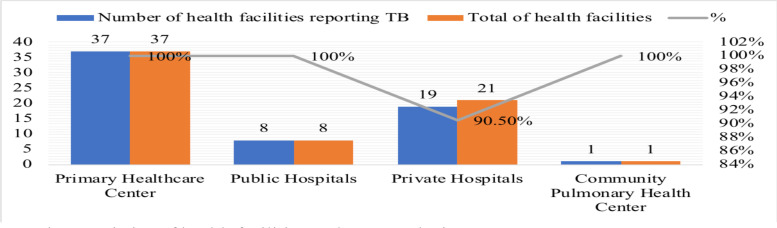
BACKGROUND: Indonesia’s national Tuberculosis (TB) strategy is public-private mix (PPM). The PPM aims to treat patients who have lost sight during TB treatment as these patients are TB carriers and at risk of transmitting TB. The purpose of this study was to identify predictive factors for loss to follow-up (LFTU) among TB patients receiving treatment when the PPM was at place in Indonesia. METHODS: The design of this study was a retrospective cohort study. The data used in this study was sourced from the Tuberculosis Information System (SITB) of Semarang which was recorded routinely during 2020-2021. Univariate analysis, crosstabulation, and logistic regression were performed on 3434 TB patients meeting the minimum variables. RESULTS: The participation of health facilities in reporting TB during the PPM era in Semarang reached 97.6% consisting of 37 primary healthcare center (100%), 8 public hospitals (100%), 19 private hospitals (90.5%), and a community-based pulmonary health center (100%). The regression analysis reveal that the predictive factors of LTFU-TB during the PPM are the year of diagnosis (AOR=1.541; p-value=<0.001; 95% CI=1.228-1.934), referral status (AOR=1.562, p-value=0.007; 95% CI=1.130-2160), healthcare and social security insurance ownership (AOR=1.638; p-value=<0.001; 95% CI=1.263-2.124), drugs source (AOR=4.667; p-value=0.035; 95% CI=1.117-19.489). CONCLUSIONS: The PPM strategy in dealing with LTFU patients should focus on TB patients without Healthcare and Social Security Insurance and who receive TB treatment rather than program drugs.
Overview
The claims and statistics of this paper haven’t been checked yet.
Run the check — free, no account needed. It reads the open-access text and checks the sources it cites.
Integrity signals
Registry
Cites
Statistics
Figures
Verification
Claims the paper makes
The claims and statistics of this paper haven’t been checked yet.
Run the check — free, no account needed. It reads the open-access text and checks the sources it cites.
Claims other papers make about this one
Each is checked against this paper’s own text: does it say what the citing paper says it does?
The cited source says what the claim attributes to it.
In the citing paper
“Patients who discontinue treatment too early are one of the leading causes of treatment failure40.”
From Prevalence of extrapulmonary tuberculosis and factors influencing successful treatment outcomes among notified cases in South India (2025) · cites this paper as [40]
Self-check
Percentages, sums and reported differences re-computed from the paper’s own numbers.
The self-check needs the paper’s full text.
Citations
Cites
WHO global progress report on tuberculosis elimination
Harding, E. (2019) · The Lancet Respiratory Medicine · doi:10.1016/s2213-2600(19)30418-7 · Cited by 437
Tangkiatkumjai, M., Boardman, H., & Walker, D. (2020) · BMC Complementary Medicine and Therapies · doi:10.1186/s12906-020-03157-2 · Cited by 328
Universal Public Finance of Tuberculosis Treatment in India: An Extended Cost‐Effectiveness Analysis
Verguet, S., Laxminarayan, R., & Jamison, D. T. T. (2014) · Health Economics · doi:10.1002/hec.3019 · Cited by 160
Public–private mix for tuberculosis care and control: a systematic review
Lei, X., Liu, Q., Escobar, E., Philogene, J., Zhu, H., Wang, Y., & Tang, S. (2015) · International Journal of Infectious Diseases · doi:10.1016/j.ijid.2015.02.015 · Cited by 110
Soedarsono, S., Mertaniasih, N. M., Kusmiati, T., Permatasari, A., Juliasih, N. N., Anggraeni, A. T., Hadi, C., & Alfian, I. N. (2021) · BMC Pulmonary Medicine · doi:10.1186/s12890-021-01735-9 · Cited by 56
Public–Private Mix Models of Tuberculosis Care in Pakistan: A High-Burden Country Perspective
Ullah, W., Wali, A., Haq, M. U., Yaqoob, A., Fatima, R., & Khan, G. M. (2021) · Frontiers in Public Health · doi:10.3389/fpubh.2021.703631 · Cited by 34
Khan, F. U., Rehman, A. U., Khan, F. U., Hayat, K., Khan, A., Ahmad, N., Chang, J., Malik, U. R., & Fang, Y. (2022) · International Journal of Environmental Research and Public Health · doi:10.3390/ijerph19031574 · Cited by 25
Andargie, A., Molla, A., Tadese, F., & Zewdie, S. (2021) · PLoS ONE · doi:10.1371/journal.pone.0248687 · Cited by 24
Kassa, G. M., Teferra, A. S., Wolde, H. F., Muluneh, A. G., & Merid, M. W. (2019) · BMC Infectious Diseases · doi:10.1186/s12879-019-4447-8 · Cited by 23
McAllister, S. M., Lestari, B. W., Sullivan, T. A., Hadisoemarto, P. F., Afifah, N., Apip, R. A., Murray, M. B., Hill, P. C., & Alisjahbana, B. (2020) · American Journal of Tropical Medicine and Hygiene · doi:10.4269/ajtmh.19-0848 · Cited by 22
Research works printed but not linked: 4
- [4]Haileamlak A Tuberculosis Continued as Global Challenge Though the Burden Remained High in Low-Income and High-Income Countries Ethiop J Health Sci 2018 28 517 518 30607065 PMC6308771
- [9]Mahendradhata Y Trisnantoro L Listyadewi S The Republic of Indonesia Health System Review 2017 Health Sys ed. India WHO Regional Office for South-East Asia
- [13]Gani A Budiharsana MP The consolidated report on Indonesia health sector review 2018 2019
- [28]Ameer R Othman R Sustainability practices and corporate financial performance: a study based on the top global corporations Journal of Business Ethics 2012 108 61 79
Cited by
Sorted by citations
VidyaRaj, C. K., Vadakunnel, M. J., Mani, B. R., Anbazhagi, M., Pradhabane, G., Venkateswari, R., Palavesam, S., Venkatesh, K., Usharani, B., Sriramkumar, S. R., et al. (2025) · Scientific Reports · doi:10.1038/s41598-025-92613-5 · Cited by 31
Ngmenbelle, D., Amoa-Saah, B., Nimirkpen, S., Akesem, M. A., Idan, J. S., & Mohammed, A. (2025) · PLoS ONE · doi:10.1371/journal.pone.0326444 · Cited by 2
Rahayu, S. R., Nugroho, A., Ningrum, D. N. A., Merzistya, A. N. A., Wijayantiningrum, T., Simanjuntak, J. S., Maali, M. Z., Hafidh, K. A., Salsabila, A. P., Pranindita, S. K., et al. (2026) · Healthcare Informatics Research · doi:10.4258/hir.2026.32.1.4
Self-citationNihaya, A. U., & Cholisoh, Z. (2026) · Journal of Pharmaceutical And Sciences · doi:10.36490/journal-jps.com.v9i2.1704
Metadata
- Authors
- Rahayu, S. R., Susilastuti, M. S., Saefurrohim, M. Z., Azam, M., Indrawati, F., Supriyono, M., Miarso, D., Safitri, B. D., Daniswara, S., Merzistya, A. N., Amilia, R., Affandi, M. D., Wahidah, N. W., Isbandi, Wandastuti, A. D., Laila, A. K., & Muflikhah, Z.
- Affiliations
- State University of Semarang (ID)
- Universitas Gadjah Mada (ID)
- Corresponding author
- Sri R. Rahayu
- ORCID
- Venue
- Ethiopian Journal of Health Sciences
- Publisher
- African Journals Online (AJOL)
- Published
- 2023-01-01
- Volume
- 33
- Issue
- 1
- Pages
- 115-122
- ISSN
- 1029-1857 (ISSN-L)
- 2413-7170
- PMC
- PMC9987293
- OpenAlex
- W4323653123
- Cited by
- 4
- References
- 18
- Citations by year
- 2026: 2 · 2025: 2
- FWCI
- 0.83
- Type
- journal article
- Language
- en
- Open access
- diamond
- dx.doi.org
- Licence
- cc-by
- Locations
- Ethiopian Journal of Health Sciences (publishedVersion, cc-by)
- PubMed Central (publishedVersion, cc-by)
- PubMed (publishedVersion)
- Funders
- Universitas Negeri Semarang
- Topics
- Health Sciences › Medicine › Infectious Diseases › Tuberculosis Research and Epidemiology
- Health Sciences › Medicine › Public Health, Environmental and Occupational Health › Healthcare Systems and Reforms
- Health Sciences › Medicine › Infectious Diseases › Infectious Diseases and Tuberculosis
- Keywords
- tuberculosis, loss to follow-up, public-private mix, tuberculosis treatment, predictive factors, health insurance, drug sources, referral status, rural Indonesia, Semarang
- MeSH terms
- Delivery of Health Care, Humans, Indonesia, Retrospective Studies, Tuberculosis, Lost to Follow-Up
About these checks
Registry, retraction, Cites and statistics results are computed, not judged, with one exception: a printed reference that no index lists is read once by a model before it counts as a citation error. Claims are extracted by a model and kept only when their quote appears verbatim in the text; each cited source is then checked, with a model’s help, for whether it says what the claim relies on. Those verdicts can be wrong — read the claim’s quote and the cited source before relying on one.
Statistics and arithmetic are recomputed, not judged.
Confidence bands are shown only for fields calibrated on our annotated test set. None is calibrated yet, so no band is shown.
What counts as a claim ›How we measure confidence ›How we check this ›
Are you an author, or do you see a problem with this page? Request a review
