

Authenticity, Legitimacy and the Transglobal Yoga Industry: A Sociological Analysis of Shanti Mandir
Open accessThe DOI matches its Crossref record; 35 of the 35 references it cites were found in a registry or an index; none of the 28 sources its claims cite is checked for support yet.
Abstract
This book is a sociological study of knowledge and knowers and explores the production and perceived value of ‘yogic knowledge,’ how distinction is curated, and how access to this knowledge is gained. The book focuses on the organization Shanti Mandir (SM) in India, a new religious movement, which was founded in 1987 by Swami Nityananda Saraswati. It is a non-profit charity operating within the unregulated and competitive multi-billion dollar global and domestic wellness/spiritual tourism industries, and as a registered education provider within India’s education industry. The main aim of this book is to answer the question how legitimacy is acquired, negotiated and expressed within the SM yoga ashram. The theoretical framework applied in this study is a confluence of the sociology of education, knowledge and religion. The author engages a methodology based primarily on ethnographic participant-observation and discourse analysis. Situating SM within the transglobal yoga and spiritual tourism industries, the book demonstrates how SM promotes itself as a provider of a consumable lifestyle that spiritual aspirants can adopt through attending retreats, workshops, meditation intensives, yoga teacher training and philosophy courses in their global network of ashrams. By identifying the structuring forces of the guru’s discourse, and focusing on the marketing strategies and subsequent exchanges of capital and affective emotions, this monograph documents what the legitimate yogic identity promoted by SM is within the context of the transglobal yoga industry. A highly original and incisive portrait of an Indian devotional community with strong transnational connections, this book will be of interest to researchers studying South Asian Studies, Religious Studies, Indian religion and yoga.
Overview
CoChat Summary
# TL;DR
This is a sociological monograph on Shanti Mandir (SM), a transglobal yoga/new religious movement, arguing that legitimacy in the ashram is produced through yogic knowledge, pedagogy, discourse, and embodied dispositions. It combines ethnographic participant-observation and discourse analysis with Legitimation Code Theory and Sanskrit textual analysis to show how SM markets and cultivates an “authentic” yogic identity.
# Key findings
- SM is described as a transglobal, non-profit, neo-Hindu/NRM with “several thousand devotees spread across the globe,” operating through a network of ashrams and associated schools/centres in multiple countries.
- The book argues that SM’s legitimate yogic disposition is the śāntamūrti (“embodier of peace”), composed of the sākṣin (“silent witness”) and sahṛdaya (“true connoisseur”); these are presented as the ideal knower traits within SM.
- The formal pedagogical arena, satsaṅga, is analysed as a space of moral edification and affective transmission that produces shared identity, social boundaries, and an experience of śāntarasa (quietude); the text says this supports SM’s identity and marketing strategy in the transglobal yoga industry.
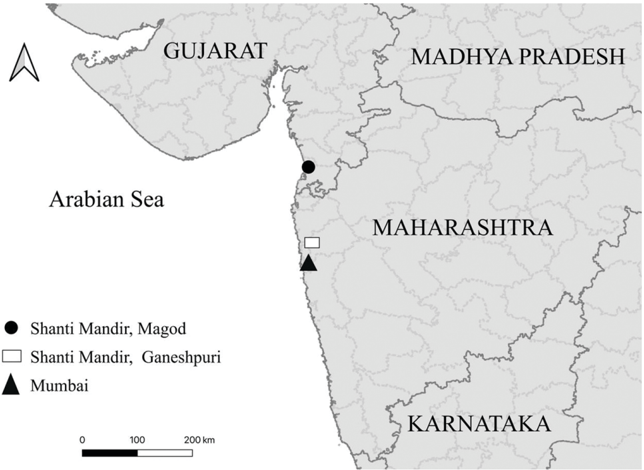
- The book states that SM’s ashram research was conducted at the Magod ashram in Valsad District, Gujarat; the author reports fieldwork there between 2009 and 2014, with the longest continuous stay being nine months and close to eighteen months total across visits.
- SM’s legitimacy is shown to depend on symbolic capital and social differentiation: the community is divided into groups such as Scholars, Renunciants, and Patrons, and the guru’s discourse and gaze structure access to “yogic knowledge.”
# Methods
- The book is a sociological study using ethnographic participant-observation and discourse analysis as its main methods; the author also explicitly says the work is informed by anthropology of religion and sociology of spirituality.
- Data/scope: fieldwork at Shanti Mandir’s Magod ashram in Gujarat, with reference to SM’s global network, published materials, websites, videos, and Sanskrit texts; the author notes research spanning 2009–2014.
- Main analytic framework: a confluence of sociology of education, knowledge, and religion, especially Legitimation Code Theory (LCT), combined with close reading of Sanskrit literary/aesthetic sources to analyse knowledge, knowers, pedagogy, and symbolic capital.
# Limitations
- The author states the analysis is focused on one case study—SM—and says it is a “quite focused case study,” though potentially informative for similar domains.
- The text itself notes that some chapters may be “more accessible to a general readership,” and that the book’s later chapters take a “higher theoretical gear”; this suggests uneven accessibility across the volume (text-implied limitation).
- The book explicitly says it does not discuss several adjacent topics, including the historical development of haṭha-yogic bodies, therapeutic uses of yogic knowledge, or queer/crip/decolonial applications of yoga; this is a scope limitation stated in the text.
Model-written summary. Check it against the paper before relying on it.
Integrity signals
Registry
Cites
Statistics
Figures

Verification
Claims the paper makes
0 Valid · 3 Not valid · 24 Not checked · 28 Own results and interpretations
A result the paper states — it cites no source for it, so there is none to check. The quote shows it is in the paper.
In the paper
“the book demonstrates how SM promotes itself as a provider of a consumable lifestyle that spiritual aspirants can adopt through attending retreats, workshops, meditation intensives, yoga teacher training and philosophy courses in their global network of ashrams.”
boosted- Asserted: passes — The authors put it forward as true.
- Checkable: passes — It can be checked against evidence.
- Load-bearing: passes — The paper’s conclusions depend on it.
- Based: passes — The paper gives a reason why it holds.
A result the paper states — it cites no source for it, so there is none to check. The quote shows it is in the paper.
In the paper
“The fourth chapter explores the social network of Shanti Mandir's (SM) ashram, which comprises three groups: The Scholars, Renunciants and Patrons.”
plain- Asserted: passes — The authors put it forward as true.
- Checkable: passes — It can be checked against evidence.
- Load-bearing: unclear — It is unclear whether the paper’s conclusions depend on it.
- Based: passes — The paper gives a reason why it holds.
None of the sources cited for this claim could be matched to a paper, so there is nothing to check it against.
In the paper
“The majority of SM's devotees share in the belief that an idealised, romanticised and re- imagined representation of a glorified Vedic past is a necessary counterpoint to modernity (see McCartney 2021a, 2017b, 2014, 2011).”
What the sources say
- Not matchedcites McCartney 2021a
More than one paper fits this citation.
- Not matchedcites McCartney 2017b
More than one paper fits this citation.
- Not matchedcites McCartney 2014
An author–year citation the paper’s reference list doesn’t settle. We don’t search these by name.
plain- Asserted: passes — The authors put it forward as true.
- Checkable: passes — It can be checked against evidence.
- Load-bearing: unclear — It is unclear whether the paper’s conclusions depend on it.
- Based: passes — The paper gives a reason why it holds.
- Not matched
In the paper
“This ritualised space focuses on moral edification and the transference of affect through uplifting conversation, music, dance, poetry and contemplation (see Hüsken 2011).”
What the sources say
- Not matchedcites Hüsken 2011
An author–year citation the paper’s reference list doesn’t settle. We don’t search these by name.
plain- Asserted: passes — The authors put it forward as true.
- Checkable: passes — It can be checked against evidence.
- Load-bearing: unclear — It is unclear whether the paper’s conclusions depend on it.
- Based: passes — The paper gives a reason why it holds.
- Not matched
A conclusion the paper draws from its own results — it cites no other source for it, so there is none to check. The quote shows it is in the paper.
In the paper
“As the guru sets the principles of legitimation through his behaviour and discourse, it is the aim of the guru to use his 'cultivated' gaze to align the devotees with his utopic vision.”
plainstates a cause- Asserted: passes — The authors put it forward as true.
- Checkable: passes — It can be checked against evidence.
- Load-bearing: unclear — It is unclear whether the paper’s conclusions depend on it.
- Based: passes — The paper gives a reason why it holds.
4 more claims
Create a free account to see all 55 claims and to verify the 1 reference still open.
- Probably not a substantial claim. 44
- It may state two separate claims as one. 16
Citations
Cites
The publisher hasn’t deposited this paper’s reference list.
Research works printed but not linked: 46
- Aiyar, K.N. 1914. Thirty Minor Upanishads . Madras: Vasanta Press.
- ---. 2007. 'The Global Diffusion and Westernization of Neo- Hindu Movements: Siddha Yoga and Sivananda Centres.' Religions of South Asia 1 (2): 217- 237.
- Barker, Eileen. 2004. 'What Are We Studying? A Sociological Case for Keeping the 'Nova'.' Nova Religio 8 (3): 1- 13.
- Berezin, Mabel. 2005. 'Emotions and the Economy.' In Handbook of Economic Sociology , edited by Neil J. Smelser and Richard Swedberg, 109- 127. New York and Princeton: Princeton University Press.
- Bhattacharya, Srirupa. 2023. 'Doing Seeing: Televised Yoga, Consumption and Religious Nationalism in Neoliberal India ' In Gurus and Media: Sound, Image, Machine, Text and the Digital , edited by Jacob Copeman, Arkotong Longkumer and Koonal Duggal, 419- 444. London: UCL Press.
- Bourdieu, Pierre and Löic Wacquant. 1992. An Invitation to Reflexive Sociology . Chicago: The University of Chicago Press.
- Chatterjee, Tara. 2003. Knowledge and Freedom in Indian Philosophy . Oxford: Lexington Books.
- ---. 1982. 'The Concept of Sākṣin.' Journal of Indian Philosophy 10: 339- 356.
- Colebrook, H.T. and H.H. Wilson, eds. 1837. Īśvarakṛṣṇa's Sāṃkyakārikā and Gaudapāda's Bhāṣya . Oxford: Oriental Translation Fund of Great Britain and Ireland.
- Das, N. 2022. 'Pratibhā, Intuition, and Practical Knowledge.' British Journal for the History of Philosophy 31 (4): 630- 656. https:// doi.org/ 10.1080/ 09608 788.2022.2074 365
- Evans- Pritchard, E.E. 1937. Witchcraft, Oracles and Magic Among the Azande. Oxford: Clarendon Press.
- Glass, James M. 1973. 'The Yogin & the Utopian: Nirvana & the Discovery of Being.' Polity 5 (4): 427- 450. https:// doi.org/ 10.2307/ 3234 014
- Gupta, Bina. 1998. The Disinterested Witness: A Fragment of Advaita Vedānta Phenomenology . Illinois: Northwestern University Press.
- Hacker, Paul and Wilhelm Halbfass. 1995. Philology and Confrontation: Paul Hacker on Traditional and Modern Vedanta . New York: State University of New York Press.
- Hacking, Ian. 1986. 'Self- Improvement.' In D.C. Roy (Ed.) Foucault: A Critical Reader , 235- 240. Oxford: Blackwell.
- ---. 2009. 'Schisms of Swami Muktananda's Siddha Yoga.' Marburg Journal of Religion 15: 1- 15.
- ---. 2006. 'Thinking about Levinas in Relation to a Spiritual Community.' In Through a Glass Darkly: Reflections on the Sacred , edited by Frances Di Lauro, 300- 312. Sydney: Sydney University Press.
- Heifetz, Daniel. 2021. The Science of Satyug: Class, Charisma, and Vedic Revivalism in the All World Gayatrik Pariwar . New York: SUNY Press.
- Hoblitzelle, Olivia Ames. 2024. Ley Lines of Love: Adventures Along the Spiritual Path . Housatonic, MA: Green Fire Press.
- Hüsken, Ute. 2011. 'Ritual Competence as Embodied Knowledge.' In Images of the Body in India: South Asian and European Perspectives on Rituals and Performativity , edited by Axel Michaels and Christoph Wulf, 193- 213. New Delhi: Routledge.
- ---. 2012. 'Branding Yoga: The Cases of Iyengar Yoga, Siddha Yoga and Anusara Yoga.' Approaching Religion 2 (2): 3- 17. https:// doi.org/ 10.30664/ ar.67499
- Kitty, Wheater. 2017. An Analysis of E.E. Evans- Pritchard's Witchcraft, Oracles and Magic Among the Azande . London: Routledge.
- ---. 1993. Knowledge and Practice in Mayotte: Local Discourses of Islam, Sorcery and Spirit Possession . Toronto: University of Toronto Press.
- ---. 2023. 'Poles Apart? From Wrestling and Mallkhāmb to Pole Yoga.' Yoga and the Physical Practices of South Asia 4: 215- 270. https:// doi.org/ 10.34000/ JoYS.2023.V4
- ---. 2022. ''Sanskrit- Speaking' Villages, Faith- Based Development and the Indian Census.' Bhasha 1 (1): 77- 110.
- ---. 2020a. 'Yoga- Scapes, Embodiment and Imagined Spiritual Tourism.' In Tourism and Embodiment , edited by Catherine Palmer and Hazel Andrews, 86- 106. London: Routledge.
- ---. 2019a. 'Stretching in the Yogaland's Shade: Unlikely Alliances, Strategic Syncretism and De- Post- Colonizing Yogatopia(s).' Asian Ethnology 78 (2): 373- 401.
- Politics and Religion Journal 13 (1): 137- 175. https:// doi.org/ 10.17605/ OSF.IO/ MFB5N ---. 2018a. 'Śāntamūrti: The Legitimate Disposition(s) of the 'Temple of Peace' Social Network.' Bulletin of the Nanzan Institute for Religion and Culture 8: 65- 104. https:// doi. org/ 10.17605/ OSF.IO/ 4MP3K
- ---. 2017d. 'Jhirī: A 'Sanskrit- speaking' village in Madhya Pradesh.' Journal of South Asian Languages and Linguistics 4 (2): 167- 209. https:// doi.org/ 10.1515/ jsall- 2017- 0007
- ---. 2016. 'Utopian Symmetries: Reflections on Future Worlds and Transglobal Yoga.' The Journal of the International Society for the Interdisciplinary Study of Symmetry 1: 86- 89.
- ---. 2011. 'Spoken Sanskrit in a Gujarat Ashram.' JOSA 43 (Australasian Sanskrit Conference Special Issue): 61- 82.
- ---. forthcoming- b. Imagining Sanskritland: A Journey from Yoga Fundamentalism to India's 'Sanskrit- speaking' Villages . London & New York: Routledge.
- McCartney, P.S.D. and Diego Lourenço. 2023. ' 'Non- Human Gurus': Yoga Dolls, Online Avatars, and Meaningful Narratives.' In Gurus and Media , edited by Jacob Copeman, Arkotong Longkumer and Koonal Duggal, 95- 124. London: UCL Press.
- McCartney, P.S.D. and Ghil'ad Zuckermann. 2019. 'Unsanitizable Yoga: Revivalistics and Hybridic Reclaimed Sanskrit.' Mentalities Journal 33 (1): 1- 48.
- McKean, Lisa. 1996. Divine Enterprise . New York, University of Chicago Press.
- Mahony, William K. 1997. 'The Ashram: Life in the Abode of a Siddha.' In Meditation Revolution: A History and Theology of the Siddha Yoga Lineage , edited by S.P. Sabharathnam, Douglas Brooks, Constantina Rhodes Baily, William K. Mahony, Paul E. Muller- Ortega, Swami Durgananda and Peggy Bendet, 521- 568. New York: Agama Press.
- Mangalwadi, Vishal and Ronald Enroth. 2005. A Guide to New Religious Movements . Downers Grove, IL: Invervarsity Press.
- Marcuse, Herbert. 1974. Eros and Civilization: A Philosophical Inquiry into Freud . Boston: Beacon Press.
- ---. 1939. 'Integral Humanism and the Crisis of Modern Times.' The Review of Politics 1 (1): 1- 17.
- Maton, Karl. 2013. Knowledge and Knowers: Towards a Realist Sociology of Education . London: Routledge.
- Narayan, Kirin. 1989. Storytellers, Saints and Scoundrels: Folk Narrative in Hindu Religious Teaching . Philadelphia: Uninversity of Pennsylvania Press.
- Pechilis, Karen. 2004. The Graceful Guru: Hindu Female Gurus in India and the United States . Oxford: Oxford University Press.
- Ranganathan, Shyam. 2008. Patanjali's Yoga Sutra . New Delhi: Penguin Books.
- Rodarmor, W. 1983. 'The Secret Life of Swami Muktananda.' CoEvolution Quarterly (Winter): 40, 104- 110. https:// who leea rth.info/ p/ coev olut ion- quarte rly- win ter- 1983?for mat= spre ads&index= 105
- Sabharathnam, S.P., Douglas Brooks, Constantina Rhodes Baily, William K. Mahony, Paul E. Muller- Ortega, Swami Durgananda, and Peggy Bendet. 1997. Meditation Revolution: A History and Theology of the Siddha Yoga Lineage . New York: Agama Press.
- Schechner, Richard. 2013. Performance Studies: An Introduction . New York, Routledge.
Cited by
Guru Logics after Artificial Intelligence
Copeman, J. (2026) · Religions · doi:10.3390/rel17091033 · Cited by 1
Gauḍapāda’s Oṃkāraprakaraṇam in the Āgamaśāstra: The Gnostic Mantra
Bouthillette, K.-S. (2025) · Springer eBooks · doi:10.1007/978-981-96-2556-7_9
What Is Yogic Gnosticism? The Spiritual Exercise of Inner Sacrifice
Bouthillette, K.-S. (2025) · Springer eBooks · doi:10.1007/978-981-96-2556-7_4
Williams, C. (2025) · SpringerBriefs in offending populations & correctional psychotherapy · doi:10.1007/978-3-031-98368-9_1
Yoga Entrepreneurship in India: Barriers and enablersPreprint
Shetty, L., Shetty, A., & Reddy, G. G. (2026) · SSRN Electronic Journal · doi:10.2139/ssrn.7201335
Metadata
- Authors
- McCartney, P. S. D.
- Affiliations
- Hiroshima University (JP)
- Corresponding author
- McCartney, Patrick S.D.
- Venue
- Routledge eBooks
- Publisher
- Routledge
- Published
- 2025-02-11
- OpenAlex
- W4407369181
- Cited by
- 5
- References
- 0
- Citations by year
- 2026: 2 · 2025: 3
- FWCI
- 19.44
- Type
- book
- Language
- en
- Open access
- bronze
- doi.org
- Locations
- Routledge eBooks (publishedVersion)
- Topics
- Social Sciences › Geography, Planning and Development › Religious Tourism and Spaces
- Social Sciences › Arts and Humanities › Religious studies › Religious Studies and Spiritual Practices
- Social Sciences › Arts and Humanities › Religious studies › Indian and Buddhist Studies
- Keywords
- new religious movements, spiritual journey, legitimacy, authenticity, yoga teacher training, ashrams, transnational religious communities, marketing strategy, affective emotions
About these checks
Registry, retraction, Cites and statistics results are computed, not judged, with one exception: a printed reference that no index lists is read once by a model before it counts as a citation error. Claims are extracted by a model and kept only when their quote appears verbatim in the text; each cited source is then checked, with a model’s help, for whether it says what the claim relies on. Those verdicts can be wrong — read the claim’s quote and the cited source before relying on one.
A language model drew the claims from the paper on 2026-10-10, under version 3 of the claim definition (model deepseek-v4.1-flash, prompt extract-v3).
A second model labelled each claim on 2026-10-10 (model jev-1.13-20260917, definition revision gold-guideline-v0.2).
Statistics and arithmetic are recomputed, not judged.
Confidence bands are shown only for fields calibrated on our annotated test set. None is calibrated yet, so no band is shown.
What counts as a claim ›How we measure confidence ›How we check this ›
Are you an author, or do you see a problem with this page? Request a review
Data sources
Bibliographic data: Semantic Scholar, OpenAlex, Crossref.
Contains information from the Semantic Scholar Academic Graph Datasets, made available under the ODC Attribution License (ODC-BY 1.0).
Semantic Scholar’s data is described in: Kinney, R., et al. (2023). The Semantic Scholar Open Data Platform. arXiv:2301.10140.
