

4 Quantitative Reasoning and the Development of Algebraic Reasoning
The DOI matches its Crossref record, with a small difference in title or year; 20 of the 20 references it cites were found in a registry or an index; none of the 6 sources its claims cite is checked for support yet.
Abstract
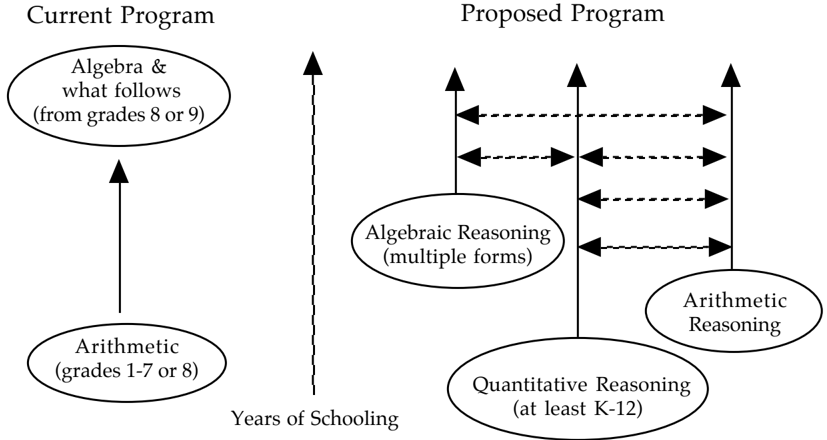
This chapter describes a conceptual orientation toward what is going on in complex quantitative situations, and shows how teachers can help students make mathematical sense of those situations. It argues for better curricular balance between teaching and learning about number/operation and quantity/quantitative reasoning. Algebraic reasoning is characterized by its generality and by the role that symbolic expressions play in stating general relationships, comparing and manipulating them, and facilitating many numerical evaluations. The basic idea is to move out of the situation and its constituent quantities and into the world of symbolic expressions and equations. Algebraic notation and methods are powerful tools for stating, analyzing, and manipulating general relationships, but without ideas of substantial generality to express, students will find little sense in and little use for algebra. An emphasis on the quantitative aspects of situations reorients students&s; mathematical focus in some important ways, affecting both the development of their arithmetic reasoning and their future prospects in algebra.
Overview
CoChat Summary
TL;DR
The chapter argues that early algebra should be built on long-term development of quantitative reasoning—reasoning about measurable quantities and relationships—rather than on importing Algebra I content into K–8. It claims this quantitative foundation gives students meaningful content for algebraic notation and can support multiple approaches to algebra.
Key findings
- The authors argue the current K–8 focus on numbers and arithmetic operations is insufficient for algebra; students need to conceptualize and reason about quantities and relationships before symbolic manipulation becomes meaningful.
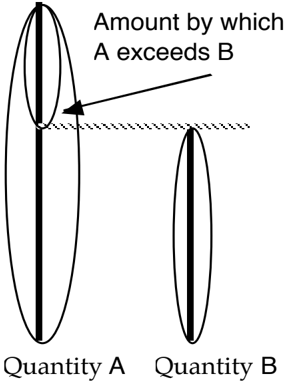
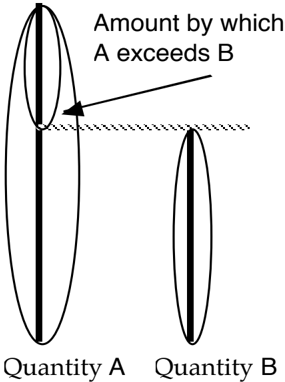
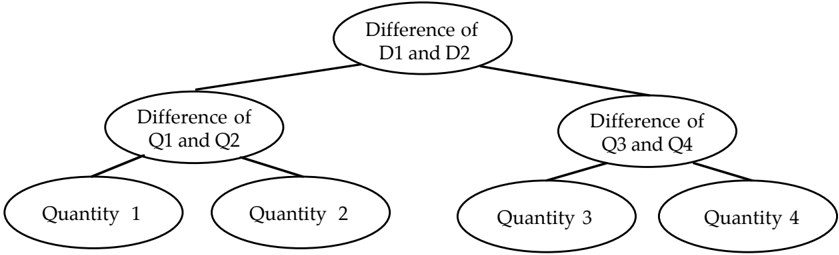
- They distinguish quantitative reasoning from numerical reasoning: quantities are measurable attributes and can be reasoned about without known numerical values; differences and ratios are themselves quantities arising from quantitative operations.
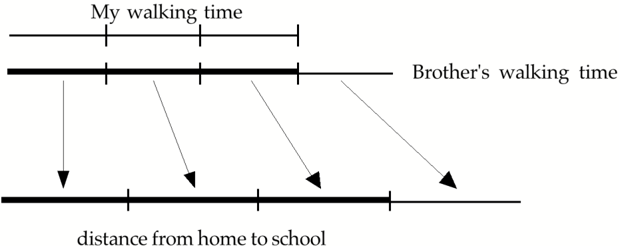
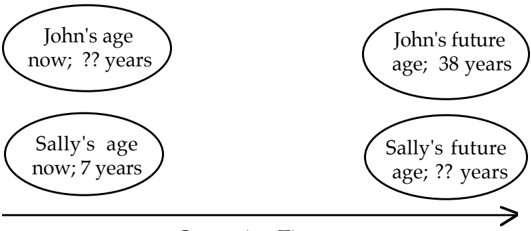
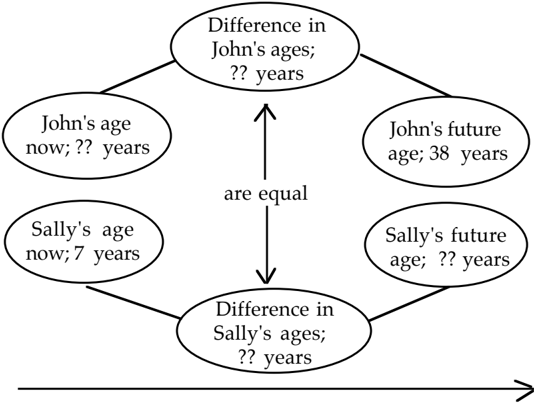
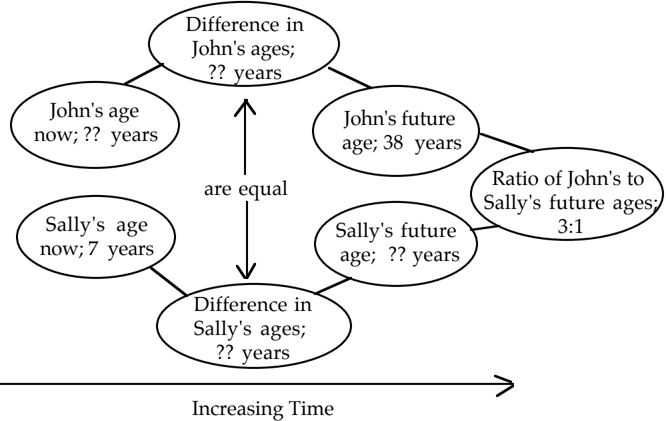
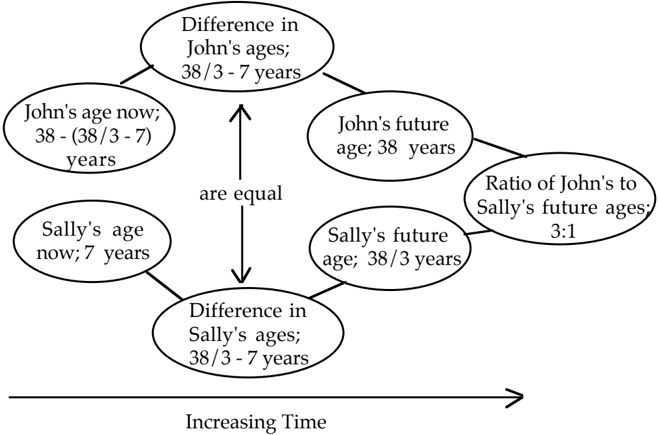
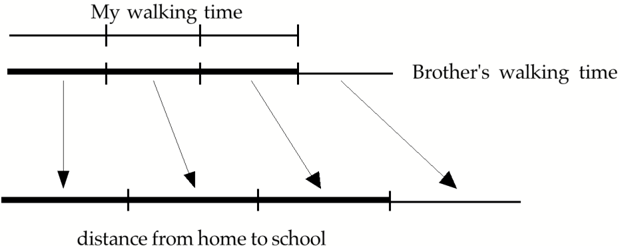
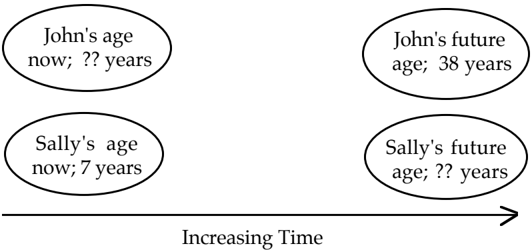
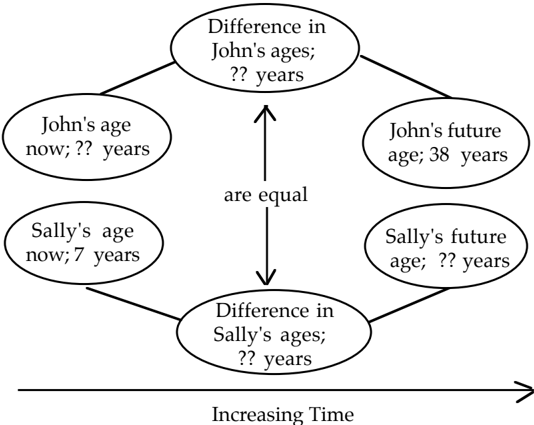
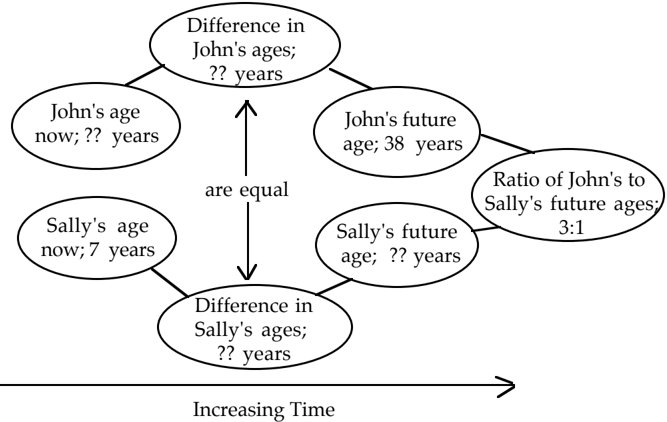
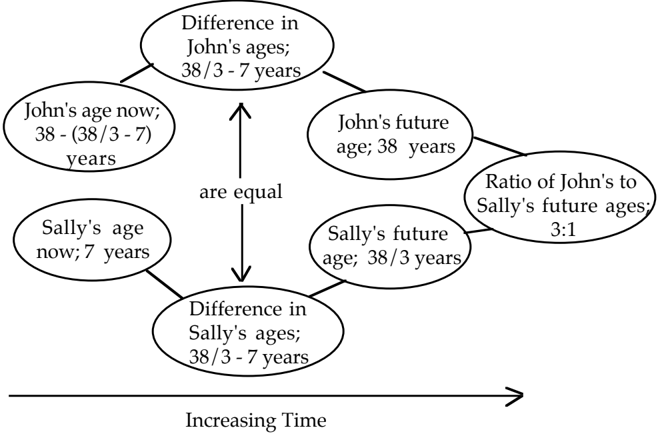
- Worked examples contrast algebraic and quantitative solutions: in the walking/overtaking problem, quantitative reasoning yields 18 minutes; in the age problem, John’s current age is computed as 32 1/3 years (with Sally’s future age 38/3 and growth 17/3 years).
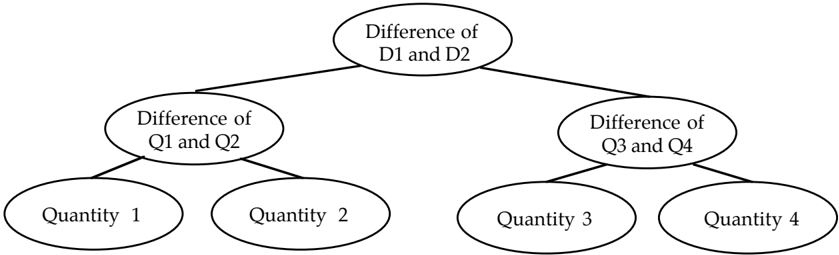
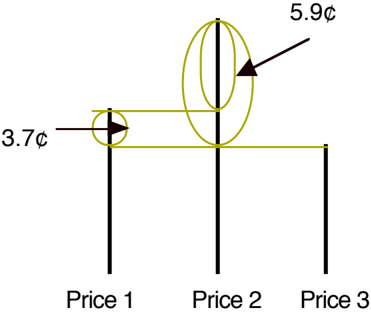
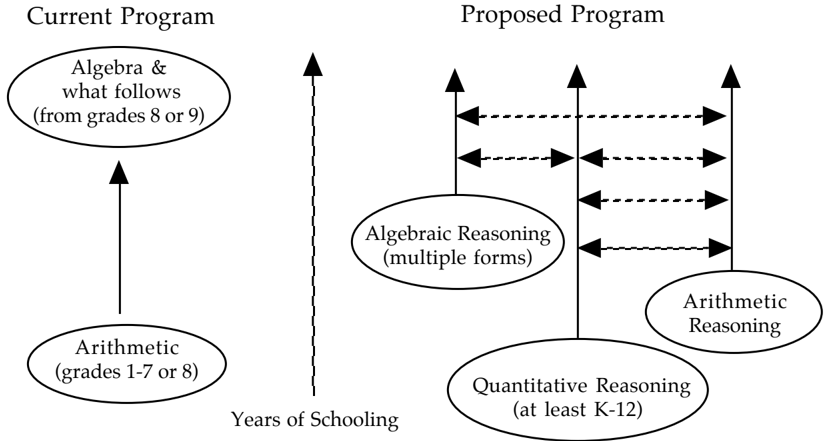
- They propose complex additive situations, open-form expressions, and diagrams as instructional supports, and argue quantitative reasoning can serve as a “root stalk” for multiple algebra approaches (modeling, structure, pattern finding).
Methods
- Conceptual/theoretical chapter, not an empirical study; no formal sample, dataset, or statistical analysis.
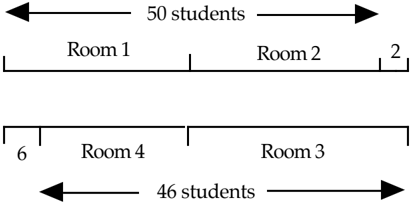
- The argument is developed through worked mathematical problems (Problems 1–10), including motion, age, marbles, and height/class-size examples, plus a fifth-grade classroom vignette.
- Main analysis is conceptual: contrasting numerical/computational solutions with quantitative/conceptual solutions and drawing instructional implications.
Limitations
- Stated: the authors do not outline a full K–8 curriculum in quantitative reasoning and say much work remains; they also cannot resolve the dilemma that there is more worthwhile mathematics than curriculum space.
- Stated: they do not claim a strict conceptual distinction between number and quantity is psychologically defensible or educationally useful.
- Evident: the chapter reports no empirical data or systematic sample; the examples and classroom vignette are illustrative, so claims about developmental effects and instructional efficacy are not tested here.
Model-written summary. Check it against the paper before relying on it.
Integrity signals
Registry
Cites
Statistics
Figures
Verification
Claims the paper makes
0 Valid · 0 Not valid · 7 Not checked · 95 Own results and interpretations
A result the paper states — it cites no source for it, so there is none to check. The quote shows it is in the paper.
In the paper
“We also know that however much Sally grows older, John (and every other person) will grow older by the same amount, so the difference between Sally's present and future ages will be the same as the difference in John's present and future ages.”
plain- Asserted: passes — The authors put it forward as true.
- Checkable: passes — It can be checked against evidence.
- Load-bearing: passes — The paper’s conclusions depend on it.
- Based: passes — The paper gives a reason why it holds.
A result the paper states — it cites no source for it, so there is none to check. The quote shows it is in the paper.
In the paper
“But this problem can also be solved by reasoning about the relationships among distances, walking rates, and times of travel without the support of variable assignments or algebraic expressions.”
plain- Asserted: passes — The authors put it forward as true.
- Checkable: passes — It can be checked against evidence.
- Load-bearing: passes — The paper’s conclusions depend on it.
- Based: passes — The paper gives a reason why it holds.
A conclusion the paper draws from its own results — it cites no other source for it, so there is none to check. The quote shows it is in the paper.
In the paper
“This curriculum does not prepare students for the use of explicit, rulegoverned notational systems to express, manipulate, and formalize ways of thinking about quantitative and numerical relationships.”
plainstates a cause- Asserted: passes — The authors put it forward as true.
- Checkable: passes — It can be checked against evidence.
- Load-bearing: passes — The paper’s conclusions depend on it.
- Based: unclear — It is unclear why the paper says it holds.
- Rests on an assumption not shown here.
A conclusion the paper draws from its own results — it cites no other source for it, so there is none to check. The quote shows it is in the paper.
In the paper
“We argue that a focus on quantitative reasoning can develop students' abilities to conceptualize, reason about, and operate on quantities and relationships in sensible problem situations.”
plainstates a cause- Asserted: passes — The authors put it forward as true.
- Checkable: unclear — It is unclear whether it could be checked against evidence.
- Load-bearing: passes — The paper’s conclusions depend on it.
- Based: unclear — It is unclear why the paper says it holds.
- Rests on an assumption not shown here.
A conclusion the paper draws from its own results — it cites no other source for it, so there is none to check. The quote shows it is in the paper.
In the paper
“We describe a broad view of quantitative reasoning as it relates to algebraic and arithmetical reasoning and show how it actually provides content for algebra.”
plainstates a cause- Asserted: passes — The authors put it forward as true.
- Checkable: unclear — It is unclear whether it could be checked against evidence.
- Load-bearing: passes — The paper’s conclusions depend on it.
- Based: passes — The paper gives a reason why it holds.
21 more claims
Create a free account to see all 102 claims and every source verdict.
- Probably not a substantial claim. 65
- It may state two separate claims as one. 23
- The quote only partly states this claim. 1
Self-check
Percentages, sums and reported differences re-computed from the paper’s own numbers.
Each contradiction between two passages listed here was confirmed by an independent check.
Rated minor: it would not touch a result — a value no result rests on, a p-value that stays on the same side of the significance level, or a conflict that is clerical, resolved elsewhere in the paper, or outside its own findings.
In the paper
§ Quantitative Reasoning and the Development of Algebraic Reasoning
“Patrick W. Thompson Department of Teaching and Learning Arizona State University”
§ Author Note
“Patrick W. Thompson, Department of Teaching and Learning, Vanderbilt University.”
Citations
Cites
Mathematical Problem Solving: Current Themes, Trends, and Research
(2019) · ICME-13 Monographs · doi:10.1007/978-3-030-10472-6 · Cited by 2,696
(1985) · Elsevier eBooks · doi:10.1016/c2013-0-05012-8 · Cited by 1,934
The Child's Conception of Number
Peel, E. A., & Piaget, J. (1953) · British Journal of Educational Studies · doi:10.2307/3118763 · Cited by 1,753
The Acquisition of Addition and Subtraction Concepts in Grades One through Three
Carpenter, T. P., & Moser, J. M. (1984) · Journal for Research in Mathematics Education · doi:10.5951/jresematheduc.15.3.0179 · Cited by 434
Addition and Subtraction: A Cognitive Perspective
(2020) · Routledge eBooks · doi:10.4324/9781003046585 · Cited by 423
Approaches to Algebra: Perspectives for Research and Teaching
Bednarz, N., Kieran, C., & Lee, L. (1996) · Approaches to Algebra · doi:10.1007/978-94-009-1732-3_1 · Cited by 339
Fuson, K. C., Wearne, D., Hiebert, J. C., Murray, H. G., Human, P. G., Olivier, A. I., Carpenter, T. P., & Fennema, E. (1997) · Journal for Research in Mathematics Education · doi:10.2307/749759 · Cited by 305
Hawking, S. W., Kepler, J., Galilei, G., & Copernicus, N. (2002) · Cited by 237
Child's Conception of Movement and Speed
Piaget, J. (2013) · Routledge eBooks · doi:10.4324/9780203715635 · Cited by 232
Quantitative reasoning, complexity, and additive structures
Thompson, P. W. (1993) · Educational Studies in Mathematics · doi:10.1007/bf01273861 · Cited by 216 · cited 6×
“In teaching fifth graders about complex additive situations, one of us opened the discussion of Problem 5 above as follows (Thompson, 1993).”
BackgroundInfluentialSelf-citation
Research works printed but not linked: 21
- Carraher, D. W., & Schliemann, A. D. (2000, October). Children's early algebra concepts. Invited keynote address, 22nd Annual Meeting of the North American Chapter of the International Group for Psychology of Mathematics Education. Tucson, AZ.
- Confrey, J. (1994). Splitting, similarity, and rate of change. In G. Harel & J. Confrey (Eds.), The development of multiplicative reasoning in the learning of mathematics (pp. 291330). Albany, NY: SUNY Press.
- Cuoco, A. (1993). Toward one meaning for algebra. Proceedings of the Algebra Initiative Colloquium, vol. 2 (pp. XX-XX [page number?] ). Washington, DC: Department of Education.
- Davydov, V. V. (1975). The psychological characteristics of the 'prenumerical' period of mathematics instruction (A. Bigelow, Trans.). In L. P. Steffe (Ed.), Soviet studies in the psychology of learning and teaching mathematics (Vol. 7, pp. 109-206). Palo Alto, CA and Reston, VA: School Mathematics Study Group and National Council of Teachers of Mathematics.
- Davydov, V. V. (1982). The psychological characteristics of the formation of elementary mathematical operations in children. In T. P. Carpenter, J. M. Moser & T. A. Romberg (Eds.), Addition and subtraction: A cognitive perspective (pp. 224-238). Hillsdale, NJ: Erlbaum.
- Demana, F. D. & Waits, B. (1990). Instructional strategies and delivery systems. In E. L. Edwards (Ed.), Algebra for everyone (pp. 53-61). Reston, VA: National Council of Teachers of Mathematics.
- Dossey, J. A. (1998). Making algebra dynamic and motivating: A national challenge. In The nature and role of algebra in the K-14 curriculum (pp. 17-22). Washington, DC: National Academy Press.
- El'konin, D. B., & Davydov, V. V. (1975). Learning capacity and age level: Introduction (A. Bigelow, Trans.). In L. P. Steffe (Ed.), Soviet studies in the psychology of learning and teaching mathematics (Vol. 7, pp. 1-12). Palo Alto, CA and Reston, VA: School Mathematics Study Group and National Council of Teachers of Mathematics.
- Fennema, E., Carpenter, T. P., Peterson, P. L. (1989). Learning mathematics with understanding: Cognitively Guided Instruction. In J. Brophy (Ed.), Advances in research on teaching (pp. 195-221). Greenwich, CN: JAI Press.
- Harel, G. & Confrey, J. (Eds.) (1994). The development of multiplicative reasoning . Albany, NY: SUNY Press.
- Kaput, J. (1995, October). A research base supporting long term algebra reform ? Invited Address, Annual Meeting of the North American Chapter of the International Group for the Psychology of Mathematics Education, Columbus, OH.
- Kaput, J. & West, M. (1994). Missing value proportional reasoning problems: Factors affecting informal reasoning patterns. In J. Confrey & G. Harel (Eds.), The development of multiplicative reasoning in the learning of mathematics (Research in Mathematics Education Series, pp. 235-287). Albany, NY: State University of New York Press.
- Krutetskii, V. A. (1976). The psychology of mathematics abilities in school children (J. Teller, Trans.). Chicago: University of Chicago Press.
- Phillips, E. & Lappan, G. (1998). Algebra: The first gate. In L. Leutzinger (Ed.), Mathematics in the middle (pp. 10-19). Reston, VA: National Council of Teachers of Mathematics.
- Riley, M. S., Greeno, J. G., Heller, J. I. (1983). Development of children's problemsolving ability in arithmetic. In H. P. Ginsburg (Ed.), The development of mathematical thinking (pp. 153-196). New York: Academic Press.
- Sowder, L. (1988). Children's solutions of story problems. Journal of Mathematical Behavior, 7 , 227-238.
- Thompson, P.W. (1994). The development of the concept of speed and its relationship to concepts of rate. In G. Harel & J. Confrey (Eds.), The development of multiplicative reasoning (pp. 179-234). New York: SUNY Press.
- Thompson, P. W., & Saldanha, L. A. (2003). Fractions and multiplicative reasoning. In J. Kilpatrick, G. Martin & D. Schifter (Eds.), Research companion to the Principles and Standards for School Mathematics (pp. 95-114). Reston, VA: National Council of Teachers of Mathematics.
- Vergnaud, G. (1982). A classification of cognitive tasks and operations of thought involved in addition and subtraction problems. In T.P. Carpenter, J. M. Moser, & T. A. Romberg (Eds.), Addition and subtraction: A cognitive perspective (pp. 39-59). Hillsdale, NJ: Lawrence Erlbaum.
- Vergnaud, G. (1983). Multiplicative structures . In R. Lesh & M. Landau (Eds.), Acquisition of mathematics concepts and processes (pp. 127-174). New York; Academic Press.
- Vergnaud, G. (1988). Multiplicative structures . In J. Hiebert & M. Behr (Eds.), Number operations and concepts in the middle grades (pp. 162-181). Hillsdale, NJ: Erlbaum.
Cited by
Early algebra and mathematical generalization
Carraher, D. W., Martinez, M. V., & Schliemann, A. D. (2008) · ZDM · doi:10.1007/s11858-007-0067-7 · Cited by 243
“Young learners acquire and enrich their understanding of mathematics by reflecting on situations involving physical quantities as well as numbers (Fridman, 1991; Inhelder & Piaget, 1958; Piaget, 1952; Schwartz, 1996; Smith & Thompson, 2007).”
BackgroundMethodStudents’ Reasoning With Reversible Multiplicative Relationships
Hackenberg, A. J. (2010) · Cognition and Instruction · doi:10.1080/07370008.2010.511565 · Cited by 161
“Other researchers (eg, Smith & Thompson, 2008 ; Thompson, 1993 , 1994 ; Thompson & Saldanha, 2003 ) have highlighted a distinction between quantitative and numerical reasoning in order to emphasize that reasoning with and about quantities involves much more than computation.”
BackgroundRelationships Between Students' Fractional Knowledge and Equation Writing
Hackenberg, A. J., & Lee, M. Y. (2015) · Journal for Research in Mathematics Education · doi:10.5951/jresematheduc.46.2.0196 · Cited by 132
DeWolf, M., Bassok, M., & Holyoak, K. J. (2015) · Journal of Experimental Child Psychology · doi:10.1016/j.jecp.2015.01.013 · Cited by 126
Quantitative Reasoning and the Sine Function: The Case of Zac
Moore, K. C. (2013) · Journal for Research in Mathematics Education · doi:10.5951/jresematheduc.45.1.0102 · Cited by 130
Students’ images of problem contexts when solving applied problems
Moore, K. C., & Carlson, M. P. (2011) · The Journal of Mathematical Behavior · doi:10.1016/j.jmathb.2011.09.001 · Cited by 100
“Smith and Thompson (2008) and Thompson (1989) have examined the thinking involved in conceptualizing both a situation (e.g., a runner in a race) and the quantities in a situation (e.g., time elapsed or distance ran since beginning the race).”
BackgroundEllis, A. B., Ozgur, Z., Kulow, T., Dogan, M. F., & Amidon, J. (2016) · Mathematical Thinking and Learning · doi:10.1080/10986065.2016.1183090 · Cited by 73
Students' Mathematical Noticing
Lobato, J., Hohensee, C., & Rhodehamel, B. (2013) · Journal for Research in Mathematics Education · doi:10.5951/jresematheduc.44.5.0809 · Cited by 87
“Specifically, if teachers want their students to reason quantitatively (in the sense of Smith & Thompson, 2008), then the students need to notice measureable attributes of objects and situations, not just numbers and numeric patterns.”
BackgroundDesign Research: An Analysis and Critique
WATSON, J. M., & Fitzallen, N. (2015) · Routledge eBooks · doi:10.4324/9780203448946-29 · Cited by 71
Making sense by measuring arcs: a teaching experiment in angle measure
Moore, K. C. (2012) · Educational Studies in Mathematics · doi:10.1007/s10649-012-9450-6 · Cited by 98
Algebra in the Middle School: Developing Functional Relationships Through Quantitative Reasoning
Ellis, A. B. (2011) · Advances in mathematics education · doi:10.1007/978-3-642-17735-4_13 · Cited by 100
“Quantities “are attributes of objects or phenomena that are measurable; it is our capacity to measure them—whether we have carried out those measurements or not— that makes them quantities” ( Smith and Thompson 2007, p. 101, emphasis original).”
BackgroundInfluentialStudents’ images of two-variable functions and their graphs
Weber, E., & Thompson, P. W. (2014) · Educational Studies in Mathematics · doi:10.1007/s10649-014-9548-0 · Cited by 64
Self-citationA Systematic Review on Algebraic Thinking in Education
Sibgatullin, I. R., Korzhuev, A. V., Khairullina, E. R., Sadykova, A. R., Батурина, Р. В., & Арнольдовна, Ч. В. (2022) · Eurasia Journal of Mathematics Science and Technology Education · doi:10.29333/ejmste/11486 · Cited by 145
A Study of Students’ Readiness to Learn Calculus
Carlson, M. P., Madison, B. L., & West, R. D. (2015) · International Journal of Research in Undergraduate Mathematics Education · doi:10.1007/s40753-015-0013-y · Cited by 73
“This ability to both conceptualize a situation and imagine the measurable attributes of the objects (quantities) in a situation is referred to as quantitative reasoning (Smith and Thompson 2007; Thompson 1993, 2011, 2012).”
BackgroundLobato, J., Hohensee, C., Rhodehamel, B., & Diamond, J. (2012) · Mathematical Thinking and Learning · doi:10.1080/10986065.2012.656362 · Cited by 59
“Researchers have argued for developing a foundation for algebraic reasoning by focusing on younger students' abilities to conceptualize and reason about quantities in contextually-rich situations ( Carraher, Schliemann, & Schwartz, 2008 ; Dougherty, 2008 ; Smith & Thompson, 2008 ).”
BackgroundA Local Instruction Theory for the Development of Number Sense
Nickerson, S. D., & Whitacre, I. (2010) · Mathematical Thinking and Learning · doi:10.1080/10986061003689618 · Cited by 63
“The context-based problems provided opportunities for analyzing the structure of a problem with regards to its quantities, thus opening solution possibilities beyond the calculation needed to solve a problem with a standard algorithm and promoting sense making ( Bowers & Nickerson, 2001 ; Smith & Thompson, 2008 ).”
BackgroundOlive, J., & Çağlayan, G. (2007) · International Journal of Science and Mathematics Education · doi:10.1007/s10763-007-9107-6 · Cited by 44
Quantitative Reasoning Learning Progressions for Environmental Science: Developing a Framework
Mayes, R. L., Peterson, F., & Bonilla, R. (2013) · Numeracy · doi:10.5038/1936-4660.6.1.4 · Cited by 58
“Smith and Thompson (2007) give examples of this process by comparing a numerical solution to a given problem with a quantitative or conceptual solution.”
BackgroundPre-service teachers’ flexibility with referent units in solving a fraction division problem
Lee, M. Y. (2017) · Educational Studies in Mathematics · doi:10.1007/s10649-017-9771-6 · Cited by 52
Preparing elementary prospective teachers to teach early algebra
Hohensee, C. (2015) · Journal of Mathematics Teacher Education · doi:10.1007/s10857-015-9324-9 · Cited by 54
“As stated above, early algebra that begins with pre-symbolic reasoning can help support the development of conceptual understanding prior to introducing elementary students to ‘‘rule-governed notational systems’’ (Smith and Thompson 2007, p. 95).”
BackgroundInfluentialAn Intervention Including an Online Game to Improve Grade 6 Students' Performance in Early Algebra
Kolovou, A., van den Heuvel‐Panhuizen, M., & Köller, O. (2013) · Journal for Research in Mathematics Education · doi:10.5951/jresematheduc.44.3.0510 · Cited by 51
Breaking Conventions to Support Quantitative Reasoning
Moore, K. C., Silverman, J. H., Paoletti, T. J., & LaForest, K. R. (2014) · Mathematics Teacher Educator · doi:10.5951/mathteaceduc.2.2.0141 · Cited by 43
Primary school students’ strategies in early algebra problem solving supported by an online game
van den Heuvel‐Panhuizen, M., Kolovou, A., & Robitzsch, A. (2013) · Educational Studies in Mathematics · doi:10.1007/s10649-013-9483-5 · Cited by 53
“These problems can be solved informally, i.e., without using symbolic algebra, but can also lay a foundation for developing formal algebraic skills (Kieran, 2004; Smith & Thompson, 2008).”
BackgroundInfluentialWorking with the big ideas in number and the Australian curriculum: mathematics
Siemon, D. E., Bleckly, J., & Neal, D. (2012) · RMIT Research Repository (RMIT University Library) · Cited by 38
Hohensee, C. (2014) · Mathematical Thinking and Learning · doi:10.1080/10986065.2014.889503 · Cited by 49
“Reasoning procedurally represents using a proportional reasoning algorithm with a lack of understanding of the algorithm (Smith & Thompson, 2007).”
BackgroundMethodQuantitative Reasoning in the Contemporary World, 1: The Course and Its Challenges
Dingman, S., & Madison, B. L. (2010) · Numeracy · doi:10.5038/1936-4660.3.2.4 · Cited by 33
“Various kinds of mathematical reasoning—geometric, multiplicative, proportional, algebraic, statistical, and quantitative—have received considerable attention and have been well researched in younger students (e.g., Harel and Confrey, 1994; Steffe and Nesher, 1996; Thompson, 1988; Thompson and Saladanha, 2003; Smith a…”
BackgroundCalculus students’ quantitative reasoning in the context of solving related rates of change problems
Mkhatshwa, T. P. (2019) · Mathematical Thinking and Learning · doi:10.1080/10986065.2019.1658055 · Cited by 39
“In light of Smith III and Thompson (2007) argument that what is important in quantitative reasoning are relationships between two or more quantities, we argue that Andrew’s rationale suggests that he did not merely recall a formula, but that he was engaged in quantitative reasoning-thinking about relationships between…”
BackgroundWhitacre, I., & Nickerson, S. D. (2014) · Journal of Mathematics Teacher Education · doi:10.1007/s10857-014-9295-2 · Cited by 41
RELATIONSHIPS BETWEEN FRACTIONAL KNOWLEDGE AND ALGEBRAIC REASONING: THE CASE OF WILLA
Lee, M. Y., & Hackenberg, A. J. (2013) · International Journal of Science and Mathematics Education · doi:10.1007/s10763-013-9442-8 · Cited by 29
“Following Kaput (2008) and other early algebra researchers (e.g. Carraher, Schliemann & Scwartz, 2008; Russell, Schifter & Bastable, 2011; Smith & Thompson, 2008), we view early algebraic reasoning to be about generalizing and abstracting arithmetical and quantitative relationships and…”
BackgroundTallman, M. A., & Frank, K. M. (2018) · Journal of Mathematics Teacher Education · doi:10.1007/s10857-018-9409-3 · Cited by 34
“So we operationalized this study’s general focus by examining the role of quantitative reasoning2 (Smith and Thompson 2007; Thompson 1990, 2011) on the quality and coherence of a secondary mathematics teacher’s instruction of angle measure.”
MethodJacobson, E. D., Lobato, J., & Orrill, C. H. (2017) · International Journal of Science and Mathematics Education · doi:10.1007/s10763-017-9845-z · Cited by 27
“According to Smith and Thompson (2008), quantities are constituted in people’s conceptions of measurable attributes of objects, events, or situations (such as distance or speed).”
BackgroundPsychology in Mathematics Education: Past, Present, and Future.
Steffe, L. P. (2017) · Proceedings of the ... PME Conference · Cited by 28
“Approximate” multiplicative relationships between quantitative unknowns
Hackenberg, A. J., Jones, R., Eker, A., & Creager, M. (2017) · The Journal of Mathematical Behavior · doi:10.1016/j.jmathb.2017.07.002 · Cited by 25
Complexities in students’ construction of the polar coordinate system
Moore, K. C., Paoletti, T. J., & Musgrave, S. (2014) · The Journal of Mathematical Behavior · doi:10.1016/j.jmathb.2014.10.001 · Cited by 27
The Empowerment of Problem-Based Learning Models to Improve Students’ Quantitative Reasoning
Muzaini, M., Hasbi, M., Ernawati, E., & Kristiawati, K. (2022) · Formatif Jurnal Ilmiah Pendidikan MIPA · doi:10.30998/formatif.v12i1.8502 · Cited by 30
United States and South Korean citizens’ interpretation and assessment of COVID-19 quantitative data
Yoon, H., Byerley, C. O., Joshua, S., Moore, K. C., Park, M. S., Musgrave, S., Valaas, L. A., & Drimalla, J. (2021) · The Journal of Mathematical Behavior · doi:10.1016/j.jmathb.2021.100865 · Cited by 20
Attention to meaning by algebra teachers
Harel, G., Fuller, E., & Rabin, J. M. (2008) · The Journal of Mathematical Behavior · doi:10.1016/j.jmathb.2008.08.002 · Cited by 27
“Referential symbolic reasoning, in which symbols are manipulated according to a coherent system of referents, is a special case of quantitative reasoning, as discussed by Thompson (e.g. Smith & Thompson, 2007 ).”
BackgroundQuantitative Reasoning in the Contemporary World, 2: Focus Questions for the Numeracy Community
Madison, B. L., & Dingman, S. (2010) · Numeracy · doi:10.5038/1936-4660.3.2.5 · Cited by 19
Online game-generated feedback as a way to support early algebraic reasoning
Kolovou, A., & van den Heuvel‐Panhuizen, M. (2010) · International Journal of Continuing Engineering Education and Life-Long Learning · doi:10.1504/ijceell.2010.036817 · Cited by 22
“Therefore, several researchers (Kaput, 2007; Smith and Thompson, 2007) have supported the integration of algebra into the early mathematics curriculum.”
BackgroundContinuing Research on Students’ Fraction Schemes
Norton, A., & Hackenberg, A. J. (2009) · Springer eBooks · doi:10.1007/978-1-4419-0591-8_11 · Cited by 19
Exploring the connection between arithmetic and prealgebraic reasoning at first and second grade.
Powell, S. R., Kearns, D. M., & Driver, M. K. (2016) · Journal of Educational Psychology · doi:10.1037/edu0000112 · Cited by 16
Quantitative Reasoning in Mathematics and Science Education
Akar, G. K., Zembat, I., Arslan, S., et al. (2022) · Mathematics education in the digital era · doi:10.1007/978-3-031-14553-7 · Cited by 15
Self-citationMiddle school students’ construction of quantitative unknowns
Hackenberg, A. J., Aydeniz, F., & Jones, R. (2020) · The Journal of Mathematical Behavior · doi:10.1016/j.jmathb.2020.100832 · Cited by 20
Developing Elementary Teachers’ Knowledge about Functions and Rate of Change through Modeling
Weber, E., Tallman, M. A., & Middleton, J. A. (2015) · Mathematical Thinking and Learning · doi:10.1080/10986065.2015.981940 · Cited by 17
Yu, F. (2024) · The Journal of Mathematical Behavior · doi:10.1016/j.jmathb.2023.101122 · Cited by 21
Investigating the transformation of a secondary teacher’s knowledge of trigonometric functions
Tallman, M. A. (2021) · The Journal of Mathematical Behavior · doi:10.1016/j.jmathb.2021.100869 · Cited by 16
Foundational ways of thinking for understanding the idea of logarithm
Kuper, E., & Carlson, M. P. (2019) · The Journal of Mathematical Behavior · doi:10.1016/j.jmathb.2019.100740 · Cited by 27
Quantitative Literacy and the Common Core State Standards in Mathematics
Madison, B. L. (2015) · Numeracy · doi:10.5038/1936-4660.8.1.11 · Cited by 18
Otten, M., van den Heuvel‐Panhuizen, M., Veldhuis, M., Boom, J., & Heinze, A. (2020) · Education Sciences · doi:10.3390/educsci10060163 · Cited by 24
A Quantitative and Combinatorial Approach to Non-Linear Meanings of Multiplication.
Tillema, E. S., & Gatza, A. M. (2016) · for the learning of mathematics · Cited by 19
Lee, M. Y., & Lee, J.-E. (2021) · Journal of Mathematics Teacher Education · doi:10.1007/s10857-021-09520-5 · Cited by 14
“…mathematics have the important responsibility of supporting students’ progression from arithmetic to algebraic reasoning (Cai & Knuth, 2011; Smith & Thompson, 2008); and (2) although these abilities are crucial for successful mathematics teaching in elementary classrooms, there has been…”
BackgroundÇağlayan, G. (2013) · Journal of Mathematics Teacher Education · doi:10.1007/s10857-013-9237-4 · Cited by 16
“Smith and Thompson (2008) state: Conceiving of and reasoning about quantities in situations does not require knowing their numerical value (e.g., how many there are, how long or wide they are, etc.).”
BackgroundGantt, A. L., Paoletti, T. J., & Corven, J. (2023) · International Journal of Science and Mathematics Education · doi:10.1007/s10763-023-10353-2 · Cited by 16
“A quantity, which can be represented numerically or non-numerically, describes a measurable attribute of an object or phenomenon that can be operated upon and reasoned with (Smith & Thompson, 2008).”
BackgroundWhat meanings are assessed in collegiate calculus in the United States?
Tallman, M. A., Reed, Z., Oehrtman, M., et al. (2021) · ZDM · doi:10.1007/s11858-020-01212-3 · Cited by 11
Reasoning within quantitative frames of reference: The case of Lydia
Lee, H. Y., Moore, K. C., & Taşova, H. İ. (2018) · The Journal of Mathematical Behavior · doi:10.1016/j.jmathb.2018.06.001 · Cited by 13
How Middle Grade Teachers Think about Algebraic Reasoning.
Glassmeyer, D., & Edwards, B. P. (2016) · Mathematics teacher education and development · Cited by 11
Teaching Practices That Can Promote the Authoritative Proof Scheme
Harel, G., & Rabin, J. M. (2010) · Canadian Journal of Science Mathematics and Technology Education · doi:10.1080/14926151003778282 · Cited by 10
“Quantitative reasoning ( Smith & Thompson, 2007 ; Thompson, 1994 ) is a way of thinking by which one reasons with quantities and about relations among quantities.”
BackgroundMeta-Representation in an Algebra I Classroom
Izsák, A., Çağlayan, G., & Olive, J. (2009) · Journal of the Learning Sciences · doi:10.1080/10508400903191912 · Cited by 13
“Several researchers have developed accounts of quantitative reasoning that emphasize the importance of mentally constructing and relating quantities (eg, Schwartz, 1988 ; Smith & Thompson, 2008 ; Thompson, 1993 , 1994 , 1995 ).”
BackgroundModeling grade eight students' construction of fraction multiplying schemes and algebraic operations
Tunç-Pekkan, Z. (2008) · Cited by 13
Proposing and testing a model to explain traits of algebra preparedness
Venenciano, L. C. H., & Heck, R. H. (2015) · Educational Studies in Mathematics · doi:10.1007/s10649-015-9672-5 · Cited by 13
“…the use of models and representations (Cai, Ng, & Moyer, 2011; Cooper & Warren, 2011). the development of functional thinking (Blanton & Kaput, 2011) and theoretical thinking (Schmittau, 2004). and the development of quantitative reasoning (e.g., Smith & Thompson, 2008; Steffe & Izsák, 2002).”
MethodAltindis, N., & Fonger, N. L. (2025) · Education Sciences · doi:10.3390/educsci15080980 · Cited by 16
Students’ Problem Solving and Transitioning from Numerical to Relational Thinking
Polotskaia, E., Fellus, O., Cavalcante, A., & Savard, A. (2022) · Canadian Journal of Science Mathematics and Technology Education · doi:10.1007/s42330-022-00218-1 · Cited by 15
Syarifuddin, S., Nusantara, T., Qohar, A., & Muksar, M. (2020) · Participatory Educational Research · doi:10.17275/per.20.35.7.3 · Cited by 24
“The quantity in this case (Kaput, 1995; Smith & Thompson, 2007; Thompson, 1994) is a person's conception of the quality of the object or phenomenon, unit or dimension that are appropriate, and a process for assigning a numerical value to quality.”
BackgroundConnecting Research to Teaching: Reasoning about Quantities That Change Together
Johnson, H. L. (2013) · Mathematics Teacher Learning and Teaching PK-12 · doi:10.5951/mathteacher.106.9.0704 · Cited by 13
A design approach to research in technology enhanced mathematics education
Mor, Y. (2010) · IOE EPrints · Cited by 18
Instructional Conventions for Conceptualizing, Graphing and Symbolizing Quantitative Relationships
Carlson, M. P., O’Bryan, A. E., & Rocha, A. (2022) · Mathematics education in the digital era · doi:10.1007/978-3-031-14553-7_9 · Cited by 9
Abstracted Quantitative Structures: Using Quantitative Reasoning to Define Concept Construction
Moore, K. C., Liang, B., Stevens, I. E., Taşova, H. İ., & Paoletti, T. J. (2022) · Mathematics education in the digital era · doi:10.1007/978-3-031-14553-7_3 · Cited by 14
Visual Reasoning in Mathematics Education: A Conceptual Framework Proposal
Geçici, M. E., & Türnüklü, E. (2021) · Acta Didactica Napocensia · doi:10.24193/adn.14.1.9 · Cited by 8
Developing Number Sense: An Approach to Initiate Algebraic Thinking in Primary Education
Adamuz-Povedano, N., Fernández-Ahumada, E., García-Pérez, M. T., & Montejo–Gámez, J. (2021) · Mathematics · doi:10.3390/math9050518 · Cited by 18
“Ref [35] recognize that quantitative thinking does not develop easily or quickly.”
BackgroundTime as a measure: Elementary students positioning the hands of an analog clock
Earnest, D., Gonzales, A. C., & Plant, A. M. (2018) · Journal of Numerical Cognition · doi:10.5964/jnc.v4i1.94 · Cited by 12
“As Smith and Thompson (2008) indicate, building quantitative reasoning is not a one or two-year program, but rather it requires focus across elementary and middle school years.”
A Local Instruction Theory for Emergent Graphical Shape Thinking: A Middle School Case Study
Paoletti, T. J., Gantt, A. L., & Corven, J. (2023) · Journal for Research in Mathematics Education · doi:10.5951/jresematheduc-2021-0066 · Cited by 21
Mkhatshwa, T. P. (2022) · International Journal of Mathematical Education in Science and Technology · doi:10.1080/0020739x.2022.2129497 · Cited by 8
Understanding additive composition is important for symbolic numerical magnitude processing
Ching, B. H., & Kong, K. H. C. (2022) · Cognitive Development · doi:10.1016/j.cogdev.2022.101170 · Cited by 9
Constructing a system of covariational relationships: two contrasting cases
Paoletti, T. J., Gantt, A. L., & Vishnubhotla, M. (2022) · Educational Studies in Mathematics · doi:10.1007/s10649-021-10134-0 · Cited by 13
“Smith and Thompson (2008) described, “It is not necessary—and this is a crucial point—to know the values of either quantity to conceptualize their difference and reason about it.”
BackgroundInfluentialMiddle school students’ construction of reciprocal reasoning with unknowns
Hackenberg, A. J., & Sevinç, Ş. (2021) · The Journal of Mathematical Behavior · doi:10.1016/j.jmathb.2021.100929 · Cited by 7
Fu'adiah, D. (2018) · Jurnal Riset Pendidikan dan Inovasi Pembelajaran Matematika (JRPIPM) · doi:10.26740/jrpipm.v1n1.p19-29 · Cited by 11
“Meskipun perhatian mungkin diberikan pada menentukan operasi (misalnya, mencatat bahwa “tiga kali lebih tua” adalah petunjuk untuk melakukan operasi perkalian), sehingga fokus utama pada solusi penalaran aritmetika pada bilangan dan perhitungannya [4].”
BackgroundInfluentialTeachers’ beliefs about students’ transfer of learning
Diamond, J. M. (2018) · Journal of Mathematics Teacher Education · doi:10.1007/s10857-018-9400-z · Cited by 11
“Fourth, the types of quantities (i.e., measurable attributes of an object or event; Smith and Thompson 2008) and quantitative relationships varied across tasks from linear situations involving, for instance, a burning candle’s height over time to quadratic motion situations.”
BackgroundScaffolding Teacher Practice to Develop Early Algebraic Reasoning
Hunter, J., Anthony, G. J., & Burghes, D. N. (2017) · ICME-13 monographs · doi:10.1007/978-3-319-68351-5_16 · Cited by 7
Students' Conceptions Supporting Their Symbolization and Meaning of Function Rules.
Fonger, N. L., Ellis, A. B., & DOĞAN, M. F. (2016) · Proceedings of the ... PME Conference · Cited by 7
Reflections on Collaboration Between Mathematics and Mathematics Education
Thompson, P. W. (2013) · Advances in mathematics education · doi:10.1007/978-94-007-7473-5_18 · Cited by 10
Self-citationThe Impact of Early Algebra: Results from a Longitudinal Intervention
Brizuela, B. M., Martinez, M. V., & Cayton-Hodges, G. A. (2013) · Journal of Research in Mathematics Education · doi:10.4471/redimat.2013.28 · Cited by 17
“Smith and Thompson (2008) structured their work on arithmetic and quantities focusing on referent-transforming operations, while Kobayashi (1 988) and Goldenberg and Shteingold (2008) among others focus their work on magnitudes and measures.”
BackgroundStudents' Ways of Thinking about Two-Variable Functions and Rate of Change in Space
Weber, E. (2012) · ProQuest LLC eBooks · Cited by 7
Constructing Covariational Relationships and Distinguishing Nonlinear and Linear Relationships
Paoletti, T. J., & Vishnubhotla, M. (2022) · Mathematics education in the digital era · doi:10.1007/978-3-031-14553-7_6 · Cited by 16
Belin, M., & Akar, G. K. (2020) · The Journal of Mathematical Behavior · doi:10.1016/j.jmathb.2020.100757 · Cited by 11
Oliveira, I., Rhéaume, S., & Geerts, F. (2019) · Nouveaux cahiers de la recherche en éducation · doi:10.7202/1055732ar · Cited by 6
“D'autres études montrent également que les élèves sont en mesure de résoudre différents types de problèmes algébriques avant tout enseignement de l'algèbre (Adihou et al. , 2015; Bronner, 2015; Câmara dos Santos et Oliveira, 2010; Oliveira et Rhéaume, 2014; Smith et Thompson, 2008).”
BackgroundAlgebra knowledge in early elementary school supporting later mathematics ability.
Strother, S. (2011) · ThinkIR: The University of Louisville's Institutional Repository (University of Louisville) · doi:10.18297/etd/1394 · Cited by 10
Altindis, N. (2025) · The Journal of Mathematical Behavior · doi:10.1016/j.jmathb.2025.101276 · Cited by 10
Carlson, M. P., O’Bryan, A. E., Strayer, J. F., McNicholl, T. H., & Hagman, J. E. (2024) · The Journal of Mathematical Behavior · doi:10.1016/j.jmathb.2024.101126 · Cited by 7
Hackenberg, A. J., & Sevinç, Ş. (2024) · Research in mathematics education · doi:10.1007/978-3-031-47386-9_11 · Cited by 5
Una progresión de la simbolización de estudiantes: Soluciones de un sistema de ecuaciones lineales
Smith, J., Lee, I.-Y., Zandieh, M., et al. (2022) · Avances de Investigación en Educación Matemática · doi:10.35763/aiem21.4237 · Cited by 5
Making Time: Words, Narratives, and Clocks in Elementary Mathematics
Earnest, D., & Chandler, J. (2021) · Journal for Research in Mathematics Education · doi:10.5951/jresematheduc-2021-0020 · Cited by 5
The use of cross multiplication and other mal–rules in fraction operations by pre-service teachers
Bansilal, S., & Ubah, I. J. A. (2020) · The Journal of Mathematical Behavior · doi:10.1016/j.jmathb.2020.100781 · Cited by 11
Exploring the Mathematics of Gravity
Basu, D., Panorkou, N., Zhu, M., Lal, P., & Samanthula, B. K. (2020) · Mathematics Teacher Learning and Teaching PK-12 · doi:10.5951/mtlt.2019.0130 · Cited by 5
Effects of The Geometer’s Sketchpad on Algebraic Reasoning Among Junior Private High School Students
Li, H. L., & Zulnaidi, H. (2019) · Journal of Research on Mathematics Instruction (JRMI) · doi:10.33578/jrmi.v1i1.10 · Cited by 5
Venkat, H., Beckmann, S., Larsson, K., Xin, Y. P., Ramploud, A., & Chen, L. (2018) · New ICMI studies series · doi:10.1007/978-3-319-63555-2_13 · Cited by 5
Whitacre, I. (2017) · Cognition and Instruction · doi:10.1080/07370008.2017.1394303 · Cited by 7
“This emphasis on quantitative reasoning (Smith & Thompson, 2007; Thompson, 1993) was typical of mathematical activity in the course.”
BackgroundQuantitative Reasoning in the Context of Energy and Environment: Modeling Problems in the Real World
Mayes, R. L., & Myers, J. D. (2014) · SensePublishers eBooks · doi:10.1007/978-94-6209-527-4 · Cited by 21
“19 Steen (2001) developed a list of expressions of numeracy which can be used to create a categorization of distance from interest (Figure 4).”
BackgroundQuantitative Reasoning: Changing Practice in Science and Mathematics
Mayes, R. L., & Myers, J. D. (2014) · SensePublishers eBooks · doi:10.1007/978-94-6209-527-4_1 · Cited by 4
Preparing elementary pre-service teachers to teach early algebra: A conceptual replication study
Hohensee, C., & Borji, V. (2024) · The Journal of Mathematical Behavior · doi:10.1016/j.jmathb.2024.101174 · Cited by 5
Exploring and promoting a student's covariational reasoning and developing graphing meanings
Paoletti, T. J., Stevens, I. E., Acharya, S., Margolis, C., Olshefke-Clark, A., & Gantt, A. L. (2024) · The Journal of Mathematical Behavior · doi:10.1016/j.jmathb.2024.101156 · Cited by 13
Metadata
- Authors
- Jack, J. P., & Thompson, P. W.
- Affiliations
- Arizona State University (US)
- ORCID
- Thompson, Patrick W.
- Venue
- Algebra in the Early Grades
- Publisher
- Routledge
- Published
- 2017-09-25
- Pages
- 95-132
- OpenAlex
- W2610468757
- Cited by
- 172
- References
- 18
- Citations by year
- 2025: 4 · 2024: 17 · 2023: 6 · 2022: 13 · 2021: 14 · 2020: 13 · 2019: 8 · 2018: 12 · 2017: 10
- FWCI
- 64.47
- Type
- book chapter
- Language
- en
- Open access
- closed
- Locations
- Routledge eBooks (publishedVersion)
- Topics
- Social Sciences › Education › Mathematics Education and Teaching Techniques
- Social Sciences › Education › Mathematics Education and Pedagogy
- Social Sciences › Education › Mathematics Education and Programs
- Keywords
- quantitative reasoning, algebraic thinking, algebraic notation, symbolic expression, numbers and operations, quantity, arithmetic reasoning, mathematics curriculum
About these checks
Registry, retraction, Cites and statistics results are computed, not judged, with one exception: a printed reference that no index lists is read once by a model before it counts as a citation error. Claims are extracted by a model and kept only when their quote appears verbatim in the text; each cited source is then checked, with a model’s help, for whether it says what the claim relies on. Those verdicts can be wrong — read the claim’s quote and the cited source before relying on one.
A language model drew the claims from the paper on 2026-09-30, under version 3 of the claim definition (model deepseek-v4.1-flash, prompt extract-v3).
A second model labelled each claim on 2026-09-30 (model jev-1.13-20260917, definition revision gold-guideline-v0.2).
Statistics and arithmetic are recomputed, not judged.
Confidence bands are shown only for fields calibrated on our annotated test set. None is calibrated yet, so no band is shown.
What counts as a claim ›How we measure confidence ›How we check this ›
Are you an author, or do you see a problem with this page? Request a review
Data sources
Bibliographic data: Semantic Scholar, OpenAlex, Crossref.
Contains information from the Semantic Scholar Academic Graph Datasets, made available under the ODC Attribution License (ODC-BY 1.0).
Semantic Scholar’s data is described in: Kinney, R., et al. (2023). The Semantic Scholar Open Data Platform. arXiv:2301.10140.
