

The DOI matches its Crossref record.
Preparing Big Manuscript Data for Hierarchical Clustering with Minimal HTR Training
Abstract
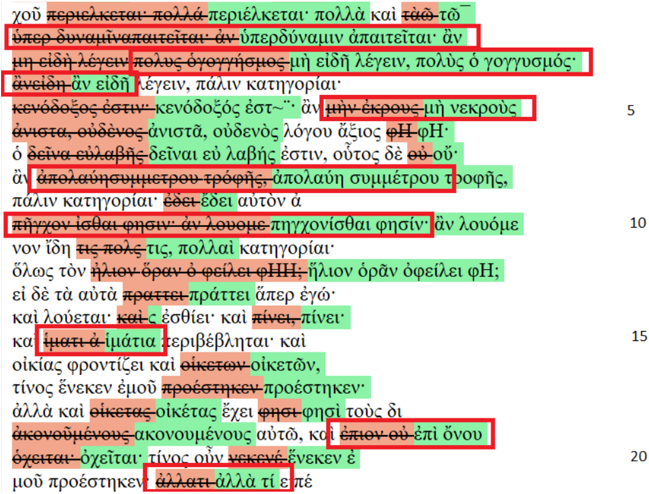
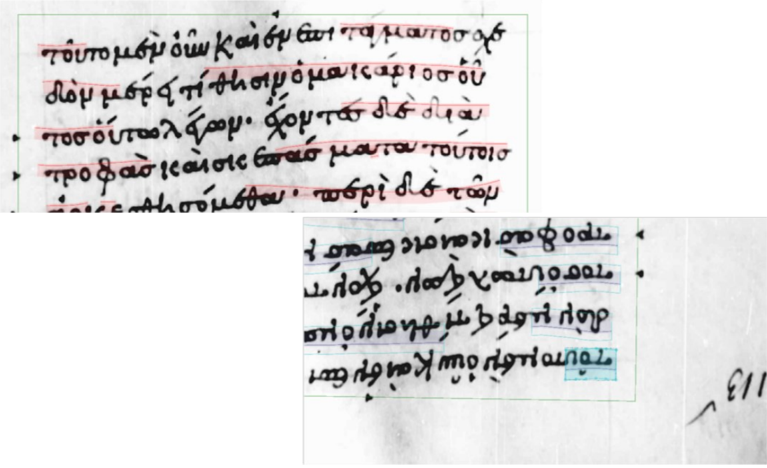
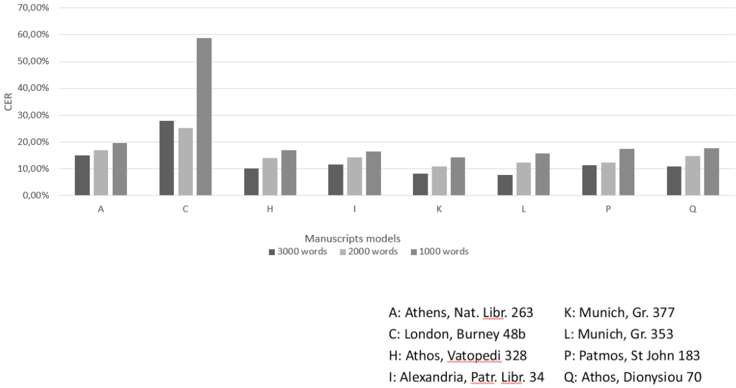
HTR (Handwritten Text Recognition) technologies have progressed enough to offer high-accuracy results in recognising handwritten documents, even on a synchronous level. Despite the state-of-the-art algorithms and software, historical documents (especially those written in Greek) remain a real-world challenge for researchers. A large number of unedited or under-edited works of Greek Literature (ancient or Byzantine, especially the latter) exist to this day due to the complexity of producing critical editions. To critically edit a literary text, scholars need to pinpoint text variations on several manuscripts, which requires fully (or at least partially) transcribed manuscripts. For a large manuscript tradition (i.e., a large number of manuscripts transmitting the same work), such a process can be a painstaking and time-consuming project. To that end, HTR algorithms that train AI models can significantly assist, even when not resulting in entirely accurate transcriptions. Deep learning models, though, require a quantum of data to be effective. This, in turn, intensifies the same problem: big (transcribed) data require heavy loads of manual transcriptions as training sets. In the absence of such transcriptions, this study experiments with training sets of various sizes to determine the minimum amount of manual transcription needed to produce usable results. HTR models are trained through the Transkribus platform on manuscripts from multiple works of a single Byzantine author, John Chrysostom. By gradually reducing the number of manually transcribed texts and by training mixed models from multiple manuscripts, economic transcriptions of large bodies of manuscripts (in the hundreds) can be achieved. Results of these experiments show that if the right combination of manuscripts is selected, and with the transfer-learning tools provided by Transkribus, the required training sets can be reduced by up to 80%. Certain peculiarities of Greek manuscripts, which lead to easy automated cleaning of resulting transcriptions, could further improve these results. The ultimate goal of these experiments is to produce a transcription with the minimum required accuracy (and therefore the minimum manual input) for text clustering. If we can accurately assess HTR learning and outcomes, we may find that less data could be enough. This case study proposes a solution for researching/editing authors and works that were popular enough to survive in hundreds (if not thousands) of manuscripts and are, therefore, unfeasible to be evaluated by humans.
Overview
The claims and statistics of this paper haven’t been checked yet.
Run the check — free, no account needed. It reads the open-access text and checks the sources it cites.
Integrity signals
Registry
Cites
Statistics
Figures

Verification
Claims the paper makes
The claims and statistics of this paper haven’t been checked yet.
Run the check — free, no account needed. It reads the open-access text and checks the sources it cites.
Claims other papers make about this one
Each is checked against this paper’s own text: does it say what the citing paper says it does?
In the citing paper
“At the same time, ambiguous punctuation, capital letters, and non alphabetical character formation can also artificially inflate error rates (Perdiki 2023).”
From Unlocking the archives: Using large language models to transcribe handwritten historical documents (2025) · cites this paper as Perdiki 2023
Self-check
Percentages, sums and reported differences re-computed from the paper’s own numbers.
The self-check needs the paper’s full text.
Citations
Cites
No references could be resolved yet.
Research works printed but not linked: 26
- Augustin, P., Binggeli, A. and Cassin, M. La base de données Pinakes: textes et manuscrits grecs. Scriptorium, 2009;63(1):148-149.
- Clérice, T. Ground-Truth Free Evaluation of HTR on Old French and Latin Medieval Literary Manuscripts. Proceedings of the Computational Humanities Research Conference 2022, edited by Folgert Karsdorp, Alie Lassche, and Kristoffer Nielbo, 2022a;3290:1-24. CEUR Workshop Proceedings. Antwerp, Belgium: CEUR. https://ceur-ws.org/Vol- 3290/#long_paper2081.
- Clérice, T. You Actually Look Twice At it (YALTAi): using an object detection approach instead of region segmentation within the Kraken engine. arXiv, 2022b. Available at: https://doi.org/10.48550/arXiv.2207.11230. · DOI
- Firmani, D., Maiorino, M., Merialdo, P., & Nieddu, E., Towards Knowledge Discovery from the Vatican Secret Archives. In Codice Ratio --Episode 1: Machine Transcription of the Manuscripts. Proceedings of the 24th ACM SIGKDD International Conference on Knowledge Discovery & Data Mining, 2018:263-272. Available at: https://doi.org/10.1145/3219819.3219879. · DOI
- Ingle, R. R., Fujii, Y., Deselaers, T., Baccash, J., & Popat, A. C., A Scalable Handwritten Text Recognition System. 2019 International Conference on Document Analysis and Recognition (ICDAR), 2019:17-24. Available at: https://doi.org/10.1109/ICDAR.2019.00013. · DOI
- Kahle, P., Colutto, S., Hackl, G., & Mühlberger, G., Transkribus -A Service Platform for Transcription, Recognition and Retrieval of Historical Documents. 2017 14th IAPR International Conference on Document Analysis and Recognition (ICDAR), Kyoto: IEEE, 2017:19-24. Available at: https://doi.org/10.1109/ICDAR.2017.307. · DOI · Paper page
- Kang, L., Riba, P., Rusiñol, M., Fornés, A., & Villegas, M., Pay attention to what you read: Non-recurrent handwritten text- Line recognition. Pattern Recognition, 2022;129:108766. Available at: https://doi.org/10.1016/j.patcog.2022.108766. · DOI
- Kiessling, B., Kraken -an Universal Text Recognizer for the Humanities. In ADHO, Éd., Actes de Digital Humanities Conference, 2019.
- Kiessling, B., Tissot, R., Stokes, P., & Ezra, D. S. B., eScriptorium: An Open Source Platform for Historical Document Analysis. 2019 International Conference on Document Analysis and Recognition Workshops (ICDARW), 2019:19-19. Available at: https://doi.org/10.1109/ICDARW.2019.10032. · DOI
- Konstantinidou, M. The Double Tradition of John Chrysostom's Exegetical Works: Revisions Revisited. M. Vinzent, G. Bady, and C. Broc-Schmezer (eds) Studia Patristica. Vol. CXIV -Papers presented at the Eighteenth International Conference on Patristic Studies held in Oxford 2019. Peeters Publishers (Volume 11: John Chrysostom through Manuscripts, Editions and History), 2021:5-26. Available at: https://doi.org/10.2307/j.ctv27vt5gb. · DOI
- Macé, C. and Baret, P.V. Why Phylogenetic Methods Work : The Theory of Evolution and Textual Criticism. Linguistica computazionale [Preprint], 2004:(24/25). Available at: https://doi.org/10.1400/54380. · DOI
- Muehlberger, G., Seaward, L., Terras, M., Oliveira, S. A., Bosch, V., Bryan, M., ... & Zagoris, K., Transforming scholarship in the archives through handwritten text recognition: Transkribus as a case study. Journal of Documentation, 2019;75(5):954-976. Available at: https://doi.org/10.1108/JD-07-2018-0114. · DOI · Paper page
- Pang, B., Nijkamp, E. and Wu, Y.N. Deep Learning With TensorFlow: A Review. Journal of Educational and Behavioral Statistics, 2020;45(2):227-248. Available at: https://doi.org/10.3102/1076998619872761. · DOI
- Patel, C., Patel, A. and Patel, D. Optical Character Recognition by Open source OCR Tool Tesseract: A Case Study. International Journal of Computer Applications, 2012;55(10):50-56. Available at: https://doi.org/10.5120/8794-2784. · DOI
- Pavlopoulos, J., Kougia, V., Platanou, P., Shabalin, S., Liagkou, K., Papadatos E., Essler H., Camps J.B., Fischer, F., Error Correcting HTR'ed Byzantine Text, 15 May 2023, PREPRINT (Version 1) available at Research Square: https://doi.org/10.21203/rs.3.rs-2921088/v1 · DOI
- Rabus, A. Recognizing handwritten text in Slavic manuscripts: A neural-network approach using Transkribus. Scripta & e- Scripta, 2019;19:9-32.
- Sánchez, J. A., Romero, V., Toselli, A. H., Villegas, M., & Vidal, E. A set of benchmarks for Handwritten Text Recognition on historical documents. Pattern Recognition, 2019;94:122-134. Available at: https://doi.org/10.1016/j.patcog.2019.05.025. · DOI
- Schoen, J. and Saretto, G.E. Optical Character Recognition (OCR) and Medieval Manuscripts: Reconsidering Transcriptions in the Digital Age. Digital Philology: A Journal of Medieval Cultures, 2022;11(1):174-206. Available at: https://doi.org/10.1353/dph.2022.0010. · DOI
- Smith, R. An Overview of the Tesseract OCR Engine. Ninth International Conference on Document Analysis and Recognition (ICDAR 2007), 2007:629-633. Available at: https://doi.org/10.1109/ICDAR.2007.4376991. · DOI
- Spencer, M., Davidson, E. A., Barbrook, A. C., & Howe, C. J., Phylogenetics of artificial manuscripts. Journal of Theoretical Biology, 2004;227(4):503-511. Available at: https://doi.org/10.1016/j.jtbi.2003.11.022. · DOI
- Ströbel, P. and Clematide, S. Improving OCR of Black Letter in Historical Newspapers: The Unreasonable Effectiveness of HTR Models on Low-Resolution Images. Digital Humanities 2019 [Preprint], 2019. Available at: https://doi.org/10.5167/UZH-177164. · DOI
- Ströbel, P. B., Clematide, S., Volk, M., Schwitter, R., Hodel, T., & Schoch, D., Evaluation of HTR models without Ground Truth Material. Proceedings of the Thirteenth Language Resources and Evaluation Conference. LREC 2022, Marseille, France: European Language Resources Association, 2022:4395-4404. Available at: https://aclanthology.org/2022.lrec- 1.467 (Accessed: 17 January 2023).
- Ströbel, P.B., Clematide, S. and Volk, M. How Much Data Do You Need? About the Creation of a Ground Truth for Black Letter and the Effectiveness of Neural OCR. Proceedings of the 12th Language Resources and Evaluation Conference. LREC 2020, Marseille, France: European Language Resources Association, 2020:3551-3559. Available at: https://www.aclweb.org/anthology/2020.lrec-1.436 (Accessed: 14 October 2020).
- Stutzmann, D., Clustering of medieval scripts through computer image analysis: Towards an evaluation protocol. Digital Medievalist, 2016;10. DOI: http://doi.org/10.16995/dm. · DOI
- Tomoiaga, C., Feng, P., Salzmann, M., & Jayet, P., Field typing for improved recognition on heterogeneous handwritten forms. arXiv, 2019. Available at: http://arxiv.org/abs/1909.10120 (Accessed: 27 October 2022). · arXiv
- Tsochatzidis, L., Symeonidis, S., Papazoglou, A., & Pratikakis, I., HTR for Greek Historical Handwritten Documents. Journal of Imaging, 2021;7(12):260. Available at: https://doi.org/10.3390/jimaging7120260. · DOI
Cited by
Unlocking the archives: Using large language models to transcribe handwritten historical documents
Humphries, M., Leddy, L. C., Downton, Q., Legace, M., McConnell, J., Murray, I., & Spence, E. (2025) · Historical Methods: A Journal of Quantitative and Interdisciplinary History · doi:10.1080/01615440.2025.2500309 · Cited by 72
Metadata
- Authors
- Perdiki, E.
- Affiliations
- Democritus University of Thrace
- ORCID
- Perdiki, Elpida
- Venue
- Journal of Data Mining & Digital Humanities
- Published
- 2023-12-20
- Volume
- Historical Documents and...
- Issue
- Sciences of Antiquity and...
- ISSN
- 2416-5999
- Cited by
- 2
- References
- 0
- Language
- en
About these checks
Registry, retraction, Cites and statistics results are computed, not judged, with one exception: a printed reference that no index lists is read once by a model before it counts as a citation error. Claims are extracted by a model and kept only when their quote appears verbatim in the text; each cited source is then checked, with a model’s help, for whether it says what the claim relies on. Those verdicts can be wrong — read the claim’s quote and the cited source before relying on one.
Statistics and arithmetic are recomputed, not judged.
Confidence bands are shown only for fields calibrated on our annotated test set. None is calibrated yet, so no band is shown.
What counts as a claim ›How we measure confidence ›How we check this ›
Are you an author, or do you see a problem with this page? Request a review
How to cite
Cite CoChat for the checks on this page, and the paper for its own findings.
- This page
- CoChat. (2026). Citation check: Preparing Big Manuscript Data for Hierarchical Clustering with Minimal HTR Training. https://app.cochat.ai/papers/10.46298/jdmdh.10419
- The paper
- Perdiki, E. (2023). Preparing Big Manuscript Data for Hierarchical Clustering with Minimal HTR Training. Journal of Data Mining & Digital Humanities. https://doi.org/10.46298/jdmdh.10419
Data sources
Bibliographic data: Semantic Scholar, OpenAlex, Crossref.
Contains information from the Semantic Scholar Academic Graph Datasets, made available under the ODC Attribution License (ODC-BY 1.0).
Semantic Scholar’s data is described in: Kinney, R., et al. (2023). The Semantic Scholar Open Data Platform. arXiv:2301.10140.
