

The DOI matches its Crossref record.
Investigating the Effects of Tablet-Based Math Interventions: A Meta-Analysis
Open accessAbstract
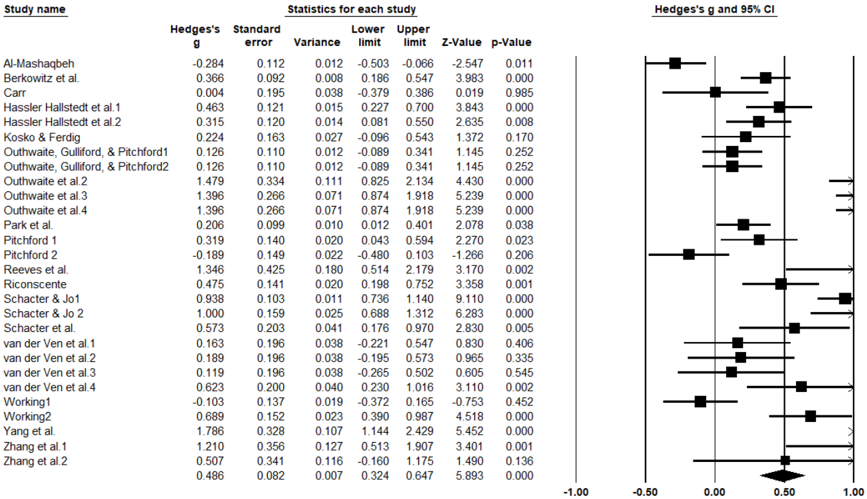
There is debate over the effectiveness of using touch-screen tablet technology on overall student learning gains. This article provides a meta-analysis of studies that used tablets for the delivery of math interventions, programs, or apps to increase student math achievement. A total of 20 group design studies with 2,805 participants were included in the meta-analysis. Overall, tablet-based math interventions provided moderate positive effects for student math gains. Significant moderator variables included participant ethnicity, and socio-economic status, selecting a specific app for use, minutes in intervention, dependent variable, and type of control group. Discussion focuses on the need for more rigorous methodology and reporting of participant and design variables in future studies and the implications for researchers and practitioners when using tablets as a delivery method for math interventions.
Overview
The claims and statistics of this paper haven’t been checked yet.
Run the check — free, no account needed. It reads the open-access text and checks the sources it cites.
Integrity signals
Registry
Cites
Statistics
Figures
Verification
Claims the paper makes
The claims and statistics of this paper haven’t been checked yet.
Run the check — free, no account needed. It reads the open-access text and checks the sources it cites.
Claims other papers make about this one
Each is checked against this paper’s own text: does it say what the citing paper says it does?
The cited source says what the claim attributes to it.
In the citing paper
“A meta-analysis by Aspiranti and Larwin (2021) examining 20 group design studies with 2,805 participants found that tablet-based math interventions provided moderate positive effects for student mathematics gains.”
From Effects of a Realistic Mathematics Education-Based Tablet Intervention on Second-Grade Addition Skills (2026) · cites this paper as Aspiranti and Larwin (2021)
Self-check
Percentages, sums and reported differences re-computed from the paper’s own numbers.
The self-check needs the paper’s full text.
Citations
Cites
No references could be resolved yet.
Research works printed but not linked: 38
- Al-Mashaqbeh, I. F. (2016). iPad in elementary school math learning setting. International Journal of Emerging Technologies in Learning, 11(2), 48-52. https://doi.org/10.3991/ijet.v11i02.5053 · DOI
- Aspiranti, K. B., Larwin, K. H., & Shade, B. (2020). iPads/tablets and students with autism: An analysis of academic effects. Assistive Technology, 32(1), 23-30. https://doi.org/10.1080/10400435.2018.1463575 · DOI
- Berkowitz, T., Schaeffer, M. W., Maloney, E. A., Peterson, L., Gregor, C., Levine, S. C., & Beilock, S. L. (2015). Math at home adds up to achievement in school. Science, 350(6257), 196-198.
- Blackwell, C. (2014). Teacher practices with mobile technology: integrating tablet computers into the early childhood classroom. Journal of Education Research, 7(4), 231-255.
- Bryant, B., Ok, M., Kang, E., Kim, M., Lang, R. R., Bryant, D., & Pfannestiel, K. (2015). Performance of fourth-grade students with learning disabilities on multiplication facts comparing teacher-mediated and technology-mediated interventions: A preliminary investigation. Journal of Behavioral Education, 24, 255-272. https://doi.org/10.1007/s10864-015-9218-z * · DOI
- Carr, J. M. (2012). Does math achievement h'APP'en when iPads and game-based learning are incorporated into fifth-grade mathematics instruction? Journal of Information Technology Education, 11(1), 269-286.
- Cheung, A., & Slavin, R. E. (2013). The effectiveness of educational technology applications on mathematics achievement in K-12 classrooms: A meta-analysis. Educational Research Review, 9, 88-113. https://doi.org/10.1016/j.edurev.2013.01.001 · DOI · Paper page
- Cooper, L. Z. (2005). Developmentally appropriate digital environments for young children. Library Trends, 54(2), 286-302. https://doi.org/0.1353/lib.2006.0014
- Creech-Galloway, C., Collins, B. C., Knight, V., & Bausch, M. (2013). Using a simultaneous prompting procedure with an iPad to teach the Pythagorean Theorem to adolescents with moderate intellectual disability. Research & Practice for Persons with Severe Disabilities, 38(4), 222-232. https://doi.org/10.1177/154079691303800402 · DOI
- Ferrer, F., Belvís, E., & Pàmies, J. (2011). Tablet PCs, academic results and educational inequalities. Computers & Education, 56(1), 280-288. https://doi.org/10.1016/j.compedu.2010.07.018 · DOI
- Hammer, C. S. (2011). From the editor: The importance of participant demographics. American Journal of Speech-Language Pathology, 20(4), 261. https://doi.org/10.1044/1058-0360(2011/ed-04) · DOI
- Hassler Hallstedt, M., Klingberg, T., & Ghaderi, A. (2018). Short and long-term effects of a mathematics tablet intervention for low performing second graders. Journal of Educational Psychology, 110(8), 1127-1148.
- Haydon, T., Hawkins, R., Denune, H., Kimener, L., McCoy, D., & Basham, J. (2012). A comparison of iPads and worksheets on math skills of high school students with emotional disturbance. Behavioral Disorders, 37(4), 232-243. https://doi.org/10.1177/019874291203700404 · DOI
- Hutchison, A., Beschorner, B., & Schmidt-Crawford, D. (2012). Exploring the use of the iPad for literacy learning. Reading Teacher, 66(1), 15-23. https://doi.org/10.1002/TRTR.01090 · DOI
- Kaur, D., Koval, A., & Chaney, H. (2017). Potential of using iPad as a supplement to teach math to students with learning disabilities. International Journal of Research in Education and Science, 3(1), 114-121.
- Kim, J., & Kimm, C. H. (2017). Functional technology for individuals with intellectual disabilities: Meta- analysis of mobile device-based interventions. Journal of Special Education Apprenticeship, 6(1), 1-22.
- Kosko, K. W., & Ferdig, R. E. (2016). Effects of tablet-based mathematics application for pre-school children. Journal of Computers in Mathematics and Science Teaching, 35(1), 61-79.
- Kucirkova, N. (2014). iPads in early education: Separating assumptions and evidence. Frontiers in Psychology, 5(715), 1-3. https://doi.org/10.3389/fpsyg.2014.00715 · DOI · Paper page
- Lapek, J. (2017). 21st century skills: The tools students need. Children's Technology & Engineering, 21(3), 24- 26.
- Larkin, K. (2013). Mathematics education: Is there an app for that? In V. Steinle, L. Ball, & C. Bardini (Eds.), Mathematics Education Research Group of Australasia (pp. 426-433). Melbourne, Australia: MERGA.
- Musti-Rao, S., & Plati, E. (2015). Comparing two classwide interventions: Implications of using technology for increasing multiplication fact fluency. Journal of Behavioral Education, 24(4), 418-437. https://doi.org/10.1007/s10864-015-9228-x · DOI
- Neumann, M. M., & Neumann, D. L. (2014). Touch screen tablets and emergent literacy. Early ChildhoodEducation, 42, 231-239. https://doi.org/10.1007/S10643-013-0608-3 · DOI
- Ok, M. W., & Bryant, D. P. (2016). Effects of a strategic intervention with iPad practice on the multiplication fact performance of fifth-grade students with learning disabilities. Learning Disability Quarterly, 39(3), 146-158.
- Ok, M. W., & Kim, W. (2017). Use of iPads and iPods for academic performance and engagement of preK-12 students with disabilities: A research synthesis. Exceptionality, 25(3), 54-75.
- O'Malley, P., Lewis, M. E. B., Donehower, C., & Stone, D. (2014). Effectiveness of using iPads to increase academic task completion by students with autism. Universal Journal of Educational Research, 2(1), 90- 97. https://doi.org/10.13189/ujer.2014.020111 · DOI
- Outhwaite, L. A., Gulliford, A., & Pitchford, N. J. (2017). Closing the gap: Efficacy of a tablet intervention to support the development of early mathematical skills in UK primary school children. Computers & Education, 108, 43-58. https://doi.org/10.1016/j.compedu.2017.01.011 · DOI · Paper page
- Park, J., Bermudez, V., Roberts, R. C., & Brannon, E. M. (2016). Non-symbolic approximate arithmetic training improves math performance in preschoolers. Journal of Experimental Child Psychology, 152, 278-293. https://doi.org/10.1016/j.jecp.2016.07.011 · DOI
- Petersen-Brown, S. M., Henze, E. E. C., Klingbeil, D. A., Reynolds, J. L., Weber, R. C., & Codding, R. S. (2019). The use of touch devices for enhancing academic achievement: A meta-analysis. Psychology in the Schools, 56(7), 1187-1206. https://doi.org/10.1002/pits.22225 · DOI
- Powell, S. (2014). Choosing iPad apps with a purpose: Aligning skills and standards. Teaching Exceptional Children, 47(1), 20-26. https://doi.org/10.1177/0040059914542765 * · DOI
- Reeves, J. L., Gunter, G. A., & Lacey, C. (2017). Mobile learning in pre-kindergarten: Using student feedback to inform practice. Journal of Educational Technology & Society, 20(1), 37-44.
- Riconscente, M. M. (2013). Results from a controlled study of the iPad fractions game Motion Math. Games and Culture: A Journal of Interactive Media, 8(4), 186-214. https://doi.org/10.1177/1555412013496894 * · DOI
- Schacter, J., Shih, J., Allen, C. M., DeVaul, L., Adkins, A. B., Ito, T., & Jo, B. (2016). Math Shelf: A randomized trial of a prekindergarten tablet number sense curriculum. Early Education & Development, 27(1), 74-88. https://doi.org/10.1080/10409289.2015.1057462 · DOI
- Schacter, J., & Jo, B. (2016). Improving low-income preschoolers mathematics achievement with Math Shelf: A preschool tablet computer curriculum. Computers in Human Behavior, 55, 223-229. https://doi.org/0.1016/j.chb.2015.09.013
- Schacter, J., & Jo, B. (2017). Improving preschoolers' mathematics achievement with tablets: A randomized controlled trial. Mathematics Education Research Journal, 29(3), 313-327. https://doi.org/10.1007/s13394-017-0203-9 * · DOI · Paper page
- van der Ven, F., Segers, E., Takashima, A., & Verhoeven, L. (2017). Effects of a tablet game intervention on simple addition and subtraction fluency in first graders. Computers in Human Behavior, 72, 200-207. https://doi.org/10.1016/j.chb.2017.02.031 · DOI
- Working, C. (2018). The effects of technology-mediated dialogic learning in elementary mathematics instruction. Journal of Computers in Mathematics and Science Teaching, 37(3), 265-286.
- Yang, E. Y., Chang, B., Cheng, H. H., & Chan, T. (2016). Improving pupils' mathematical communication abilities through computer-supported reciprocal peer tutoring. Journal of Educational Technology & Society, 19(4), 157-169.
- Zhang, M., Trussell, R., Gallegos, B., & Asam, R. (2015). Using math apps for improving student learning: An exploratory study in an inclusive fourth grade classroom. Techtrends, 59(2), 32-39. https://doi.org/10.1007/s11528-015-0837-y · DOI
Cited by
Sorted by citations
Svane, R. P., Willemsen, M. M., Bleses, D., Krøjgaard, P., Verner, M., & Nielsen, H. S. (2023) · Frontiers in Education · doi:10.3389/feduc.2023.1229849 · Cited by 27
Skordialos, E., Baralis, G., & Zaranis, N. (2026) · Advances in Mobile Learning Educational Research · doi:10.25082/amler.2026.01.007 · Cited by 3
“A meta-analysis by Aspiranti and Larwin (2021) examining 20 group design studies with 2,805 participants found that tablet-based math interventions provided moderate positive effects for student mathematics gains.”
Metadata
- Authors
- Aspiranti, K. B., & Larwin, K. H.
- Affiliations
- University of Kentucky (US)
- Youngstown State University (US)
- Venue
- International Journal of Technology in Education and Science
- Publisher
- ISTES Organization
- Published
- 2021-09-28
- Volume
- 5
- Issue
- 4
- Pages
- 629-647
- ISSN
- 2651-5369 (ISSN-L)
- OpenAlex
- W3204012758
- Cited by
- 15
- References
- 0
- Citations by year
- 2026: 3 · 2025: 4 · 2024: 3 · 2023: 5
- FWCI
- 0.49
- Type
- journal article
- Language
- en
- Open access
- diamond
- doi.org
- Licence
- Locations
- International Journal of Technology in Education and Science (publishedVersion, cc-by-nc-sa)
- Topics
- Social Sciences › Education › Education and Technology Integration
- Social Sciences › Education › Mathematics Education and Teaching Techniques
- Social Sciences › Psychology › Developmental and Educational Psychology › Cognitive and developmental aspects of mathematical skills
- Keywords
- tablet-based intervention, mathematics achievement, educational technology, touch screen tablets, intervention effectiveness, learning gains, ethnicity, socioeconomic status, intervention duration, control group design
About these checks
Registry, retraction, Cites and statistics results are computed, not judged, with one exception: a printed reference that no index lists is read once by a model before it counts as a citation error. Claims are extracted by a model and kept only when their quote appears verbatim in the text; each cited source is then checked, with a model’s help, for whether it says what the claim relies on. Those verdicts can be wrong — read the claim’s quote and the cited source before relying on one.
Statistics and arithmetic are recomputed, not judged.
Confidence bands are shown only for fields calibrated on our annotated test set. None is calibrated yet, so no band is shown.
What counts as a claim ›How we measure confidence ›How we check this ›
Are you an author, or do you see a problem with this page? Request a review
How to cite
Cite CoChat for the checks on this page, and the paper for its own findings.
- This page
- CoChat. (2026). Citation check: Investigating the Effects of Tablet-Based Math Interventions: A Meta-Analysis. https://app.cochat.ai/papers/10.46328/ijtes.266
- The paper
- Aspiranti, K. B., & Larwin, K. H. (2021). Investigating the Effects of Tablet-Based Math Interventions: A Meta-Analysis. International Journal of Technology in Education and Science. https://doi.org/10.46328/ijtes.266
