

The DOI matches its Crossref record; 32 of the 32 references it cites were found in a registry or an index; none of the 28 sources its claims cite is checked for support yet.
Exploring Relationships between Needs and Solutions in Solution Focused Brief Therapy: A Recursive Frame Analysis
Open accessAbstract
Focus is a critical component in solution focused brief therapy (SFBT; de Shazer et al., 1986), yet little research has been conducted on how SFBT therapists utilize the clients’ focus on their awareness of needs to relationally build solutions (Reiter & Chenail, 2016). To address this gap, we reviewed the notion of utilizing clients’ focus in SFBT conceptually and presented the results of our discovery-oriented qualitative study of a classic training case conducted by one of SFBT’s co-developers, Insoo Kim Berg (1994). We explored how Berg appeared to demonstrate relationally focused solution development. The findings suggest that Berg’s therapeutic style and recursive nature facilitates the clients’ awareness of needs in all stages, tapping into the clients’ internal wisdom to enhance movement towards solutions.
Overview
CoChat Summary
TL;DR
This qualitative recursive frame analysis of Insoo Kim Berg’s two-session couple therapy training case found that clients’ needs and solutions surfaced simultaneously and recursively across the SFBT problem, goal, and exception stages. Berg’s relational, curious style appeared to facilitate awareness of needs and internal wisdom, supporting movement toward solutions.
Key findings
- Across the problem, goal, and exception stages, clients’ needs and solutions surfaced simultaneously, with “problem talk” and “solution talk” occurring recursively back and forth between stages.
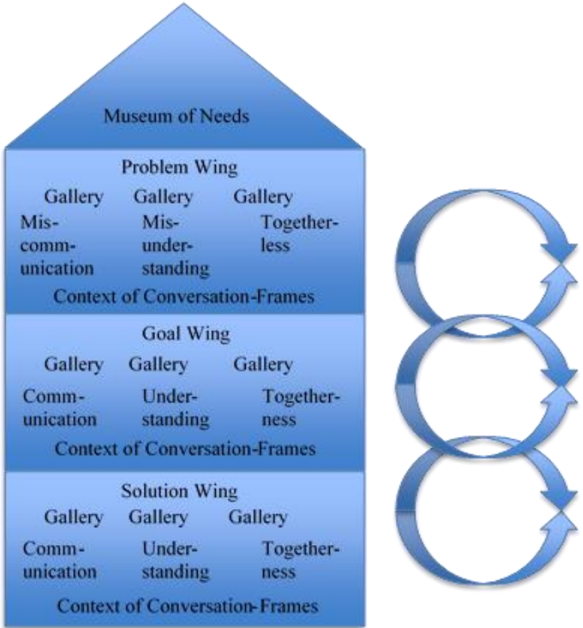
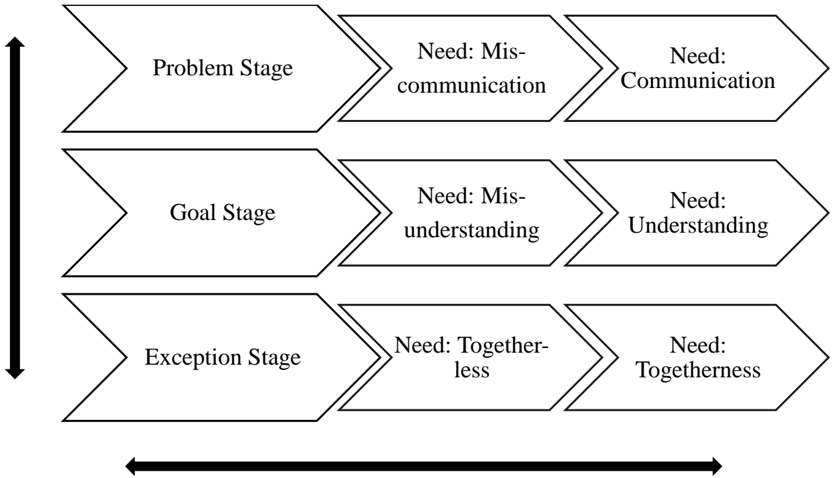
- Three primary themes/galleries emerged: communication, understanding, and togetherness; these needs remained the focus in all stages, framed slightly differently depending on the stage and gallery.
- Berg’s questions and responses facilitated clients’ articulation of needs and solutions; the authors describe an “unframing” from problem frames to solution frames (e.g., miscommunication to communication, misunderstanding to understanding, togetherless to togetherness).
- The authors suggest that awareness of needs taps into clients’ internal wisdom and can facilitate solution generating, and they note that attention to needs is missing from current SFBT literature.
Methods
- Discovery-oriented qualitative study using recursive frame analysis (RFA) of a classic training case: Insoo Kim Berg’s (1994) two SFBT sessions with a couple, “Leslie” and “Bill,” who were actors in a commercially available training video.
- The first author/principal investigator watched and listened to the sessions, transcribed them, numbered speaker turns, and coded talk into RFA terms (museum, wings, galleries, frames), focusing on three primary SFBT stages: problems, goals, and exceptions; scaling and feedback were not focused on because they are primarily meta to the other three stages.
- Credibility procedures included the principal investigator reviewing transcription accuracy, extracting ample transcript excerpts, and consulting with the second author as a peer reviewer throughout the research design, RFA analysis, and results review.
Limitations
- Stated: the study involved a single reconstructed case, in two sessions, of Insoo Kim Berg’s SFBT; Berg and her clients are no longer available for member checking, so their intent could not be checked.
- Stated: RFA relies on the researcher’s view of what they are researching; the analysis was primarily through the principal investigator’s lens, with consultation from the second author, and readers are left to assess the quality of the findings.
- Evident from the text: the case used actors and a commercially released training video rather than naturalistic therapy, and only two sessions and three SFBT stages were analyzed, limiting generalizability.
Model-written summary. Check it against the paper before relying on it.
Integrity signals
Registry
Cites
Statistics
Figures

Verification
Claims the paper makes
0 Valid · 2 Not valid · 24 Not checked · 62 Own results and interpretations
A result the paper reports from its own data — it cites no other source for it, so there is none to check. The quote shows it is in the paper.
In the paper
“In this session, Berg seemed to work towards accomplishing this goal and used language by taking a position of not knowing to facilitate the clients in their awareness towards their needs.”
§ Exploring Relationships between Needs and Solutions in Solution Focused Brief Exploring Relationships between Needs and Solutions in Solution Focused Brief Therapy: A Recursive Frame Analysis Therapy: A Recursive Frame Analysis > Stage 1: Problems
hedgedstates a causeSingle case- Asserted: passes — The authors put it forward as true.
- Checkable: passes — It can be checked against evidence.
- Load-bearing: unclear — It is unclear whether the paper’s conclusions depend on it.
- Based: passes — The paper gives a reason why it holds.
A result the paper reports from its own data — it cites no other source for it, so there is none to check. The quote shows it is in the paper.
In the paper
“Through Berg's questions, she facilitated the clients' expressions of their needs in relationship to their goals.”
§ Exploring Relationships between Needs and Solutions in Solution Focused Brief Exploring Relationships between Needs and Solutions in Solution Focused Brief Therapy: A Recursive Frame Analysis Therapy: A Recursive Frame Analysis > Stage 2: Goals
plainstates a causeSingle case- Asserted: passes — The authors put it forward as true.
- Checkable: passes — It can be checked against evidence.
- Load-bearing: passes — The paper’s conclusions depend on it.
- Based: passes — The paper gives a reason why it holds.
A result the paper reports from its own data — it cites no other source for it, so there is none to check. The quote shows it is in the paper.
In the paper
“the description of needs was noted and coded, categorized (the frames), and put into three primary themes (galleries): communication, understanding, and togetherness.”
§ Exploring Relationships between Needs and Solutions in Solution Focused Brief Exploring Relationships between Needs and Solutions in Solution Focused Brief Therapy: A Recursive Frame Analysis Therapy: A Recursive Frame Analysis > Results
plain- Asserted: passes — The authors put it forward as true.
- Checkable: passes — It can be checked against evidence.
- Load-bearing: passes — The paper’s conclusions depend on it.
- Based: passes — The paper gives a reason why it holds.
A result the paper reports from its own data — it cites no other source for it, so there is none to check. The quote shows it is in the paper.
In the paper
“In this study, exceptions, strengths, and possibilities were also found to be significant-but in addition-the client's needs were closely addressed and utilized in each of primary stages.”
§ Exploring Relationships between Needs and Solutions in Solution Focused Brief Exploring Relationships between Needs and Solutions in Solution Focused Brief Therapy: A Recursive Frame Analysis Therapy: A Recursive Frame Analysis > Discussion
plainstates an associationSingle case- Asserted: passes — The authors put it forward as true.
- Checkable: passes — It can be checked against evidence.
- Load-bearing: passes — The paper’s conclusions depend on it.
- Based: passes — The paper gives a reason why it holds.
- Rests on an assumption not shown here.
A result the paper reports from its own data — it cites no other source for it, so there is none to check. The quote shows it is in the paper.
In the paper
“A recursive relationship was noted between the needs and the solutions throughout the sessions moving forward and back between the stages (the wings) of problems, goals, and exceptions.”
§ Exploring Relationships between Needs and Solutions in Solution Focused Brief Exploring Relationships between Needs and Solutions in Solution Focused Brief Therapy: A Recursive Frame Analysis Therapy: A Recursive Frame Analysis > Results
plainstates an association- Asserted: passes — The authors put it forward as true.
- Checkable: passes — It can be checked against evidence.
- Load-bearing: passes — The paper’s conclusions depend on it.
- Based: passes — The paper gives a reason why it holds.
23 more claims
Create a free account to see all 88 claims and to verify the 11 references still open.
- It may state two separate claims as one. 38
- Probably not a substantial claim. 49
Self-check
Percentages, sums and reported differences re-computed from the paper’s own numbers.
Each contradiction between two passages listed here was confirmed by an independent check.
Rated minor: it would not touch a result — a value no result rests on, a p-value that stays on the same side of the significance level, or a conflict that is clerical, resolved elsewhere in the paper, or outside its own findings.
In the paper
§ Exploring Relationships between Needs and Solutions in Solution Focused Brief Exploring Relationships between Needs and Solutions in Solution Focused Brief Therapy: A Recursive Frame Analysis Therapy: A Recursive Frame Analysis > Stage 3: Exceptions
“The themes (frames) remain the same in all stages (galleries) but framed slightly differently depending on the gallery.”
§ Exploring Relationships between Needs and Solutions in Solution Focused Brief Exploring Relationships between Needs and Solutions in Solution Focused Brief Therapy: A Recursive Frame Analysis Therapy: A Recursive Frame Analysis > Procedures
“I read line-by-line and listened to the conversations utilizing RFA to put the primary SFBT stages into wings (i.e., the conversational topics they discussed such as problems, goals, and exceptions), the context of the conversations into frames, and the frames into galleries (i.e., conversational topics, such as communication).”
Citations
Cites
Bateson, G. (2000) · University of Chicago Press eBooks · doi:10.7208/chicago/9780226924601.001.0001 · Cited by 3,401
Brief Therapy: Focused Solution Development
DE SHAZER, S., BERG, I. K., LIPCHIK, E., NUNNALLY, E., MOLNAR, A., GINGERICH, W., & WEINER‐DAVIS, M. (1986) · Family Process · doi:10.1111/j.1545-5300.1986.00207.x · Cited by 686
Nonviolent Communication: A Language of Life
Rosenberg, M. B. (2003) · Medical Entomology and Zoology · Cited by 618
Interviewing for solutions: (519732004-001)
(2013) · PsycEXTRA Dataset · doi:10.1037/e519732004-001 · Cited by 601
Examining the Effectiveness of Solution-Focused Brief Therapy: A Meta-Analysis
Kim, J. S. (2008) · Research on Social Work Practice · doi:10.1177/1049731507307807 · Cited by 294
A Sacred Unity - Further Steps to an Ecology of Mind
Bateson, G., & Donaldson, R. E. (1991) · doi:10.1037/031536 · Cited by 248
Chenail, R. J. (2014) · The Qualitative Report · doi:10.46743/2160-3715/2011.1324 · Cited by 164
Self-citationSolution-focused brief therapy a handbook of evidence-based practice
Franklin, C. (2012) · Cited by 114
Family therapy and the politics of evidence
Larner, G. (2004) · Journal of Family Therapy · doi:10.1111/j.1467-6427.2004.00265.x · Cited by 104
Further Thoughts on Second‐Order Family Therapy — This Time It's Personal
Atkinson, B. J., & Heath, A. W. (1990) · Family Process · doi:10.1111/j.1545-5300.1990.00145.x · Cited by 85
Research works printed but not linked: 6
- Erickson, M. H., & Rossi, E. L. (1980). Varieties of double bind. In E. L. Rossi (Ed.), The collected papers of Milton H. Erickson: Vol. 1 (pp. 412-429). New York, NY: Irvington.
- Hoyt, M. F., & Berg, I. K. (1998a). Solution-focused couple therapy: Helping clients construct self-fulfilling realities. In F. M. Dattilio (Ed.), Case studies in couple and family therapy: Systemic and cognitive perspectives (pp. 203-232). New York, NY: Guilford Press.
- Hoyt, M. F., & Berg, I. K. (1998b). Solution-focused couple therapy: Helping clients construct self-fulfilling realities. In M. F. Hoyt (Ed.), The handbook of constructive therapies: Innovative approaches from leading practitioners (pp. 314-341), San Francisco, CA: Jossey-Bass.
- Need. (2017). In English Oxford living dictionaries. Retrieved from https://en.oxforddictionaries.com
- Solution. (2017). In English Oxford living dictionaries. Retrieved from https://en.oxforddictionaries.com
- Want. (2017). In English Oxford living dictionaries. Retrieved from https://en.oxforddictionaries.com
Cited by
The Universal Dimensions of Change: A Systematic Review of Couple Techniques
Rajendrakumar, J., Manjula, V., George, T. S., & Wesley, M. S. (2022) · Contemporary Family Therapy · doi:10.1007/s10591-022-09645-6 · Cited by 6
De universele veranderingsdimensies: een systematische evaluatie van relatietechnieken
Rajendrakumar, J., Manjula, V., George, T. S., & Wesley, M. S. (2024) · Gezinstherapie Wereldwijd · doi:10.1007/s12440-024-00229-4
Metadata
- Authors
- BoVee-Akyurek, A., Chenail, R., & Erolin, K.
- Affiliations
- Nova Southeastern University (US)
- Venue
- The Qualitative Report
- Publisher
- Nova Southeastern University
- Published
- 2019-07-08
- ISSN
- 1052-0147 (ISSN-L)
- 2160-3715
- OpenAlex
- W2958722404
- Semantic Scholar
- 0ff2f5f117b964f450b8a9497a4b937540fe7fc3
- Cited by
- 2
- References
- 32
- Citations by year
- 2024: 1 · 2022: 1
- FWCI
- 0.26
- Type
- journal article
- Language
- en
- Open access
- gold
- doi.org
- Licence
- cc-by-nc-sa
- Locations
- The Qualitative Report (publishedVersion, cc-by-nc-sa)
- NSUWorks (Nova Southeastern University) (submittedVersion, cc-by-nc-sa)
- Funders
- Nova Southeastern University
- Hope For Vision
- Topics
- Social Sciences › Psychology › Clinical Psychology › Counseling, Therapy, and Family Dynamics
- Social Sciences › Psychology › Clinical Psychology › Psychotherapy Techniques and Applications
- Social Sciences › Psychology › Clinical Psychology › Counseling Practices and Supervision
- Keywords
- solution-focused therapy, client focus, solution development, relational psychotherapy, Insoo Kim Berg, therapeutic style, therapeutic relationship
About these checks
Registry, retraction, Cites and statistics results are computed, not judged, with one exception: a printed reference that no index lists is read once by a model before it counts as a citation error. Claims are extracted by a model and kept only when their quote appears verbatim in the text; each cited source is then checked, with a model’s help, for whether it says what the claim relies on. Those verdicts can be wrong — read the claim’s quote and the cited source before relying on one.
A language model drew the claims from the paper on 2026-11-17, under version 3 of the claim definition (model deepseek-v4.1-flash, prompt extract-v3).
A second model labelled each claim on 2026-11-17 (model jev-1.13-20260917, definition revision gold-guideline-v0.2).
Statistics and arithmetic are recomputed, not judged.
Confidence bands are shown only for fields calibrated on our annotated test set. None is calibrated yet, so no band is shown.
What counts as a claim ›How we measure confidence ›How we check this ›
Are you an author, or do you see a problem with this page? Request a review
How to cite
Cite CoChat for the checks on this page, and the paper for its own findings.
- This page
- CoChat. (2026). Citation check: Exploring Relationships between Needs and Solutions in Solution Focused Brief Therapy: A Recursive Frame Analysis. https://app.cochat.ai/papers/10.46743/2160-3715/2019.3600
- The paper
- BoVee-Akyurek, A., Chenail, R., & Erolin, K. (2019). Exploring Relationships between Needs and Solutions in Solution Focused Brief Therapy: A Recursive Frame Analysis. The Qualitative Report. https://doi.org/10.46743/2160-3715/2019.3600
Data sources
Bibliographic data: Semantic Scholar, OpenAlex, Crossref.
Contains information from the Semantic Scholar Academic Graph Datasets, made available under the ODC Attribution License (ODC-BY 1.0).
Semantic Scholar’s data is described in: Kinney, R., et al. (2023). The Semantic Scholar Open Data Platform. arXiv:2301.10140.
