

Generative AI and Academic Integrity in Higher Education: Challenges and Future Directions
Open accessThe DOI matches its Crossref record; 29 of the 29 references it cites were found in a registry or an index; none of the 77 sources its claims cite is checked for support yet.
Abstract
The public release of ChatGPT in late 2022, and the wave of generative artificial intelligence (GenAI) tools that followed it, has unsettled long-standing assumptions about how learning is demonstrated and assessed in higher education. Essays, reports, code, and even reflective writing can now be produced in seconds by systems whose output is fluent, personalised, and largely indistinguishable from student work. This paper examines the resulting collision between GenAI and academic integrity from a governance and assurance perspective. Drawing on the rapidly growing literature published since 2022, it maps the principal challenges facing institutions: the unreliability and demonstrated bias of AI-text detection tools, the erosion of assessment validity, widening equity gaps, fragmented and reactive policy, limited faculty capacity, and the contamination of scholarly work by fabricated references and hallucinated content. The paper argues that detection-centred enforcement is a structurally weak control and proposes instead a layered institutional framework in which policy and governance, pedagogy and assessment redesign, and technology-based assurance operate as mutually reinforcing controls, sustained by a continuous audit and improvement cycle. Future directions are discussed, including two-lane assessment models, AI literacy as a graduate attribute, provenance and watermarking infrastructure, and the emergence of academic integrity as an auditable domain of institutional risk management
Overview
CoChat Summary
TL;DR
This conceptual review synthesises post-2022 literature on generative AI and academic integrity in higher education, arguing that detection-centred enforcement is a structurally weak control. It proposes a layered institutional governance framework combining policy, pedagogy/assessment redesign, and technology-based assurance within a continuous audit cycle.
Key findings
- Detection tools are unreliable: Weber-Wulff et al. (2023) tested fourteen detectors (including Turnitin's AI-writing indicator and GPTZero) and found none achieved both high accuracy and high reliability, with performance degrading under light paraphrasing, translation, or interleaving with human writing.
- Detectors are biased: Liang et al. (2023) showed widely used detectors systematically misclassify text by non-native English speakers as AI-generated.
- The paper identifies six interlocking challenge domains: the detection dilemma, assessment validity and security, equity/bias/fairness, policy vacuum and governance gaps, faculty capacity, and hallucination/fabricated citations.
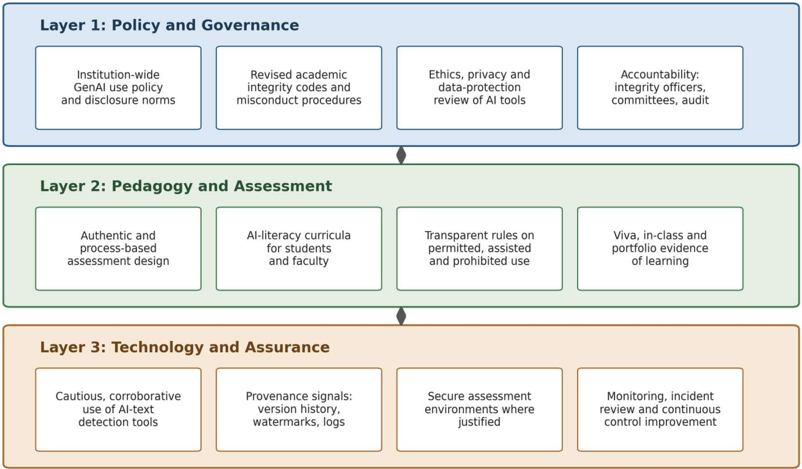
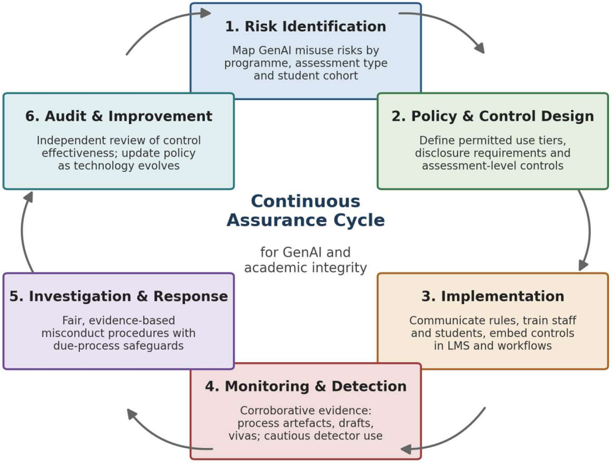
- It proposes a three-layer framework (policy and governance; pedagogy and assessment; technology and assurance) plus a continuous assurance cycle, and future directions including two-lane assessment, AI literacy as a graduate attribute, and provenance/watermarking infrastructure.
Methods
- Conceptual/review paper drawing on literature published since 2022; no primary data collection is reported.
- Synthesises empirical benchmarking studies, detector evaluations, institutional policy analyses, and governance literature to map challenges and propose a framework.
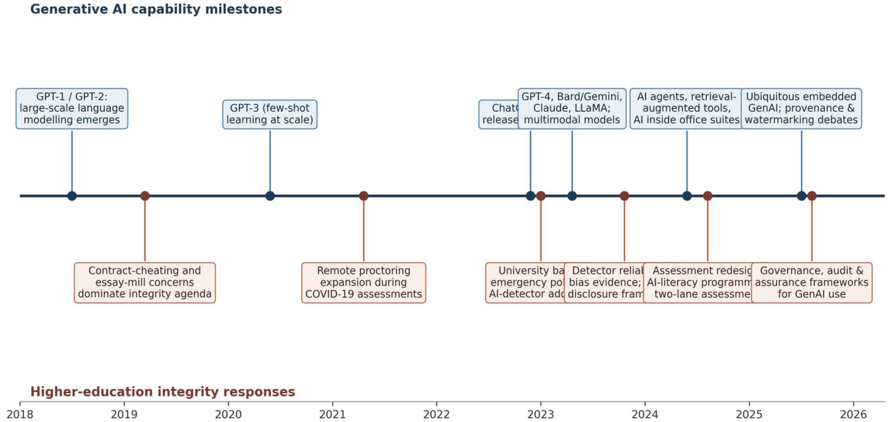
- Presents two conceptual figures (capability milestones vs. integrity responses; layered governance framework) and a mapping table linking the six challenge domains to controls across the three layers.
Limitations
- The paper states the research literature "remains dominated by commentary, single-institution surveys, and benchmarking exercises," and identifies gaps: little longitudinal evidence on how sustained GenAI use affects learning, few controlled evaluations of redesigned assessments' resistance to GenAI, almost none on fairness properties of integrity procedures in practice, and nearly no governance studies on how institutions allocate ownership of GenAI risk.
- The paper notes most published evidence comes from "a handful of Anglophone systems," limiting cross-national generalisability.
- Evident from the text: the framework and figures are the authors' own conceptualisation, not empirically validated; the reference list also contains numerous entries unrelated to the paper's topic, which is not acknowledged by the authors.
Model-written summary. Check it against the paper before relying on it.
Integrity signals
Registry
Cites
Statistics
Figures









Verification
Claims the paper makes
0 Valid · 2 Not valid · 53 Not checked · 54 Own results and interpretations
A conclusion the paper draws from its own results — it cites no other source for it, so there is none to check. The quote shows it is in the paper.
In the paper
“nearly every genre of academic writing that universities use to certify learning can now be generated on demand, at negligible cost, in seconds.”
plain- Asserted: passes — The authors put it forward as true.
- Checkable: passes — It can be checked against evidence.
- Load-bearing: passes — The paper’s conclusions depend on it.
- Based: unclear — It is unclear why the paper says it holds.
A conclusion the paper draws from its own results — it cites no other source for it, so there is none to check. The quote shows it is in the paper.
In the paper
“The evidentiary foundation on which plagiarism management was built for three decades has simply fallen away.”
plainstates a cause- Asserted: passes — The authors put it forward as true.
- Checkable: passes — It can be checked against evidence.
- Load-bearing: passes — The paper’s conclusions depend on it.
- Based: passes — The paper gives a reason why it holds.
In the paper
“By the time many universities had drafted their first ChatGPT policies, the technology those policies described had already been superseded by multimodal systems, retrieval-augmented tools that cite real sources, and AI assistance woven invisibly into mainstream word processors, browsers, and integrated development environments (Farrokhnia et al., 2024).”
What the sources say
- Not matchedcites Farrokhnia et al., 2024
An author–year citation the paper’s reference list doesn’t settle. We don’t search these by name.
plain- Asserted: passes — The authors put it forward as true.
- Checkable: passes — It can be checked against evidence.
- Load-bearing: passes — The paper’s conclusions depend on it.
- Based: passes — The paper gives a reason why it holds.
- Not matched
In the paper
“GPT-4 and its contemporaries extended these capabilities to graduate-level examinations, professional certification tests, and multimodal reasoning over images and documents (OpenAI, 2023).”
What the sources say
- Not matchedcites OpenAI, 2023
An author–year citation the paper’s reference list doesn’t settle. We don’t search these by name.
plainstates a cause- Asserted: passes — The authors put it forward as true.
- Checkable: passes — It can be checked against evidence.
- Load-bearing: unclear — It is unclear whether the paper’s conclusions depend on it.
- Based: passes — The paper gives a reason why it holds.
- Not matched
In the paper
“Remote proctoring, the pandemic-era alternative, brings well-documented privacy, equity, and reliability problems of its own (Dawson, 2021).”
What the sources say
- Not matchedcites Dawson, 2021
An author–year citation the paper’s reference list doesn’t settle. We don’t search these by name.
boostedstates an association- Asserted: passes — The authors put it forward as true.
- Checkable: passes — It can be checked against evidence.
- Load-bearing: passes — The paper’s conclusions depend on it.
- Based: passes — The paper gives a reason why it holds.
- Not matched
44 more claims
Create a free account to see all 109 claims and every source verdict.
- Probably not a substantial claim. 31
- It may state two separate claims as one. 39
- The quote only partly states this claim. 1
Self-check
Percentages, sums and reported differences re-computed from the paper’s own numbers.
Each contradiction between two passages listed here was confirmed by an independent check.
Rated minor: it would not touch a result — a value no result rests on, a p-value that stays on the same side of the significance level, or a conflict that is clerical, resolved elsewhere in the paper, or outside its own findings.
In the paper
§ International Journal of Advanced Research in Science, Communication and Technology · p. 2
“Section 6 discusses future directions before Section 7 concludes.”
§ VI. CONCLUSION · p. 10
“## VI. CONCLUSION”
Citations
Cites
Kumar, S., Choudhary, S., Gowroju, S., & Bhola, A. (2023) · Wiley eBooks · doi:10.1002/9781119785491.ch12 · Cited by 45
Choudhary, S., Kandikattu, C. H., Kumar, S., Kantipudi, M. P., & Kumar, M. (2024) · International Conference on Innovative Engineering Sciences and Technological Research (ICIESTR) · doi:10.1109/iciestr60916.2024.10798189 · Cited by 43
Saini, V., Jain, A., Anurag, & Kantipudi, M. P. (2025) · Lecture notes in networks and systems · doi:10.1007/978-3-031-81086-2_18 · Cited by 41
Reconstruction of wire frame model of complex images using syntactic pattern recognition
Rani, S., Ghai, D., & Kumar, S. (2022) · IET conference proceedings. · doi:10.1049/icp.2022.0304 · Cited by 40
Self-Healing REST Services Using Artificial Intelligence in Multi-Cloud Environments
Jaiswal, I. A. (2024) · Scientific Journal of Artificial Intelligence and Blockchain Technologies · doi:10.63345/sjaibt.v1.i3.201 · Cited by 39
Prashanth, M. S., Maheswari, V. U., Aluvalu, R., & Kantipudi, M. V. V. P. (2024) · EAI Endorsed Transactions on Pervasive Health and Technology · doi:10.4108/eetpht.10.5544 · Cited by 36
Emotion Classification using Feature Extraction of Facial Expression
Swathi, A., Kumar, S., Venkata Subbamma., T., Rani, S., Jain, A., & Kumar, R. (2022) · International Conference on Technological Advancements in Computational Sciences (ICTACS) · doi:10.1109/ictacs56270.2022.9988544 · Cited by 35
Aluvalu, R., Venkatachalam, R., Viswanadhula, U. M., et al. (2024) · International Journal of Transport Development and Integration · doi:10.18280/ijtdi.080204 · Cited by 34
Jani, H. K., Kantipudi, M. V. V. P., Nagababu, G., et al. (2022) · Sustainable Energy Technologies and Assessments · doi:10.1016/j.seta.2022.102665 · Cited by 33
Proposing model for water quality analysis based on hyperspectral remote sensor data
Kantipudi, M. V. V. P., Vemuri, S., Kumar, N. S. P., et al. (2023) · Elsevier eBooks · doi:10.1016/b978-0-12-821962-1.00007-6 · Cited by 33
Research works printed but not linked: 10
- 7. Jaiswal, I. A. (2023). Intelligent Cybersecurity Framework for Large-Scale RESTful Service Architectures. International Journal of Research Radicals in Multidisciplinary Fields, ISSN: 2960-043X, 2 (1), 178–184. Retrieved from https://www. researchradicals. com/index. php/rr/article/view, 252.
- 12. Khan, S. (2019). Sales force security compliance: An in-depth study of GDPR, HIPAA, and PCI-DSS enforcement in cloud-based CRM systems and their implications for global enterprises. International Journal of Advanced Research in Electrical, Electronics and Instrumentation Engineering, 8(9), 2211–2219. https://doi.org/10.15662/IJAREEIE.2019.0809010 · doi:10.15662/ijareeie.2019.0809010
- 20. S. Choudhary, C. H. Kandikattu, S. Kumar, M. V. V. P. Kantipudi, and M. Kumar, “Enhancing cybersecurity through combined convolutional neural network-gated recurrent unit approach for distributed denial of service attack detection,” in Proceedings of the 2024 1st International Conference on Innovative Engineering Sciences and Technological Research (ICIESTR), pp. 1–6, 2024. · DOI
- 21. Jaiswal, I. A. (2023). High-Performance AI-Augmented Content Management Systems for Distributed Clouds. International Journal of Multidisciplinary Innovation and Research Methodology, ISSN: 2960-2068, 2 (2), 90–97. Retrieved from https://ijmirm. com/index. php/ijmirm/article/view, 243.
- 22. Khan, S. (2018). The role of zero-trust models in database security: Eliminating implicit trust and enforcing continuous verification in enterprise data access systems. International Journal of Research in Electronics and Computer Engineering, 6(1), 1622–1628.
- 25. Khan, S. (2017). The role of privacy-preserving techniques in database security: Secure multi-party computation, differential privacy, and homomorphic encryption. The Research Journal, 3(4), 29–35.
- 26. Khan, S. (2016). A study of data provenance and integrity in database security: Ensuring authenticity, non-repudiation, and accountability in data lifecycle management. International Journal of Research in Electronics and Computer Engineering, 4(3), 180–186.
- 28. Rallabandi, B. R. (2020). MEC-native 5G systems: Orchestration algorithms for ultra-low latency cloud-edge integration. International Journal of Intelligent Systems and Applications in Engineering, 8(4), 398–408. https://ijisae.org/index.php/IJISAE/article/view/7889
- 29. Rallabandi, B. R. (2018). Joint deployment and operational energy optimization in heterogeneous cellular networks under traffic variability. International Journal of Communication Networks and Information Security, 10(3), 638–647. https://ijcnis.org/index.php/ijcnis/article/view/8604
- 34. Kalal, M. (2024). Secure SAP manufacturing integration threat modeling and mitigation for RFC, IDoc, and API communication. International Journal of Communication Networks and Information Security, 16(4). https://doi.org/10.5281/zenodo.20088018 · doi:10.5281/zenodo.20088018
Metadata
- Authors
- Dr. G. Purushothaman, D. S. G., & Mr. Saurabh Jaiswal, M. T. K. M.
- Affiliations
- Prof. Rajendra Singh (Rajju Bhaiya) University, Prayagraj, India
- Venue
- International Journal of Advanced Research in Science, Communication and Technology
- Publisher
- Naksh Solutions
- Published
- 2026-07-08
- Pages
- 222
- ISSN
- 2581-9429 (ISSN-L)
- OpenAlex
- W7167696570
- Cited by
- 0
- References
- 28
- FWCI
- 0.00
- Type
- journal article
- Language
- en
- Open access
- diamond
- doi.org
- Licence
- other-oa
- Locations
- International Journal of Advanced Research in Science Communication and Technology (publishedVersion, other-oa)
- Topics
- Social Sciences › Education › Academic integrity and plagiarism
- Social Sciences › Education › Artificial Intelligence in Education
- Physical Sciences › Computer Science › Artificial Intelligence › Ethics and Social Impacts of AI
- Keywords
- generative AI, academic integrity, higher education, ChatGPT, AI detection tools, assessment validity, equity gaps, AI literacy, assessment redesign, institutional governance, risk management, plagiarism, hallucinations, AI watermarking, provenance, faculty capacity
About these checks
Registry, retraction, Cites and statistics results are computed, not judged, with one exception: a printed reference that no index lists is read once by a model before it counts as a citation error. Claims are extracted by a model and kept only when their quote appears verbatim in the text; each cited source is then checked, with a model’s help, for whether it says what the claim relies on. Those verdicts can be wrong — read the claim’s quote and the cited source before relying on one.
A language model drew the claims from the paper on 2026-10-10, under version 3 of the claim definition (model deepseek-v4.1-flash, prompt extract-v3).
A second model labelled each claim on 2026-10-10 (model jev-1.13-20260917, definition revision gold-guideline-v0.2).
Statistics and arithmetic are recomputed, not judged.
Confidence bands are shown only for fields calibrated on our annotated test set. None is calibrated yet, so no band is shown.
What counts as a claim ›How we measure confidence ›How we check this ›
Are you an author, or do you see a problem with this page? Request a review
How to cite
Cite CoChat for the checks on this page, and the paper for its own findings.
- This page
- CoChat. (2026). Citation check: Generative AI and Academic Integrity in Higher Education: Challenges and Future Directions. https://app.cochat.ai/papers/10.48175/ijarsct-37626
- The paper
- Dr. G. Purushothaman, D. S. G., & Mr. Saurabh Jaiswal, M. T. K. M. (2026). Generative AI and Academic Integrity in Higher Education: Challenges and Future Directions. International Journal of Advanced Research in Science, Communication and Technology. https://doi.org/10.48175/ijarsct-37626
Data sources
Bibliographic data: Semantic Scholar, OpenAlex, Crossref.
Contains information from the Semantic Scholar Academic Graph Datasets, made available under the ODC Attribution License (ODC-BY 1.0).
Semantic Scholar’s data is described in: Kinney, R., et al. (2023). The Semantic Scholar Open Data Platform. arXiv:2301.10140.
