

The DOI matches its DataCite record; its reference list is not available; none of the 8 sources its claims cite is checked for support yet.
Multiresolution Priority Queues
Open accessAbstract
Priority queues are container data structures essential to many high performance computing (HPC) applications. In this paper, we introduce multiresolution priority queues, a data structure that improves the performance of the standard heap based implementations by trading off a controllable amount of resolution in the space of priorities. The new data structure can reduce the worst case performance of inserting an element from O(log(n)) to O(log(r)), where n is the number of elements in the queue and r is the number of resolution groups in the priority space. The worst case cost of removing the top element is O(1). When the number of elements in the table is high, the amortized cost to insert an element becomes O(1).
Overview
CoChat Summary
TL;DR
The paper introduces multiresolution priority queues (MR-PQs), which relax total priority ordering by discretizing the priority space into resolution groups to improve performance. It gives algorithms and complexity bounds, then shows an implementation in the Bro network monitor that reduces the priority-queue bottleneck.
Key findings
- MR-PQ trades a controllable amount of priority resolution for speed: it guarantees ordering only across resolution groups, not within a group.
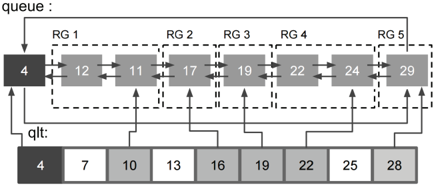
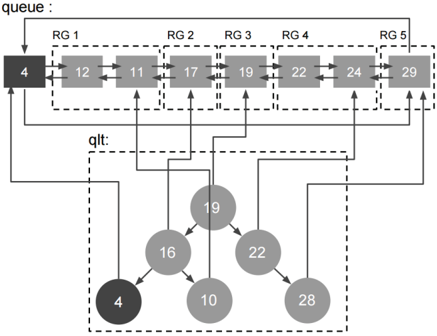
- Worst-case insert cost is reduced from \(O(\log n)\) for a binary heap priority queue to \(O(\log r)\) for the binary-tree-based MR-PQ, where \(n\) is the number of elements and \(r\) is the number of resolution groups; the base MR-PQ has worst-case insert \(O(r)\) and amortized insert \(O(1)\) when the table is highly populated. Peek, extract-min, and arbitrary extract are \(O(1)\).
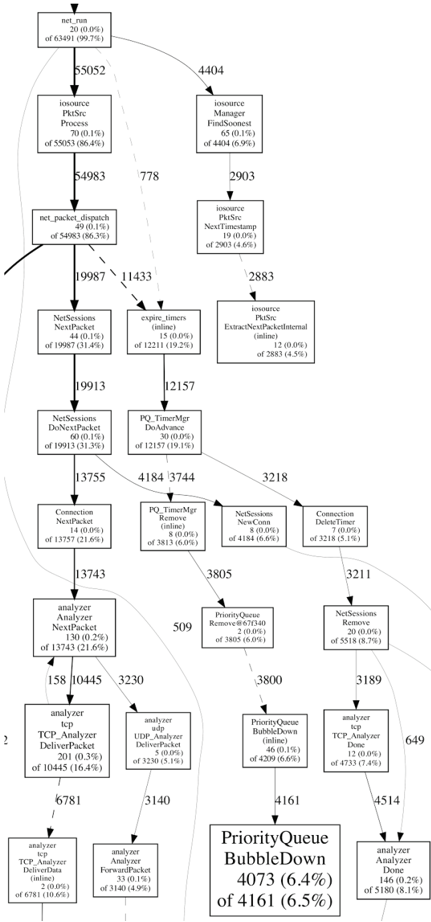
- In Bro, the binary-heap priority queue’s `PriorityQueue::BubbleDown` was the top profiled function at 6.5% of total processing cost, while the priority queue implementation was 105 lines of C++ out of 333,930 lines of C/C++ code (0.03%).
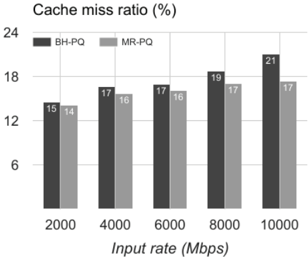
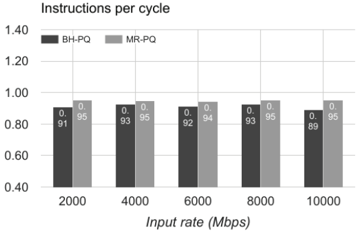
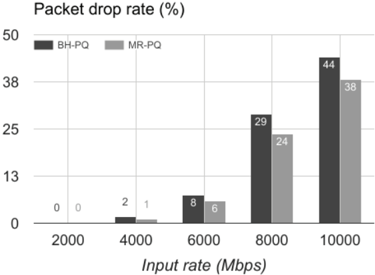
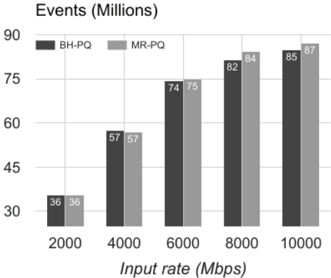
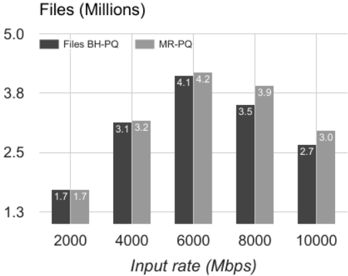
- Replacing Bro’s timer manager with the sliding MR-PQ took 144 lines of C++ and improved cache performance, instructions per cycle, packet drop rate, total network events generated, and total files processed across traffic rates from 2 Gbps to 10 Gbps.
Methods
- The paper formally defines the MR-PQ invariant, gives pseudocode for insert, peek, extract, extract-min, lookup-table repair, and a sliding-priority variant, and proves correctness and complexity via lemmas.
- It also proposes a binary-tree-based variant, BT-MR-PQ, to reduce worst-case insert from \(O(r)\) to \(O(\log r)\).
- For evaluation, the authors implement the sliding MR-PQ in Bro, an event-driven network analytics application, and benchmark it against Bro’s default binary heap priority queue using a traffic dataset mixing real corporate-network traces from New York and synthetically generated Ixia traffic; tests run from 2 Gbps to 10 Gbps on two Intel Xeon E5-2670 processors at 2.50 GHz, 20 physical cores, 25.6 MB L3 cache per processor, and 4 x 10 Gbps interfaces.
Limitations
- The paper states that MR-PQ does not guarantee total ordering within a priority resolution group; larger \(p_\Delta\) improves performance but makes the priority space more granular.
- The base MR-PQ has worst-case insert \(O(r)\), and the paper leaves study of implications for graph algorithms to future work.
- Evident from the text: the empirical evaluation is limited to one application, Bro, and one traffic dataset; the referenced figures report improvements but the text does not give exact numerical values for most of them.
Model-written summary. Check it against the paper before relying on it.
Integrity signals
Registry
Cites
Statistics
Figures
Verification
Claims the paper makes
0 Valid · 4 Not valid · 8 Not checked · 40 Own results and interpretations
A result the paper states — it cites no source for it, so there is none to check. The quote shows it is in the paper.
In the paper
“Lemma 2. Complexity of the MR-PQ algorithm. The worst case complexity of the MR-PQ algorithm for the I ɴ ꜱ ᴇʀᴛ routine is , where is ( r ) O p ) p ¬ r = ( max p min / Δ the number of resolution groups supported by the queue.”
plainstates a cause- Asserted: passes — The authors put it forward as true.
- Checkable: passes — It can be checked against evidence.
- Load-bearing: passes — The paper’s conclusions depend on it.
- Based: passes — The paper gives a reason why it holds.
A result the paper states — it cites no source for it, so there is none to check. The quote shows it is in the paper.
In the paper
“Again thanks to removing the bottleneck produced by the BubbleDown function, MR-PQ substantially reduces packet drops across the board for all traffic rates.”
plainstates a cause- Asserted: passes — The authors put it forward as true.
- Checkable: passes — It can be checked against evidence.
- Load-bearing: passes — The paper’s conclusions depend on it.
- Based: passes — The paper gives a reason why it holds.
A result the paper states — it cites no source for it, so there is none to check. The quote shows it is in the paper.
In the paper
“When the number of elements in the table is high, the amortized cost to insert an element becomes . (1) O”
- Also stated in: § 5. C ᴏɴᴄʟᴜ ꜱ ɪᴏɴ ꜱ · p. 10 · plain
“Further, when the number of elements in the table is high, the amortized cost to insert an element becomes . (1) ¬ O”
plainstates a cause- Asserted: passes — The authors put it forward as true.
- Checkable: passes — It can be checked against evidence.
- Load-bearing: passes — The paper’s conclusions depend on it.
- Based: passes — The paper gives a reason why it holds.
- Also stated in: § 5. C ᴏɴᴄʟᴜ ꜱ ɪᴏɴ ꜱ · p. 10 · plain
A result the paper reports from its own data — it cites no other source for it, so there is none to check. The quote shows it is in the paper.
In the paper
“While binary heaps are excellent implementations of priority queues, we find that when dealing with very high speed traffic (e.g., at rates of 10Gbps), they become a system bottleneck.”
plainstates a cause- Asserted: passes — The authors put it forward as true.
- Checkable: passes — It can be checked against evidence.
- Load-bearing: passes — The paper’s conclusions depend on it.
- Based: passes — The paper gives a reason why it holds.
A result the paper states — it cites no source for it, so there is none to check. The quote shows it is in the paper.
In the paper
“Lemma 1. Correctness of the MR-PQ algorithm. The I ɴ ꜱ ᴇʀᴛ and R ᴇᴍᴏᴠᴇ routines preserve the MR-PQ invariant (Property 1).”
plainstates a causen = 2- Asserted: passes — The authors put it forward as true.
- Checkable: passes — It can be checked against evidence.
- Load-bearing: passes — The paper’s conclusions depend on it.
- Based: passes — The paper gives a reason why it holds.
22 more claims
Create a free account to see all 52 claims and to verify the 5 references still open.
- Probably not a substantial claim. 15
- It may state two separate claims as one. 11
- The quote only partly states this claim. 3
Self-check
Percentages, sums and reported differences re-computed from the paper’s own numbers.
Each contradiction between two passages listed here was confirmed by an independent check.
Rated minor: it would not touch a result — a value no result rests on, a p-value that stays on the same side of the significance level, or a conflict that is clerical, resolved elsewhere in the paper, or outside its own findings.
In the paper
§ Total: 63724 samples · p. 9
“In Fig. 5, the reduction in the instructions per cycle (IPC) can be explained as a consequence of the improvements on the cache performance.”
§ Total: 63724 samples · p. 9
“Since MR-PQ reduces cache miss ratios, this leads to lower stalling cycles waiting for data fetches from main memory to reload the cache, which leads to better scheduling of the CPU instruction pipeline and hence an improved IPC metric.”
Citations
No citation lists for this paper
No DOI on record — the citation lists can’t be looked up.
References 14 · Cited by 3
Metadata
- Authors
- Ros-Giralt, J., Commike, A., Cullen, P., Lucovsky, J., Madathil, D., & Lethin, R.
- Affiliations
- Reservoir Labs (United States) (US)
- ORCID
- Ros-Giralt, Jordi
- Venue
- arXiv
- Publisher
- arXiv
- Published
- 2017
- ISSN
- 2331-8422 (ISSN-L)
- arXiv
- 1705.09642
- OpenAlex
- W2617217604
- Cited by
- 3
- References
- 14
- Citations by year
- 2023: 1 · 2018: 2
- Type
- posted content
- Language
- en
- Open access
- green
- arxiv.org
- Locations
- arXiv (Cornell University) (submittedVersion)
- arXiv (Cornell University)
- Funders
- U.S. Department of Energy
- Topics
- Physical Sciences › Computer Science › Hardware and Architecture › Parallel Computing and Optimization Techniques
- Physical Sciences › Mathematics › Theoretical Computer Science › Algorithms and Data Compression
- Physical Sciences › Computer Science › Information Systems › Advanced Database Systems and Queries
- Keywords
- priority queues, heap data structures, insertion cost, amortized cost
About these checks
Registry, retraction, Cites and statistics results are computed, not judged, with one exception: a printed reference that no index lists is read once by a model before it counts as a citation error. Claims are extracted by a model and kept only when their quote appears verbatim in the text; each cited source is then checked, with a model’s help, for whether it says what the claim relies on. Those verdicts can be wrong — read the claim’s quote and the cited source before relying on one.
A language model drew the claims from the paper on 2026-11-14, under version 3 of the claim definition (model deepseek-v4.1-flash, prompt extract-v3).
A second model labelled each claim on 2026-11-14 (model jev-1.13-20260917, definition revision gold-guideline-v0.2).
Statistics and arithmetic are recomputed, not judged.
Confidence bands are shown only for fields calibrated on our annotated test set. None is calibrated yet, so no band is shown.
What counts as a claim ›How we measure confidence ›How we check this ›
Are you an author, or do you see a problem with this page? Request a review
How to cite
Cite CoChat for the checks on this page, and the paper for its own findings.
- This page
- CoChat. (2026). Citation check: Multiresolution Priority Queues. https://app.cochat.ai/papers/10.48550/arxiv.1705.09642
- The paper
- Ros-Giralt, J., Commike, A., Cullen, P., Lucovsky, J., Madathil, D., & Lethin, R. (2017). Multiresolution Priority Queues. arXiv. https://doi.org/10.48550/arxiv.1705.09642
Data sources
Bibliographic data: Semantic Scholar, OpenAlex, Crossref.
Contains information from the Semantic Scholar Academic Graph Datasets, made available under the ODC Attribution License (ODC-BY 1.0).
Semantic Scholar’s data is described in: Kinney, R., et al. (2023). The Semantic Scholar Open Data Platform. arXiv:2301.10140.
