

An Image is Worth 16x16 Words: Transformers for Image Recognition at Scale
Open accessThe DOI matches its DataCite record; 64 of the 64 references it cites were found in a registry or an index; 11 of the 23 sources its claims cite were checked for support.
Abstract
While the Transformer architecture has become the de-facto standard for natural language processing tasks, its applications to computer vision remain limited. In vision, attention is either applied in conjunction with convolutional networks, or used to replace certain components of convolutional networks while keeping their overall structure in place. We show that this reliance on CNNs is not necessary and a pure transformer applied directly to sequences of image patches can perform very well on image classification tasks. When pre-trained on large amounts of data and transferred to multiple mid-sized or small image recognition benchmarks (ImageNet, CIFAR-100, VTAB, etc.), Vision Transformer (ViT) attains excellent results compared to state-of-the-art convolutional networks while requiring substantially fewer computational resources to train.
Overview
CoChat Summary
TL;DR
Vision Transformer (ViT) applies a standard Transformer directly to sequences of image patches and, when pre-trained on large datasets, matches or exceeds state-of-the-art convolutional networks on image classification while using substantially less pre-training compute. Large-scale pre-training can overcome ViT’s weaker image-specific inductive biases, though ViT underperforms ResNets on smaller pre-training datasets.
Key findings
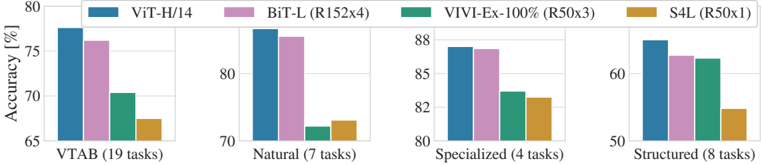
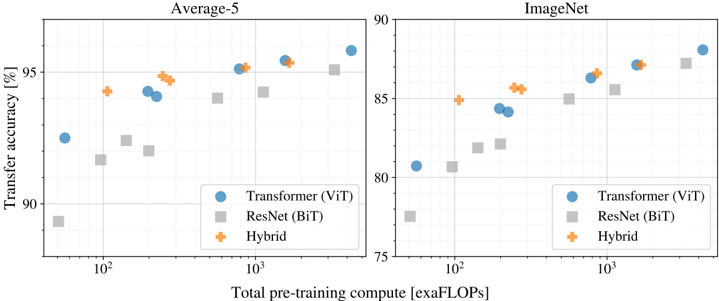
- ViT-H/14 pre-trained on JFT-300M reaches 88.55% ImageNet, 90.72% ImageNet-ReaL, 94.55% CIFAR-100, and 77.63% on VTAB (19 tasks), outperforming BiT-L on all reported tasks while using 2.5k TPUv3-core-days versus BiT-L’s 9.9k and Noisy Student’s 12.3k.
- ViT-L/16 pre-trained on public ImageNet-21k reaches 85.30% ImageNet, 88.62% ImageNet-ReaL, 93.25% CIFAR-100, and 72.72% VTAB, using 0.23k TPUv3-core-days.
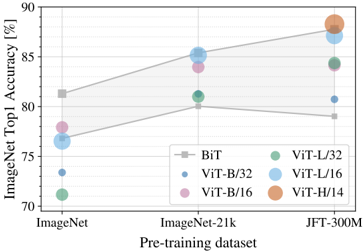
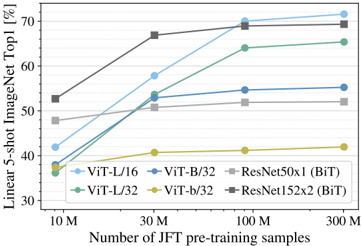
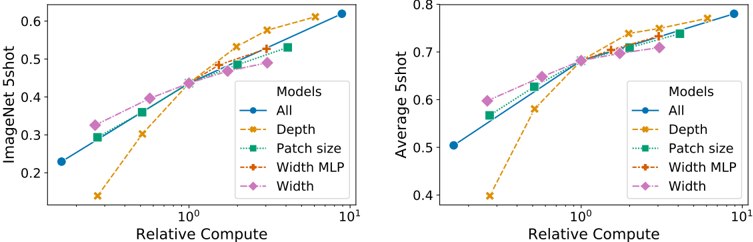
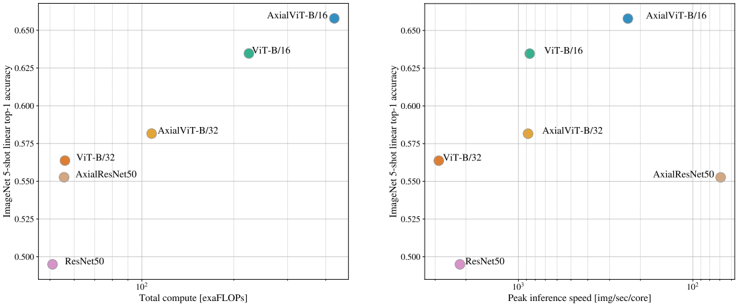
- On smaller pre-training datasets, ViT underperforms comparable ResNets; with JFT-300M, larger ViT models overtake smaller ones and ViT overtakes BiT. In a scaling study, ViT uses approximately 2–4× less compute to attain the same performance averaged over 5 datasets.
- Self-supervised masked patch prediction with ViT-B/16 achieves 79.9% ImageNet accuracy, a 2% improvement over training from scratch but still 4% behind supervised pre-training.
Methods
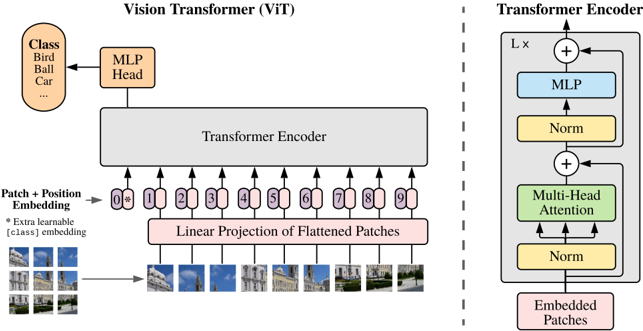
- Images are split into fixed-size patches, flattened, linearly projected to D dimensions, given position embeddings, and fed as a sequence to a standard Transformer encoder; a learnable [class] token provides the image representation for classification.
- Models include ViT-Base (12 layers, D=768, 86M params), ViT-Large (24 layers, D=1024, 307M params), and ViT-Huge (32 layers, D=1280, 632M params); baselines are ResNet (BiT) and hybrid ResNet+ViT models.
- Pre-training uses ImageNet, ImageNet-21k, or JFT-300M; training uses Adam with batch size 4096 and weight decay 0.1, while fine-tuning uses SGD with momentum and batch size 512; evaluation reports fine-tuning and few-shot/linear accuracies.
Limitations
- Stated by the paper: applying ViT to other vision tasks such as detection and segmentation remains a challenge; self-supervised pre-training still lags large-scale supervised pre-training; further scaling of ViT would likely improve performance but remains future work.
- Evident from the text: ViT has much less image-specific inductive bias than CNNs, so it generalizes worse when trained on insufficient data and requires large-scale pre-training (14M–300M images) to become competitive.
- Evident from the text: higher-resolution fine-tuning requires 2D interpolation of pre-trained position embeddings, and the paper notes that pre-training efficiency may be affected by factors beyond architecture, such as training schedule, optimizer, and weight decay.
Model-written summary. Check it against the paper before relying on it.
Integrity signals
Registry
Cites
Statistics
Figures
Verification
Claims the paper makes
6 Valid · 3 Not valid · 7 Not checked · 89 Own results and interpretations
Some cited sources support this claim and some don’t — read each source’s verdict below.
In the paper
“Therefore, in large-scale image recognition, classic ResNetlike architectures are still state of the art (Mahajan et al., 2018; Xie et al., 2020; Kolesnikov et al., 2020).”
What the sources say
- Supportedcites Mahajan et al., 2018 matched to “Exploring the Limits of Weakly Supervised Pretraining” (2018) source
Section A.5 (p. 23) compares the paper’s ResNeXt-101 models with the state of the art on ImageNet-1k and reports that they improved on those results. This supports citing the paper as an example of a ResNet-like architecture achieving state-of-the-art large-scale image recognition results at the time of publication. (LLM, conf=0.88)
- Disputedcites Xie et al., 2020 matched to “Self-Training With Noisy Student Improves ImageNet Classification” (2020) sourceExperimental — accuracy not yet measured
In §3.2 (p. 4), the paper calls the ResNeXt-101 WSL result the previous state of the art, then reports that its EfficientNet-L2 model surpasses it on ImageNet. It therefore does not support the claim that classic ResNet-like architectures are still state of the art. (LLM, conf=0.88)
Checked by a reasoning model — may be wrong.
- Supportedcites Kolesnikov et al., 2020 matched to “Big Transfer (BiT): General Visual Representation Learning” (2020) source
Section 3.3 (p. 5) says BiT uses a ResNet-v2 architecture, with changes to normalization and convolutional layers. Section 3.4 (p. 6) reports that BiT-L outperforms previously reported state-of-the-art generalist models on standard computer-vision benchmarks. This supports the claim about ResNet-like architectures, rather than unmodified classic ResNets. (LLM, conf=0.89)
plain- Asserted: passes — The authors put it forward as true.
- Checkable: passes — It can be checked against evidence.
- Load-bearing: passes — The paper’s conclusions depend on it.
- Based: passes — The paper gives a reason why it holds.
- Supported
The cited sources support only part of this claim — read each source’s verdict below.
In the paper
“The latter models, while theoretically efficient, have not yet been scaled effectively on modern hardware accelerators due to the use of specialized attention patterns.”
What the sources say
- Partly supportedcites Ramachandran et al., 2019 matched to “Stand-Alone Self-Attention in Vision Models” (2019) sourceExperimental — accuracy not yet measured
The Discussion (Sec. 5) of our copy does state the hardware-efficiency point attributed here: although the attention-based architecture is favourable in training efficiency and computational demand, 'the resulting network is slower in wall-clock time', and 'the reason for this discrepancy is the lack of optimized kernels available on various hardware accelerators'. But two elements of the claim are not in the source: it never says such models 'have not yet been scaled effectively' (it reports its own fully attentional model trained and scaled across widths/depths on 128 Cloud TPUv3 cores, Sec. 4.1 and A.2), and it locates the cause in the absence of optimized kernels/libraries rather than in 'the use of specialized attention patterns'. So the source supports the general thrust (pure self-attention vision models run inefficiently on current accelerators) but not the scaling claim or the stated causal mechanism. (LLM, conf=0.70)
- Not matchedcites Wang et al., 2020a
More than one paper fits this citation.
plainstates a cause- Asserted: passes — The authors put it forward as true.
- Checkable: passes — It can be checked against evidence.
- Load-bearing: passes — The paper’s conclusions depend on it.
- Based: passes — The paper gives a reason why it holds.
- Partly supported
A result the paper reports from its own data — it cites no other source for it, so there is none to check. The quote shows it is in the paper.
In the paper
“In particular, the best model reaches the accuracy of 88 . 55% on ImageNet, 90 . 72% on ImageNet-ReaL, 94 . 55% on CIFAR-100, and 77 . 63% on the VTAB suite of 19 tasks.”
plain- Asserted: passes — The authors put it forward as true.
- Checkable: passes — It can be checked against evidence.
- Load-bearing: passes — The paper’s conclusions depend on it.
- Based: passes — The paper gives a reason why it holds.
A result the paper reports from its own data — it cites no other source for it, so there is none to check. The quote shows it is in the paper.
In the paper
“Our Vision Transformer (ViT) attains excellent results when pre-trained at sufficient scale and transferred to tasks with fewer datapoints.”
plainstates a cause- Asserted: passes — The authors put it forward as true.
- Checkable: passes — It can be checked against evidence.
- Load-bearing: passes — The paper’s conclusions depend on it.
- Based: passes — The paper gives a reason why it holds.
54 more claims
Create a free account to see all 105 claims and to verify the 1 reference still open.
- Probably not a substantial claim. 21
- It may state two separate claims as one. 27
Claims other papers make about this one
Each is checked against this paper’s own text: does it say what the citing paper says it does?
The cited source doesn’t support the claim as written.
In the citing paper
“The results of ViT on image classification are encouraging, but its architecture is unsuitable for use as a general-purpose backbone network on dense vision tasks or when the input image resolution is high, due to its low-resolution feature maps and the quadratic increase in complexity with image size.”
From Swin Transformer: Hierarchical Vision Transformer using Shifted Windows (2021) · cites this paper as [20]
Checked by a reasoning model — may be wrong.
Experimental — accuracy not yet measuredThe cited source doesn’t support the claim as written.
In the citing paper
“The ViT-B, ViT-L, DeiT-S, DeiT-B are adopted as the baseline model, whose top-1 accuracy on ImageNet dataset are 71.58%, 71.48%, 79.8%, 81.8% respectively.”
From Post-Training Quantization for Vision Transformer (2021) · cites this paper as [11]
Checked by a reasoning model — may be wrong.
Experimental — accuracy not yet measuredThe cited source doesn’t support the claim as written.
In the citing paper
“its computational and memory costs are relatively high even for common input image sizes ( e.g. , shorter edge of 800 pixels in the COCO benchmark [40]).”
From Pyramid Vision Transformer: A Versatile Backbone for Dense Prediction without Convolutions (2021) · cites this paper as [13]
Checked by a reasoning model — may be wrong.
Experimental — accuracy not yet measuredThe source backs part of the claim, not all of it — or backs it for a different population, condition or comparison.
In the citing paper
“In existing Transformer-based models [64, 20], tokens are all of a fixed scale, a property unsuitable for these vision applications.”
From Swin Transformer: Hierarchical Vision Transformer using Shifted Windows (2021) · cites this paper as [20]
Experimental — accuracy not yet measured
63 more claims about this paper
Create a free account to see every claim other papers make about this one.
Self-check
Percentages, sums and reported differences re-computed from the paper’s own numbers.
Each contradiction between two passages listed here was confirmed by an independent check.
Rated minor: it would not touch a result — a value no result rests on, a p-value that stays on the same side of the significance level, or a conflict that is clerical, resolved elsewhere in the paper, or outside its own findings.
In the paper
§ 4.2 COMPARISON TO STATE OF THE ART · p. 5
“The smaller ViT-L/16 model pre-trained on JFT-300M outperforms BiT-L (which is pre-trained on the same dataset) on all tasks”
§ 4.2 COMPARISON TO STATE OF THE ART · p. 6
“| VTAB (19 tasks) | 77 . 63 ± 0 . 23 | 76 . 28 ± 0 . 46 | 72 . 72 ± 0 . 21 | 76 . 29 ± 1 . 70 | - |”
Rated minor: it would not touch a result — a value no result rests on, a p-value that stays on the same side of the significance level, or a conflict that is clerical, resolved elsewhere in the paper, or outside its own findings.
In the paper
§ 4.1 SETUP · p. 5
“We train all models, including ResNets, using Adam (Kingma & Ba, 2015) with β 1 = 0 . 9 , β 2 = 0 . 999 , a batch size of 4096 and apply a high weight decay of 0 . 1”
§ REFERENCES · p. 13
“| ViT-B/ { 16,32 } | ImageNet-21k | 90 | 10 - 3 | linear | 0.03 | 0.1 |”
Citations
Cites
Deep Residual Learning for Image Recognition
He, K., Zhang, X., Ren, S., & Sun, J. (2016) · 2016 IEEE Conference on Computer Vision and Pattern Recognition (CVPR) · doi:10.1109/cvpr.2016.90 · Cited by 235,474 · cited 2×
“In computer vision, however, convolutional architectures remain dominant (LeCun et al., 1989; Krizhevsky et al., 2012; He et al., 2016).”
Vaswani, A., Shazeer, N., Parmar, N., Uszkoreit, J., Jones, L., Gomez, A. N., Kaiser, L., & Polosukhin, I. (2017) · arXiv · doi:10.48550/arxiv.1706.03762 · Cited by 120,404
Self-citationImageNet classification with deep convolutional neural networks
Krizhevsky, A., Sutskever, I., & Hinton, G. E. (2017) · Communications of the ACM · doi:10.1145/3065386 · Cited by 112,155 · cited 1×
“In computer vision, however, convolutional architectures remain dominant (LeCun et al., 1989; Krizhevsky et al., 2012; He et al., 2016).”
BackgroundAdam: A Method for Stochastic Optimization
Kingma, D. P., & Ba, J. (2014) · arXiv · doi:10.48550/arxiv.1412.6980 · Cited by 98,946
ImageNet: A large-scale hierarchical image database
Deng, J., Dong, W., Socher, R., Li, L.-J., Li, K., & Fei-Fei, L. (2009) · 2009 IEEE Conference on Computer Vision and Pattern Recognition · doi:10.1109/cvpr.2009.5206848 · Cited by 65,333 · cited 2×
“…model scalability, we use the ILSVRC-2012 ImageNet dataset with 1k classes and 1.3M images (we refer to it as ImageNet in what follows), its superset ImageNet-21k with 21k classes and 14M images (Deng et al., 2009), and JFT (Sun et al., 2017) with 18k classes and 303M high-resolution images.”
MethodBERT: Pre-training of Deep Bidirectional Transformers for Language Understanding
Devlin, J., Chang, M.-W., Lee, K., & Toutanova, K. (2019) · Proceedings of the 2019 Conference of the North American Chapter of the Association for Computational Linguistics: Human Language Technologies, Volume 1 (Long and Short Papers) · doi:10.18653/v1/n19-1423 · Cited by 54,325 · cited 10×
“We base ViT configurations on those used for BERT (Devlin et al., 2019), as summarized in Table 1.”
InfluentialBatch Normalization: Accelerating Deep Network Training by Reducing Internal Covariate Shift
Ioffe, S., & Szegedy, C. (2015) · arXiv · doi:10.48550/arxiv.1502.03167 · Cited by 27,818 · cited 1×
“For the baseline CNNs, we use ResNet (He et al., 2016), but replace the Batch Normalization layers (Ioffe & Szegedy, 2015) with Group Normalization (Wu & He, 2018), and used standardized convolutions (Qiao et al., 2019).”
Learning Multiple Layers of Features from Tiny Images
Krizhevsky, A. (2024) · doi:10.57702/zp44cu3g · Cited by 23,395
Language Models are Few-Shot Learners
Brown, T. B., Mann, B., Ryder, N., Subbiah, M., Kaplan, J., Dhariwal, P., Neelakantan, A., Shyam, P., Sastry, G., Askell, A., et al. (2020) · arXiv · doi:10.48550/arxiv.2005.14165 · Cited by 23,372 · cited 2×
“…models are often pre-trained on large corpora and then fine-tuned for the task at hand: BERT (Devlin et al., 2019) uses a denoising self-supervised pre-training task, while the GPT line of work uses language modeling as its pre-training task (Radford et al., 2018; 2019; Brown et al., 2020).”
End-to-End Object Detection with Transformers
Carion, N., Massa, F., Synnaeve, G., Usunier, N., Kirillov, A., & Zagoruyko, S. (2020) · Lecture Notes in Computer Science · doi:10.1007/978-3-030-58452-8_13 · Cited by 18,285 · cited 3×
“…classification (Bello et al., 2019) or by further processing the output of a CNN using self-attention, e.g. for object detection (Hu et al., 2018; Carion et al., 2020), video processing (Wang et al., 2018; Sun et al., 2019), image classification (Wu et al., 2020), unsupervised object discovery…”
Research works printed but not linked: 2
- Jean-Baptiste Cordonnier, Andreas Loukas, and Martin Jaggi. On the relationship between selfattention and convolutional layers. In ICLR , 2020.
- Yuxin Wu and Kaiming He. Group normalization. In ECCV , 2018.
Cited by
Items 16,601–16,700 of 21,832
Transformer-based spectro-temporal fusion for Sentinel-2 super-resolution
Pogodziński, B., Tarasiewicz, T., & Kawulok, M. (2023) · International Conference on Systems, Signals and Image Processing · doi:10.1109/iwssip58668.2023.10180305 · Cited by 1
Anomaly Detection with Transformer in Face Anti-spoofing
Abduh, L., Omar, L., & Ivrissimtzis, I. P. (2023) · Journal of WSCG · doi:10.24132/jwscg.2023.10 · Cited by 1
Niu, Y., Ding, M., Zhang, Y., et al. (2023) · IEEE Intelligent Vehicles Symposium · doi:10.1109/iv55152.2023.10186652 · Cited by 1
TCFNet: Transformer and CNN Fusion Model for LiDAR Point Cloud Semantic Segmentation
Ren, L., Niu, J., Ouyang, Z., Zhang, Z., & Zheng, S. (2022) · IEEE Smart World Congress (SWC) · doi:10.1109/smartworld-uic-atc-scalcom-digitaltwin-pricomp-metaverse56740.2022.00197 · Cited by 1
Islam, M., Zunair, H., & Mohammed, N. (2023) · PubMed · doi:10.48550/arxiv.2307.13842 · Cited by 1
Detection and characterization of defects on mechanical structures by using 3D vision
Belbacha, Z., Abdallah, H. B., Jovančević, I., Orteu, J., & Brèthes, L. (2023) · International Conference on Quality Control by Artificial Vision (QCAV) · doi:10.1117/12.3000509 · Cited by 1
Laser flying-spot thermography: an open-access dataset for machine learning and deep learning
Helvig, K., Trouvé-Peloux, P., Gavérina, L., et al. (2023) · doi:10.1117/12.3000481 · Cited by 1
Enhancing the Linear Probing Performance of Masked Auto-Encoders
Qian, Y., Wang, Y., & Lin, J. (2023) · Lecture notes in computer science · doi:10.1007/978-3-031-37660-3_20 · Cited by 2
Exploring latent weight factors and global information for food-oriented cross-modal retrieval
Zhao, W., Zhou, D. M., Cao, B., Liang, W., & Sukhija, N. (2023) · Connection Science · doi:10.1080/09540091.2023.2233714 · Cited by 2
Automatic Bowel Preparation Assessment Using Deep Learning
Haithami, M., Ahmed, A. A., Liao, I. Y., & Jalab, H. A. (2023) · Lecture notes in computer science · doi:10.1007/978-3-031-37660-3_40 · Cited by 3
The role of echocardiography segmentation evaluation metrics in clinical diagnosis
Chen, Z., Zhang, S., Hou, S., Zhao, W., Liu, J., & Xiao, J. (2023) · International Conference on Computer Vision and Pattern Analysis (ICCPA) · doi:10.1117/12.2684351 · Cited by 1
Learning Golf Swing Key Events from Gaussian Soft Labels Using Multi-Scale Temporal MLPFormer
Zhang, Y., Tu, F., Wang, Z., Guo, W., & Zhu, D. (2023) · International Joint Conference on Neural Networks (IJCNN) · doi:10.1109/ijcnn54540.2023.10191526 · Cited by 2
IC-CViT: Inverse-Consistent Convolutional Vision Transformer for Diffeomorphic Image Registration
Xu, T., Jiang, T., & Li, X. (2023) · International Joint Conference on Neural Networks (IJCNN) · doi:10.1109/ijcnn54540.2023.10191209 · Cited by 2
Yang, Z., Han, B., Chen, W., & Gao, X. (2023) · International Joint Conference on Neural Networks (IJCNN) · doi:10.1109/ijcnn54540.2023.10191508 · Cited by 1
Zhang, Y., Cai, Z., Higashita, R., & Liu, J. (2023) · International Joint Conference on Neural Networks (IJCNN) · doi:10.1109/ijcnn54540.2023.10191116 · Cited by 1
Images Classification Integrating Transformer with Convolutional Neural Network
Peng, Y. (2023) · Advances in Engineering Technology Research · doi:10.56028/aetr.6.1.621.2023 · Cited by 2
Stochastic Bridges as Effective Regularizers for Parameter-Efficient Tuning
Chen, W., Han, X., Lin, Y., Liu, Z., Sun, M., & Zhou, J. (2023) · Findings of the Association for Computational Linguistics: ACL (Findings of ACL) · doi:10.18653/v1/2023.findings-acl.661 · Cited by 1
Lyu, C., Ji, T., Graham, Y., & Foster, J. (2023) · Workshop on Simple and Efficient Natural Language Processing (SustaiNLP) · doi:10.18653/v1/2023.sustainlp-1.12 · Cited by 1
UTSA-NLP at RadSum23: Multi-modal Retrieval-Based Chest X-Ray Report Summarization
Wang, T., Zhao, X., & Rios, A. (2023) · Workshop on Biomedical Language Processing (BioNLP) · doi:10.18653/v1/2023.bionlp-1.58 · Cited by 6
An Anchor-based Relative Position Embedding Method for Cross-Modal Tasks
Wang, Y., Sun, X., Fengzong, L., Kang, Z., & Xu, C. X. (2022) · Conference on Empirical Methods in Natural Language Processing (EMNLP) · doi:10.18653/v1/2022.emnlp-main.362 · Cited by 3
Enriching Transformer using Fourier Transform for Image Captioning
Joshy, D. M., Das, A., Amijith, M. M., Sunil, D. T., & Safar, S. (2023) · International Conference on Intelligent Technologies (CONIT) · doi:10.1109/conit59222.2023.10205936 · Cited by 1
Detecting Potholes from Dashboard Camera Images Using Ensemble of Classification Mechanisms
Bekku, H., Minami, M., Kawasaki, T., & Nakazawa, J. (2023) · IEEE International Conference on Smart Computing · doi:10.1109/smartcomp58114.2023.00031 · Cited by 5
Dammu, P. P. S., Feng, Y., & Shah, C. S. (2023) · International Joint Conference on Artificial Intelligence · doi:10.24963/ijcai.2023/659 · Cited by 2
Disentanglement of Latent Representations via Causal Interventions
Gendron, G., Witbrock, M., & Dobbie, G. (2023) · International Joint Conference on Artificial Intelligence · doi:10.24963/ijcai.2023/361 · Cited by 8
THzformer: Terahertz Image Restoration Based on Transformer Learning
Wang, M., Zhu, S., & Qi-tong, O. (2023) · International Conference on Computer Communication and the Internet (ICCCI) · doi:10.1109/iccci59363.2023.10210147 · Cited by 1
Gaze estimation based on swin transformer
Chen, J., Ma, J., Wang, X., Huang, L., & Li, Y. (2023) · International Conference on Advanced Electronic Materials, Computers and Software Engineering (AEMCSE) · doi:10.1117/12.3004623 · Cited by 1
Train-Once-for-All Personalization
Chen, H.-Y., Li, Y., Cui, Y., Zhang, M., Chao, W., & Zhang, L. (2023) · IEEE Computer Society Conference on Computer Vision and Pattern Recognition/Proceedings - IEEE Computer Society Conference on Computer Vision and Pattern Recognition/Proceedings · doi:10.1109/cvpr52729.2023.01137 · Cited by 5
Generalizable Solar Irradiation Prediction using Large Transformer Models with Sky Imagery
Gorantla, K. R., & Roy, A. (2023) · doi:10.23919/mva57639.2023.10216081 · Cited by 1
Superclass Learning with Representation Enhancement
Gan, Z., Zhao, S., Kang, J., Shang, L., Chen, H., & Li, C. (2023) · IEEE Computer Society Conference on Computer Vision and Pattern Recognition/Proceedings - IEEE Computer Society Conference on Computer Vision and Pattern Recognition/Proceedings · doi:10.1109/cvpr52729.2023.02304 · Cited by 4
Lin, H.-L., Jiang, J., Juan, M.-H., & Cheng, P. (2023) · ACM International Conference on Information and Knowledge Management (CIKM) · doi:10.1145/3583780.3615012 · Cited by 1
IDP: Image Denoising Using PoolFormer
Yin, S.-K., & Chen, J. (2023) · International Symposium on Computer, Consumer and Control · doi:10.1109/is3c57901.2023.00019 · Cited by 2
Prediction of optimal control input in a fully developed turbulent channel flow by machine learning
Yugeta, Y., Uji, K., Itoh, T., & Hasegawa, Y. (2023) · Journal of Fluid Science and Technology · doi:10.1299/jfst.2023jfst0033 · Cited by 2
Li, H., Zheng, M., Han, Y., et al. (2023) · IEEE Journal of Selected Topics in Applied Earth Observations and Remote Sensing · doi:10.1109/jstars.2023.3308748 · Cited by 1
Communication Compression for Decentralized Learning With Operator Splitting Methods
Takezawa, Y., Niwa, K., & Yamada, M. (2023) · IEEE Transactions on Signal and Information Processing over Networks · doi:10.1109/tsipn.2023.3307894 · Cited by 2
ShiftFormer: Spatial-Temporal Shift Operation in Video Transformer
Yang, B., Zhu, G., Ge, G., Luo, J., & Wang, J. (2023) · IEEE International Conference on Multimedia and Expo (ICME) · doi:10.1109/icme55011.2023.00325 · Cited by 1
ART: An Efficient Transformer with Atrous Residual Learning for Medical Images
He, Y., Wang, Y., He, L., Pan, G., & Ma, H. (2023) · IEEE International Conference on Multimedia and Expo (ICME) · doi:10.1109/icme55011.2023.00327 · Cited by 1
DynaSlim: Dynamic Slimming for Vision Transformers
Shi, D., Gao, J., Liu, T., & Fu, Y. (2023) · IEEE International Conference on Multimedia and Expo (ICME) · doi:10.1109/icme55011.2023.00251 · Cited by 2
Boundary-aware Shadow Detection via Mask Decoupling and Feature Correction
Chen, J., Xing, G., Liao, J., Wei, H., & Liu, Y. (2023) · IEEE International Conference on Multimedia and Expo (ICME) · doi:10.1109/icme55011.2023.00034 · Cited by 2
Trajectory Alignment based Multi-Scaled Temporal Attention for Efficient Video Transformer
Zhang, Z., Yuan, D., Zhang, Y., & Bao, W. (2023) · IEEE International Conference on Multimedia and Expo (ICME) · doi:10.1109/icme55011.2023.00244 · Cited by 1
DiST-GAN: Distillation-based Semantic Transfer for Text-Guided Face Generation
Yang, G., Fu, F., Fei, N., Wu, H., Ma, R., & Lu, Z. (2023) · IEEE International Conference on Multimedia and Expo (ICME) · doi:10.1109/icme55011.2023.00149 · Cited by 3
Anchor-Free Action Proposal Network with Uncertainty Estimation
Pehlivan, S., & Laaksonen, J. T. (2023) · IEEE International Conference on Multimedia and Expo (ICME) · doi:10.1109/icme55011.2023.00318 · Cited by 1
LA-layer: General local attention layer for full attention networks
Lu, H. J., Poppe, R. W., & Salah, A. A. (2023) · IEEE International Conference on Multimedia and Expo (ICME) · doi:10.1109/icme55011.2023.00352 · Cited by 2
Auxiliary Fine-grained Alignment Constraints for Vision-and-Language Navigation
Cui, Y., Huang, R., Zhang, Y., Cen, Y., Xie, L., Yan, Y., & Yin, E. (2023) · IEEE International Conference on Multimedia and Expo (ICME) · doi:10.1109/icme55011.2023.00446 · Cited by 3
Generative Iris Prior Embedded Transformer for Iris Restoration
Huang, Y., Wang, J., Li, P., et al. (2023) · IEEE International Conference on Multimedia and Expo (ICME) · doi:10.1109/icme55011.2023.00094 · Cited by 1
Single Image Dehazing Based on Deep Feature Fusion Network
Yang, R., Guo, Y., Zheng, G., Yang, H., & Zhang, Y. (2023) · International Conference on Blockchain Technology and Information Security (ICBCTIS) · doi:10.1109/icbctis59921.2023.00010 · Cited by 1
Swin Transformer based Siamese Network for Thermal and Optical Image Registration
Elsaeidy, M., Yağmur, İ. C., Ateş, H. F., & Gunturk, B. K. (2023) · Signal Processing and Communications Applications Conference (SIU) · doi:10.1109/siu59756.2023.10224035 · Cited by 2
Intelligent Deep Motion Magnification Analysis in Advanced Driving Assistance Systems
Rundo, F., Pino, C., Castagnolo, G., Messina, A. A., Spampinato, C., & Calabretta, M. (2023) · AEIT International Conference of Electrical and Electronic Technologies for Automotive (AEIT AUTOMOTIVE) · doi:10.23919/aeitautomotive58986.2023.10217201 · Cited by 1
SFB-net for Cardiac Segmentation: Bridging the Semantic Gap with Attention
Portal, N., Kachenoura, N., Dietenbeck, T., & Achard, C. (2023) · IEEE International Symposium on Biomedical Imaging (ISBI) · doi:10.1109/isbi53787.2023.10230354 · Cited by 1
Multi-Scale Convolution-Transformer Fusion Network for Endoscopic Image Segmentation
Zou, B., Zhou, Z., Han, Y., et al. (2023) · IEEE International Symposium on Biomedical Imaging (ISBI) · doi:10.1109/isbi53787.2023.10230738 · Cited by 1
Jin, P., Yeh, Y., Ye, J., Wang, Z., Xue, Y., Zhang, N., Huang, S., Ghedin, E., Lu, H., Schmitt, A. P., et al. (2023) · IEEE International Symposium on Biomedical Imaging (ISBI) · doi:10.1109/isbi53787.2023.10230416 · Cited by 2
Doppler Image-Based Weakly-Supervised Vascular Ultrasound Segmentation with Transformer
Ning, G., Liang, H., Chen, F., Zhang, X., & Liao, H. (2023) · IEEE International Symposium on Biomedical Imaging (ISBI) · doi:10.1109/isbi53787.2023.10230548 · Cited by 2
Multimodal Representation Learning for Blastocyst Assessment
Wang, Y., Zheng, Z., Ni, N., Tong, G., Cheng, N., Li, K., Yin, P., Chen, Y., Wu, Y., & Xie, G. (2023) · IEEE International Symposium on Biomedical Imaging (ISBI) · doi:10.1109/isbi53787.2023.10230468 · Cited by 1
Multi-dimension unified Swin Transformer for 3D Lesion Segmentation in Multiple Anatomical Locations
Pan, S., Liu, Y., Halek, S., Tomaszewski, M. R., Wang, S., Baumgartner, R., Yuan, J. D., Goldmacher, G., & Chen, A. (2023) · IEEE International Symposium on Biomedical Imaging (ISBI) · doi:10.1109/isbi53787.2023.10230562 · Cited by 2
Large Class Separation is Not What You Need for Relational Reasoning-Based OOD Detection
Lu, L. L., D’Ascenzi, G., Borlino, F. C., & Tommasi, T. (2023) · Lecture notes in computer science · doi:10.1007/978-3-031-43153-1_25 · Cited by 2
Feng, J., Liu, J., Gu, Z., & Zheng, W. (2023) · International Journal of Remote Sensing · doi:10.1080/01431161.2023.2249603 · Cited by 1
Transparent autoencoding of network packets with self-attention-based transformers
Kummerow, A., Esrom, A., Nicolai, S., & Bretschneider, P. (2023) · Conference on Local Computer Networks · doi:10.1109/lcn58197.2023.10223390 · Cited by 1
SEGMENTACIJA LEZIJA U MAMOGRAFSKIM SLIKAMA KORIŠĆENJEM SEGFORMER MREŽNE ARHITEKTURE
Kljajić, J. (2023) · Zbornik radova Fakulteta tehničkih nauka u Novom Sadu · doi:10.24867/24be33kljajic · Cited by 1
MEGL: Multi-Experts Guided Learning Network for Single Camera Training Person Re-Identification
Li, H., Shi, Y., Ling, H., Li, Z., Wang, R., Zhao, C., & Li, P. (2023) · Proceedings - International Conference on Image Processing · doi:10.1109/icip49359.2023.10222860 · Cited by 1
Flow-Based One-Class Anomaly Detection with Multi-Frequency Feature Fusion
Ma, W., Lan, S., Huang, W., Ma, Y., Yang, H., Pan, W., & Zheng, Y. (2023) · Proceedings - International Conference on Image Processing · doi:10.1109/icip49359.2023.10222200 · Cited by 1
Parameter-Efficient Vision Transformer with Linear Attention
Zhao, Y., Tang, H., Jiang, Y., Yong, A., Wu, Q., & Wang, J. (2023) · Proceedings - International Conference on Image Processing · doi:10.1109/icip49359.2023.10222812 · Cited by 2
Target-Aware Feature Bottleneck for Real-Time Visual Tracking
Choi, J. (2023) · Applied Sciences · doi:10.3390/app131810198 · Cited by 4
PSF-based Analysis for Detecting Unresolved Wide Binaries
Wu, Y., Li, J., Liu, C., Hu, Y., Xu, L., Li, T., Chen, X., & Han, Z. (2023) · The Astrophysical Journal Supplement Series · doi:10.3847/1538-4365/ace9be · Cited by 1
Towards Deep Anomaly Detection with Structured Knowledge Representations
Kirchheim, K. (2023) · Lecture notes in computer science · doi:10.1007/978-3-031-40953-0_32 · Cited by 2
EDIRNet: an unsupervised deformable registration model for X-ray and neutron images
Zeng, Q., Yang, C., Gan, Q., Wang, Q., & Wang, S. (2023) · Applied Optics · doi:10.1364/ao.500442 · Cited by 1
Voting from Nearest Tasks: Meta-Vote Pruning of Pre-trained Models for Downstream Tasks
Zhao, H., Zhou, T., Long, G., Jiang, J. B., & Zhang, C. (2023) · Lecture notes in computer science · doi:10.1007/978-3-031-43415-0_4 · Cited by 2
Unsupervised Salient Patch Selection for Data-Efficient Reinforcement Learning
Jiang, Z., & Weng, P. (2023) · Lecture notes in computer science · doi:10.1007/978-3-031-43421-1_33 · Cited by 1
Distance Awared:Adaptive Voxel Resolution to help 3D Object Detection Networks See Farther
Liao, Z., Jin, Y. A., Ma, H., & Alsumeri, A. (2023) · Chinese Control Conference (CCC) · doi:10.23919/ccc58697.2023.10240474 · Cited by 1
GP-Net: Global Perceptual Network with Adaptive Gradient Clipping for Emotional Image Classification
Wang, X., Yang, J., Hu, M. Q., & Wu, X. (2023) · International Conference on Intelligent Computing and Signal Processing (ICSP) · doi:10.1109/icsp58490.2023.10248465 · Cited by 1
ADPal: Automatic Detection of Troubled Users in Online Service Systems via Page Access Logs
Shen, H., Ma, Y., Li, Y., Wang, X., Tian, D., Jia, T., He, T., & Luo, S. (2023) · IEEE International Conference on Web Services (ICWS) · doi:10.1109/icws60048.2023.00082 · Cited by 2
Espantaleón-Pérez, R., Jiménez-Velasco, I., Muñoz‐Salinas, R., & Marín-Jiménez, M. J. (2023) · Lecture notes in computer science · doi:10.1007/978-3-031-44240-7_10 · Cited by 3
Lee, Y., Lee, S., & Hwang, S. (2023) · Applied Sciences · doi:10.3390/app131810493 · Cited by 1
Wave Self-Attention Mechanism for Three-Dimensional Features
Liu, H., Cheng, Y., & Li, H. (2023) · IEEE International Conference on Electronic Information and Communication Technology (ICEICT) · doi:10.1109/iceict57916.2023.10245724 · Cited by 1
Medical Image Classification using CMT and FTGD Layer
Verma, S., & Sanjeevi, S. G. (2023) · International Conference on Circuit, Power and Computing Technologies · doi:10.1109/iccpct58313.2023.10245792 · Cited by 1
Multimodal Cross-Attention Graph Network for Desire Detection
Gu, R., Wang, X., & Yang, Q. (2023) · Lecture notes in computer science · doi:10.1007/978-3-031-44216-2_42 · Cited by 1
Improving Detection of Diabetic Retinopathy in Low-Resolution Images via Latent Diffusion
Catapang, J. K., Santiago, D. E., & Isip-Tan, I. T. (2023) · IEEE International Conference on Multimedia Information Processing and Retrieval (MIPR) · doi:10.1109/mipr59079.2023.00024 · Cited by 1
End-to-end Image Captioning via Visual Region Aggregation and Dual-level Collaboration
Song, J., Zeng, P., Gu, J., Zhu, J., & Gao, L. (2023) · International Journal of Software and Informatics · doi:10.21655/ijsi.1673-7288.00316 · Cited by 1
DeepDiscord: Dual Contrastive Coding for Transferable Time Series Anomaly Detection
Li, X., Zhong, P.-N., Chen, D., Zhang, Z., & Yang, Y.-B. (2023) · Frontiers in artificial intelligence and applications · doi:10.3233/faia230422 · Cited by 1
Gastro-Intestinal Tract Image Segmentation using Edge U-Net and U-Net VGG19
Talakola, S., Reddy, M. S., Nagam, R., & Chebrolu, S. (2023) · International Conference on Computer, Electronics & Electrical Engineering & their Applications (IC2E3) · doi:10.1109/ic2e357697.2023.10262483 · Cited by 3
Class-aware cross-domain target detection based on cityscape in fog
Gan, L., Liu, H., Chen, A., Xu, X., & Zhang, X. (2023) · Machine Vision and Applications · doi:10.1007/s00138-023-01463-6 · Cited by 1
PointWave-MLP: Point Cloud Analysis Based on Wave-MLP Architecture
Li, M., Zhao, Y., & Wang, C. Z. (2023) · International Conference on Control, Robotics and Intelligent System (CCRIS) · doi:10.1145/3622896.3622915 · Cited by 1
Wu, X., Yi, J., Shi, Y., et al. (2023) · PeerJ Computer Science · doi:10.7717/peerj-cs.1618 · Cited by 1
Si, J., Zhao, H., Huang, L., & Tu, Z. (2023) · International Conference on Intelligent Medicine and Image Processing (IMIP) · doi:10.1109/imip57114.2023.00022 · Cited by 2
Guan, Y., Ding, W., Liao, S., & Yang, W. (2023) · Engineering Applications of Artificial Intelligence · doi:10.1016/j.engappai.2023.107220 · Cited by 2
PCA and SE-ResNet-VIT Based Malware Detection Method
凡, 聪. (2023) · Computer Science and Application · doi:10.12677/csa.2023.139177 · Cited by 1
Missing-Modal Face Anti-Spoofing: A Benchmark
Li, X., Li, C., & Hu, J. S. (2023) · International Conference on Image, Vision and Computing (ICIVC) · doi:10.1109/icivc58118.2023.10270580 · Cited by 1
Wang, J., Yoshie, O., & Shimizu, K. (2023) · International Conference on Image, Vision and Computing (ICIVC) · doi:10.1109/icivc58118.2023.10270774 · Cited by 1
AgeTrans: Estimating the Age of Faces Using Global Features
Nguyen, V. A. (2023) · International Symposium on Computer Engineering and Intelligent Communications (ISCEIC) · doi:10.1109/isceic59030.2023.10271215 · Cited by 1
Cui, M., Xin-ke, G., Song, J., & Zhang, P. (2023) · International Conference on Advanced Algorithms and Signal Image Processing (AASIP) · doi:10.1117/12.3005817 · Cited by 1
Gated axial transformer network for mass segmentation in mammographic
Zhong, Y., & Piao, Y. (2023) · International Conference on Computer Science and Communication Technology (ICCSCT) · doi:10.1117/12.3009417 · Cited by 3
An improved YOLOv7 algorithm for laser welding defect detection
Zhang, L., He, Y., Zhou, Y., Chen, Y., Chen, Z., & Yang, Y. (2023) · International Conference on Computer Information Science and Application Technology (CISAT) · doi:10.1117/12.3003811 · Cited by 1
Matsun, A., Mohamed, D. O., Chokuwa, S., Ridzuan, M., & Yaqub, M. K. (2023) · Lecture notes in computer science · doi:10.1007/978-3-031-45857-6_12 · Cited by 1
Beyond animal detection: a benchmark for detecting animal age group
Zhou, H., Wu, Y., Li, J., Pan, L., Ye, H., & Li, S. (2023) · International Conference on Artificial Intelligence and Computer Science (AICS) · doi:10.1117/12.3009574 · Cited by 1
Fan, X., Wang, P., Li, J., & Yang, N. (2023) · Research in Astronomy and Astrophysics · doi:10.1088/1674-4527/ad0498 · Cited by 1
Racing with Vision Transformer Architecture
Tian, C., & Song, L. (2022) · International Symposium on Smart and Healthy Cities (ISHC) · doi:10.1109/ishc56805.2022.00055 · Cited by 1
A Novel Impervious Surface Extraction Method Based on Transformer
Zhang, W. A., Qiu, D., Wan, X., et al. (2023) · IEEE International Geoscience and Remote Sensing Symposium (IGARSS) · doi:10.1109/igarss52108.2023.10282343 · Cited by 1
All-In-One Network for NLOS Mm-Wave Radar Object Detection Based on Transformer
Chen, Z., Zhou, Y., Zhou, Z., et al. (2023) · IEEE International Geoscience and Remote Sensing Symposium (IGARSS) · doi:10.1109/igarss52108.2023.10282816 · Cited by 1
Benchmarking Adversarial Attacks and Defenses in Remote Sensing Images
Zhang, H., & Jiang, X. (2023) · IEEE International Geoscience and Remote Sensing Symposium (IGARSS) · doi:10.1109/igarss52108.2023.10283102 · Cited by 1
Verma, U., & Puthumanaillam, G. (2023) · IEEE International Geoscience and Remote Sensing Symposium (IGARSS) · doi:10.1109/igarss52108.2023.10283035 · Cited by 1
Liu, H., Zhang, N., Tian, T., & Tian, J. (2023) · IEEE International Geoscience and Remote Sensing Symposium (IGARSS) · doi:10.1109/igarss52108.2023.10282461 · Cited by 2
Kurapati, S., & Arun, P. V. (2023) · IEEE International Geoscience and Remote Sensing Symposium (IGARSS) · doi:10.1109/igarss52108.2023.10282093 · Cited by 1
Metadata
- Authors
- Dosovitskiy, A., Beyer, L., Kolesnikov, A., Weissenborn, D., Zhai, X., Unterthiner, T., Dehghani, M., Minderer, M., Heigold, G., Gelly, S., Uszkoreit, J., & Houlsby, N.
- Affiliations
- Google (United States) (US)
- ORCID
- Venue
- arXiv
- Publisher
- arXiv
- Published
- 2020
- ISSN
- 2331-8422 (ISSN-L)
- arXiv
- 2010.11929
- OpenAlex
- W3094502228
- Semantic Scholar
- 268d347e8a55b5eb82fb5e7d2f800e33c75ab18a
- Cited by
- 47,472
- References
- 52
- Citations by year
- 2026: 8731 · 2025: 12671 · 2024: 11821 · 2023: 8591 · 2022: 4351 · 2021: 1263 · 2020: 30
- Type
- posted content
- Language
- en
- Open access
- green
- arxiv.org
- Locations
- arXiv (Cornell University) (submittedVersion)
- arXiv (Cornell University)
- Topics
- Physical Sciences › Computer Science › Computer Vision and Pattern Recognition › Advanced Neural Network Applications
- Physical Sciences › Computer Science › Artificial Intelligence › Domain Adaptation and Few-Shot Learning
- Physical Sciences › Computer Science › Computer Vision and Pattern Recognition › Visual Attention and Saliency Detection
- Keywords
- vision transformer, image classification, image patches, attention mechanism, pre-training, transfer learning, computational efficiency, ImageNet, CIFAR-100
About these checks
Registry, retraction, Cites and statistics results are computed, not judged, with one exception: a printed reference that no index lists is read once by a model before it counts as a citation error. Claims are extracted by a model and kept only when their quote appears verbatim in the text; each cited source is then checked, with a model’s help, for whether it says what the claim relies on. Those verdicts can be wrong — read the claim’s quote and the cited source before relying on one.
The claim verdicts this report counts are experimental: their accuracy is not yet measured.
A language model drew the claims from the paper on 2026-10-10, under version 3 of the claim definition (model deepseek-v4.1-flash, prompt extract-v3).
A second model labelled each claim on 2026-10-10 (model jev-1.13-20260917, definition revision gold-guideline-v0.2).
Cited sources are checked with a language model’s help (gpt-6-sol and qwen3.8-omni-flash).
Statistics and arithmetic are recomputed, not judged.
Confidence bands are shown only for fields calibrated on our annotated test set. None is calibrated yet, so no band is shown.
What counts as a claim ›How we measure confidence ›How we check this ›
Are you an author, or do you see a problem with this page? Request a review
Data sources
Bibliographic data: Semantic Scholar, OpenAlex, Crossref.
Contains information from the Semantic Scholar Academic Graph Datasets, made available under the ODC Attribution License (ODC-BY 1.0).
Semantic Scholar’s data is described in: Kinney, R., et al. (2023). The Semantic Scholar Open Data Platform. arXiv:2301.10140.
