

An Image is Worth 16x16 Words: Transformers for Image Recognition at Scale
Open accessThe DOI matches its DataCite record; 64 of the 64 references it cites were found in a registry or an index; 11 of the 23 sources its claims cite were checked for support.
Abstract
While the Transformer architecture has become the de-facto standard for natural language processing tasks, its applications to computer vision remain limited. In vision, attention is either applied in conjunction with convolutional networks, or used to replace certain components of convolutional networks while keeping their overall structure in place. We show that this reliance on CNNs is not necessary and a pure transformer applied directly to sequences of image patches can perform very well on image classification tasks. When pre-trained on large amounts of data and transferred to multiple mid-sized or small image recognition benchmarks (ImageNet, CIFAR-100, VTAB, etc.), Vision Transformer (ViT) attains excellent results compared to state-of-the-art convolutional networks while requiring substantially fewer computational resources to train.
Overview
CoChat Summary
TL;DR
Vision Transformer (ViT) applies a standard Transformer directly to sequences of image patches and, when pre-trained on large datasets, matches or exceeds state-of-the-art convolutional networks on image classification while using substantially less pre-training compute. Large-scale pre-training can overcome ViT’s weaker image-specific inductive biases, though ViT underperforms ResNets on smaller pre-training datasets.
Key findings
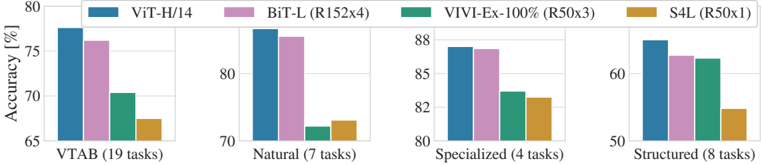
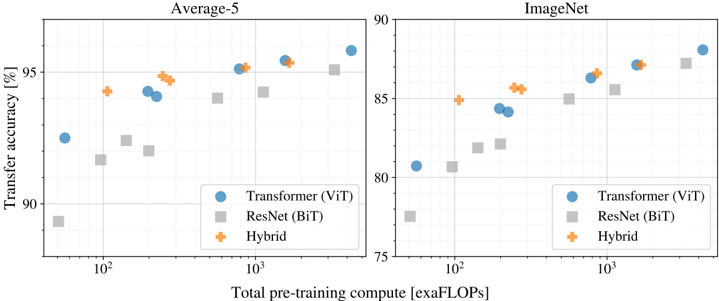
- ViT-H/14 pre-trained on JFT-300M reaches 88.55% ImageNet, 90.72% ImageNet-ReaL, 94.55% CIFAR-100, and 77.63% on VTAB (19 tasks), outperforming BiT-L on all reported tasks while using 2.5k TPUv3-core-days versus BiT-L’s 9.9k and Noisy Student’s 12.3k.
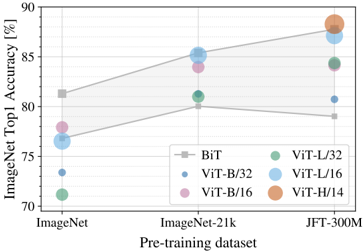
- ViT-L/16 pre-trained on public ImageNet-21k reaches 85.30% ImageNet, 88.62% ImageNet-ReaL, 93.25% CIFAR-100, and 72.72% VTAB, using 0.23k TPUv3-core-days.
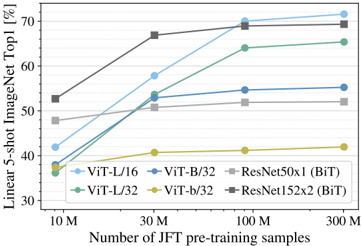
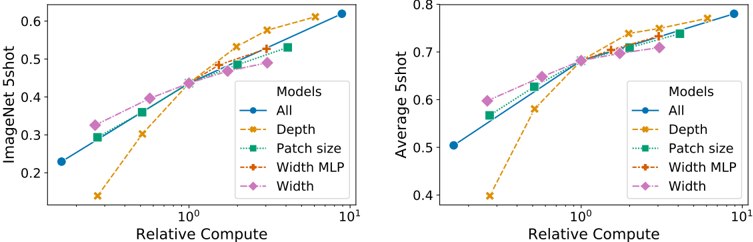
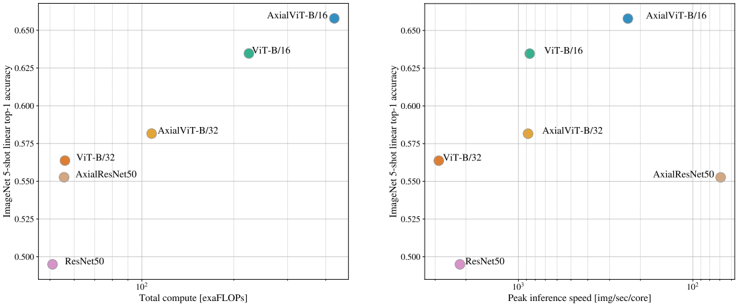
- On smaller pre-training datasets, ViT underperforms comparable ResNets; with JFT-300M, larger ViT models overtake smaller ones and ViT overtakes BiT. In a scaling study, ViT uses approximately 2–4× less compute to attain the same performance averaged over 5 datasets.
- Self-supervised masked patch prediction with ViT-B/16 achieves 79.9% ImageNet accuracy, a 2% improvement over training from scratch but still 4% behind supervised pre-training.
Methods
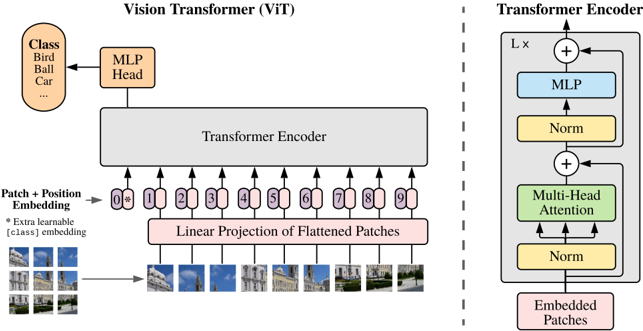
- Images are split into fixed-size patches, flattened, linearly projected to D dimensions, given position embeddings, and fed as a sequence to a standard Transformer encoder; a learnable [class] token provides the image representation for classification.
- Models include ViT-Base (12 layers, D=768, 86M params), ViT-Large (24 layers, D=1024, 307M params), and ViT-Huge (32 layers, D=1280, 632M params); baselines are ResNet (BiT) and hybrid ResNet+ViT models.
- Pre-training uses ImageNet, ImageNet-21k, or JFT-300M; training uses Adam with batch size 4096 and weight decay 0.1, while fine-tuning uses SGD with momentum and batch size 512; evaluation reports fine-tuning and few-shot/linear accuracies.
Limitations
- Stated by the paper: applying ViT to other vision tasks such as detection and segmentation remains a challenge; self-supervised pre-training still lags large-scale supervised pre-training; further scaling of ViT would likely improve performance but remains future work.
- Evident from the text: ViT has much less image-specific inductive bias than CNNs, so it generalizes worse when trained on insufficient data and requires large-scale pre-training (14M–300M images) to become competitive.
- Evident from the text: higher-resolution fine-tuning requires 2D interpolation of pre-trained position embeddings, and the paper notes that pre-training efficiency may be affected by factors beyond architecture, such as training schedule, optimizer, and weight decay.
Model-written summary. Check it against the paper before relying on it.
Integrity signals
Registry
Cites
Statistics
Figures
Verification
Claims the paper makes
6 Valid · 3 Not valid · 7 Not checked · 89 Own results and interpretations
Some cited sources support this claim and some don’t — read each source’s verdict below.
In the paper
“Therefore, in large-scale image recognition, classic ResNetlike architectures are still state of the art (Mahajan et al., 2018; Xie et al., 2020; Kolesnikov et al., 2020).”
What the sources say
- Supportedcites Mahajan et al., 2018 matched to “Exploring the Limits of Weakly Supervised Pretraining” (2018) source
Section A.5 (p. 23) compares the paper’s ResNeXt-101 models with the state of the art on ImageNet-1k and reports that they improved on those results. This supports citing the paper as an example of a ResNet-like architecture achieving state-of-the-art large-scale image recognition results at the time of publication. (LLM, conf=0.88)
- Disputedcites Xie et al., 2020 matched to “Self-Training With Noisy Student Improves ImageNet Classification” (2020) sourceExperimental — accuracy not yet measured
In §3.2 (p. 4), the paper calls the ResNeXt-101 WSL result the previous state of the art, then reports that its EfficientNet-L2 model surpasses it on ImageNet. It therefore does not support the claim that classic ResNet-like architectures are still state of the art. (LLM, conf=0.88)
Checked by a reasoning model — may be wrong.
- Supportedcites Kolesnikov et al., 2020 matched to “Big Transfer (BiT): General Visual Representation Learning” (2020) source
Section 3.3 (p. 5) says BiT uses a ResNet-v2 architecture, with changes to normalization and convolutional layers. Section 3.4 (p. 6) reports that BiT-L outperforms previously reported state-of-the-art generalist models on standard computer-vision benchmarks. This supports the claim about ResNet-like architectures, rather than unmodified classic ResNets. (LLM, conf=0.89)
plain- Asserted: passes — The authors put it forward as true.
- Checkable: passes — It can be checked against evidence.
- Load-bearing: passes — The paper’s conclusions depend on it.
- Based: passes — The paper gives a reason why it holds.
- Supported
The cited sources support only part of this claim — read each source’s verdict below.
In the paper
“The latter models, while theoretically efficient, have not yet been scaled effectively on modern hardware accelerators due to the use of specialized attention patterns.”
What the sources say
- Partly supportedcites Ramachandran et al., 2019 matched to “Stand-Alone Self-Attention in Vision Models” (2019) sourceExperimental — accuracy not yet measured
The Discussion (Sec. 5) of our copy does state the hardware-efficiency point attributed here: although the attention-based architecture is favourable in training efficiency and computational demand, 'the resulting network is slower in wall-clock time', and 'the reason for this discrepancy is the lack of optimized kernels available on various hardware accelerators'. But two elements of the claim are not in the source: it never says such models 'have not yet been scaled effectively' (it reports its own fully attentional model trained and scaled across widths/depths on 128 Cloud TPUv3 cores, Sec. 4.1 and A.2), and it locates the cause in the absence of optimized kernels/libraries rather than in 'the use of specialized attention patterns'. So the source supports the general thrust (pure self-attention vision models run inefficiently on current accelerators) but not the scaling claim or the stated causal mechanism. (LLM, conf=0.70)
- Not matchedcites Wang et al., 2020a
More than one paper fits this citation.
plainstates a cause- Asserted: passes — The authors put it forward as true.
- Checkable: passes — It can be checked against evidence.
- Load-bearing: passes — The paper’s conclusions depend on it.
- Based: passes — The paper gives a reason why it holds.
- Partly supported
A result the paper reports from its own data — it cites no other source for it, so there is none to check. The quote shows it is in the paper.
In the paper
“In particular, the best model reaches the accuracy of 88 . 55% on ImageNet, 90 . 72% on ImageNet-ReaL, 94 . 55% on CIFAR-100, and 77 . 63% on the VTAB suite of 19 tasks.”
plain- Asserted: passes — The authors put it forward as true.
- Checkable: passes — It can be checked against evidence.
- Load-bearing: passes — The paper’s conclusions depend on it.
- Based: passes — The paper gives a reason why it holds.
A result the paper reports from its own data — it cites no other source for it, so there is none to check. The quote shows it is in the paper.
In the paper
“Our Vision Transformer (ViT) attains excellent results when pre-trained at sufficient scale and transferred to tasks with fewer datapoints.”
plainstates a cause- Asserted: passes — The authors put it forward as true.
- Checkable: passes — It can be checked against evidence.
- Load-bearing: passes — The paper’s conclusions depend on it.
- Based: passes — The paper gives a reason why it holds.
54 more claims
Create a free account to see all 105 claims and to verify the 1 reference still open.
- Probably not a substantial claim. 21
- It may state two separate claims as one. 27
Claims other papers make about this one
Each is checked against this paper’s own text: does it say what the citing paper says it does?
The cited source doesn’t support the claim as written.
In the citing paper
“The results of ViT on image classification are encouraging, but its architecture is unsuitable for use as a general-purpose backbone network on dense vision tasks or when the input image resolution is high, due to its low-resolution feature maps and the quadratic increase in complexity with image size.”
From Swin Transformer: Hierarchical Vision Transformer using Shifted Windows (2021) · cites this paper as [20]
Checked by a reasoning model — may be wrong.
Experimental — accuracy not yet measuredThe cited source doesn’t support the claim as written.
In the citing paper
“The ViT-B, ViT-L, DeiT-S, DeiT-B are adopted as the baseline model, whose top-1 accuracy on ImageNet dataset are 71.58%, 71.48%, 79.8%, 81.8% respectively.”
From Post-Training Quantization for Vision Transformer (2021) · cites this paper as [11]
Checked by a reasoning model — may be wrong.
Experimental — accuracy not yet measuredThe cited source doesn’t support the claim as written.
In the citing paper
“its computational and memory costs are relatively high even for common input image sizes ( e.g. , shorter edge of 800 pixels in the COCO benchmark [40]).”
From Pyramid Vision Transformer: A Versatile Backbone for Dense Prediction without Convolutions (2021) · cites this paper as [13]
Checked by a reasoning model — may be wrong.
Experimental — accuracy not yet measuredThe source backs part of the claim, not all of it — or backs it for a different population, condition or comparison.
In the citing paper
“In existing Transformer-based models [64, 20], tokens are all of a fixed scale, a property unsuitable for these vision applications.”
From Swin Transformer: Hierarchical Vision Transformer using Shifted Windows (2021) · cites this paper as [20]
Experimental — accuracy not yet measured
63 more claims about this paper
Create a free account to see every claim other papers make about this one.
Self-check
Percentages, sums and reported differences re-computed from the paper’s own numbers.
Each contradiction between two passages listed here was confirmed by an independent check.
Rated minor: it would not touch a result — a value no result rests on, a p-value that stays on the same side of the significance level, or a conflict that is clerical, resolved elsewhere in the paper, or outside its own findings.
In the paper
§ 4.2 COMPARISON TO STATE OF THE ART · p. 5
“The smaller ViT-L/16 model pre-trained on JFT-300M outperforms BiT-L (which is pre-trained on the same dataset) on all tasks”
§ 4.2 COMPARISON TO STATE OF THE ART · p. 6
“| VTAB (19 tasks) | 77 . 63 ± 0 . 23 | 76 . 28 ± 0 . 46 | 72 . 72 ± 0 . 21 | 76 . 29 ± 1 . 70 | - |”
Rated minor: it would not touch a result — a value no result rests on, a p-value that stays on the same side of the significance level, or a conflict that is clerical, resolved elsewhere in the paper, or outside its own findings.
In the paper
§ 4.1 SETUP · p. 5
“We train all models, including ResNets, using Adam (Kingma & Ba, 2015) with β 1 = 0 . 9 , β 2 = 0 . 999 , a batch size of 4096 and apply a high weight decay of 0 . 1”
§ REFERENCES · p. 13
“| ViT-B/ { 16,32 } | ImageNet-21k | 90 | 10 - 3 | linear | 0.03 | 0.1 |”
Citations
Cites
Deep Residual Learning for Image Recognition
He, K., Zhang, X., Ren, S., & Sun, J. (2016) · 2016 IEEE Conference on Computer Vision and Pattern Recognition (CVPR) · doi:10.1109/cvpr.2016.90 · Cited by 235,474 · cited 2×
“In computer vision, however, convolutional architectures remain dominant (LeCun et al., 1989; Krizhevsky et al., 2012; He et al., 2016).”
Vaswani, A., Shazeer, N., Parmar, N., Uszkoreit, J., Jones, L., Gomez, A. N., Kaiser, L., & Polosukhin, I. (2017) · arXiv · doi:10.48550/arxiv.1706.03762 · Cited by 120,404
Self-citationImageNet classification with deep convolutional neural networks
Krizhevsky, A., Sutskever, I., & Hinton, G. E. (2017) · Communications of the ACM · doi:10.1145/3065386 · Cited by 112,155 · cited 1×
“In computer vision, however, convolutional architectures remain dominant (LeCun et al., 1989; Krizhevsky et al., 2012; He et al., 2016).”
BackgroundAdam: A Method for Stochastic Optimization
Kingma, D. P., & Ba, J. (2014) · arXiv · doi:10.48550/arxiv.1412.6980 · Cited by 98,946
ImageNet: A large-scale hierarchical image database
Deng, J., Dong, W., Socher, R., Li, L.-J., Li, K., & Fei-Fei, L. (2009) · 2009 IEEE Conference on Computer Vision and Pattern Recognition · doi:10.1109/cvpr.2009.5206848 · Cited by 65,333 · cited 2×
“…model scalability, we use the ILSVRC-2012 ImageNet dataset with 1k classes and 1.3M images (we refer to it as ImageNet in what follows), its superset ImageNet-21k with 21k classes and 14M images (Deng et al., 2009), and JFT (Sun et al., 2017) with 18k classes and 303M high-resolution images.”
MethodBERT: Pre-training of Deep Bidirectional Transformers for Language Understanding
Devlin, J., Chang, M.-W., Lee, K., & Toutanova, K. (2019) · Proceedings of the 2019 Conference of the North American Chapter of the Association for Computational Linguistics: Human Language Technologies, Volume 1 (Long and Short Papers) · doi:10.18653/v1/n19-1423 · Cited by 54,325 · cited 10×
“We base ViT configurations on those used for BERT (Devlin et al., 2019), as summarized in Table 1.”
InfluentialBatch Normalization: Accelerating Deep Network Training by Reducing Internal Covariate Shift
Ioffe, S., & Szegedy, C. (2015) · arXiv · doi:10.48550/arxiv.1502.03167 · Cited by 27,818 · cited 1×
“For the baseline CNNs, we use ResNet (He et al., 2016), but replace the Batch Normalization layers (Ioffe & Szegedy, 2015) with Group Normalization (Wu & He, 2018), and used standardized convolutions (Qiao et al., 2019).”
Learning Multiple Layers of Features from Tiny Images
Krizhevsky, A. (2024) · doi:10.57702/zp44cu3g · Cited by 23,395
Language Models are Few-Shot Learners
Brown, T. B., Mann, B., Ryder, N., Subbiah, M., Kaplan, J., Dhariwal, P., Neelakantan, A., Shyam, P., Sastry, G., Askell, A., et al. (2020) · arXiv · doi:10.48550/arxiv.2005.14165 · Cited by 23,372 · cited 2×
“…models are often pre-trained on large corpora and then fine-tuned for the task at hand: BERT (Devlin et al., 2019) uses a denoising self-supervised pre-training task, while the GPT line of work uses language modeling as its pre-training task (Radford et al., 2018; 2019; Brown et al., 2020).”
End-to-End Object Detection with Transformers
Carion, N., Massa, F., Synnaeve, G., Usunier, N., Kirillov, A., & Zagoruyko, S. (2020) · Lecture Notes in Computer Science · doi:10.1007/978-3-030-58452-8_13 · Cited by 18,285 · cited 3×
“…classification (Bello et al., 2019) or by further processing the output of a CNN using self-attention, e.g. for object detection (Hu et al., 2018; Carion et al., 2020), video processing (Wang et al., 2018; Sun et al., 2019), image classification (Wu et al., 2020), unsupervised object discovery…”
Research works printed but not linked: 2
- Jean-Baptiste Cordonnier, Andreas Loukas, and Martin Jaggi. On the relationship between selfattention and convolutional layers. In ICLR , 2020.
- Yuxin Wu and Kaiming He. Group normalization. In ECCV , 2018.
Cited by
Items 21,201–21,300 of 21,854
TSRST: A LongNet Transformer Model for Imputing Super-Resolution Spatial Transcriptomics
Xiong, Z., Cheng, R., & Zhang, J. (2025) · IEEE International Conference on Bioinformatics and Biomedicine (BIBM) · doi:10.1109/bibm66473.2025.11357199
Modality-Guided Edge Fusion and Semantic Enhancement for Multi-Modal Brain Tumor Segmentation
Zhou, W., Zeng, Y., Zhang, X., et al. (2025) · IEEE International Conference on Bioinformatics and Biomedicine (BIBM) · doi:10.1109/bibm66473.2025.11356218
Xiang, T., Li, B., Hu, Z., Wang, X., Dang, Y., & Deng, Y. (2025) · International Conference on Computer, Internet of Things and Control Engineering (CITCE) · doi:10.1109/citce67565.2025.11360039 · Cited by 1
An Efficient Hybrid Network for Tibial Dyschondroplasia Segmentation: Application to Medical Images
Yang, Y., Liu, X., Feng, C., et al. (2025) · IEEE International Conference on Bioinformatics and Biomedicine (BIBM) · doi:10.1109/bibm66473.2025.11356847
3D Venous Anatomy Analysis for Pancreatic Surgery Using Large Vision-Language Model
Zeng, Y., Wang, Y., Li, M., Ren, S., Li, J., Yuan, W., Meng, C., & Yuan, C. (2025) · IEEE International Conference on Bioinformatics and Biomedicine (BIBM) · doi:10.1109/bibm66473.2025.11356698 · Cited by 2
Xu, M., Yang, T., Zhou, T., Chen, Q., Wang, S., & Zhang, Y. (2025) · IEEE International Conference on Bioinformatics and Biomedicine (BIBM) · doi:10.1109/bibm66473.2025.11356968
UOPSL: Unpaired OCT Predilection Sites Learning for Fundus Image Diagnosis Augmentation
Zhao, Z., Zhao, Y., Yang, J., Yao, X., Liang, Q., Zapp, D., Huang, K., Navab, N., & Nasseri, M. A. (2025) · IEEE International Conference on Bioinformatics and Biomedicine (BIBM) · doi:10.1109/bibm66473.2025.11357134
A-Mel: A Resource-Efficient Deep Learning Agent for Precise Early Melanoma Diagnosis
Liu, Y., Zhang, J., Cao, Y., Liu, D., Chang, J., Chen, S., & Peng, S. (2025) · IEEE International Conference on Bioinformatics and Biomedicine (BIBM) · doi:10.1109/bibm66473.2025.11356230
MSLD: Medical Image Segmentation via Latent Diffusion Model
Zhang, X., Ye, X., Zhang, M., Yang, T., & Hu, K. (2025) · IEEE International Conference on Bioinformatics and Biomedicine (BIBM) · doi:10.1109/bibm66473.2025.11357093
Liu, L., Wang, Y., Li, J., Zheng, M., Jiang, Z., Song, Y., & Liu, X. (2025) · IEEE International Conference on Bioinformatics and Biomedicine (BIBM) · doi:10.1109/bibm66473.2025.11356719
Jiang, Z., Liu, L., Li, Z., Xie, Y., Wang, Y., Hou, B., Chi, J., & Liu, X. (2025) · IEEE International Conference on Bioinformatics and Biomedicine (BIBM) · doi:10.1109/bibm66473.2025.11356657
Modern Deep Neural Networks in Acoustic Emission Signal Analysis
Zavadil, J., Kus, V., & Chlada, M. (2025) · Springer proceedings in mathematics & statistics · doi:10.1007/978-3-032-00914-2_26
Interpretable Multi-Class Brain MRI Tumor Classification with Vit-B16 Transformer
Panigrahi, S., Adhikary, D. R. D., Pattanayak, B. K., et al. (2025) · doi:10.1109/iconat66879.2025.11362544
Yang, S., Shi, H., tian, X., Xu, X., Yin, J., Yao, J., & Liu, S. (2026) · IEEE Transactions on Instrumentation and Measurement · doi:10.1109/tim.2026.3659624
Environment-sensitive motion modelling in healthcare with synthetic retargeting
Guan, X., Gray, R., Mah, Y., Esfandiari, A., Cardoso, M. J., & Nachev, P. (2026) · Digital Health · doi:10.1177/20552076261418835 · Cited by 1
Self-Supervised Transformer-Based Pipeline for Liver Tumor Segmentation and Type Classification
Mojtahedi, R., Hamghalam, M., Peoples, J., Jarnagin, W. R., Do, R. K. G., & Simpson, A. L. (2026) · JCO Clinical Cancer Informatics · doi:10.1200/cci-25-00135 · Cited by 2
ViDToken: A Video-Transformer-Based Latent Token Defense for Adversarial Video Detection
Song, W., Sui, Y., Xing, Z., Zhu, L., & Xue, J. (2025) · International Symposium on Research in Attacks, Intrusions and Defenses (RAID) · doi:10.1109/raid67961.2025.00012 · Cited by 4
Multimodal Puzzle Solving Using Vision Transformers and Attention Mechanism
Joshi, N., Marathe, D., Khochare, A., Kaslay, R., & Natu, S. J. (2026) · Lecture notes in networks and systems · doi:10.1007/978-3-032-10664-3_25
Parale, M., Patil, C. H., & Mali, S. M. (2026) · Multimedia Tools and Applications · doi:10.1007/s11042-026-21330-6 · Cited by 1
Yan, G., Zhao, P., & Geng, S. (2026) · Multimedia Systems · doi:10.1007/s00530-025-02141-5 · Cited by 1
Liao, X., Zhang, J., Wang, J., Lyu, Y., Zhong, R. Y., & Zhang, Q. (2026) · International Journal of Production Research · doi:10.1080/00207543.2026.2623534 · Cited by 2
Parameter-Space Data Distillation in Generative Models
Do, H.-M., & Tran, T. (2025) · RIVF International Conference on Computing and Communication Technologies (RIVF) · doi:10.1109/rivf68649.2025.11365067
Enhancing Knee Disease Diagnosis via Multi-View Graph Representation With Multi-Task Pre-Training
Zhuang, Z., Chen, D., Wang, S., Xuan, K., Zhao, X., Xue, Z., Shen, D. G., Zhang, L., Yao, W., & Wang, Q. (2026) · IEEE Transactions on Medical Imaging · doi:10.1109/tmi.2026.3656355 · Cited by 2
Dimensionality reduced antenna array for beamforming/steering
Xia, S., Zhao, M., Ma, Q., et al. (2026) · Communications Engineering · doi:10.1038/s44172-026-00588-6
Accurate Braintumor Detection with NeuroMS-ViT: A Transformer Based Multi-Scale Architecture
Srinidhi, B. S., & Keerthika, P. (2025) · doi:10.1109/iemecon69302.2025.11365937
Leveraging Hybrid Deep and Machine Learning Models for Plant Disease Classification
Khan, M. T., & Islam, M. R. (2025) · doi:10.1109/sti69347.2025.11367606
Sifat, S. M. S., Fahmida, M., & Deb, K. (2025) · doi:10.1109/sti69347.2025.11367550
Global-Local Contrastive Learning Method for Fingerprint Feature Extraction of Non-modern Paintings
Wang, X., Lian, S., Xing, W., Lin, H., & Zhao, L. (2025) · International Conference on Cyber Security and Information Engineering (ICCSIE) · doi:10.1109/iccsie65832.2025.00090
He, J. (2026) · Intelligent Service Robotics · doi:10.1007/s11370-025-00686-y
Statically scheduled interconnect for neural network inter-layer accelerating
Zhou, Q., Xu, H., Li, J., Yang, W., & Chen, C. (2026) · Microelectronics Journal · doi:10.1016/j.mejo.2026.107098
Manju, D., Sudarsan, V., Sreenivasu, S. V. N., Purimetla, N. M. R., Jala, J., & Reddy, D. N. (2026) · Soft Computing · doi:10.1007/s00500-025-11026-8 · Cited by 2
Classification of moving objects through scattering media based on a dynamic vision sensor
Yang, B., Liao, Y., & Ke, J. (2026) · Applied Optics · doi:10.1364/ao.585162
Li, D., Fu, C.-H., & Tang, K. (2026) · bioRxiv (Cold Spring Harbor Laboratory) · doi:10.64898/2026.02.06.703926 · Cited by 1
Enhanced Deep Learning Techniques for Multi-Class Classification of Lung Disorders in Chest X-Rays
Devayani, A., Anurag, K., Anil, B., Reddy, C. A., & Jabbar, M. A. (2025) · International Conference on Emerging Research in Electronics, Computer Science and Technology (ICERECT) · doi:10.1109/icerect65215.2025.11376083
Huang, Z., Li, W., Zhang, Y., Guo, J., Zheng, J., Ji, G., & Tao, Y. (2026) · IEEE Transactions on Intelligent Transportation Systems · doi:10.1109/tits.2025.3649738 · Cited by 3
Dabbir, R. (2025) · International Conference on Emerging Research in Electronics, Computer Science and Technology (ICERECT) · doi:10.1109/icerect65215.2025.11377309
Eisele, O., Heidenreich, T., & Maares, P. (2026) · European Journal of Political Research · doi:10.1017/s1475676526100668 · Cited by 1
Liu, D., Ning, L., & Xie, Y. (2026) · Communications in computer and information science · doi:10.1007/978-981-95-6730-0_12
SHFE: Transparent And Green Image Classification Via Supervised Hierarchical Feature Extraction
Yao, J.-E., Wang, X., & Kuo, C. J. (2025) · IEEE International Conference on Image Processing Workshops (ICIPW) · doi:10.1109/icipw68931.2025.11386284
Do, T. T., Eftekhar, P., & Cheung, G. (2025) · IEEE International Conference on Image Processing Workshops (ICIPW) · doi:10.1109/icipw68931.2025.11386014
ICIP 2025 Competition on Beyond Visible Spectrum: AI For Agriculture
Han, P. L., Huang, W., Zhang, X., et al. (2025) · doi:10.1109/icipw68931.2025.11386379
TECIS: Text-Enhanced Cross-Modal Instrument Segmentation in Surgical Video
Kim, H. B., Cho, E., Kim, J. U., & Kim, S. T. (2025) · IEEE International Conference on Image Processing Workshops (ICIPW) · doi:10.1109/icipw68931.2025.11386280
Urban Elements Reid Challenge 2025
Moral, P., Galán, J., García‐Martín, Á., et al. (2025) · doi:10.1109/icipw68931.2025.11385884
Alignment-Invertibility Regularization for Explainable Neural Networks
Zhang, B., Rao, Q., Zhou, J., & Lu, J. (2026) · IEEE Transactions on Pattern Analysis and Machine Intelligence · doi:10.1109/tpami.2026.3665728
Urban Reid with Part-Aware Transformers: Evaluating Backbones, Losses, and Post-Processing
Un, A. F., & Đình, N. L. (2025) · IEEE International Conference on Image Processing Workshops (ICIPW) · doi:10.1109/icipw68931.2025.11385928 · Cited by 1
Clinical XAI For Classification in Pathology Images Via Vision-Language Model
Song, J., Lee, C., & 곽진태 (2025) · IEEE International Conference on Image Processing Workshops (ICIPW) · doi:10.1109/icipw68931.2025.11386035
Data-Centric and Model-Centric Enhancements for Urban Object Re-Identification
Benito, M. D., & González, J. S. (2025) · IEEE International Conference on Image Processing Workshops (ICIPW) · doi:10.1109/icipw68931.2025.11386256 · Cited by 1
Fernandes, V. J., de Louw, P. G. B., Ritsema, C. J., et al. (2026) · Environmental Earth Sciences · doi:10.1007/s12665-026-12825-4
Vision Transformer-Based Structural Simulation of Energy Absorption Systems in Armored Vehicles
Goud, S., Kumar, K. L., Pradeep, P., Bohidar, S. K., Harsha, A. S., & Gupta, S. (2025) · International Conference on Science Technology Engineering and Mathematics (ICONSTEM) · doi:10.1109/iconstem65670.2025.11374837
SerViT: A Vision Transformer-Based Model for Service Detection in Badminton Match Videos
See, S. Y., Krishnasamy, G., & Hassan, M. F. (2026) · International Conference on Electronics, Information, and Communication (ICEIC) · doi:10.1109/iceic69189.2026.11386385
Dao, H. N., Hashimoto, Y., Paik, I., & Thang, T. C. (2026) · International Conference on Electronics, Information, and Communication (ICEIC) · doi:10.1109/iceic69189.2026.11386349
Ganapathy, N. B. S., & Mayan, J. A. (2025) · doi:10.1109/icec2nt65402.2025.11380106
Priya, S. V., Lotus, R., Varalakshmi, S., Karthikeyan, G., Kumari, E. N. V., & Al-Safarini, M. Y. (2025) · International Conference on Electronics and Computing, Communication Networking Automation Technologies (ICEC2NT) · doi:10.1109/icec2nt65402.2025.11380168
A Framework Leveraging Temporal Features for Accurate Video Classification and Object Detection
Sen, C., Yogi, K. K., & Singh, P. (2025) · International Conference on Advancement in Electronics & Communication Engineering (AECE) · doi:10.1109/aece67531.2025.11386742
Closit: Clipped-Regime Posit Quantization for Edge-Friendly Vision Transformers
Han, S., Choi, D., & Kim, H. (2025) · IEEE Asia Pacific Conference on Circuits and Systems (APCCAS) · doi:10.1109/apccas67402.2025.11376611
Multimodal Spam Detection Based on Multi-View Complementary Hybrid Feature Fusion
Zhai, G., Yang, B., Sun, R., et al. (2025) · doi:10.1109/icbctis66509.2025.11387473
Performance Analysis of VGGT with Denoising under Various Compression Levels in Lossy Compression
Kim, J., Kim, D.-H., Moon, C., Lee, Y., Kim, E., Jeong, J., & Park, S. (2026) · Journal of Broadcast Engineering · doi:10.5909/jbe.2026.31.1.2
Kim, D., & Lee, J. (2026) · Journal of Chemical Information and Modeling · doi:10.1021/acs.jcim.5c02734 · Cited by 2
Quantum-Augmented MobileNet for Efficient Land Classification in Satellite Imagery
Santosh, N. K., Vivek, M., Teja, K. S., Kranthi, B. S. N., & Adithya, K. (2025) · IEEE International Conference on Green Industrial Electronics and Sustainable Technologies (GIEST) · doi:10.1109/giest66547.2025.11387560
Song, J., Kim, J., Seo, S., Kang, H.-J., & Lee, Y. (2026) · The International Journal of Advanced Manufacturing Technology · doi:10.1007/s00170-026-17649-x
Enhancing Occupational Safety: Real-Time Detection of Protective Equipment
Bhingarde, S., Chalke, K., Kartar, N., Dalvi, M., & More, J. S. (2026) · Cureus Journal of Computer Science. · doi:10.7759/s44389-026-00031-5
Core Tokensets for Data-Efficient Sequential Training of Transformers
Paul, S., Brack, M., Schramowski, P., Kersting, K., & Mundt, M. (2025) · IEEE International Conference on Computer Vision Workshops · doi:10.1109/iccvw69036.2025.00545 · Cited by 1
TULIP: Contrastive Image-Text Learning with Richer Vision Understanding
Tang, Z., Lian, L., Eisape, S., Wang, X., Herzig, R., Yala, A., Suhr, A., Darrell, T., & Chan, D. C.-Y. (2025) · IEEE International Conference on Computer Vision Workshops · doi:10.1109/iccvw69036.2025.00449 · Cited by 2
ConvertNet: Training-Time Model Scaling for In-Vehicle Continuous Learning
Zhang, Q., Han, R., Liu, C. H., Wang, G., & Chen, L. Y. (2026) · IEEE Transactions on Mobile Computing · doi:10.1109/tmc.2026.3667390 · Cited by 1
Ma, Z. (2025) · International Conference on Robotics, Intelligent Control and Artificial Intelligence (RICAI) · doi:10.1109/ricai68060.2025.11385079
HUO, Y., Lim, Y. D., & Tan, C. S. (2026) · Applied Optics · doi:10.1364/ao.587843
PolyFold: A Generalizable Framework for Language-Conditioned Bimanual Cloth Folding
Du, H., Xu, K., Xiong, R., & Wang, Y. (2026) · IEEE Transactions on Automation Science and Engineering · doi:10.1109/tase.2026.3667056
FaceScanPaliGemma multi-agent vision language models for facial attribute recognition
AlDahoul, N., Tan, M. J. T., Kasireddy, H. R., & Zaki, Y. (2026) · Scientific Reports · doi:10.1038/s41598-026-39584-3 · Cited by 19
Choi, S.-Y., & Lee, K. (2025) · IEEE International Conference on Computer Vision Workshops · doi:10.1109/iccvw69036.2025.00238
A Raspberry Pi Based Approach to Skin Cancer Detection Through Transfer Learning
Deepika, A. V. S., Chowdary, V. R., Aditya, P. P., et al. (2025) · doi:10.1109/idicaihei65991.2025.11378775
Sketch-to-Layout: Sketch-Guided Multimodal Layout Generation
Brioschi, R., Alekseev, A., Nevali, E., Döner, B., Malki, O. E., Mitrevski, B., Kieliger, L., Collier, M. A., Maksai, A., Berent, J., et al. (2025) · IEEE International Conference on Computer Vision Workshops · doi:10.1109/iccvw69036.2025.00199 · Cited by 1
FetaTrack: Enhancing Visual Object Tracking via Foreground-Aware Dynamic Template Co-Evolution
Zhang, Y., Wang, X., Song, Y., & Yan, W. (2025) · International Conference on Data Science and Intelligent Systems (DSIS) · doi:10.1109/dsis67228.2025.11390605
Dynamic Variance Reduction-Based Reusable Test Case Generation for Image Classification
Huang, C., Ji, S., Shi, Y., & Zhang, P. (2025) · Asia-Pacific Software Engineering Conference (APSEC) · doi:10.1109/apsec66846.2025.00051
Santhi, K., Shrichandran, G. V., Indhumathi, K., et al. (2026) · Microfluidics and Nanofluidics · doi:10.1007/s10404-026-02880-5
Serage, R., Nyirenda, C., Omomule, T. G., Christoffels, A. G., & Anderson, D. E. (2026) · Bioinformatics and Biology Insights · doi:10.1177/11779322251415123 · Cited by 2
GeoToken: Hierarchical Geolocalization of Images via Next Token Prediction
Ghasemi, N., Ziashahabi, A., Avestimehr, S., & Shahabi, C. (2025) · Industrial Conference on Data Mining · doi:10.1109/icdm65498.2025.00130 · Cited by 8
Hasan, M. J., Mohammed, N., Rahman, S., et al. (2025) · Proceedings · doi:10.1109/icdm65498.2025.00041
Prompt Learning with Text-Augmented Cues for Out-of-Distribution Detection
Feng, M., Chao, D., Zhang, Y., Yang, Y., & Guo, W. (2025) · Proceedings · doi:10.1109/icdm65498.2025.00129
shehab, S., & Saeed, M. (2026) · Multimedia Tools and Applications · doi:10.1007/s11042-026-21308-4
Generative Modeling of Entangled Polymers with a Distance-Based Variational Autoencoder
Chiarantoni, P., Serra, O., Mowlaei, M. E., Choutipalli, V. S. K., DelloStritto, M. J., Shi, X. M., Klein, M. L., & Carnevale, V. (2026) · Journal of Chemical Theory and Computation · doi:10.1021/acs.jctc.5c01953
Kim, T.-H., Kim, E.-B., & Hwang, E. (2026) · Fire science and engineering · doi:10.7731/kifse.4a12fb95 · Cited by 1
Crowd Counting via Single-Domain Generalization
Hu, Y., Liu, Y., Cao, G., & Wang, J. (2026) · IEEE Transactions on Multimedia · doi:10.1109/tmm.2026.3668677
Sun, C., Wei, J., Wu, Y., Shi, Y., He, S., Ma, Z., Xie, N., & Yang, Y. (2026) · IEEE Transactions on Multimedia · doi:10.1109/tmm.2026.3668691 · Cited by 23
Zhang, Y., Wang, J., Huang, Y., Chen, T., Wong, H., & Wu, S. (2026) · IEEE Transactions on Multimedia · doi:10.1109/tmm.2026.3668641 · Cited by 3
Det-Agent: Open-Vocabulary Object Localization and Detection With Reinforcement Learning Agent
Zhang, R., Wu, X.-J., Wang, C., & Liu, C.-L. (2026) · IEEE Transactions on Multimedia · doi:10.1109/tmm.2026.3668516 · Cited by 3
Qi, N., Zhao, P. F., Gui-qin, W., Zhao, C., & Yang, S. (2026) · IEEE Transactions on Multimedia · doi:10.1109/tmm.2026.3668476 · Cited by 1
Venkatakrishnan, S., Nithyleshwaran, P. S., Fareed, S., et al. (2025) · International Conference on Intelligent Systems and Embedded Design (ISED) · doi:10.1109/ised67359.2025.11405137
Classifying More Rectangle Regions of Bacteria in Gram Stained Smears Images
Kuroishi, H., & Hirata, K. (2025) · International Conference on Digital Medicine and Image Processing (DMIP) · doi:10.1145/3785443.3785456
A Unified Framework for Backdoor Trigger Segmentation
Xue, D., Qian, S., & Xu, C. (2026) · IEEE Transactions on Image Processing · doi:10.1109/tip.2026.3666796 · Cited by 1
Quantum-Inspired Audio Unlearning: Towards Privacy-Preserving Voice Biometrics
Pathak, S., Shreshtha, S., Singh, R., & Vatsa, M. (2025) · IEEE International Joint Conference on Biometrics (IJCB) · doi:10.1109/ijcb65343.2025.11411246 · Cited by 4
Trade-offs in Cross-Domain Generalization of Foundation Model Fine-Tuned for Biometric Applications
Chettaoui, T., Damer, N., & Boutros, F. (2025) · IEEE International Joint Conference on Biometrics (IJCB) · doi:10.1109/ijcb65343.2025.11411053
Nandini, Mishra, R. P., Mittal, S., & Dhiman, C. (2025) · IEEE International Conference on Recent Advances in Computing and Systems (REACS) · doi:10.1109/reacs67479.2025.11413264
Li, X., Zhang, W., Ando, S., Wang, Z., Lin, J., & Yoshioka, K. (2026) · IEEE Transactions on Very Large Scale Integration (VLSI) Systems · doi:10.1109/tvlsi.2026.3665471
Data-Efficient Industrial Defect Segmentation with Multiscale Bidirectional Interaction Adapter
Gao, K., Hu, Q., & Qi, F. (2025) · International Conference on Electronic Information Engineering and Computer Communication (EIECC) · doi:10.1109/eiecc67963.2025.11409589
Bayesian Multiclass Segmentation for Remote Sensing: Integrating User Priors and Uncertainty
Kim, Y., Lee, H., Choi, S.-Y., & Lee, K. (2026) · IEEE Transactions on Geoscience and Remote Sensing · doi:10.1109/tgrs.2026.3670205
Enhanced YOLOv8 with global attention for precise continuous casting slab detection
Liu, L., Gu, L., Li, Z., & Fang, Y. (2026) · The Journal of Supercomputing · doi:10.1007/s11227-026-08355-2
Lightweight YOLOv8 variants for enhanced real-time surgical tool detection
Do, T. M., Kim, T. D., & Le, H. X. (2026) · PeerJ Computer Science · doi:10.7717/peerj-cs.3622 · Cited by 1
Multi-scale Multimodal Representation for Enhanced Survival Prediction in Computational Pathology
Hou, Q., Sun, Y., Ling, J., Lu, M., & Yao, S. (2026) · Interdisciplinary Sciences Computational Life Sciences · doi:10.1007/s12539-026-00816-9
Organisciak, P., & Gillette, E. (2026) · Emerald Group Publishing Limited eBooks · doi:10.1108/s0065-283020260000060012
Lim, S., Kim, J.-H., Moon, S., Cha, J., Seo, D., Kim, J., Lee, H., Lee, J., & Kim, J. (2026) · IEEE Journal of Solid-State Circuits · doi:10.1109/jssc.2026.3663603
Metadata
- Authors
- Dosovitskiy, A., Beyer, L., Kolesnikov, A., Weissenborn, D., Zhai, X., Unterthiner, T., Dehghani, M., Minderer, M., Heigold, G., Gelly, S., Uszkoreit, J., & Houlsby, N.
- Affiliations
- Google (United States) (US)
- ORCID
- Venue
- arXiv
- Publisher
- arXiv
- Published
- 2020
- ISSN
- 2331-8422 (ISSN-L)
- arXiv
- 2010.11929
- OpenAlex
- W3094502228
- Semantic Scholar
- 268d347e8a55b5eb82fb5e7d2f800e33c75ab18a
- Cited by
- 47,472
- References
- 52
- Citations by year
- 2026: 8731 · 2025: 12671 · 2024: 11821 · 2023: 8591 · 2022: 4351 · 2021: 1263 · 2020: 30
- Type
- posted content
- Language
- en
- Open access
- green
- arxiv.org
- Locations
- arXiv (Cornell University) (submittedVersion)
- arXiv (Cornell University)
- Topics
- Physical Sciences › Computer Science › Computer Vision and Pattern Recognition › Advanced Neural Network Applications
- Physical Sciences › Computer Science › Artificial Intelligence › Domain Adaptation and Few-Shot Learning
- Physical Sciences › Computer Science › Computer Vision and Pattern Recognition › Visual Attention and Saliency Detection
- Keywords
- vision transformer, image classification, image patches, attention mechanism, pre-training, transfer learning, computational efficiency, ImageNet, CIFAR-100
About these checks
Registry, retraction, Cites and statistics results are computed, not judged, with one exception: a printed reference that no index lists is read once by a model before it counts as a citation error. Claims are extracted by a model and kept only when their quote appears verbatim in the text; each cited source is then checked, with a model’s help, for whether it says what the claim relies on. Those verdicts can be wrong — read the claim’s quote and the cited source before relying on one.
The claim verdicts this report counts are experimental: their accuracy is not yet measured.
A language model drew the claims from the paper on 2026-10-10, under version 3 of the claim definition (model deepseek-v4.1-flash, prompt extract-v3).
A second model labelled each claim on 2026-10-10 (model jev-1.13-20260917, definition revision gold-guideline-v0.2).
Cited sources are checked with a language model’s help (gpt-6-sol and qwen3.8-omni-flash).
Statistics and arithmetic are recomputed, not judged.
Confidence bands are shown only for fields calibrated on our annotated test set. None is calibrated yet, so no band is shown.
What counts as a claim ›How we measure confidence ›How we check this ›
Are you an author, or do you see a problem with this page? Request a review
Data sources
Bibliographic data: Semantic Scholar, OpenAlex, Crossref.
Contains information from the Semantic Scholar Academic Graph Datasets, made available under the ODC Attribution License (ODC-BY 1.0).
Semantic Scholar’s data is described in: Kinney, R., et al. (2023). The Semantic Scholar Open Data Platform. arXiv:2301.10140.
