

An Image is Worth 16x16 Words: Transformers for Image Recognition at Scale
Open accessThe DOI matches its DataCite record; 64 of the 64 references it cites were found in a registry or an index; 11 of the 23 sources its claims cite were checked for support.
Abstract
While the Transformer architecture has become the de-facto standard for natural language processing tasks, its applications to computer vision remain limited. In vision, attention is either applied in conjunction with convolutional networks, or used to replace certain components of convolutional networks while keeping their overall structure in place. We show that this reliance on CNNs is not necessary and a pure transformer applied directly to sequences of image patches can perform very well on image classification tasks. When pre-trained on large amounts of data and transferred to multiple mid-sized or small image recognition benchmarks (ImageNet, CIFAR-100, VTAB, etc.), Vision Transformer (ViT) attains excellent results compared to state-of-the-art convolutional networks while requiring substantially fewer computational resources to train.
Overview
CoChat Summary
TL;DR
Vision Transformer (ViT) applies a standard Transformer directly to sequences of image patches and, when pre-trained on large datasets, matches or exceeds state-of-the-art convolutional networks on image classification while using substantially less pre-training compute. Large-scale pre-training can overcome ViT’s weaker image-specific inductive biases, though ViT underperforms ResNets on smaller pre-training datasets.
Key findings
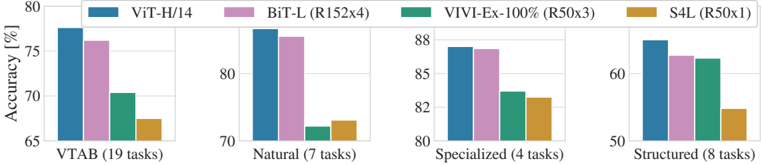
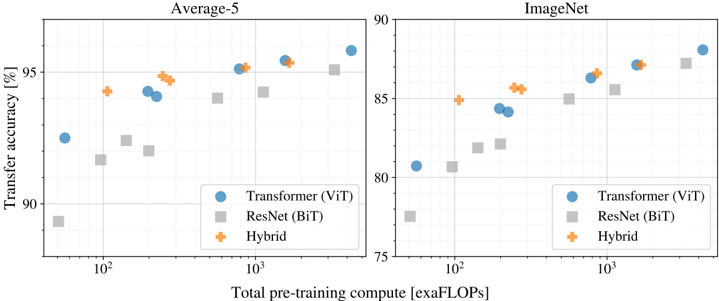
- ViT-H/14 pre-trained on JFT-300M reaches 88.55% ImageNet, 90.72% ImageNet-ReaL, 94.55% CIFAR-100, and 77.63% on VTAB (19 tasks), outperforming BiT-L on all reported tasks while using 2.5k TPUv3-core-days versus BiT-L’s 9.9k and Noisy Student’s 12.3k.
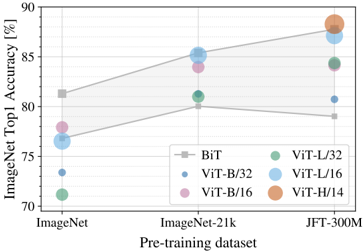
- ViT-L/16 pre-trained on public ImageNet-21k reaches 85.30% ImageNet, 88.62% ImageNet-ReaL, 93.25% CIFAR-100, and 72.72% VTAB, using 0.23k TPUv3-core-days.
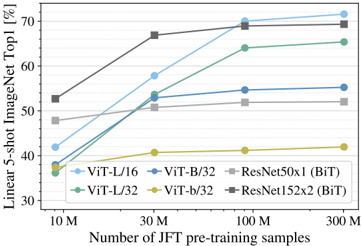
- On smaller pre-training datasets, ViT underperforms comparable ResNets; with JFT-300M, larger ViT models overtake smaller ones and ViT overtakes BiT. In a scaling study, ViT uses approximately 2–4× less compute to attain the same performance averaged over 5 datasets.
- Self-supervised masked patch prediction with ViT-B/16 achieves 79.9% ImageNet accuracy, a 2% improvement over training from scratch but still 4% behind supervised pre-training.
Methods
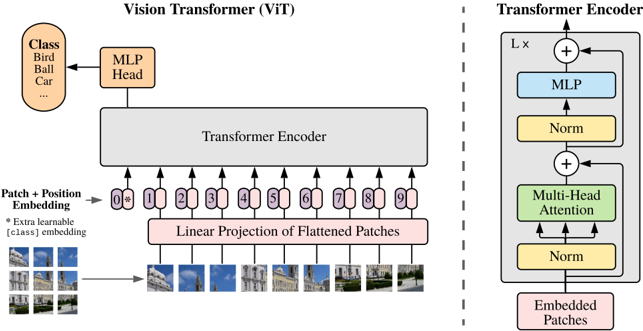
- Images are split into fixed-size patches, flattened, linearly projected to D dimensions, given position embeddings, and fed as a sequence to a standard Transformer encoder; a learnable [class] token provides the image representation for classification.
- Models include ViT-Base (12 layers, D=768, 86M params), ViT-Large (24 layers, D=1024, 307M params), and ViT-Huge (32 layers, D=1280, 632M params); baselines are ResNet (BiT) and hybrid ResNet+ViT models.
- Pre-training uses ImageNet, ImageNet-21k, or JFT-300M; training uses Adam with batch size 4096 and weight decay 0.1, while fine-tuning uses SGD with momentum and batch size 512; evaluation reports fine-tuning and few-shot/linear accuracies.
Limitations
- Stated by the paper: applying ViT to other vision tasks such as detection and segmentation remains a challenge; self-supervised pre-training still lags large-scale supervised pre-training; further scaling of ViT would likely improve performance but remains future work.
- Evident from the text: ViT has much less image-specific inductive bias than CNNs, so it generalizes worse when trained on insufficient data and requires large-scale pre-training (14M–300M images) to become competitive.
- Evident from the text: higher-resolution fine-tuning requires 2D interpolation of pre-trained position embeddings, and the paper notes that pre-training efficiency may be affected by factors beyond architecture, such as training schedule, optimizer, and weight decay.
Model-written summary. Check it against the paper before relying on it.
Integrity signals
Registry
Cites
Statistics
Figures
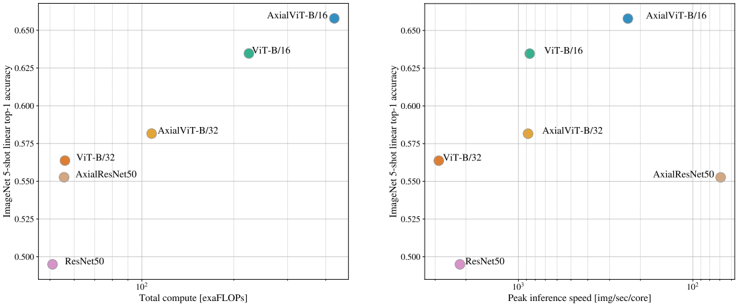
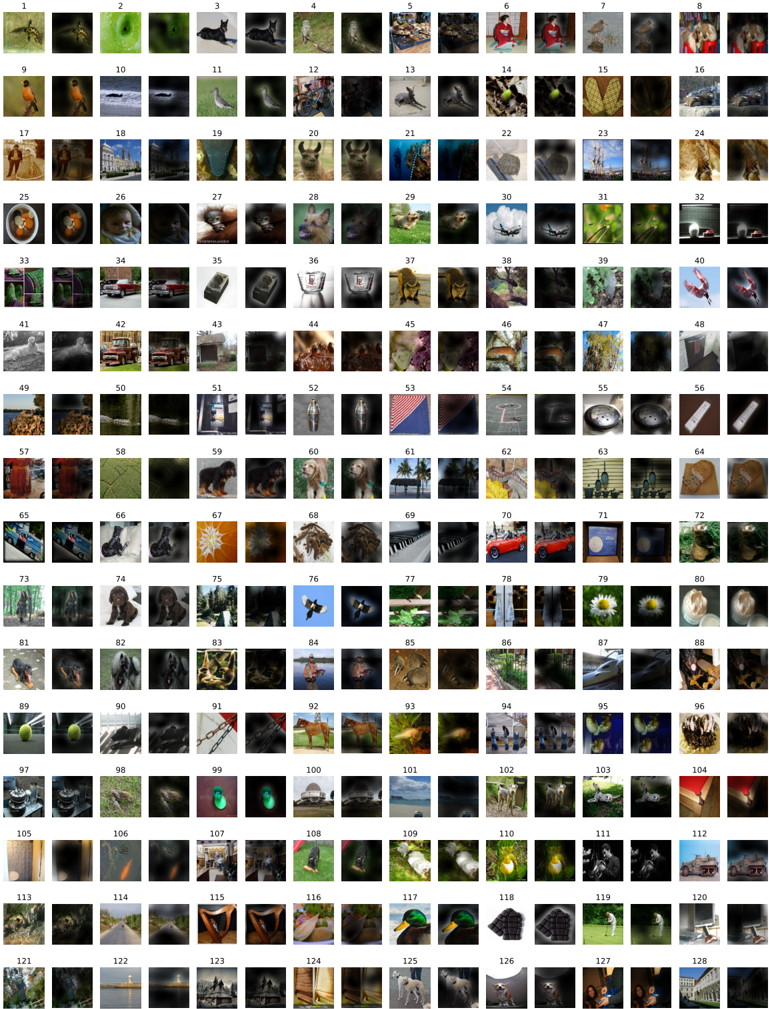
Verification
Claims the paper makes
6 Valid · 3 Not valid · 7 Not checked · 89 Own results and interpretations
Some cited sources support this claim and some don’t — read each source’s verdict below.
In the paper
“Therefore, in large-scale image recognition, classic ResNetlike architectures are still state of the art (Mahajan et al., 2018; Xie et al., 2020; Kolesnikov et al., 2020).”
What the sources say
- Supportedcites Mahajan et al., 2018 matched to “Exploring the Limits of Weakly Supervised Pretraining” (2018) source
Section A.5 (p. 23) compares the paper’s ResNeXt-101 models with the state of the art on ImageNet-1k and reports that they improved on those results. This supports citing the paper as an example of a ResNet-like architecture achieving state-of-the-art large-scale image recognition results at the time of publication. (LLM, conf=0.88)
- Disputedcites Xie et al., 2020 matched to “Self-Training With Noisy Student Improves ImageNet Classification” (2020) sourceExperimental — accuracy not yet measured
In §3.2 (p. 4), the paper calls the ResNeXt-101 WSL result the previous state of the art, then reports that its EfficientNet-L2 model surpasses it on ImageNet. It therefore does not support the claim that classic ResNet-like architectures are still state of the art. (LLM, conf=0.88)
Checked by a reasoning model — may be wrong.
- Supportedcites Kolesnikov et al., 2020 matched to “Big Transfer (BiT): General Visual Representation Learning” (2020) source
Section 3.3 (p. 5) says BiT uses a ResNet-v2 architecture, with changes to normalization and convolutional layers. Section 3.4 (p. 6) reports that BiT-L outperforms previously reported state-of-the-art generalist models on standard computer-vision benchmarks. This supports the claim about ResNet-like architectures, rather than unmodified classic ResNets. (LLM, conf=0.89)
plain- Asserted: passes — The authors put it forward as true.
- Checkable: passes — It can be checked against evidence.
- Load-bearing: passes — The paper’s conclusions depend on it.
- Based: passes — The paper gives a reason why it holds.
- Supported
The cited sources support only part of this claim — read each source’s verdict below.
In the paper
“The latter models, while theoretically efficient, have not yet been scaled effectively on modern hardware accelerators due to the use of specialized attention patterns.”
What the sources say
- Partly supportedcites Ramachandran et al., 2019 matched to “Stand-Alone Self-Attention in Vision Models” (2019) sourceExperimental — accuracy not yet measured
The Discussion (Sec. 5) of our copy does state the hardware-efficiency point attributed here: although the attention-based architecture is favourable in training efficiency and computational demand, 'the resulting network is slower in wall-clock time', and 'the reason for this discrepancy is the lack of optimized kernels available on various hardware accelerators'. But two elements of the claim are not in the source: it never says such models 'have not yet been scaled effectively' (it reports its own fully attentional model trained and scaled across widths/depths on 128 Cloud TPUv3 cores, Sec. 4.1 and A.2), and it locates the cause in the absence of optimized kernels/libraries rather than in 'the use of specialized attention patterns'. So the source supports the general thrust (pure self-attention vision models run inefficiently on current accelerators) but not the scaling claim or the stated causal mechanism. (LLM, conf=0.70)
- Not matchedcites Wang et al., 2020a
More than one paper fits this citation.
plainstates a cause- Asserted: passes — The authors put it forward as true.
- Checkable: passes — It can be checked against evidence.
- Load-bearing: passes — The paper’s conclusions depend on it.
- Based: passes — The paper gives a reason why it holds.
- Partly supported
A result the paper reports from its own data — it cites no other source for it, so there is none to check. The quote shows it is in the paper.
In the paper
“In particular, the best model reaches the accuracy of 88 . 55% on ImageNet, 90 . 72% on ImageNet-ReaL, 94 . 55% on CIFAR-100, and 77 . 63% on the VTAB suite of 19 tasks.”
plain- Asserted: passes — The authors put it forward as true.
- Checkable: passes — It can be checked against evidence.
- Load-bearing: passes — The paper’s conclusions depend on it.
- Based: passes — The paper gives a reason why it holds.
A result the paper reports from its own data — it cites no other source for it, so there is none to check. The quote shows it is in the paper.
In the paper
“Our Vision Transformer (ViT) attains excellent results when pre-trained at sufficient scale and transferred to tasks with fewer datapoints.”
plainstates a cause- Asserted: passes — The authors put it forward as true.
- Checkable: passes — It can be checked against evidence.
- Load-bearing: passes — The paper’s conclusions depend on it.
- Based: passes — The paper gives a reason why it holds.
54 more claims
Create a free account to see all 105 claims and to verify the 1 reference still open.
- Probably not a substantial claim. 21
- It may state two separate claims as one. 27
Claims other papers make about this one
Each is checked against this paper’s own text: does it say what the citing paper says it does?
The cited source doesn’t support the claim as written.
In the citing paper
“The results of ViT on image classification are encouraging, but its architecture is unsuitable for use as a general-purpose backbone network on dense vision tasks or when the input image resolution is high, due to its low-resolution feature maps and the quadratic increase in complexity with image size.”
From Swin Transformer: Hierarchical Vision Transformer using Shifted Windows (2021) · cites this paper as [20]
Checked by a reasoning model — may be wrong.
Experimental — accuracy not yet measuredThe cited source doesn’t support the claim as written.
In the citing paper
“The ViT-B, ViT-L, DeiT-S, DeiT-B are adopted as the baseline model, whose top-1 accuracy on ImageNet dataset are 71.58%, 71.48%, 79.8%, 81.8% respectively.”
From Post-Training Quantization for Vision Transformer (2021) · cites this paper as [11]
Checked by a reasoning model — may be wrong.
Experimental — accuracy not yet measuredThe cited source doesn’t support the claim as written.
In the citing paper
“its computational and memory costs are relatively high even for common input image sizes ( e.g. , shorter edge of 800 pixels in the COCO benchmark [40]).”
From Pyramid Vision Transformer: A Versatile Backbone for Dense Prediction without Convolutions (2021) · cites this paper as [13]
Checked by a reasoning model — may be wrong.
Experimental — accuracy not yet measuredThe source backs part of the claim, not all of it — or backs it for a different population, condition or comparison.
In the citing paper
“In existing Transformer-based models [64, 20], tokens are all of a fixed scale, a property unsuitable for these vision applications.”
From Swin Transformer: Hierarchical Vision Transformer using Shifted Windows (2021) · cites this paper as [20]
Experimental — accuracy not yet measured
63 more claims about this paper
Create a free account to see every claim other papers make about this one.
Self-check
Percentages, sums and reported differences re-computed from the paper’s own numbers.
Each contradiction between two passages listed here was confirmed by an independent check.
Rated minor: it would not touch a result — a value no result rests on, a p-value that stays on the same side of the significance level, or a conflict that is clerical, resolved elsewhere in the paper, or outside its own findings.
In the paper
§ 4.2 COMPARISON TO STATE OF THE ART · p. 5
“The smaller ViT-L/16 model pre-trained on JFT-300M outperforms BiT-L (which is pre-trained on the same dataset) on all tasks”
§ 4.2 COMPARISON TO STATE OF THE ART · p. 6
“| VTAB (19 tasks) | 77 . 63 ± 0 . 23 | 76 . 28 ± 0 . 46 | 72 . 72 ± 0 . 21 | 76 . 29 ± 1 . 70 | - |”
Rated minor: it would not touch a result — a value no result rests on, a p-value that stays on the same side of the significance level, or a conflict that is clerical, resolved elsewhere in the paper, or outside its own findings.
In the paper
§ 4.1 SETUP · p. 5
“We train all models, including ResNets, using Adam (Kingma & Ba, 2015) with β 1 = 0 . 9 , β 2 = 0 . 999 , a batch size of 4096 and apply a high weight decay of 0 . 1”
§ REFERENCES · p. 13
“| ViT-B/ { 16,32 } | ImageNet-21k | 90 | 10 - 3 | linear | 0.03 | 0.1 |”
Citations
Cites
Deep Residual Learning for Image Recognition
He, K., Zhang, X., Ren, S., & Sun, J. (2016) · 2016 IEEE Conference on Computer Vision and Pattern Recognition (CVPR) · doi:10.1109/cvpr.2016.90 · Cited by 235,474 · cited 2×
“In computer vision, however, convolutional architectures remain dominant (LeCun et al., 1989; Krizhevsky et al., 2012; He et al., 2016).”
Vaswani, A., Shazeer, N., Parmar, N., Uszkoreit, J., Jones, L., Gomez, A. N., Kaiser, L., & Polosukhin, I. (2017) · arXiv · doi:10.48550/arxiv.1706.03762 · Cited by 120,404
Self-citationImageNet classification with deep convolutional neural networks
Krizhevsky, A., Sutskever, I., & Hinton, G. E. (2017) · Communications of the ACM · doi:10.1145/3065386 · Cited by 112,155 · cited 1×
“In computer vision, however, convolutional architectures remain dominant (LeCun et al., 1989; Krizhevsky et al., 2012; He et al., 2016).”
BackgroundAdam: A Method for Stochastic Optimization
Kingma, D. P., & Ba, J. (2014) · arXiv · doi:10.48550/arxiv.1412.6980 · Cited by 98,946
ImageNet: A large-scale hierarchical image database
Deng, J., Dong, W., Socher, R., Li, L.-J., Li, K., & Fei-Fei, L. (2009) · 2009 IEEE Conference on Computer Vision and Pattern Recognition · doi:10.1109/cvpr.2009.5206848 · Cited by 65,333 · cited 2×
“…model scalability, we use the ILSVRC-2012 ImageNet dataset with 1k classes and 1.3M images (we refer to it as ImageNet in what follows), its superset ImageNet-21k with 21k classes and 14M images (Deng et al., 2009), and JFT (Sun et al., 2017) with 18k classes and 303M high-resolution images.”
MethodBERT: Pre-training of Deep Bidirectional Transformers for Language Understanding
Devlin, J., Chang, M.-W., Lee, K., & Toutanova, K. (2019) · Proceedings of the 2019 Conference of the North American Chapter of the Association for Computational Linguistics: Human Language Technologies, Volume 1 (Long and Short Papers) · doi:10.18653/v1/n19-1423 · Cited by 54,325 · cited 10×
“We base ViT configurations on those used for BERT (Devlin et al., 2019), as summarized in Table 1.”
InfluentialBatch Normalization: Accelerating Deep Network Training by Reducing Internal Covariate Shift
Ioffe, S., & Szegedy, C. (2015) · arXiv · doi:10.48550/arxiv.1502.03167 · Cited by 27,818 · cited 1×
“For the baseline CNNs, we use ResNet (He et al., 2016), but replace the Batch Normalization layers (Ioffe & Szegedy, 2015) with Group Normalization (Wu & He, 2018), and used standardized convolutions (Qiao et al., 2019).”
Learning Multiple Layers of Features from Tiny Images
Krizhevsky, A. (2024) · doi:10.57702/zp44cu3g · Cited by 23,395
Language Models are Few-Shot Learners
Brown, T. B., Mann, B., Ryder, N., Subbiah, M., Kaplan, J., Dhariwal, P., Neelakantan, A., Shyam, P., Sastry, G., Askell, A., et al. (2020) · arXiv · doi:10.48550/arxiv.2005.14165 · Cited by 23,372 · cited 2×
“…models are often pre-trained on large corpora and then fine-tuned for the task at hand: BERT (Devlin et al., 2019) uses a denoising self-supervised pre-training task, while the GPT line of work uses language modeling as its pre-training task (Radford et al., 2018; 2019; Brown et al., 2020).”
End-to-End Object Detection with Transformers
Carion, N., Massa, F., Synnaeve, G., Usunier, N., Kirillov, A., & Zagoruyko, S. (2020) · Lecture Notes in Computer Science · doi:10.1007/978-3-030-58452-8_13 · Cited by 18,285 · cited 3×
“…classification (Bello et al., 2019) or by further processing the output of a CNN using self-attention, e.g. for object detection (Hu et al., 2018; Carion et al., 2020), video processing (Wang et al., 2018; Sun et al., 2019), image classification (Wu et al., 2020), unsupervised object discovery…”
Research works printed but not linked: 2
- Jean-Baptiste Cordonnier, Andreas Loukas, and Martin Jaggi. On the relationship between selfattention and convolutional layers. In ICLR , 2020.
- Yuxin Wu and Kaiming He. Group normalization. In ECCV , 2018.
Cited by
Items 6,201–6,300 of 21,826
Robust Multiview Multimodal Driver Monitoring System Using Masked Multi-Head Self-Attention
Ma, Y., Sánchez, V., Nikan, S., Upadhyay, D. K., Atote, B. S., & Guha, T. (2023) · IEEE/CVF Conference on Computer Vision and Pattern Recognition Workshops (CVPRW) · doi:10.1109/cvprw59228.2023.00260 · Cited by 16
Saliency-aware Stereoscopic Video Retargeting
Imani, H., Islam, M. B., & Wong, L.-K. (2023) · IEEE/CVF Conference on Computer Vision and Pattern Recognition Workshops (CVPRW) · doi:10.1109/cvprw59228.2023.00130 · Cited by 14
Eff-PCNet: An Efficient Pure CNN Network for Medical Image Classification
Yue, W., Liu, S., & Li, Y. (2023) · Applied Sciences · doi:10.3390/app13169226 · Cited by 18
Graph embedding based multi-label Zero-shot Learning
Zhang, H., Meng, X., Cao, W., Liu, Y., Zhong, M., & Yang, J. (2023) · Neural Networks · doi:10.1016/j.neunet.2023.08.023 · Cited by 16
Attention-guided and fine-grained feature extraction from face images for gaze estimation
Wu, C., Hu, H., Lin, K., Wang, Q., Liu, T., & Chen, G. (2023) · Engineering Applications of Artificial Intelligence · doi:10.1016/j.engappai.2023.106994 · Cited by 15
AutoRecon: Automated 3D Object Discovery and Reconstruction
Wang, Y., He, X., Peng, S., Lin, H., Bao, H., & Zhou, X. (2023) · IEEE Computer Society Conference on Computer Vision and Pattern Recognition/Proceedings - IEEE Computer Society Conference on Computer Vision and Pattern Recognition/Proceedings · doi:10.1109/cvpr52729.2023.02048 · Cited by 25
Mandari: Multi-Modal Temporal Knowledge Graph-aware Sub-graph Embedding for Next-POI Recommendation
Liu, X., Li, X., Cao, Y., Zhang, F., Jin, X., & Chen, J. (2023) · IEEE International Conference on Multimedia and Expo (ICME) · doi:10.1109/icme55011.2023.00264 · Cited by 19
Learning Degradation-Robust Spatiotemporal Frequency-Transformer for Video Super-Resolution
Qiu, Z., Yang, H., Fu, J., Liu, D., Xu, C., & Fu, D. (2023) · IEEE Transactions on Pattern Analysis and Machine Intelligence · doi:10.1109/tpami.2023.3312166 · Cited by 29
Zhao, L., Yao, H., Fan, Y., Ma, H., Li, Z., & Tian, M. (2023) · IEEE Transactions on Aerospace and Electronic Systems · doi:10.1109/taes.2023.3313993 · Cited by 14
Wang, Z., Wang, G., Jiang, H., Xu, N., & He, G. (2023) · ACM/IEEE Design Automation Conference (DAC) · doi:10.1109/dac56929.2023.10247678 · Cited by 25
Accelerating Sparse Attention with a Reconfigurable Non-volatile Processing-In-Memory Architecture
Zheng, Q., Li, S., Wang, Y., Li, Z., Chen, Y., & Li, H. H. (2023) · ACM/IEEE Design Automation Conference (DAC) · doi:10.1109/dac56929.2023.10247908 · Cited by 15
An adaptive n-gram transformer for multi-scale scene text recognition
Yan, X., Fang, Z., & Jin, Y. (2023) · Knowledge-Based Systems · doi:10.1016/j.knosys.2023.110964 · Cited by 16
Multiple templates transformer for visual object tracking
Pang, H., Su, J., Ma, R., Li, T., & Liu, C. (2023) · Knowledge-Based Systems · doi:10.1016/j.knosys.2023.111025 · Cited by 18
Explainable survival analysis with uncertainty using convolution-involved vision transformer
Tang, Z., Liu, L., Shen, Y., Chen, Z., Ma, G., Dong, J., Sun, X., Zhang, X., Li, C., Zheng, Q., et al. (2023) · Computerized Medical Imaging and Graphics · doi:10.1016/j.compmedimag.2023.102302 · Cited by 19
Zhang, Y., Hao, D., Lin, Y., Sun, W., Zhang, J., Meng, J., Ma, F., Guo, Y., Lu, H., Li, G., et al. (2023) · Quantitative Imaging in Medicine and Surgery · doi:10.21037/qims-23-194 · Cited by 18
Hybrid quantum-classical convolutional neural network for phytoplankton classification
Shi, S., Wang, Z., Shang, R., Li, Y., Li, J., Zhong, G., & Gu, Y. (2023) · Frontiers in Marine Science · doi:10.3389/fmars.2023.1158548 · Cited by 16
Anomaly Detection With Memory-Augmented Adversarial Autoencoder Networks for Industry 5.0
Zhang, H., Kumar, N., Wu, S., Wu, C., Wang, J., & Zhang, P. (2023) · IEEE Transactions on Consumer Electronics · doi:10.1109/tce.2023.3319131 · Cited by 16
Tile Classification Based Viewport Prediction with Multi-modal Fusion Transformer
Zhang, Z., Chen, Y., Zhang, W., Yan, C., Zheng, Q., Wang, Q., & Chen, W. (2023) · ACM International Conference on Multimedia (ACM MM) · doi:10.1145/3581783.3613809 · Cited by 27
Context-Based Adaptive Multimodal Fusion Network for Continuous Frame-Level Sentiment Prediction
Huang, M., Qing, C., Tan, J., & Xu, X. (2023) · IEEE/ACM Transactions on Audio Speech and Language Processing · doi:10.1109/taslp.2023.3321971 · Cited by 21
Fast terahertz image classification with a single-pixel detector
Yao, J., Jiao, S., Wang, X., & Zhang, Y. (2023) · Optics Communications · doi:10.1016/j.optcom.2023.130016 · Cited by 15
Self-supervised deep monocular visual odometry and depth estimation with observation variation
Zhao, W., Wang, Y., Wang, Z., Li, R., Xiao, P., Wang, J., & Guo, R. (2023) · Displays · doi:10.1016/j.displa.2023.102553 · Cited by 18
Patch-to-Sample Reasoning for Cervical Cancer Screening of Whole Slide Image
Cao, M., Fei, M., Xiong, H., Zhang, X., Fan, X., Zhang, L., & Wang, Q. (2023) · IEEE Transactions on Artificial Intelligence · doi:10.1109/tai.2023.3323637 · Cited by 15
EMS-NET: Efficient Multi-Temporal Self-Attention for Hyperspectral Change Detection
Hu, M., Wu, C., & Du, B. (2023) · IEEE International Geoscience and Remote Sensing Symposium (IGARSS) · doi:10.1109/igarss52108.2023.10282722 · Cited by 14
Xiao, Y., Hou, Y., Wang, Z., Zhang, Y., Li, X., Hu, K., & Gao, X. (2023) · Biomedical Signal Processing and Control · doi:10.1016/j.bspc.2023.105614 · Cited by 16
Expediting Large-Scale Vision Transformer for Dense Prediction Without Fine-Tuning
Yuan, Y., Liang, W., Ding, H., Liang, Z., Zhang, C., & Hu, H. (2024) · IEEE Transactions on Pattern Analysis and Machine Intelligence · doi:10.1109/tpami.2023.3327511 · Cited by 14
RTQ: Rethinking Video-language Understanding Based on Image-text Model
Wang, X., Li, Y., Gan, T., Zhang, Z., Lv, J., & Nie, L. (2023) · ACM International Conference on Multimedia (ACM MM) · doi:10.1145/3581783.3612152 · Cited by 25
Practical Edge Detection via Robust Collaborative Learning
Fu, Y., & Guo, X. (2023) · ACM International Conference on Multimedia (ACM MM) · doi:10.1145/3581783.3612099 · Cited by 31
CaViT: Early Stage Dental Caries Detection from Smartphone-image Using Vision Transformer
Hossain, M. S., Rahman, M. M., Syeed, M. M. M., Hannan, U. H., Uddin, M. F., & Mumu, S. B. (2023) · International Conference on Artificial Intelligence, Robotics and Control (AIRC) · doi:10.1109/airc57904.2023.10303012 · Cited by 14
Zhang, K., Wang, W., Cui, Y., Lv, Z., & Fan, Y. (2023) · Engineering Applications of Artificial Intelligence · doi:10.1016/j.engappai.2023.107301 · Cited by 15
Secure Aggregation in Heterogeneous Federated Learning for Digital Ecosystems
Zhang, J., Li, X., Gu, K., Liang, W., & Li, K. (2023) · IEEE Transactions on Consumer Electronics · doi:10.1109/tce.2023.3330501 · Cited by 17
DAMS-Net: Dual attention and multi-scale information fusion network for 12-lead ECG classification
Zhou, R., Yao, J., Hong, Q., Zheng, Y., & Zheng, L. (2023) · Methods · doi:10.1016/j.ymeth.2023.10.013 · Cited by 19
Li, J., Wang, X., & Zeng, Z. (2023) · Engineering Applications of Artificial Intelligence · doi:10.1016/j.engappai.2023.107530 · Cited by 18
SalsaPicante: A Machine Learning Attack on LWE with Binary Secrets
Li, C., Sotáková, J., Wenger, E., Malhou, M., Garcelon, E., Charton, F., & Lauter, K. (2023) · ACM SIGSAC Conference on Computer and Communications Security (CCS) · doi:10.1145/3576915.3623076 · Cited by 33
A Novel Visual Transformer for Long-Distance Pipeline Pattern Recognition in Complex Environment
Zhu, C., Pu, Y., Yang, K., Yang, Q., & Chen, C. L. P. (2023) · IEEE Transactions on Artificial Intelligence · doi:10.1109/tai.2023.3333821 · Cited by 16
Anand, A., & Vinitha Panicker, J. (2023) · International Conference on Computing, Communication and Networking Technologies (ICCCNT) · doi:10.1109/icccnt56998.2023.10307686 · Cited by 14
Fast SwT-Based Deep Steganalysis Network for Arbitrary-Sized Images
Weng, S., Sun, S., & Yu, L. (2023) · IEEE Signal Processing Letters · doi:10.1109/lsp.2023.3336561 · Cited by 17
Enhancing Pneumonia Detection using Vision Transformer with Dynamic Mapping Re-Attention Mechanism
Khaniki, M. A. L., Mirzaeibonehkhater, M., & Manthouri, M. (2023) · International Conference on Computer and Knowledge Engineering · doi:10.1109/iccke60553.2023.10326313 · Cited by 28
Traffic Sign Recognition Using Local Vision Transformer
Farzipour, A., Manzari, O. N., & Shokouhi, S. B. (2023) · International Conference on Computer and Knowledge Engineering · doi:10.1109/iccke60553.2023.10326288 · Cited by 23
TRACE: Transformer-based continuous tracking framework using IoT and MCS
Mohammed, S. K., Singh, S., Mizouni, R., & Otrok, H. (2023) · Journal of Network and Computer Applications · doi:10.1016/j.jnca.2023.103793 · Cited by 16
Fumanal-Idocin, J., Andreu-Pérez, J., Cordón, Ó., Hagras, H., & Bustince, H. (2023) · IEEE Transactions on Fuzzy Systems · doi:10.1109/tfuzz.2023.3337878 · Cited by 28
Hong, Z., Tang, Z., Pan, H., Zhang, Y., Zheng, Z., Zhou, R., Zhang, Y., Han, Y., Wang, J., & Yang, S. (2023) · IEEE Journal of Selected Topics in Applied Earth Observations and Remote Sensing · doi:10.1109/jstars.2023.3338448 · Cited by 19
A combination network of CNN and transformer for interference identification
Zhang, H., Zhao, M., Zhang, M., et al. (2023) · Frontiers in Computational Neuroscience · doi:10.3389/fncom.2023.1309694 · Cited by 14
Jing, Y., Wang, W., Wang, J., Jiao, Y., Xiang, K., Lin, T., Shi, W., & Hou, Z. (2023) · Annual International Conference of the IEEE Engineering in Medicine and Biology Society (EMBC) · doi:10.1109/embc40787.2023.10341167 · Cited by 18
Artificial intelligence-based solutions for coffee leaf disease classification
Pham, T. C., Nguyễn, V. D., Le, C. H., Packianather, M., & Hoang, V.-D. (2023) · IOP Conference Series Earth and Environmental Science · doi:10.1088/1755-1315/1278/1/012004 · Cited by 23
ETU-Net: edge enhancement-guided U-Net with transformer for skin lesion segmentation
Chen, L., Li, J., Zou, Y., & Wang, T. (2023) · Physics in Medicine and Biology · doi:10.1088/1361-6560/ad13d2 · Cited by 17
Interactive Image Segmentation with Cross-Modality Vision Transformers
Li, K., Vosselman, G., & Yang, M. Y. (2023) · IEEE International Conference on Computer Vision Workshops · doi:10.1109/iccvw60793.2023.00084 · Cited by 20
Zheng, K., Cao, X., Jiang, Z., Chen, H., Qiu, B., Lu, W., Wu, C., Pan, Z., & Wu, Z. (2023) · Composites Science and Technology · doi:10.1016/j.compscitech.2023.110395 · Cited by 19
MetaSwin: a unified meta vision transformer model for medical image segmentation
Lee, S., & Lee, M. (2024) · PeerJ Computer Science · doi:10.7717/peerj-cs.1762 · Cited by 18
Hybrid Attention-Aware Learning Network for Facial Expression Recognition in the Wild
Gong, W., La, Z., Qian, Y., & Zhou, W. (2024) · Arabian Journal for Science and Engineering · doi:10.1007/s13369-023-08538-6 · Cited by 17
CRSANet: Class Representations Self-Attention network for the segmentation of thyroid nodules
Sun, S., Fu, C., Xu, S., Wen, Y., & Ma, T. (2024) · Biomedical Signal Processing and Control · doi:10.1016/j.bspc.2023.105917 · Cited by 18
IEEG-HCT: A Hierarchical CNN-Transformer Combined Network for Intracranial EEG Signal Identification
Yang, M., Wang, K., Li, C., et al. (2024) · IEEE Sensors Letters · doi:10.1109/lsens.2024.3351913 · Cited by 14
How to Boost Face Recognition with StyleGAN?
Sevastopolsky, A., Malkov, Y. A., Durasov, N., Verdoliva, L., & Nießner, M. (2023) · IEEE/CVF International Conference on Computer Vision (ICCV) · doi:10.1109/iccv51070.2023.01913 · Cited by 21
Local Context-Aware Active Domain Adaptation
Sun, T., Lu, C. Y., & Ling, H. (2023) · IEEE/CVF International Conference on Computer Vision (ICCV) · doi:10.1109/iccv51070.2023.01708 · Cited by 21
Clusterformer: Cluster-based Transformer for 3D Object Detection in Point Clouds
Pei, Y., Zhao, X., Li, H., Ma, J., Zhang, J., & Pu, S. (2023) · IEEE/CVF International Conference on Computer Vision (ICCV) · doi:10.1109/iccv51070.2023.00613 · Cited by 18
Deep learning algorithms for hyperspectral remote sensing classifications: an applied review
Pal, M. (2024) · International Journal of Remote Sensing · doi:10.1080/01431161.2023.2297178 · Cited by 15
Wang, W., Pan, B., Ai, Y., Li, G., Fu, Y., & Liu, Y. (2024) · Computers in Biology and Medicine · doi:10.1016/j.compbiomed.2024.107999 · Cited by 19
Hou, L. X., Ma, C., Tang, W., Zhou, Y., Ye, S., Chen, X., Zhang, X., Yu, C., Chen, A., Zheng, D., et al. (2024) · Geoenergy Science and Engineering · doi:10.1016/j.geoen.2024.212662 · Cited by 17
Bai, Q., Luo, X., Wang, Y., & Wei, T. (2024) · IEEE Journal of Selected Topics in Applied Earth Observations and Remote Sensing · doi:10.1109/jstars.2024.3357216 · Cited by 16
Zeng, Q., Sun, J., & Wang, S. (2024) · Frontiers in Plant Science · doi:10.3389/fpls.2023.1273029 · Cited by 21
Yi, L., Wu, Y., Tolba, A. K. R., Li, T., Ren, S., & Ding, J. (2024) · IEEE Internet of Things Journal · doi:10.1109/jiot.2024.3359662 · Cited by 17
Ghelmani, A., & Hammad, A. (2024) · Computer-Aided Civil and Infrastructure Engineering · doi:10.1111/mice.13157 · Cited by 20
M4BRAM: Mixed-Precision Matrix-Matrix Multiplication in FPGA Block RAMs
Chen, Y., Dotzel, J., & Abdelfattah, M. S. (2023) · International Conference on Field-Programmable Technology (FPT) · doi:10.1109/icfpt59805.2023.00013 · Cited by 26
Zhao, Y., Wang, W., Ji, Y., Guo, Y., Duan, J., Liu, X., Yan, D., Liang, D., Li, W., Zhang, Z., et al. (2024) · American Journal Of Pathology · doi:10.1016/j.ajpath.2024.01.009 · Cited by 16
Cui, C., Ma, Y., Lu, J., & Wang, Z. (2023) · IEEE International Conference on Intelligent Transportation Systems (ITSC) · doi:10.1109/itsc57777.2023.10422147 · Cited by 18
Generating Pixel Enhancement for Road Extraction in High-Resolution Aerial Images
Liu, R., Li, F., Jiang, W., Song, C., Chen, Q., & Li, Z. (2024) · IEEE Transactions on Intelligent Vehicles · doi:10.1109/tiv.2024.3366021 · Cited by 17
Liu, Y., & Jiang, W. (2024) · Remote Sensing · doi:10.3390/rs16050731 · Cited by 16
Deciphering the Feature Representation of Deep Neural Networks for High-Performance AI
Islam, M. T., & Xing, L. (2024) · IEEE Transactions on Pattern Analysis and Machine Intelligence · doi:10.1109/tpami.2024.3363642 · Cited by 22
Zhu, Q., Huang, X., & Guan, Q. (2024) · International Journal of Applied Earth Observation and Geoinformation · doi:10.1016/j.jag.2024.103723 · Cited by 23
TSwinPose: Enhanced monocular 3D human pose estimation with JointFlow
Li, M., Hu, H., Xiong, J., Zhao, X., & Yan, H. (2024) · Expert Systems with Applications · doi:10.1016/j.eswa.2024.123545 · Cited by 25
Enhanced multi-label cardiology diagnosis with channel-wise recurrent fusion
Wen, W., Zhang, H., Wang, Z., Gao, X., Wu, P., Lin, J., & Zeng, N. (2024) · Computers in Biology and Medicine · doi:10.1016/j.compbiomed.2024.108210 · Cited by 15
INTRUSION DETECTION MODEL BASED ON IMPROVED TRANSFORMER
Gavrylenko, S., Poltoratskyi, V., & Nechyporenko, A. S. (2024) · Advanced Information Systems · doi:10.20998/2522-9052.2024.1.12 · Cited by 22
Wang, H., Wang, J., Sui, Q., Zhang, F., Li, Y., Jiang, M., & Paitekul, P. (2024) · Structural durability & health monitoring · doi:10.32604/sdhm.2023.041522 · Cited by 17
Li, L., Yang, R., Lv, M., Wu, A., & Zhao, Z. (2024) · IEEE Transactions on Artificial Intelligence · doi:10.1109/tai.2024.3376510 · Cited by 21
Multi-view orientational attention network combining point-based affinity for polyp segmentation
Liu, Y., Yang, Y. Z., Jiang, Y., & Xie, Z. (2024) · Expert Systems with Applications · doi:10.1016/j.eswa.2024.123663 · Cited by 14
Self-supervised learning for medical image data with anatomy-oriented imaging planes
Zhang, T., Wei, D., Zhu, M., Gu, S., & Zheng, Y. (2024) · Medical Image Analysis · doi:10.1016/j.media.2024.103151 · Cited by 23
Progressive Poisoned Data Isolation for Training-Time Backdoor Defense
Chen, Y., Wu, H., & Zhou, J. (2024) · Proceedings of the AAAI Conference on Artificial Intelligence · doi:10.1609/aaai.v38i10.29023 · Cited by 36
Sequential Fusion Based Multi-Granularity Consistency for Space-Time Transformer Tracking
Hu, K., Yang, W., Huang, W., Zhou, X., Cao, M., Ren, J., & Tan, H. (2024) · Proceedings of the AAAI Conference on Artificial Intelligence · doi:10.1609/aaai.v38i11.29145 · Cited by 19
DreamIdentity: Enhanced Editability for Efficient Face-Identity Preserved Image Generation
Chen, Z., Fang, S., Liu, W., He, Q., Huang, M., & Mao, Z. (2024) · Proceedings of the AAAI Conference on Artificial Intelligence · doi:10.1609/aaai.v38i2.27891 · Cited by 42
Weakly Supervised Semantic Segmentation for Driving Scenes
Kim, D., Lee, S., Choe, J., & Shim, H. (2024) · Proceedings of the AAAI Conference on Artificial Intelligence · doi:10.1609/aaai.v38i3.28053 · Cited by 27
ResMatch: Residual Attention Learning for Feature Matching
Deng, Y., Zhang, K., Zhang, S., Li, Y., & Ma, J. (2024) · Proceedings of the AAAI Conference on Artificial Intelligence · doi:10.1609/aaai.v38i2.27915 · Cited by 27
AGS: Affordable and Generalizable Substitute Training for Transferable Adversarial Attack
Wang, R., Guo, Y., & Wang, Y. (2024) · Proceedings of the AAAI Conference on Artificial Intelligence · doi:10.1609/aaai.v38i6.28365 · Cited by 25
Trade-Offs in Fine-Tuned Diffusion Models between Accuracy and Interpretability
Dombrowski, M., Reynaud, H., Müller, J. P., Baugh, M., & Kainz, B. (2024) · Proceedings of the AAAI Conference on Artificial Intelligence · doi:10.1609/aaai.v38i19.30095 · Cited by 24
Hamada, K., Murakami, R., Ueda, A., Kashima, Y., Miyagawa, C., Taki, M., Yamanoi, K., Yamaguchi, K. D., Hamanishi, J., Minamiguchi, S., et al. (2024) · American Journal Of Pathology · doi:10.1016/j.ajpath.2024.02.016 · Cited by 16
Omnidirectional Image Super-resolution via Bi-projection Fusion
Wang, J.-G., Cui, Y., Li, Y., Ren, W., & Cao, X. (2024) · Proceedings of the AAAI Conference on Artificial Intelligence · doi:10.1609/aaai.v38i6.28354 · Cited by 28
CA-Captioner: A novel concentrated attention for image captioning
Yang, X., Yang, Y., Wu, J., Sun, W., Ma, S., & Hou, Z. (2024) · Expert Systems with Applications · doi:10.1016/j.eswa.2024.123847 · Cited by 17
Depth-aware guidance with self-estimated depth representations of diffusion models
Kim, G., Jang, W., Lee, G., Hong, S., Seo, J., & Kim, S. (2024) · Pattern Recognition · doi:10.1016/j.patcog.2024.110474 · Cited by 38
VMFormer: End-to-End Video Matting with Transformer
Li, J., Goel, V., Ohanyan, M., Navasardyan, S., Wei, Y., & Shi, H. (2024) · IEEE Winter Conference on Applications of Computer Vision · doi:10.1109/wacv57701.2024.00654 · Cited by 40
Rehman, A., Zhovmer, A. S., Sato, R., Mukouyama, Y., Chen, J., Rissone, A., Puertollano, R., Liu, J., Vishwasrao, H. D., Shroff, H., et al. (2024) · Scientific Reports · doi:10.1038/s41598-024-68918-2 · Cited by 22
Xin, X., Li, M., Wu, Y., Li, X., Zhang, P., & Xu, D. (2024) · IEEE Journal of Selected Topics in Applied Earth Observations and Remote Sensing · doi:10.1109/jstars.2024.3386854 · Cited by 15
XGrad: Boosting Gradient-Based Optimizers With Weight Prediction
Guan, L., Li, D., Shi, Y., & Meng, J. (2024) · IEEE Transactions on Pattern Analysis and Machine Intelligence · doi:10.1109/tpami.2024.3387399 · Cited by 18
Analyzing to discover origins of CNNs and ViT architectures in medical images
Oh, S., Kim, N., & Ryu, J. (2024) · Scientific Reports · doi:10.1038/s41598-024-58382-3 · Cited by 18
Xie, Q., Chen, Y., Liu, S., & Lu, X. (2024) · IEEE Journal of Biomedical and Health Informatics · doi:10.1109/jbhi.2024.3392488 · Cited by 20
Transformer-based framework for multi-class segmentation of skin cancer from histopathology images
Imran, M., Tiwana, M. I., Mohsan, M. M., Alghamdi, N. S., & Akram, M. U. (2024) · Frontiers in Medicine · doi:10.3389/fmed.2024.1380405 · Cited by 18
A Causality-Informed Graph Intervention Model for Pancreatic Cancer Early Diagnosis
Li, X., Guo, R., Zhu, H., Chen, T., & Qian, X. (2024) · IEEE Transactions on Artificial Intelligence · doi:10.1109/tai.2024.3395586 · Cited by 16
Improved object detection method for unmanned driving based on Transformers
Zhao, H., Peng, X., Wang, S., Li, J., Pan, J., Su, X., & Liu, X. (2024) · Frontiers in Neurorobotics · doi:10.3389/fnbot.2024.1342126 · Cited by 15
Artificial intelligence for computer aided detection of pneumoconiosis: A succinct review since 1974
Mushtaq, F., Bhattacharjee, S., Mandia, S., Singh, K., Chouhan, S. S., Kumar, R., & Harjule, P. (2024) · Engineering Applications of Artificial Intelligence · doi:10.1016/j.engappai.2024.108516 · Cited by 17
CANet: Comprehensive Attention Network for video-based action recognition
Gao, X., Chang, Z., Ran, X., & Lu, Y. (2024) · Knowledge-Based Systems · doi:10.1016/j.knosys.2024.111852 · Cited by 16
Learning De-biased prototypes for Few-shot Medical Image Segmentation
Zhu, Y., Cheng, Z., Wang, S., et al. (2024) · Pattern Recognition Letters · doi:10.1016/j.patrec.2024.05.003 · Cited by 14
Automated identification of toxigenic cyanobacterial genera for water quality control purposes
Kianian, I., Mottaqi, M., Mohammadipanah, F., & Sajedi, H. (2024) · Journal of Environmental Management · doi:10.1016/j.jenvman.2024.121274 · Cited by 17
Xu, Y., Jia, Q., Wang, H., Ji, C., Li, X., Li, Y., & Chen, F. (2024) · Computers & Electrical Engineering · doi:10.1016/j.compeleceng.2024.109361 · Cited by 14
Metadata
- Authors
- Dosovitskiy, A., Beyer, L., Kolesnikov, A., Weissenborn, D., Zhai, X., Unterthiner, T., Dehghani, M., Minderer, M., Heigold, G., Gelly, S., Uszkoreit, J., & Houlsby, N.
- Affiliations
- Google (United States) (US)
- ORCID
- Venue
- arXiv
- Publisher
- arXiv
- Published
- 2020
- ISSN
- 2331-8422 (ISSN-L)
- arXiv
- 2010.11929
- OpenAlex
- W3094502228
- Semantic Scholar
- 268d347e8a55b5eb82fb5e7d2f800e33c75ab18a
- Cited by
- 47,472
- References
- 52
- Citations by year
- 2026: 8731 · 2025: 12671 · 2024: 11821 · 2023: 8591 · 2022: 4351 · 2021: 1263 · 2020: 30
- Type
- posted content
- Language
- en
- Open access
- green
- arxiv.org
- Locations
- arXiv (Cornell University) (submittedVersion)
- arXiv (Cornell University)
- Topics
- Physical Sciences › Computer Science › Computer Vision and Pattern Recognition › Advanced Neural Network Applications
- Physical Sciences › Computer Science › Artificial Intelligence › Domain Adaptation and Few-Shot Learning
- Physical Sciences › Computer Science › Computer Vision and Pattern Recognition › Visual Attention and Saliency Detection
- Keywords
- vision transformer, image classification, image patches, attention mechanism, pre-training, transfer learning, computational efficiency, ImageNet, CIFAR-100
About these checks
Registry, retraction, Cites and statistics results are computed, not judged, with one exception: a printed reference that no index lists is read once by a model before it counts as a citation error. Claims are extracted by a model and kept only when their quote appears verbatim in the text; each cited source is then checked, with a model’s help, for whether it says what the claim relies on. Those verdicts can be wrong — read the claim’s quote and the cited source before relying on one.
The claim verdicts this report counts are experimental: their accuracy is not yet measured.
A language model drew the claims from the paper on 2026-10-10, under version 3 of the claim definition (model deepseek-v4.1-flash, prompt extract-v3).
A second model labelled each claim on 2026-10-10 (model jev-1.13-20260917, definition revision gold-guideline-v0.2).
Cited sources are checked with a language model’s help (gpt-6-sol and qwen3.8-omni-flash).
Statistics and arithmetic are recomputed, not judged.
Confidence bands are shown only for fields calibrated on our annotated test set. None is calibrated yet, so no band is shown.
What counts as a claim ›How we measure confidence ›How we check this ›
Are you an author, or do you see a problem with this page? Request a review
Data sources
Bibliographic data: Semantic Scholar, OpenAlex, Crossref.
Contains information from the Semantic Scholar Academic Graph Datasets, made available under the ODC Attribution License (ODC-BY 1.0).
Semantic Scholar’s data is described in: Kinney, R., et al. (2023). The Semantic Scholar Open Data Platform. arXiv:2301.10140.
