

The DOI matches its DataCite record.
AutoPrompt: Eliciting Knowledge from Language Models with Automatically Generated Prompts
Abstract
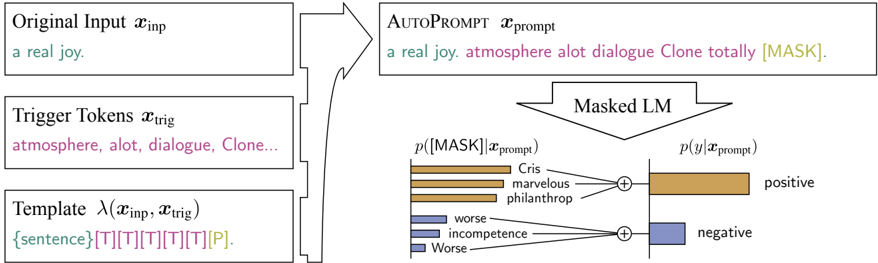
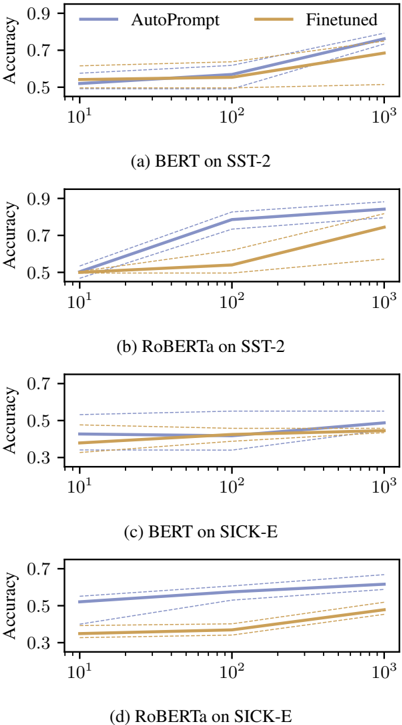
The remarkable success of pretrained language models has motivated the study of what kinds of knowledge these models learn during pretraining. Reformulating tasks as fill-in-the-blanks problems (e.g., cloze tests) is a natural approach for gauging such knowledge, however, its usage is limited by the manual effort and guesswork required to write suitable prompts. To address this, we develop AutoPrompt, an automated method to create prompts for a diverse set of tasks, based on a gradient-guided search. Using AutoPrompt, we show that masked language models (MLMs) have an inherent capability to perform sentiment analysis and natural language inference without additional parameters or finetuning, sometimes achieving performance on par with recent state-of-the-art supervised models. We also show that our prompts elicit more accurate factual knowledge from MLMs than the manually created prompts on the LAMA benchmark, and that MLMs can be used as relation extractors more effectively than supervised relation extraction models. These results demonstrate that automatically generated prompts are a viable parameter-free alternative to existing probing methods, and as pretrained LMs become more sophisticated and capable, potentially a replacement for finetuning.
Overview
The claims and statistics of this paper haven’t been checked yet.
Run the check — free, no account needed. It reads the open-access text and checks the sources it cites.
Integrity signals
Registry
Cites
Statistics
Figures
Verification
Claims the paper makes
The claims and statistics of this paper haven’t been checked yet.
Run the check — free, no account needed. It reads the open-access text and checks the sources it cites.
Claims other papers make about this one
Each is checked against this paper’s own text: does it say what the citing paper says it does?
In the citing paper
“These fall into two categories: manually constructed prompts requiring greater complexity (Liu et al., 2024), and methods to algorithmically generate prompts and automatically optimise their construction (Shin et al., 2020;Guo et al., 2021).”
From Generative AI and intellectual property: a systematic literature review of possible issues and mitigations (2026) · cites this paper as Shin et al., 2020
Self-check
Percentages, sums and reported differences re-computed from the paper’s own numbers.
The self-check needs the paper’s full text.
Citations
Cites
No references could be resolved yet.
Research works printed but not linked: 26
- Zied Bouraoui, Jose Camacho-Collados, and Steven Schockaert. 2019. Inducing relational knowledge from BERT. In AAAI.
- Samuel R Bowman, Gabor Angeli, Christopher Potts, and Christopher D Manning. 2015. A large anno- tated corpus for learning natural language inference. In EMNLP.
- Tom B Brown, Benjamin Mann, Nick Ryder, Melanie Subbiah, Jared Kaplan, Prafulla Dhariwal, Arvind Neelakantan, Pranav Shyam, Girish Sastry, Amanda Askell, et al. 2020. Language models are few-shot learners. arXiv preprint arXiv:2005.14165. · arXiv
- Alexis Conneau, Germán Kruszewski, Guillaume Lam- ple, Loïc Barrault, and Marco Baroni. 2018. What you can cram into a single vector: Probing sentence embeddings for linguistic properties. In ACL.
- Jacob Devlin, Ming-Wei Chang, Kenton Lee, and Kristina Toutanova. 2019. BERT: pre-training of deep bidirectional transformers for language under- standing. In NAACL.
- Jesse Dodge, Gabriel Ilharco, Roy Schwartz, Ali Farhadi, Hannaneh Hajishirzi, and Noah Smith. 2020. Fine-tuning pretrained language models: Weight initializations, data orders, and early stop- ping. arXiv preprint arXiv:2002.06305. · arXiv
- Hady ElSahar, Pavlos Vougiouklis, Arslen Remaci, Christophe Gravier, Jonathon S. Hare, Frédérique Laforest, and Elena Simperl. 2018. T-REx: A large scale alignment of natural language with knowledge base triples. In LREC.
- John Hewitt and Percy Liang. 2019. Designing and interpreting probes with control tasks. In EMNLP.
- Sarthak Jain and Byron C Wallace. 2019. Attention is not explanation. In NAACL.
- Zhengbao Jiang, Frank F Xu, Jun Araki, and Graham Neubig. 2020. How can we know what language models know? In TACL.
- Sunjae Kwon, Cheongwoong Kang, Jiyeon Han, and Jaesik Choi. 2019. Why do masked neural language models still need common sense knowledge? arXiv preprint arXiv:1911.03024. · arXiv
- Patrick Lewis, Ludovic Denoyer, and Sebastian Riedel. 2019. Unsupervised question answering by cloze translation. In ACL.
- Nelson F Liu, Matt Gardner, Yonatan Belinkov, Matthew Peters, and Noah A Smith. 2019. Linguis- tic knowledge and transferability of contextual rep- resentations. In NAACL.
- Marco Marelli, Stefano Menini, Marco Baroni, Luisa Bentivogli, Raffaella Bernardi, Roberto Zamparelli, et al. 2014. A SICK cure for the evaluation of com- positional distributional semantic models. In LREC.
- Matthew E. Peters, Mark Neumann, Mohit Iyyer, Matt Gardner, Christopher Clark, Kenton Lee, and Luke Zettlemoyer. 2018. Deep contextualized word repre- sentations. In NAACL.
- Fabio Petroni, Tim Rocktäschel, Patrick Lewis, Anton Bakhtin, Yuxiang Wu, Alexander H Miller, and Se- bastian Riedel. 2019. Language models as knowl- edge bases? In EMNLP.
- Timo Schick and Hinrich Schütze. 2020. Exploit- ing cloze questions for few-shot text classification and natural language inference. arXiv preprint arXiv:2001.07676. · arXiv
- Vered Shwartz, Peter West, Ronan Le Bras, Chan- dra Bhagavatula, and Yejin Choi. 2020. Unsuper- vised commonsense question answering with self- talk. arXiv preprint arXiv:2004.05483. · arXiv
- Richard Socher, Alex Perelygin, Jean Wu, Jason Chuang, Christopher D Manning, Andrew Ng, and Christopher Potts. 2013. Recursive deep models for semantic compositionality over a sentiment tree- bank. In EMNLP.
- Daniil Sorokin and Iryna Gurevych. 2017. Context- aware representations for knowledge base relation extraction. In EMNLP.
- Trieu H Trinh and Quoc V Le. 2018. A simple method for commonsense reasoning. arXiv preprint arXiv:1806.02847. · arXiv
- Elena Voita and Ivan Titov. 2020. Information- theoretic probing with minimum description length. In EMNLP.
- Eric Wallace, Shi Feng, Nikhil Kandpal, Matt Gardner, and Sameer Singh. 2019. Universal adversarial trig- gers for attacking and analyzing NLP. In EMNLP.
- Alex Wang, Amanpreet Singh, Julian Michael, Felix Hill, Omer Levy, and Samuel R Bowman. 2019. GLUE: A multi-task benchmark and analysis plat- form for natural language understanding. In ICLR.
- Sarah Wiegreffe and Yuval Pinter. 2019. Attention is not not explanation. In EMNLP.
- Thomas Wolf, Lysandre Debut, Victor Sanh, Julien Chaumond, Clement Delangue, Anthony Moi, Pier- ric Cistac, Tim Rault, Rémi Louf, Morgan Fun- towicz, Joe Davison, Sam Shleifer, Patrick von Platen, Clara Ma, Yacine Jernite, Julien Plu, Can- wen Xu, Teven Le Scao, Sylvain Gugger, Mariama Drame, Quentin Lhoest, and Alexander M. Rush. 2019. HuggingFace's Transformers: State-of-the- art natural language processing. arXiv preprint arXiv:1910.03771. · arXiv
Cited by
Jia, M., Tang, L., Chen, B.-C., Cardie, C., Belongie, S., Hariharan, B., & Lim, S.-N. (2022) · Lecture Notes in Computer Science · doi:10.1007/978-3-031-19827-4_41 · Cited by 1,965
Unifying Large Language Models and Knowledge Graphs: A Roadmap
Pan, S., Luo, L., Wang, Y., Chen, C., Wang, J., & Wu, X. (2024) · IEEE Transactions on Knowledge and Data Engineering · doi:10.1109/tkde.2024.3352100 · Cited by 1,376
Prompt Programming for Large Language Models: Beyond the Few-Shot Paradigm
Reynolds, L., & McDonell, K. (2021) · Extended Abstracts of the 2021 CHI Conference on Human Factors in Computing Systems · doi:10.1145/3411763.3451760 · Cited by 952
Graph of Thoughts: Solving Elaborate Problems with Large Language Models
Besta, M., Blach, N., Kubicek, A., Gerstenberger, R., Podstawski, M., Gianinazzi, L., Gajda, J., Lehmann, T., Niewiadomski, H., Nyczyk, P., et al. (2024) · Proceedings of the AAAI Conference on Artificial Intelligence · doi:10.1609/aaai.v38i16.29720 · Cited by 556
Fantastically Ordered Prompts and Where to Find Them: Overcoming Few-Shot Prompt Order Sensitivity
Lu, Y., Bartolo, M., Moore, A., Riedel, S., & Stenetorp, P. (2022) · Proceedings of the 60th Annual Meeting of the Association for Computational Linguistics (Volume 1: Long Papers) · doi:10.18653/v1/2022.acl-long.556 · Cited by 610
Metadata
- Authors
- Shin, T., Razeghi, Y., Logan, R. L., Wallace, E., & Singh, S.
- Venue
- arXiv
- Publisher
- arXiv
- Published
- 2020
- arXiv
- 2010.15980
- References
- 0
- Type
- Preprint
About these checks
Registry, retraction, Cites and statistics results are computed, not judged, with one exception: a printed reference that no index lists is read once by a model before it counts as a citation error. Claims are extracted by a model and kept only when their quote appears verbatim in the text; each cited source is then checked, with a model’s help, for whether it says what the claim relies on. Those verdicts can be wrong — read the claim’s quote and the cited source before relying on one.
Statistics and arithmetic are recomputed, not judged.
Confidence bands are shown only for fields calibrated on our annotated test set. None is calibrated yet, so no band is shown.
What counts as a claim ›How we measure confidence ›How we check this ›
Are you an author, or do you see a problem with this page? Request a review
How to cite
Cite CoChat for the checks on this page, and the paper for its own findings.
- This page
- CoChat. (2026). Citation check: AutoPrompt: Eliciting Knowledge from Language Models with Automatically Generated Prompts. https://app.cochat.ai/papers/10.48550/arxiv.2010.15980
- The paper
- Shin, T., Razeghi, Y., Logan, R. L., Wallace, E., & Singh, S. (2020). AutoPrompt: Eliciting Knowledge from Language Models with Automatically Generated Prompts. arXiv. https://doi.org/10.48550/arxiv.2010.15980
