

The DOI matches its DataCite record.
Contrastive predictive coding for Anomaly Detection in Multi-variate Time Series Data
Open accessAbstract
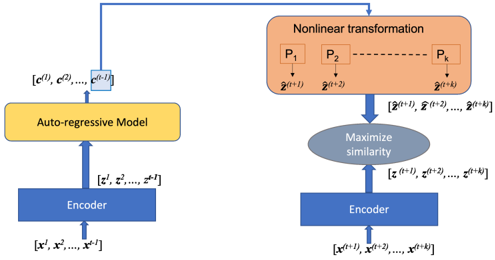
Anomaly detection in multi-variate time series (MVTS) data is a huge challenge as it requires simultaneous representation of long term temporal dependencies and correlations across multiple variables. More often, this is solved by breaking the complexity through modeling one dependency at a time. In this paper, we propose a Time-series Representational Learning through Contrastive Predictive Coding (TRL-CPC) towards anomaly detection in MVTS data. First, we jointly optimize an encoder, an auto-regressor and a non-linear transformation function to effectively learn the representations of the MVTS data sets, for predicting future trends. It must be noted that the context vectors are representative of the observation window in the MTVS. Next, the latent representations for the succeeding instants obtained through non-linear transformations of these context vectors, are contrasted with the latent representations of the encoder for the multi-variables such that the density for the positive pair is maximized. Thus, the TRL-CPC helps to model the temporal dependencies and the correlations of the parameters for a healthy signal pattern. Finally, fitting the latent representations are fit into a Gaussian scoring function to detect anomalies. Evaluation of the proposed TRL-CPC on three MVTS data sets against SOTA anomaly detection methods shows the superiority of TRL-CPC.
Overview
The claims and statistics of this paper haven’t been checked yet.
Run the check — free, no account needed. It reads the open-access text and checks the sources it cites.
Integrity signals
Registry
Cites
Statistics
Figures
Verification
Claims the paper makes
The claims and statistics of this paper haven’t been checked yet.
Run the check — free, no account needed. It reads the open-access text and checks the sources it cites.
Claims other papers make about this one
Each is checked against this paper’s own text: does it say what the citing paper says it does?
In the citing paper
“Following the architecture of CPC, LNT [110], TRL-CPC [111], TS-CP 2 [112], and Skip-Step CPC [113] were proposed.”
From Self-Supervised Learning for Time Series Analysis: Taxonomy, Progress, and Prospects (2024) · cites this paper as [111]
Self-check
Percentages, sums and reported differences re-computed from the paper’s own numbers.
The self-check needs the paper’s full text.
Citations
Cites
No references could be resolved yet.
Research works printed but not linked: 20
- Mingyan Teng, "Anomaly detection on time series," in 2010 IEEE International Conference on Progress in In- formatics and Computing. IEEE, 2010, vol. 1, pp. 603- 608.
- Pankaj Malhotra, Lovekesh Vig, Gautam Shroff, and Puneet Agarwal, "Long short term memory networks for anomaly detection in time series," in Proceedings, 2015, vol. 89, pp. 89-94.
- Mohammad Braei and Sebastian Wagner, "Anomaly de- tection in univariate time-series: A survey on the state- of-the-art," arXiv preprint arXiv:2004.00433, 2020. · arXiv
- Julien Audibert, Pietro Michiardi, Frédéric Guyard, Sébastien Marti, and Maria A Zuluaga, "Usad: Unsu- pervised anomaly detection on multivariate time series," in Proceedings of the 26th ACM SIGKDD International Conference on Knowledge Discovery & Data Mining, 2020, pp. 3395-3404.
- Dan Li, Dacheng Chen, Baihong Jin, Lei Shi, Jonathan Goh, and See-Kiong Ng, "Mad-gan: Multivariate anomaly detection for time series data with generative adversarial networks," in International Conference on Artificial Neural Networks. Springer, 2019, pp. 703- 716.
- Astha Garg, Wenyu Zhang, Jules Samaran, Ramasamy Savitha, and Chuan-Sheng Foo, "An evaluation of anomaly detection and diagnosis in multivariate time series," IEEE Transactions on Neural Networks and Learning Systems, 2021.
- Aaron van den Oord, Yazhe Li, and Oriol Vinyals, "Rep- resentation learning with contrastive predictive coding," arXiv preprint arXiv:1807.03748, 2018. · arXiv
- Olivier Henaff, "Data-efficient image recognition with contrastive predictive coding," in International Con- ference on Machine Learning. PMLR, 2020, pp. 4182- 4192.
- Yonglong Tian, Dilip Krishnan, and Phillip Isola, "Contrastive multiview coding," arXiv preprint arXiv:1906.05849, 2019. · arXiv
- Ting Chen, Simon Kornblith, Mohammad Norouzi, and Geoffrey Hinton, "A simple framework for contrastive learning of visual representations," in International con- ference on machine learning. PMLR, 2020, pp. 1597- 1607.
- Michael Laskin, Aravind Srinivas, and Pieter Abbeel, "Curl: Contrastive unsupervised representations for re- inforcement learning," in International Conference on Machine Learning. PMLR, 2020, pp. 5639-5650.
- John M Giorgi, Osvald Nitski, Gary D Bader, and Bo Wang, "Declutr: Deep contrastive learning for unsupervised textual representations," arXiv preprint arXiv:2006.03659, 2020. · arXiv
- Vassil Panayotov, Guoguo Chen, Daniel Povey, and San- jeev Khudanpur, "Librispeech: an asr corpus based on public domain audio books," in 2015 IEEE international conference on acoustics, speech and signal processing (ICASSP). IEEE, 2015, pp. 5206-5210.
- Chuadhry Mujeeb Ahmed, Venkata Reddy Palleti, and Aditya P Mathur, "Wadi: a water distribution testbed for research in the design of secure cyber physical sys- tems," in Proceedings of the 3rd International Workshop on Cyber-Physical Systems for Smart Water Networks, 2017, pp. 25-28.
- Peter Elias, "Predictive coding-i," IRE Transactions on Information Theory, vol. 1, no. 1, pp. 16-24, 1955.
- Yanping Huang and Rajesh PN Rao, "Predictive cod- ing," Wiley Interdisciplinary Reviews: Cognitive Sci- ence, vol. 2, no. 5, pp. 580-593, 2011.
- Arjen Alink, Caspar M Schwiedrzik, Axel Kohler, Wolf Singer, and Lars Muckli, "Stimulus predictability re- duces responses in primary visual cortex," Journal of Neuroscience, vol. 30, no. 8, pp. 2960-2966, 2010.
- Hanneke EM den Ouden, Jean Daunizeau, Jonathan Roiser, Karl J Friston, and Klaas E Stephan, "Striatal prediction error modulates cortical coupling," Journal of Neuroscience, vol. 30, no. 9, pp. 3210-3219, 2010.
- Fraser W Smith and Lars Muckli, "Nonstimulated early visual areas carry information about surrounding con- text," Proceedings of the National Academy of Sciences, vol. 107, no. 46, pp. 20099-20103, 2010.
- Ana Todorovic and Floris P de Lange, "Repetition sup- pression and expectation suppression are dissociable in time in early auditory evoked fields," Journal of Neuro- science, vol. 32, no. 39, pp. 13389-13395, 2012.
Cited by
Sorted by citations
Self-Supervised Learning for Time Series Analysis: Taxonomy, Progress, and Prospects
Zhang, K., Wen, Q., Zhang, C., Cai, R., Jin, M., Liu, Y., Zhang, J. Y., Liang, Y., Pang, G., Song, D., et al. (2024) · IEEE Transactions on Pattern Analysis and Machine Intelligence · doi:10.1109/tpami.2024.3387317 · Cited by 295
“LNT and TRL-CPC use the same structure as the original CPC [109] to build a representation learning model, and the purpose is to capture the local semantics across the time to detect the anomaly points.”
MethodInfluential
Metadata
- Authors
- Pranavan, T., Sim, T., Ambikapathi, A., & Ramasamy, S.
- Affiliations
- National University of Singapore (SG)
- Institute for Infocomm Research (SG)
- Venue
- arXiv
- Publisher
- arXiv
- Published
- 2022
- ISSN
- 2331-8422 (ISSN-L)
- arXiv
- 2202.03639
- OpenAlex
- W4221144446
- Cited by
- 4
- References
- 0
- Citations by year
- 2025: 2 · 2024: 2
- Type
- posted content
- Language
- en
- Open access
- green
- arxiv.org
- Licence
- Locations
- arXiv (Cornell University) (submittedVersion, cc-by)
- arXiv (Cornell University) (cc-by)
- Topics
- Physical Sciences › Computer Science › Artificial Intelligence › Anomaly Detection Techniques and Applications
- Physical Sciences › Computer Science › Signal Processing › Time Series Analysis and Forecasting
- Physical Sciences › Engineering › Control and Systems Engineering › Fault Detection and Control Systems
- Keywords
- anomaly detection, multivariate time series, contrastive predictive coding, temporal dependencies, autoregression, latent representations, density-based anomaly detection
About these checks
Registry, retraction, Cites and statistics results are computed, not judged, with one exception: a printed reference that no index lists is read once by a model before it counts as a citation error. Claims are extracted by a model and kept only when their quote appears verbatim in the text; each cited source is then checked, with a model’s help, for whether it says what the claim relies on. Those verdicts can be wrong — read the claim’s quote and the cited source before relying on one.
Statistics and arithmetic are recomputed, not judged.
Confidence bands are shown only for fields calibrated on our annotated test set. None is calibrated yet, so no band is shown.
What counts as a claim ›How we measure confidence ›How we check this ›
Are you an author, or do you see a problem with this page? Request a review
