

The DOI matches its DataCite record.
Diffusion Art or Digital Forgery? Investigating Data Replication in Diffusion Models
Abstract
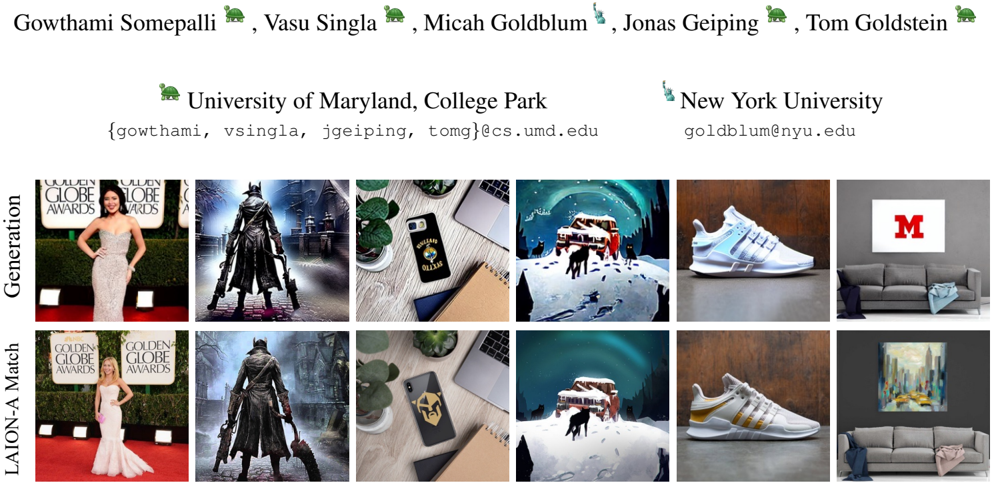
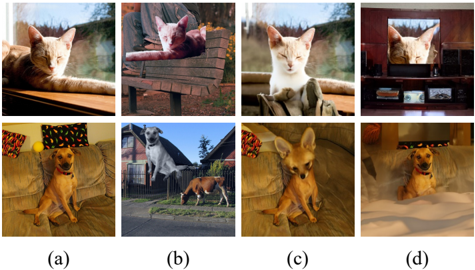
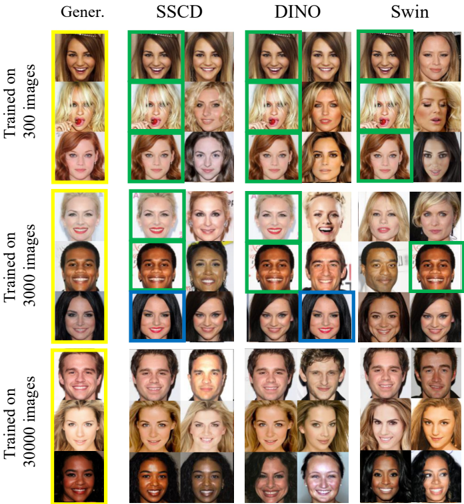
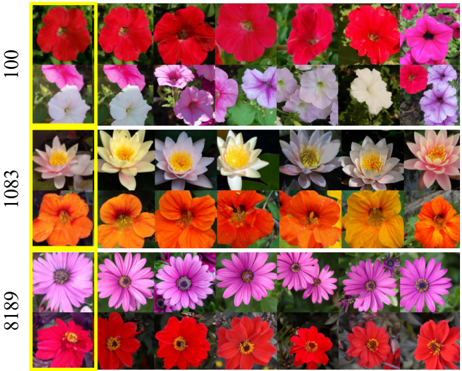
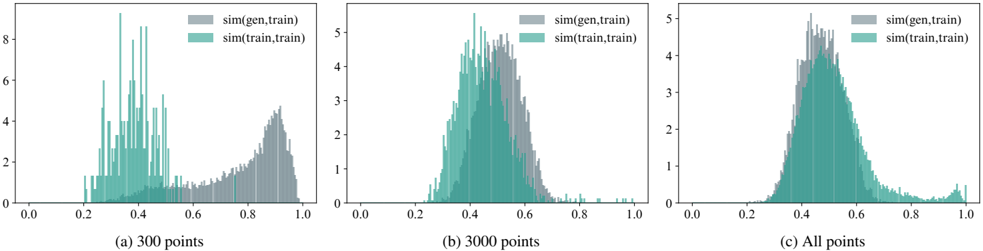
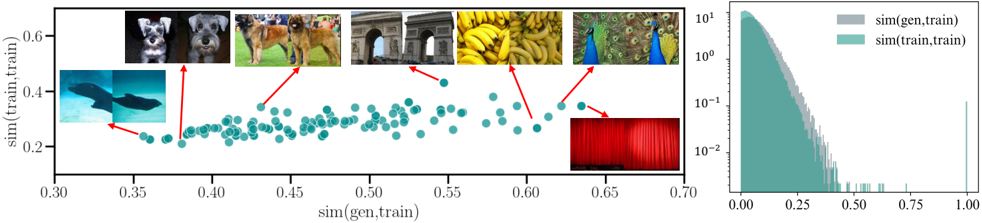
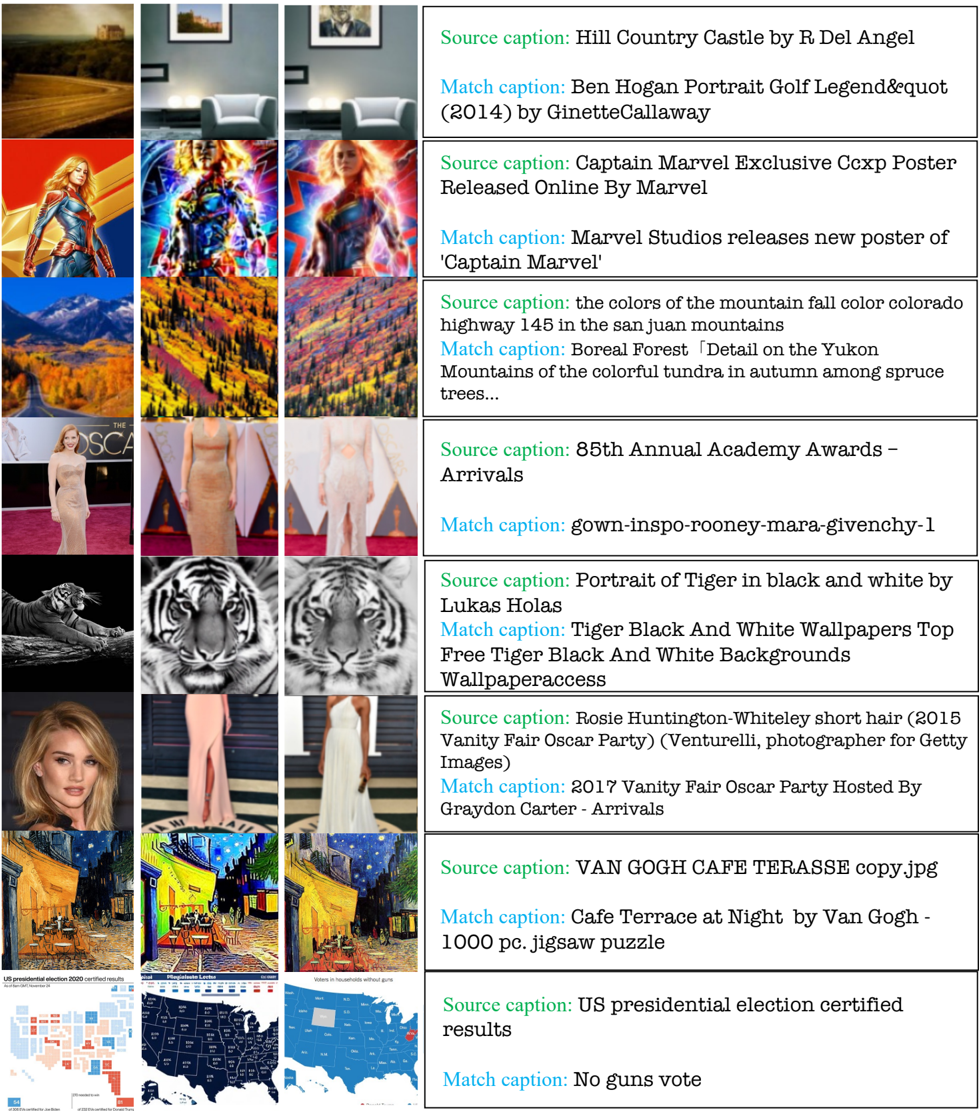
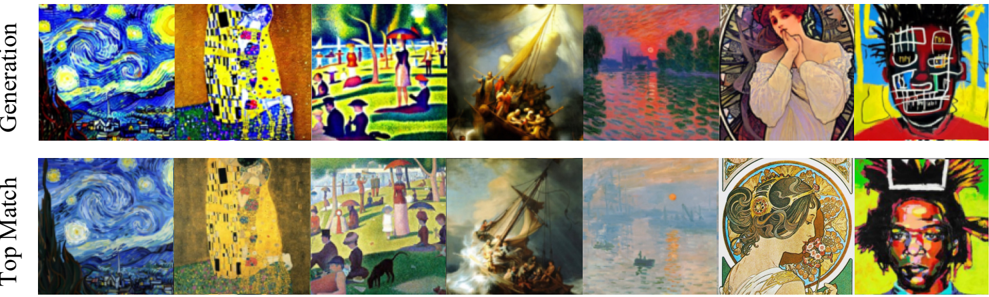
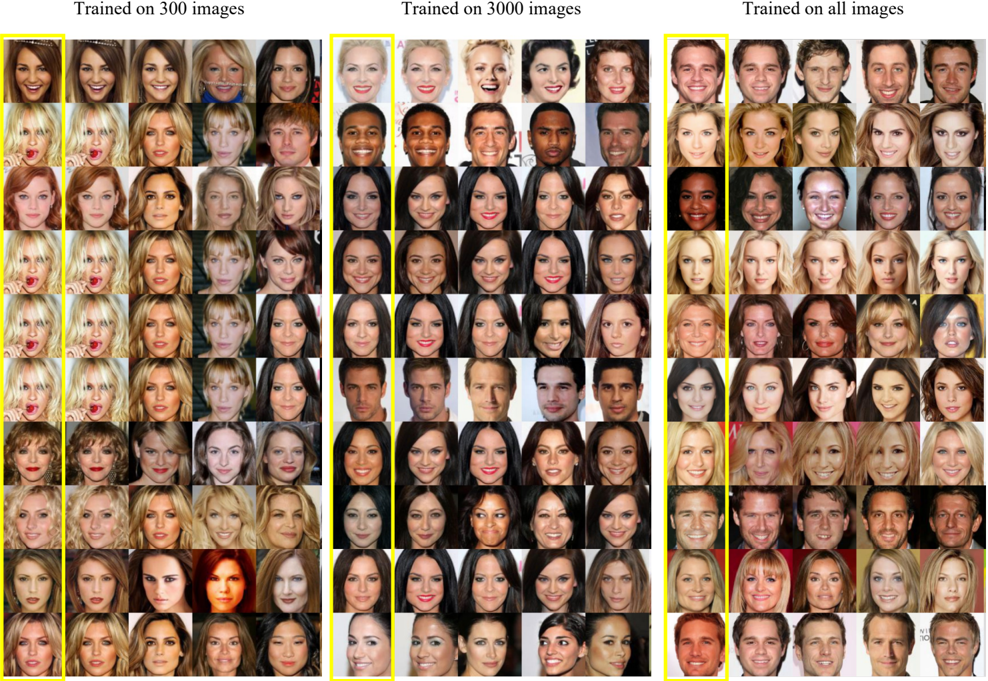
Cutting-edge diffusion models produce images with high quality and customizability, enabling them to be used for commercial art and graphic design purposes. But do diffusion models create unique works of art, or are they replicating content directly from their training sets? In this work, we study image retrieval frameworks that enable us to compare generated images with training samples and detect when content has been replicated. Applying our frameworks to diffusion models trained on multiple datasets including Oxford flowers, Celeb-A, ImageNet, and LAION, we discuss how factors such as training set size impact rates of content replication. We also identify cases where diffusion models, including the popular Stable Diffusion model, blatantly copy from their training data.
Overview
The claims and statistics of this paper haven’t been checked yet.
Run the check — free, no account needed. It reads the open-access text and checks the sources it cites.
Integrity signals
Registry
Cites
Statistics
Figures


Verification
Claims the paper makes
The claims and statistics of this paper haven’t been checked yet.
Run the check — free, no account needed. It reads the open-access text and checks the sources it cites.
Claims other papers make about this one
Each is checked against this paper’s own text: does it say what the citing paper says it does?
In the citing paper
“Moreover, there exist attack methodologies-namely inversion attacks-crafting prompts specifically designed to extract memorised training data (Carlini et al., 2023;Somepalli et al., 2022;Balan et al., 2023;Zhang et al., 2020).”
From Generative AI and intellectual property: a systematic literature review of possible issues and mitigations (2026) · cites this paper as Somepalli et al., 2022
Self-check
Percentages, sums and reported differences re-computed from the paper’s own numbers.
The self-check needs the paper’s full text.
Citations
Cites
No references could be resolved yet.
Research works printed but not linked: 64
- Ahmed Alaa, Boris Van Breugel, Evgeny S. Saveliev, and Mihaela van der Schaar. How Faithful is your Synthetic Data? Sample-level Metrics for Evaluating and Auditing Generative Models. In Proceedings of the 39th International Conference on Machine Learning, pages 290-306. PMLR, June 2022. 3
- Devansh Arpit, Stanislaw Jastrzebski, Nicolas Ballas, David Krueger, Emmanuel Bengio, Maxinder S Kanwal, Tegan Maharaj, Asja Fischer, Aaron Courville, Yoshua Bengio, et al. A closer look at memorization in deep networks. In International conference on machine learning, pages 233- 242. PMLR, 2017. 2
- Artem Babenko, Anton Slesarev, Alexandr Chigorin, and Victor Lempitsky. Neural codes for image retrieval. In European conference on computer vision, pages 584-599. Springer, 2014. 2
- Ching-Yuan Bai, Hsuan-Tien Lin, Colin Raffel, and Wendy Chi-wen Kan. On Training Sample Memorization: Lessons from Benchmarking Generative Modeling with a Large-scale Competition. In Proceedings of the 27th ACM SIGKDD Con- ference on Knowledge Discovery & Data Mining, KDD '21, pages 2534-2542, New York, NY, USA, Aug. 2021. Associ- ation for Computing Machinery. 3
- Adrien Bardes, Jean Ponce, and Yann LeCun. Vicregl: Self- supervised learning of local visual features. arXiv preprint arXiv:2210.01571, 2022. 4 · arXiv
- Maxim Berman, Hervé Jégou, Andrea Vedaldi, Iasonas Kokkinos, and Matthijs Douze. Multigrain: a unified im- age embedding for classes and instances. arXiv preprint arXiv:1902.05509, 2019. 2, 4 · arXiv
- Abeba Birhane, Vinay Uday Prabhu, and Emmanuel Kahem- bwe. Multimodal datasets: Misogyny, pornography, and ma- lignant stereotypes. arxiv:2110.01963[cs], Oct. 2021. 1 · arXiv
- Nicholas Carlini, Steve Chien, Milad Nasr, Shuang Song, Andreas Terzis, and Florian Tramèr. Membership Inference Attacks From First Principles. In 2022 IEEE Symposium on Security and Privacy (SP), pages 1897-1914, May 2022. 2
- Nicholas Carlini, Daphne Ippolito, Matthew Jagielski, Katherine Lee, Florian Tramer, and Chiyuan Zhang. Quan- tifying Memorization Across Neural Language Models. arxiv:2202.07646[cs], Feb. 2022. 1, 2 · arXiv
- Nicholas Carlini, Florian Tramèr, Eric Wallace, Matthew Jagielski, Ariel Herbert-Voss, Katherine Lee, Adam Roberts, Tom Brown, Dawn Song, Úlfar Erlingsson, Alina Oprea, and Colin Raffel. Extracting Training Data from Large Language Models. In 30th USENIX Security Symposium (USENIX Se- curity 21), pages 2633-2650, 2021. 1, 2
- Mathilde Caron, Piotr Bojanowski, Armand Joulin, and Matthijs Douze. Deep clustering for unsupervised learning of visual features. In Proceedings of the European confer- ence on computer vision (ECCV), pages 132-149, 2018. 2
- Mathilde Caron, Hugo Touvron, Ishan Misra, Hervé Jégou, Julien Mairal, Piotr Bojanowski, and Armand Joulin. Emerg- ing properties in self-supervised vision transformers. In Proceedings of the IEEE/CVF International Conference on Computer Vision, pages 9650-9660, 2021. 2, 4, 5
- Ting Chen, Simon Kornblith, Mohammad Norouzi, and Ge- offrey Hinton. A simple framework for contrastive learning of visual representations. In International conference on ma- chine learning, pages 1597-1607. PMLR, 2020. 2, 4
- Wei Chen, Yu Liu, Weiping Wang, Erwin M Bakker, Theodoros Georgiou, Paul Fieguth, Li Liu, and Michael S Lew. Deep learning for instance retrieval: A survey. IEEE Transactions on Pattern Analysis and Machine Intelligence, 2022. 2, 4
- Xinlei Chen, Saining Xie, and Kaiming He. An empiri- cal study of training self-supervised vision transformers. In Proceedings of the IEEE/CVF International Conference on Computer Vision, pages 9640-9649, 2021. 2, 4
- Alexey Dosovitskiy, Lucas Beyer, Alexander Kolesnikov, Dirk Weissenborn, Xiaohua Zhai, Thomas Unterthiner, Mostafa Dehghani, Matthias Minderer, Georg Heigold, Syl- vain Gelly, et al. An image is worth 16x16 words: Trans- formers for image recognition at scale. arXiv preprint arXiv:2010.11929, 2020. 4 · arXiv
- Matthijs Douze, Hervé Jégou, Harsimrat Sandhawalia, Lau- rent Amsaleg, and Cordelia Schmid. Evaluation of gist de- scriptors for web-scale image search. In Proceedings of the ACM International Conference on Image and Video Re- trieval, pages 1-8, 2009. 2
- Matthijs Douze, Giorgos Tolias, Ed Pizzi, Zoë Papakipos, Lowik Chanussot, Filip Radenovic, Tomas Jenicek, Maxim Maximov, Laura Leal-Taixé, Ismail Elezi, et al. The 2021 image similarity dataset and challenge. arXiv preprint arXiv:2106.09672, 2021. 2 · arXiv
- Alaaeldin El-Nouby, Natalia Neverova, Ivan Laptev, and Hervé Jégou. Training vision transformers for image re- trieval. arXiv preprint arXiv:2102.05644, 2021. 2 · arXiv
- Mark Everingham, SM Eslami, Luc Van Gool, Christo- pher KI Williams, John Winn, and Andrew Zisserman. The pascal visual object classes challenge: A retrospective. Inter- national journal of computer vision, 111(1):98-136, 2015. 3
- Vitaly Feldman. Does learning require memorization? a short tale about a long tail. In Proceedings of the 52nd Annual ACM SIGACT Symposium on Theory of Computing, pages 954-959, 2020. 2
- Vitaly Feldman and Chiyuan Zhang. What Neural Networks Memorize and Why: Discovering the Long Tail via Influence Estimation. arxiv:2008.03703[cs, stat], Aug. 2020. 1 · arXiv
- Vitaly Feldman and Chiyuan Zhang. What neural networks memorize and why: Discovering the long tail via influence estimation. Advances in Neural Information Processing Sys- tems, 33:2881-2891, 2020. 2
- Qianli Feng, Chenqi Guo, Fabian Benitez-Quiroz, and Aleix M Martinez. When do gans replicate? on the choice of dataset size. In Proceedings of the IEEE/CVF International Conference on Computer Vision, pages 6701-6710, 2021. 3
- Amin Ghiasi, Hamid Kazemi, Steven Reich, Chen Zhu, Micah Goldblum, and Tom Goldstein. Plug-In Inversion: Model-Agnostic Inversion for Vision with Data Augmenta- tions. In Proceedings of the 39th International Conference on Machine Learning, pages 7484-7512. PMLR, June 2022. 2
- Yunchao Gong, Liwei Wang, Ruiqi Guo, and Svetlana Lazebnik. Multi-scale orderless pooling of deep convolu- tional activation features. In European conference on com- puter vision, pages 392-407. Springer, 2014. 2
- Albert Gordo, Jon Almazán, Jerome Revaud, and Diane Lar- lus. Deep image retrieval: Learning global representations for image search. In European conference on computer vi- sion, pages 241-257. Springer, 2016. 2
- Jean-Bastien Grill, Florian Strub, Florent Altché, Corentin Tallec, Pierre Richemond, Elena Buchatskaya, Carl Doersch, Bernardo Avila Pires, Zhaohan Guo, Mohammad Ghesh- laghi Azar, et al. Bootstrap your own latent-a new approach to self-supervised learning. Advances in neural information processing systems, 33:21271-21284, 2020. 2
- Ishaan Gulrajani, Colin Raffel, and Luke Metz. Towards GAN Benchmarks Which Require Generalization. In In- ternational Conference on Learning Representations, Feb. 2022. 3
- Kaiming He, Xinlei Chen, Saining Xie, Yanghao Li, Piotr Dollár, and Ross Girshick. Masked autoencoders are scalable vision learners. In Proceedings of the IEEE/CVF Conference on Computer Vision and Pattern Recognition, pages 16000- 16009, 2022. 2
- Jonathan Ho, Ajay Jain, and Pieter Abbeel. Denoising diffu- sion probabilistic models. Advances in Neural Information Processing Systems, 33:6840-6851, 2020. 5
- Hailong Hu and Jun Pang. Membership Inference Attacks against GANs by Leveraging Over-representation Regions. In Proceedings of the 2021 ACM SIGSAC Conference on Computer and Communications Security, CCS '21, pages 2387-2389, New York, NY, USA, Nov. 2021. Association for Computing Machinery. 2
- Matthew Jagielski, Om Thakkar, Florian Tramèr, Daphne Ippolito, Katherine Lee, Nicholas Carlini, Eric Wallace, Shuang Song, Abhradeep Thakurta, Nicolas Papernot, and Chiyuan Zhang. Measuring Forgetting of Memorized Train- ing Examples. arxiv:2207.00099[cs], June 2022. 2 · arXiv
- Young Kyun Jang and Nam Ik Cho. Self-supervised prod- uct quantization for deep unsupervised image retrieval. In Proceedings of the IEEE/CVF International Conference on Computer Vision, pages 12085-12094, 2021. 2
- Tsung-Yi Lin, Michael Maire, Serge Belongie, James Hays, Pietro Perona, Deva Ramanan, Piotr Dollár, and C Lawrence Zitnick. Microsoft coco: Common objects in context. In European conference on computer vision, pages 740-755. Springer, 2014. 3
- Ze Liu, Yutong Lin, Yue Cao, Han Hu, Yixuan Wei, Zheng Zhang, Stephen Lin, and Baining Guo. Swin transformer: Hierarchical vision transformer using shifted windows. In Proceedings of the IEEE/CVF International Conference on Computer Vision, pages 10012-10022, 2021. 4, 5
- Ziwei Liu, Ping Luo, Xiaogang Wang, and Xiaoou Tang. Deep learning face attributes in the wild. In Proceedings of International Conference on Computer Vision (ICCV), De- cember 2015. 5
- Andreas Lugmayr, Martin Danelljan, Andres Romero, Fisher Yu, Radu Timofte, and Luc Van Gool. Repaint: Inpainting using denoising diffusion probabilistic models. In Proceed- ings of the IEEE/CVF Conference on Computer Vision and Pattern Recognition, pages 11461-11471, 2022. 3
- Casey Meehan, Kamalika Chaudhuri, and Sanjoy Dasgupta. A non-parametric test to detect data-copying in generative models. In International Conference on Artificial Intelli- gence and Statistics, 2020. 3
- Maria-Elena Nilsback and Andrew Zisserman. Automated flower classification over a large number of classes. In In- dian Conference on Computer Vision, Graphics and Image Processing, Dec 2008. 5
- Hyun Oh Song, Yu Xiang, Stefanie Jegelka, and Silvio Savarese. Deep metric learning via lifted structured fea- ture embedding. In Proceedings of the IEEE conference on computer vision and pattern recognition, pages 4004-4012, 2016. 4
- Aaron van den Oord, Yazhe Li, and Oriol Vinyals. Repre- sentation learning with contrastive predictive coding. arXiv preprint arXiv:1807.03748, 2018. 4 · arXiv
- Florent Perronnin, Yan Liu, and Jean-Michel Renders. A family of contextual measures of similarity between distribu- tions with application to image retrieval. In 2009 IEEE Con- ference on computer vision and pattern recognition, pages 2358-2365. IEEE, 2009. 5
- James Philbin, Ondrej Chum, Michael Isard, Josef Sivic, and Andrew Zisserman. Object retrieval with large vocabularies and fast spatial matching. In 2007 IEEE conference on com- puter vision and pattern recognition, pages 1-8. IEEE, 2007. 4
- James Philbin, Ondrej Chum, Michael Isard, Josef Sivic, and Andrew Zisserman. Lost in quantization: Improving partic- ular object retrieval in large scale image databases. In 2008 IEEE conference on computer vision and pattern recogni- tion, pages 1-8. IEEE, 2008. 4
- Ed Pizzi, Sreya Dutta Roy, Sugosh Nagavara Ravindra, Priya Goyal, and Matthijs Douze. A self-supervised descriptor for image copy detection. In Proceedings of the IEEE/CVF Con- ference on Computer Vision and Pattern Recognition, pages 14532-14542, 2022. 2, 4, 5
- Filip Radenović, Ahmet Iscen, Giorgos Tolias, Yannis Avrithis, and Ondřej Chum. Revisiting oxford and paris: Large-scale image retrieval benchmarking. In Proceedings of the IEEE conference on computer vision and pattern recog- nition, pages 5706-5715, 2018. 4
- Filip Radenović, Giorgos Tolias, and Ondřej Chum. Cnn image retrieval learns from bow: Unsupervised fine-tuning with hard examples. In European conference on computer vision, pages 3-20. Springer, 2016. 2
- Filip Radenović, Giorgos Tolias, and Ondřej Chum. Fine- tuning cnn image retrieval with no human annotation. IEEE transactions on pattern analysis and machine intelligence, 41(7):1655-1668, 2018. 2
- Alec Radford, Jong Wook Kim, Chris Hallacy, Aditya Ramesh, Gabriel Goh, Sandhini Agarwal, Girish Sastry, Amanda Askell, Pamela Mishkin, Jack Clark, et al. Learn- ing transferable visual models from natural language super- vision. In International Conference on Machine Learning, pages 8748-8763. PMLR, 2021. 4
- Aditya Ramesh, Prafulla Dhariwal, Alex Nichol, Casey Chu, and Mark Chen. Hierarchical text-conditional image gen- eration with clip latents. arXiv preprint arXiv:2204.06125, 2022. 1 · arXiv
- Ali S Razavian, Josephine Sullivan, Stefan Carlsson, and At- suto Maki. Visual instance retrieval with deep convolutional networks. ITE Transactions on Media Technology and Ap- plications, 4(3):251-258, 2016. 2
- Robin Rombach, Andreas Blattmann, Dominik Lorenz, Patrick Esser, and Björn Ommer. High-resolution image synthesis with latent diffusion models. In Proceedings of the IEEE/CVF Conference on Computer Vision and Pattern Recognition, pages 10684-10695, 2022. 1, 3, 6, 7
- Olga Russakovsky, Jia Deng, Hao Su, Jonathan Krause, San- jeev Satheesh, Sean Ma, Zhiheng Huang, Andrej Karpathy, Aditya Khosla, Michael Bernstein, et al. Imagenet large scale visual recognition challenge. International journal of computer vision, 115(3):211-252, 2015. 3
- Christoph Schuhmann, Romain Beaumont, Richard Vencu, Cade Gordon, Ross Wightman, Mehdi Cherti, Theo Coombes, Aarush Katta, Clayton Mullis, Mitchell Worts- man, et al. Laion-5b: An open large-scale dataset for training next generation image-text models. arXiv preprint arXiv:2210.08402, 2022. 3, 4, 7 · arXiv
- Chull Hwan Song, Jooyoung Yoon, Shunghyun Choi, and Yannis Avrithis. Boosting vision transformers for image re- trieval. arXiv preprint arXiv:2210.11909, 2022. 2 · arXiv
- Christian Szegedy, Vincent Vanhoucke, Sergey Ioffe, Jonathon Shlens, and Zbigniew Wojna. Rethinking the inception architecture for computer vision. 2015. arXiv preprint arXiv:1512.00567, 2015. 5 · arXiv
- Kushal Tirumala, Aram H Markosyan, Luke Zettlemoyer, and Armen Aghajanyan. Memorization without overfitting: Analyzing the training dynamics of large language models. arXiv preprint arXiv:2205.10770, 2022. 2 · arXiv
- Shuang Wang and Shuqiang Jiang. Instre: a new benchmark for instance-level object retrieval and recognition. ACM Transactions on Multimedia Computing, Communications, and Applications (TOMM), 11(3):1-21, 2015. 4
- Ryan Webster, Julien Rabin, Loic Simon, and Frederic Jurie. This Person (Probably) Exists. Identity Membership Attacks Against GAN Generated Faces. arxiv:2107.06018[cs], July 2021. 2, 3 · arXiv
- Yuxin Wen, Arpit Bansal, Hamid Kazemi, Eitan Borgnia, Micah Goldblum, Jonas Geiping, and Tom Goldstein. Ca- nary in a Coalmine: Better Membership Inference with En- sembled Adversarial Queries. arxiv:2210.10750[cs], Oct. 2022. 2 · arXiv
- T. Weyand, A. Araujo, B. Cao, and J. Sim. Google Land- marks Dataset v2 -A Large-Scale Benchmark for Instance- Level Recognition and Retrieval. In Proc. CVPR, 2020. 4
- Hongxu Yin, Pavlo Molchanov, Zhizhong Li, Jose M. Al- varez, Arun Mallya, Derek Hoiem, Niraj K. Jha, and Jan Kautz. Dreaming to Distill: Data-free Knowledge Transfer via DeepInversion. arxiv:1912.08795[cs, stat], June 2020. 2 · arXiv
- Sangdoo Yun, Dongyoon Han, Seong Joon Oh, Sanghyuk Chun, Junsuk Choe, and Youngjoon Yoo. Cutmix: Regu- larization strategy to train strong classifiers with localizable features. In Proceedings of the IEEE/CVF international con- ference on computer vision, pages 6023-6032, 2019. 4
Cited by
AI Art and its Impact on Artists
Jiang, H. H., Brown, L., Cheng, J., Khan, M., Gupta, A., Workman, D., Hanna, A., Flowers, J., & Gebru, T. (2023) · Proceedings of the 2023 AAAI/ACM Conference on AI, Ethics, and Society · doi:10.1145/3600211.3604681 · Cited by 265
Privacy Perceptions of Custom GPTs by Users and Creators
Ma, R., Maidhof, C., Carrillo, J. C., Lindqvist, J., & Such, J. (2025) · Proceedings of the 2025 CHI Conference on Human Factors in Computing Systems · doi:10.1145/3706598.3713540 · Cited by 8
Arnaudo, A., Coppola, R., Morisio, M., Vetrò, A., Borghi, M., Raso, R., & Khan, B. (2026) · PeerJ Computer Science · doi:10.7717/peerj-cs.3928 · Cited by 2
Metadata
- Authors
- Somepalli, G., Singla, V., Goldblum, M., Geiping, J., & Goldstein, T.
- Venue
- arXiv
- Publisher
- arXiv
- Published
- 2022
- arXiv
- 2212.03860
- References
- 0
- Type
- Preprint
About these checks
Registry, retraction, Cites and statistics results are computed, not judged, with one exception: a printed reference that no index lists is read once by a model before it counts as a citation error. Claims are extracted by a model and kept only when their quote appears verbatim in the text; each cited source is then checked, with a model’s help, for whether it says what the claim relies on. Those verdicts can be wrong — read the claim’s quote and the cited source before relying on one.
Statistics and arithmetic are recomputed, not judged.
Confidence bands are shown only for fields calibrated on our annotated test set. None is calibrated yet, so no band is shown.
What counts as a claim ›How we measure confidence ›How we check this ›
Are you an author, or do you see a problem with this page? Request a review
How to cite
Cite CoChat for the checks on this page, and the paper for its own findings.
- This page
- CoChat. (2026). Citation check: Diffusion Art or Digital Forgery? Investigating Data Replication in Diffusion Models. https://app.cochat.ai/papers/10.48550/arxiv.2212.03860
- The paper
- Somepalli, G., Singla, V., Goldblum, M., Geiping, J., & Goldstein, T. (2022). Diffusion Art or Digital Forgery? Investigating Data Replication in Diffusion Models. arXiv. https://doi.org/10.48550/arxiv.2212.03860
