

The DOI matches its DataCite record.
A Question Answering Framework for Decontextualizing User-facing Snippets from Scientific Documents
Abstract
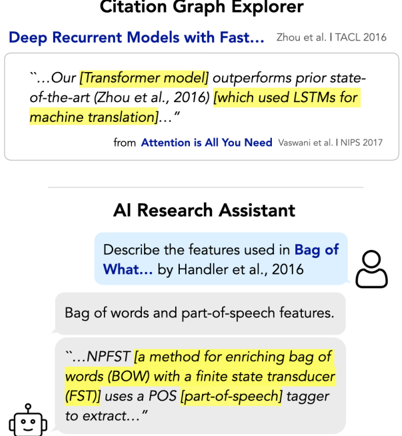
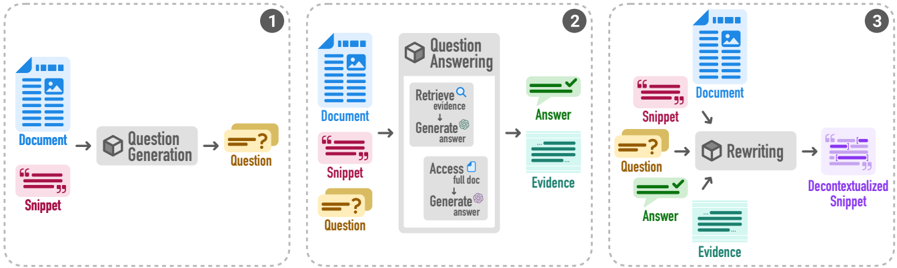
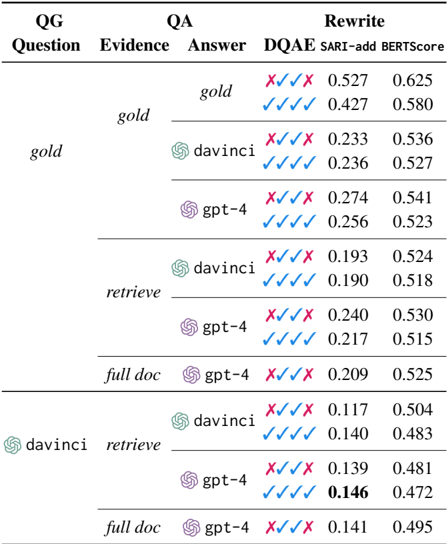
Many real-world applications (e.g., note taking, search) require extracting a sentence or paragraph from a document and showing that snippet to a human outside of the source document. Yet, users may find snippets difficult to understand as they lack context from the original document. In this work, we use language models to rewrite snippets from scientific documents to be read on their own. First, we define the requirements and challenges for this user-facing decontextualization task, such as clarifying where edits occur and handling references to other documents. Second, we propose a framework that decomposes the task into three stages: question generation, question answering, and rewriting. Using this framework, we collect gold decontextualizations from experienced scientific article readers. We then conduct a range of experiments across state-of-the-art commercial and open-source language models to identify how to best provide missing-but-relevant information to models for our task. Finally, we develop QaDecontext, a simple prompting strategy inspired by our framework that improves over end-to-end prompting. We conclude with analysis that finds, while rewriting is easy, question generation and answering remain challenging for today's models.
Overview
The claims and statistics of this paper haven’t been checked yet.
Run the check — free, no account needed. It reads the open-access text and checks the sources it cites.
Integrity signals
Registry
Cites
Statistics
Figures
Verification
Claims the paper makes
The claims and statistics of this paper haven’t been checked yet.
Run the check — free, no account needed. It reads the open-access text and checks the sources it cites.
Claims other papers make about this one
Each is checked against this paper’s own text: does it say what the citing paper says it does?
In the citing paper
“Reading extracted snippets from technical or scientific documents may lack important context making them difficult to read or even misleading.(Cohan & Goharian, 2017;Newman et al., 2023;Zhang et al., 2023).”
From RAPTOR: Recursive Abstractive Processing for Tree-Organized Retrieval (2024) · cites this paper as Newman et al., 2023
Self-check
Percentages, sums and reported differences re-computed from the paper’s own numbers.
The self-check needs the paper’s full text.
Citations
Cites
No references could be resolved yet.
Research works printed but not linked: 45
- Tal August, Lucy Lu Wang, Jonathan Bragg, Marti A. Hearst, Andrew Head, and Kyle Lo. 2023. Paper plain: Making medical research papers approachable to healthcare consumers with natural language pro- cessing. ACM Trans. Comput.-Hum. Interact. Just Accepted. · DOI
- Bernd Bohnet, Vinh Q. Tran, Pat Verga, Roee Aharoni, Daniel Andor, Livio Baldini Soares, Jacob Eisen- stein, Kuzman Ganchev, Jonathan Herzig, Kai Hui, Tom Kwiatkowski, Ji Ma, Jianmo Ni, Tal Schuster, William W. Cohen, Michael Collins, Dipanjan Das, Donald Metzler, Slav Petrov, and Kellie Webster. 2022. Attributed question answering: Evaluation and modeling for attributed large language models. ArXiv, abs/2212.08037. · arXiv
- Daniela Brook Weiss, Paul Roit, Ayal Klein, Ori Ernst, and Ido Dagan. 2021. QA-Align: Representing Cross-Text Content Overlap by Aligning Question- Answer Propositions. In Proceedings of the 2021 Conference on Empirical Methods in Natural Lan- guage Processing, pages 9879-9894, Online and Punta Cana, Dominican Republic. Association for Computational Linguistics. · DOI
- Joseph Chee Chang, Nathan Hahn, and Aniket Kittur. 2016. Supporting mobile sensemaking through inten- tionally uncertain highlighting. In Proceedings of the 29th Annual Symposium on User Interface Software and Technology, UIST '16, page 61-68, New York, NY, USA. Association for Computing Machinery. · DOI
- Joseph Chee Chang, Amy X. Zhang, Jonathan Bragg, Andrew Head, Kyle Lo, Doug Downey, and Daniel S. Weld. 2023a. Citesee: Augmenting citations in scien- tific papers with persistent and personalized historical context. In Proceedings of the 2023 CHI Conference on Human Factors in Computing Systems, CHI '23, New York, NY, USA. Association for Computing Machinery. · DOI
- Eunsol Choi, Jennimaria Palomaki, Matthew Lamm, Tom Kwiatkowski, Dipanjan Das, and Michael Collins. 2021. Decontextualization: Making sen- tences stand-alone. Transactions of the Association for Computational Linguistics, 9:447-461. · DOI · Paper page
- Leshem Choshen and Omri Abend. 2018. Inherent bi- ases in reference-based evaluation for grammatical error correction. In Proceedings of the 56th Annual Meeting of the Association for Computational Lin- guistics (Volume 1: Long Papers), pages 632-642, Melbourne, Australia. Association for Computational Linguistics. · DOI
- Elizabeth Clark, Tal August, Sofia Serrano, Nikita Haduong, Suchin Gururangan, and Noah A. Smith. 2021. All that's 'human' is not gold: Evaluating human evaluation of generated text. In Proceedings of the 59th Annual Meeting of the Association for Computational Linguistics and the 11th International Joint Conference on Natural Language Processing (Volume 1: Long Papers), pages 7282-7296, Online. Association for Computational Linguistics. · DOI · Paper page
- Arman Cohan and Nazli Goharian. 2017. Contextualiz- ing citations for scientific summarization using word embeddings and domain knowledge. In Proceedings of the 40th International ACM SIGIR Conference on Research and Development in Information Retrieval, SIGIR '17, page 1133-1136, New York, NY, USA. Association for Computing Machinery. · DOI · Paper page
- Arman Cohan, Luca Soldaini, and Nazli Goharian. 2015. Matching citation text and cited spans in biomedi- cal literature: a search-oriented approach. In Pro- ceedings of the 2015 Conference of the North Amer- ican Chapter of the Association for Computational Linguistics: Human Language Technologies, pages 1042-1048, Denver, Colorado. Association for Com- putational Linguistics. · DOI
- Pradeep Dasigi, Kyle Lo, Iz Beltagy, Arman Cohan, Noah A. Smith, and Matt Gardner. 2021. A dataset of information-seeking questions and answers an- chored in research papers. In Proceedings of the 2021 Conference of the North American Chapter of the Association for Computational Linguistics: Hu- man Language Technologies, pages 4599-4610, On- line. Association for Computational Linguistics. · DOI · Paper page
- Kordula De Kuthy, Nils Reiter, and Arndt Riester. 2018. QUD-based annotation of discourse structure and information structure: Tool and evaluation. In Pro- ceedings of the Eleventh International Conference on Language Resources and Evaluation (LREC 2018), Miyazaki, Japan. European Language Resources As- sociation (ELRA).
- Esin Durmus, He He, and Mona Diab. 2020. FEQA: A Question Answering Evaluation Framework for Faithfulness Assessment in Abstractive Summariza- tion. In Proceedings of the 58th Annual Meeting of the Association for Computational Linguistics, pages 5055-5070, Online. Association for Computational Linguistics. · DOI · Paper page
- Jacob Eisenstein, Daniel Andor, Bernd Bohnet, Michael Collins, and David Mimno. 2022. Honest students from untrusted teachers: Learning an interpretable question-answering pipeline from a pretrained lan- guage model. In Workshop on Trustworthy and So- cially Responsible Machine Learning, NeurIPS 2022.
- Raymond Fok, Hita Kambhamettu, Luca Soldaini, Jonathan Bragg, Kyle Lo, Marti Hearst, Andrew Head, and Daniel S Weld. 2023b. Scim: Intelligent skimming support for scientific papers. In Proceed- ings of the 28th International Conference on Intelli- gent User Interfaces, IUI '23, page 476-490, New York, NY, USA. Association for Computing Machin- ery. · DOI
- Sebastian Gehrmann, Hendrik Strobelt, and Alexander Rush. 2019. GLTR: Statistical detection and visual- ization of generated text. In Proceedings of the 57th Annual Meeting of the Association for Computational Linguistics: System Demonstrations, pages 111-116, Florence, Italy. Association for Computational Lin- guistics. · DOI · Paper page
- Han L. Han, Junhang Yu, Raphael Bournet, Alexandre Ciorascu, Wendy E. Mackay, and Michel Beaudouin- Lafon. 2022. Passages: Interacting with text across documents. In Proceedings of the 2022 CHI Confer- ence on Human Factors in Computing Systems, CHI '22, New York, NY, USA. Association for Computing Machinery. · DOI
- Wenlong Huang, Pieter Abbeel, Deepak Pathak, and Igor Mordatch. 2022. Language models as zero-shot planners: Extracting actionable knowledge for em- bodied agents. In International Conference on Ma- chine Learning, pages 9118-9147. PMLR.
- Gautier Izacard, Mathilde Caron, Lucas Hosseini, Se- bastian Riedel, Piotr Bojanowski, Armand Joulin, and Edouard Grave. 2021. Unsupervised dense infor- mation retrieval with contrastive learning. · DOI · Paper page
- Farnaz Jahanbakhsh, Elnaz Nouri, Robert Sim, Ryen W. White, and Adam Fourney. 2022. Understanding questions that arise when working with business documents. Proc. ACM Hum.-Comput. Interact., 6(CSCW2). · DOI
- Hyeonsu Kang, Joseph Chee Chang, Yongsung Kim, and Aniket Kittur. 2022. Threddy: An interactive system for personalized thread-based exploration and organization of scientific literature. In Proceedings of the 35th Annual ACM Symposium on User Interface Software and Technology, UIST '22, New York, NY, USA. Association for Computing Machinery. · DOI
- Tushar Khot, Harsh Trivedi, Matthew Finlayson, Yao Fu, Kyle Richardson, Peter Clark, and Ashish Sab- harwal. 2023. Decomposed prompting: A modular approach for solving complex tasks. In Proceedings of the 10th International Conference on Learning Representations. ICLR.
- Wei-Jen Ko, Te-yuan Chen, Yiyan Huang, Greg Durrett, and Junyi Jessy Li. 2020. Inquisitive question gener- ation for high level text comprehension. In Proceed- ings of the 2020 Conference on Empirical Methods in Natural Language Processing (EMNLP), pages 6544-6555, Online. Association for Computational Linguistics. · DOI
- Wei-Jen Ko, Cutter Dalton, Mark Simmons, Eliza Fisher, Greg Durrett, and Junyi Jessy Li. 2022. Dis- course comprehension: A question answering frame- work to represent sentence connections. In Proceed- ings of the 2022 Conference on Empirical Methods in Natural Language Processing, pages 11752-11764, Abu Dhabi, United Arab Emirates. Association for Computational Linguistics.
- Anne Lauscher, Brandon Ko, Bailey Kuehl, Sophie Johnson, Arman Cohan, David Jurgens, and Kyle Lo. 2022. MultiCite: Modeling realistic citations requires moving beyond the single-sentence single- label setting. In Proceedings of the 2022 Conference of the North American Chapter of the Association for Computational Linguistics: Human Language Tech- nologies, pages 1875-1889, Seattle, United States. Association for Computational Linguistics. · DOI
- Jimmy Lin, Dennis Quan, Vineet Sinha, Karun Bakshi, David Huynh, Boris Katz, and David R. Karger. 2003. The role of context in question answering systems. In CHI '03 Extended Abstracts on Human Factors in Computing Systems, CHI EA '03, page 1006-1007, New York, NY, USA. Association for Computing Machinery. · DOI
- Kyle Lo, Lucy Lu Wang, Mark Neumann, Rodney Kin- ney, and Daniel Weld. 2020. S2ORC: The semantic scholar open research corpus. In Proceedings of the 58th Annual Meeting of the Association for Compu- tational Linguistics, pages 4969-4983, Online. Asso- ciation for Computational Linguistics. · DOI · Paper page
- Pan Lu, Baolin Peng, Hao Cheng, Michel Galley, Kai- Wei Chang, Ying Nian Wu, Song-Chun Zhu, and Jian- feng Gao. 2023. Chameleon: Plug-and-play compo- sitional reasoning with large language models. ArXiv, abs/2304.09842. · arXiv
- Kelvin Luu, Xinyi Wu, Rik Koncel-Kedziorski, Kyle Lo, Isabel Cachola, and Noah A. Smith. 2021. Ex- plaining relationships between scientific documents. In Proceedings of the 59th Annual Meeting of the Association for Computational Linguistics and the 11th International Joint Conference on Natural Lan- guage Processing (Volume 1: Long Papers), pages 2130-2144, Online. Association for Computational Linguistics. · DOI
- Yan Meng, Liangming Pan, Yixin Cao, and Min-Yen Kan. 2023. Followupqg: Towards information- seeking follow-up question generation. ArXiv, abs/2309.05007. · arXiv
- Grégoire Mialon, Roberto Dessi, Maria Lomeli, Christo- foros Nalmpantis, Ramakanth Pasunuru, Roberta Raileanu, Baptiste Roziere, Timo Schick, Jane Dwivedi-Yu, Asli Celikyilmaz, Edouard Grave, Yann LeCun, and Thomas Scialom. 2023. Augmented lan- guage models: a survey. Transactions on Machine Learning Research. Survey Certification.
- Long Ouyang, Jeffrey Wu, Xu Jiang, Diogo Almeida, Carroll Wainwright, Pamela Mishkin, Chong Zhang, Sandhini Agarwal, Katarina Slama, Alex Ray, John Schulman, Jacob Hilton, Fraser Kelton, Luke Miller, Maddie Simens, Amanda Askell, Peter Welinder, Paul F. Christiano, Jan Leike, and Ryan Lowe. 2022. Training language models to follow instructions with human feedback. Advances in Neural Information Processing Systems, 35:27730-27744.
- Srishti Palani, Aakanksha Naik, Doug Downey, Amy X. Zhang, Jonathan Bragg, and Joseph Chee Chang. 2023. Relatedly: Scaffolding literature reviews with existing related work sections. In Proceedings of the 2023 CHI Conference on Human Factors in Comput- ing Systems, CHI '23, New York, NY, USA. Associa- tion for Computing Machinery. · DOI
- Bhargavi Paranjape, Scott M. Lundberg, Sameer Singh, Hanna Hajishirzi, Luke Zettlemoyer, and Marco Tulio Ribeiro. 2023. Art: Automatic multi- step reasoning and tool-use for large language mod- els. ArXiv, abs/2303.09014. · arXiv
- Valentina Pyatkin, Ayal Klein, Reut Tsarfaty, and Ido Dagan. 2020. QADiscourse -Discourse Relations as QA Pairs: Representation, Crowdsourcing and Baselines. In Proceedings of the 2020 Conference on Empirical Methods in Natural Language Processing (EMNLP), pages 2804-2819, Online. Association for Computational Linguistics. · DOI
- Timo Schick, Jane Dwivedi-Yu, Roberto Dessì, Roberta Raileanu, Maria Lomeli, Luke Zettlemoyer, Nicola Cancedda, and Thomas Scialom. 2023. Toolformer: Language models can teach themselves to use tools. ArXiv, abs/2302.04761. · arXiv
- Simeng Sun, Y. Liu, Shuo Wang, Chenguang Zhu, and Mohit Iyyer. 2023. Pearl: Prompting large language models to plan and execute actions over long docu- ments. ArXiv, abs/2305.14564. · arXiv
- Maartje ter Hoeve, Robert Sim, Elnaz Nouri, Adam Fourney, Maarten de Rijke, and Ryen W. White. 2020. Conversations with documents: An exploration of document-centered assistance. In Proceedings of the 2020 Conference on Human Information Interaction and Retrieval, CHIIR '20, page 43-52, New York, NY, USA. Association for Computing Machinery. · DOI
- Leah Velleman and David Beaver. 2016. Question- based Models of Information Structure. In The Ox- ford Handbook of Information Structure. Oxford Uni- versity Press. · DOI
- Vivek Kumar Verma, Eve Fleisig, Nicholas Tomlin, and Dan Klein. 2023. Ghostbuster: Detecting text ghostwritten by large language models. ArXiv, abs/2305.15047. · arXiv
- Sheng-Fu Wang, Shu-Hang Liu, Tian-Yi Che, Yi-Fan Lu, Song-Xiao Yang, Heyan Huang, and Xian-Ling Mao. 2022. Hammer pdf: An intelligent pdf reader for scientific papers. In Proceedings of the 31st ACM International Conference on Information & Knowl- edge Management, CIKM '22, page 5019-5023, New York, NY, USA. Association for Computing Machin- ery. · DOI
- Jason Wei, Xuezhi Wang, Dale Schuurmans, Maarten Bosma, brian ichter, Fei Xia, Ed H. Chi, Quoc V Le, and Denny Zhou. 2022. Chain of thought prompt- ing elicits reasoning in large language models. In Advances in Neural Information Processing Systems.
- Wei Xu, Courtney Napoles, Ellie Pavlick, Quanze Chen, and Chris Callison-Burch. 2016. Optimizing sta- tistical machine translation for text simplification. Transactions of the Association for Computational Linguistics, 4:401-415. · DOI
- Shiyue Zhang, David Wan, and Mohit Bansal. 2023. Extractive is not faithful: An investigation of broad unfaithfulness problems in extractive summarization. In Proceedings of the 61st Annual Meeting of the Association for Computational Linguistics (Volume 1: Long Papers), pages 2153-2174, Toronto, Canada. Association for Computational Linguistics. · DOI · Paper page
- Tianyi Zhang, Varsha Kishore, Felix Wu, Kilian Q. Weinberger, and Yoav Artzi. 2020. Bertscore: Eval- uating text generation with BERT. In International Conference on Learning Representations.
Cited by
RAPTOR: Recursive Abstractive Processing for Tree-Organized Retrieval
Sarthi, P., Abdullah, S., Tuli, A., Khanna, S., Goldie, A., & Manning, C. D. (2024) · arXiv · doi:10.48550/arxiv.2401.18059 · Cited by 36
A Judge Should Know What Changed:Construct Validity for LLM-as-a-Judge Evaluation
Chen, J., Chen, W., Lin, Z., & Vong, C. M. (2026) · arXiv · doi:10.48550/arxiv.2608.24419
Metadata
- Authors
- Newman, B., Soldaini, L., Fok, R., Cohan, A., & Lo, K.
- Venue
- arXiv
- Publisher
- arXiv
- Published
- 2023
- arXiv
- 2305.14772
- References
- 0
- Type
- Preprint
About these checks
Registry, retraction, Cites and statistics results are computed, not judged, with one exception: a printed reference that no index lists is read once by a model before it counts as a citation error. Claims are extracted by a model and kept only when their quote appears verbatim in the text; each cited source is then checked, with a model’s help, for whether it says what the claim relies on. Those verdicts can be wrong — read the claim’s quote and the cited source before relying on one.
Statistics and arithmetic are recomputed, not judged.
Confidence bands are shown only for fields calibrated on our annotated test set. None is calibrated yet, so no band is shown.
What counts as a claim ›How we measure confidence ›How we check this ›
Are you an author, or do you see a problem with this page? Request a review
Data sources
Bibliographic data: Semantic Scholar, OpenAlex, Crossref.
Contains information from the Semantic Scholar Academic Graph Datasets, made available under the ODC Attribution License (ODC-BY 1.0).
Semantic Scholar’s data is described in: Kinney, R., et al. (2023). The Semantic Scholar Open Data Platform. arXiv:2301.10140.
