

The DOI matches its DataCite record.
Generative Retrieval as Dense Retrieval
Open accessAbstract
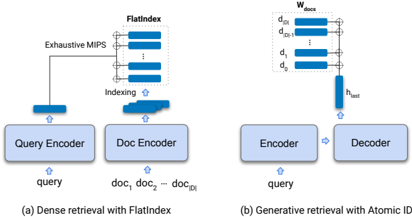
Generative retrieval is a promising new neural retrieval paradigm that aims to optimize the retrieval pipeline by performing both indexing and retrieval with a single transformer model. However, this new paradigm faces challenges with updating the index and scaling to large collections. In this paper, we analyze two prominent variants of generative retrieval and show that they can be conceptually viewed as bi-encoders for dense retrieval. Specifically, we analytically demonstrate that the generative retrieval process can be decomposed into dot products between query and document vectors, similar to dense retrieval. This analysis leads us to propose a new variant of generative retrieval, called Tied-Atomic, which addresses the updating and scaling issues by incorporating techniques from dense retrieval. In experiments on two datasets, NQ320k and the full MSMARCO, we confirm that this approach does not reduce retrieval effectiveness while enabling the model to scale to large collections.
Overview
The claims and statistics of this paper haven’t been checked yet.
Run the check — free, no account needed. It reads the open-access text and checks the sources it cites.
Integrity signals
Registry
Cites
Statistics
Figures
Verification
Claims the paper makes
The claims and statistics of this paper haven’t been checked yet.
Run the check — free, no account needed. It reads the open-access text and checks the sources it cites.
Claims other papers make about this one
Each is checked against this paper’s own text: does it say what the citing paper says it does?
In the citing paper
“However, storing raw document content directly in limited parameter spaces often lead to significant information loss (which is reflected in the suboptimal retrieval performance of GR models [138])”
From Foundations of GenIR (2025) · cites this paper as [138]
Self-check
Percentages, sums and reported differences re-computed from the paper’s own numbers.
The self-check needs the paper’s full text.
Citations
Cites
No references could be resolved yet.
Research works printed but not linked: 28
- Thibault Formal, Benjamin Piwowarski, and Stéphane Clinchant. 2021. SPLADE: Sparse lexical and expansion model for first stage ranking. In Proceedings of the 44th International ACM SIGIR Conference on Research and Development in Information Retrieval. 2288-2292.
- Sebastian Hofstätter, Sophia Althammer, Michael Schröder, Mete Sertkan, and Allan Hanbury. 2020. Improving Efficient Neural Ranking Models with Cross-Architecture Knowledge Distillation. CoRR abs/2010.02666 (2020). arXiv:2010.02666 https://arxiv.org/abs/2010.02666 · arXiv
- Sebastian Hofstätter, Sheng-Chieh Lin, Jheng-Hong Yang, Jimmy Lin, and Allan Hanbury. 2021. Efficiently Teaching an Effective Dense Retriever with Balanced Topic Aware Sampling. In SIGIR '21: The 44th International ACM SIGIR Conference on Research and Development in Information Retrieval, Virtual Event, Canada, July 11-15, 2021, Fernando Diaz, Chirag Shah, Torsten Suel, Pablo Castells, Rosie Jones, and Tetsuya Sakai (Eds.). ACM, 113-122. https://doi.org/10.1145/3404835.3462891 · DOI
- Vladimir Karpukhin, Barlas Oğuz, Sewon Min, Patrick Lewis, Ledell Wu, Sergey Edunov, Danqi Chen, and Wen-tau Yih. 2020. Dense passage retrieval for open- domain question answering. arXiv preprint arXiv:2004.04906 (2020). · arXiv
- Tom Kwiatkowski, Jennimaria Palomaki, Olivia Redfield, Michael Collins, Ankur Parikh, Chris Alberti, Danielle Epstein, Illia Polosukhin, Jacob Devlin, Kenton Lee, et al. 2019. Natural questions: a benchmark for question answering research. Transactions of the Association for Computational Linguistics 7 (2019), 453-466.
- Jimmy Lin, Rodrigo Nogueira, and Andrew Yates. 2021. Pretrained transform- ers for text ranking: Bert and beyond. Synthesis Lectures on Human Language Technologies 14, 4 (2021), 1-325.
- Ting Liu, Andrew Moore, Ke Yang, and Alexander Gray. 2004. An investiga- tion of practical approximate nearest neighbor algorithms. Advances in neural information processing systems 17 (2004).
- Yury A. Malkov and Dmitry A. Yashunin. 2020. Efficient and Robust Approximate Nearest Neighbor Search Using Hierarchical Navigable Small World Graphs. IEEE Trans. Pattern Anal. Mach. Intell. 42, 4 (2020), 824-836. https://doi.org/10.1109/ TPAMI.2018.2889473 · DOI · Paper page
- Sanket Vaibhav Mehta, Jai Gupta, Yi Tay, Mostafa Dehghani, Vinh Q Tran, Jinfeng Rao, Marc Najork, Emma Strubell, and Donald Metzler. 2022. DSI++: Updating Transformer Memory with New Documents. arXiv preprint arXiv:2212.09744 (2022). · arXiv
- Donald Metzler, Yi Tay, Dara Bahri, and Marc Najork. 2021. Rethinking Search: Making Domain Experts out of Dilettantes. SIGIR Forum 55, 1, Article 13 (jul 2021), 27 pages. https://doi.org/10.1145/3476415.3476428 · DOI · Paper page
- Tri Nguyen, Mir Rosenberg, Xia Song, Jianfeng Gao, Saurabh Tiwary, Rangan Majumder, and Li Deng. 2016. MS MARCO: A Human Generated MAchine Reading COmprehension Dataset. In Proceedings of the Workshop on Cogni- tive Computation: Integrating neural and symbolic approaches 2016 co-located with the 30th Annual Conference on Neural Information Processing Systems (NIPS 2016), Barcelona, Spain, December 9, 2016 (CEUR Workshop Proceedings, Vol. 1773),
- Tarek Richard Besold, Antoine Bordes, Artur S. d'Avila Garcez, and Greg Wayne (Eds.). CEUR-WS.org. https://ceur-ws.org/Vol-1773/CoCoNIPS_2016_paper9.pdf
- Jianmo Ni, Gustavo Hernandez Abrego, Noah Constant, Ji Ma, Keith Hall, Daniel Cer, and Yinfei Yang. 2022. Sentence-T5: Scalable Sentence Encoders from Pre- trained Text-to-Text Models. In Findings of the Association for Computational Linguistics: ACL 2022. Association for Computational Linguistics, Dublin, Ireland, 1864-1874. https://doi.org/10.18653/v1/2022.findings-acl.146 · DOI
- Rodrigo Nogueira, Wei Yang, Jimmy J. Lin, and Kyunghyun Cho. 2019. Document Expansion by Query Prediction. ArXiv abs/1904.08375 (2019). · arXiv
- Ronak Pradeep, Kai Hui, Jai Gupta, Adam D. Lelkes, Honglei Zhuang, Jimmy Lin, Donald Metzler, and Vinh Q. Tran. 2023. How Does Generative Retrieval Scale to Millions of Passages? arXiv:2305.11841 [cs.IR] · arXiv
- Colin Raffel, Noam Shazeer, Adam Roberts, Katherine Lee, Sharan Narang, Michael Matena, Yanqi Zhou, Wei Li, and Peter J. Liu. 2020. Exploring the Limits of Transfer Learning with a Unified Text-to-Text Transformer. J. Mach. Learn. Res. 21 (2020), 140:1-140:67. http://jmlr.org/papers/v21/20-074.html
- Parikshit Ram and Alexander Gray. 2013. Which space partitioning tree to use for search? Advances in Neural Information Processing Systems 26 (2013).
- Nils Reimers and Iryna Gurevych. 2019. Sentence-BERT: Sentence Embeddings using Siamese BERT-Networks. In Proceedings of the 2019 Conference on Em- pirical Methods in Natural Language Processing. Association for Computational Linguistics. https://arxiv.org/abs/1908.10084 · arXiv
- Victor Sanh, Lysandre Debut, Julien Chaumond, and Thomas Wolf. 2019. Dis- tilBERT, a distilled version of BERT: smaller, faster, cheaper and lighter. arXiv preprint arXiv:1910.01108 (2019). · arXiv
- Weiwei Sun, Lingyong Yan, Zheng Chen, Shuaiqiang Wang, Haichao Zhu, Pengjie Ren, Zhumin Chen, Dawei Yin, Maarten de Rijke, and Zhaochun Ren. 2023. Learning to Tokenize for Generative Retrieval. arXiv preprint arXiv:2304.04171 (2023). · arXiv
- Yi Tay, Vinh Tran, Mostafa Dehghani, Jianmo Ni, Dara Bahri, Harsh Mehta, Zhen Qin, Kai Hui, Zhe Zhao, Jai Gupta, et al. 2022. Transformer memory as a differentiable search index. Advances in Neural Information Processing Systems 35 (2022), 21831-21843.
- Yujing Wang, Yingyan Hou, Haonan Wang, Ziming Miao, Shibin Wu, Qi Chen, Yuqing Xia, Chengmin Chi, Guoshuai Zhao, Zheng Liu, et al. 2022. A neural corpus indexer for document retrieval. Advances in Neural Information Processing Systems 35 (2022), 25600-25614.
- Ronald J. Williams and David Zipser. 1989. A Learning Algorithm for Continually Running Fully Recurrent Neural Networks. Neural Comput. 1, 2 (1989), 270-280. https://doi.org/10.1162/neco.1989.1.2.270 · DOI · Paper page
- Lee Xiong, Chenyan Xiong, Ye Li, Kwok-Fung Tang, Jialin Liu, Paul N. Bennett, Junaid Ahmed, and Arnold Overwijk. 2021. Approximate Nearest Neighbor Negative Contrastive Learning for Dense Text Retrieval. In 9th International Conference on Learning Representations, ICLR 2021, Virtual Event, Austria, May 3-7, 2021. OpenReview.net. https://openreview.net/forum?id=zeFrfgyZln
- Peilin Yang, Hui Fang, and Jimmy Lin. 2017. Anserini: Enabling the use of lucene for information retrieval research. In Proceedings of the 40th international ACM SIGIR conference on research and development in information retrieval. 1253-1256.
- Yujia Zhou, Jing Yao, Zhicheng Dou, Ledell Wu, Peitian Zhang, and Ji-Rong Wen. 2022. Ultron: An ultimate retriever on corpus with a model-based indexer. arXiv preprint arXiv:2208.09257 (2022). · arXiv
- Han Zhu, Daqing Chang, Ziru Xu, Pengye Zhang, Xiang Li, Jie He, Han Li, Jian Xu, and Kun Gai. 2019. Joint optimization of tree-based index and deep model for recommender systems. Advances in Neural Information Processing Systems 32 (2019).
- Shengyao Zhuang, Houxing Ren, Linjun Shou, Jian Pei, Ming Gong, Guido Zuc- con, and Daxin Jiang. 2022. Bridging the gap between indexing and retrieval for differentiable search index with query generation. arXiv preprint arXiv:2206.10128 (2022). · arXiv
Cited by
Sorted by citations
From Matching to Generation: A Survey on Generative Information Retrieval
Li, X., Jin, J., Zhou, Y., Zhang, Y., Zhang, P., Zhu, Y., & Dou, Z. (2025) · ACM Transactions on Information Systems · doi:10.1145/3722552 · Cited by 172
Ai, Q., Zhan, J., & Liu, Y. (2025) · arXiv · doi:10.48550/arxiv.2501.02842
“…raw document content directly in limited parameter spaces often lead to significant information loss (which is reflected in the suboptimal retrieval performance of GR models [138]), and using model parameters as indexes make the whole system uncontrollable by both system developers and users.”
Metadata
- Authors
- Nguyen, T., & Yates, A.
- Affiliations
- University of Amsterdam (NL)
- Venue
- arXiv
- Publisher
- arXiv
- Published
- 2023
- ISSN
- 2331-8422 (ISSN-L)
- arXiv
- 2306.11397
- OpenAlex
- W4381573673
- Cited by
- 4
- References
- 0
- Citations by year
- 2025: 2 · 2024: 1 · 2023: 1
- Type
- posted content
- Language
- en
- Open access
- green
- arxiv.org
- Licence
- Locations
- arXiv (Cornell University) (submittedVersion, cc-by)
- arXiv (Cornell University) (cc-by)
- Topics
- Physical Sciences › Computer Science › Information Systems › Information Retrieval and Search Behavior
- Physical Sciences › Computer Science › Artificial Intelligence › Topic Modeling
- Physical Sciences › Computer Science › Computer Vision and Pattern Recognition › Advanced Image and Video Retrieval Techniques
- Keywords
- generative retrieval, dense retrieval, bi-encoder
About these checks
Registry, retraction, Cites and statistics results are computed, not judged, with one exception: a printed reference that no index lists is read once by a model before it counts as a citation error. Claims are extracted by a model and kept only when their quote appears verbatim in the text; each cited source is then checked, with a model’s help, for whether it says what the claim relies on. Those verdicts can be wrong — read the claim’s quote and the cited source before relying on one.
Statistics and arithmetic are recomputed, not judged.
Confidence bands are shown only for fields calibrated on our annotated test set. None is calibrated yet, so no band is shown.
What counts as a claim ›How we measure confidence ›How we check this ›
Are you an author, or do you see a problem with this page? Request a review
