

The DOI matches its DataCite record.
HomeRobot: Open-Vocabulary Mobile Manipulation
Abstract
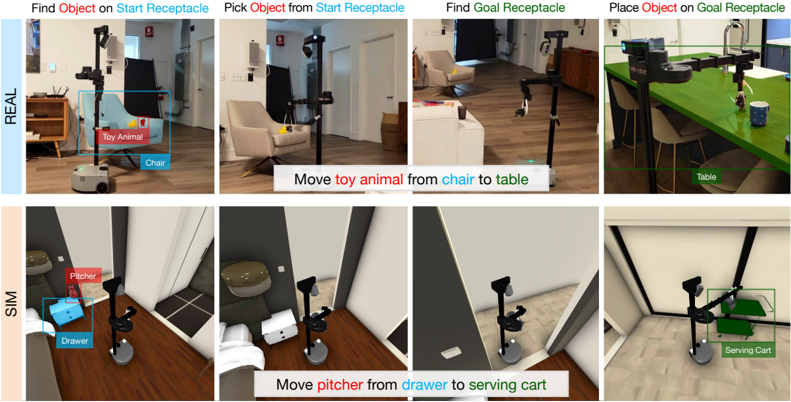
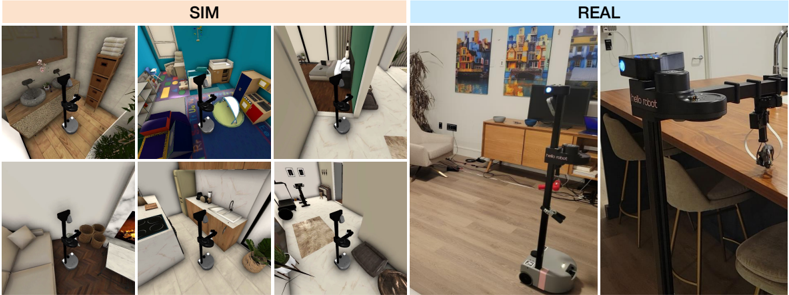
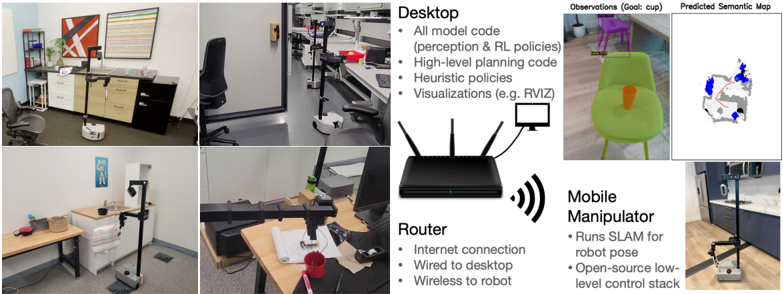
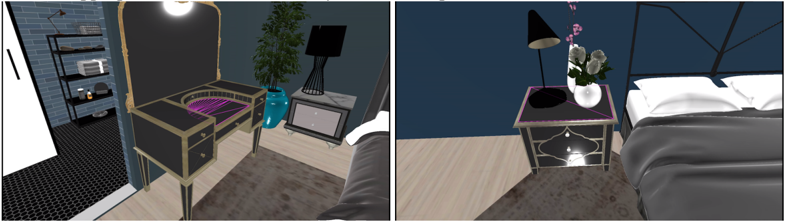
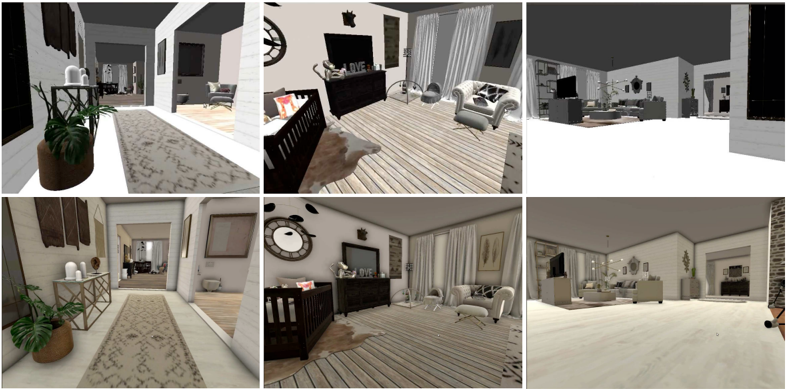
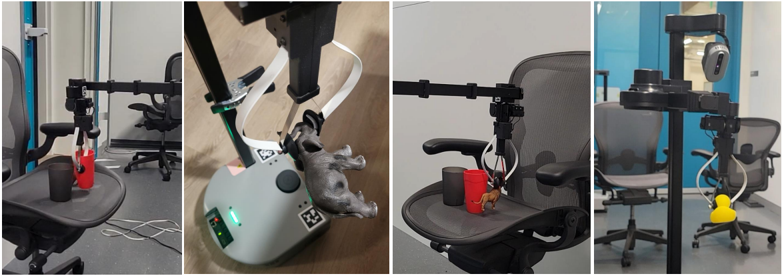
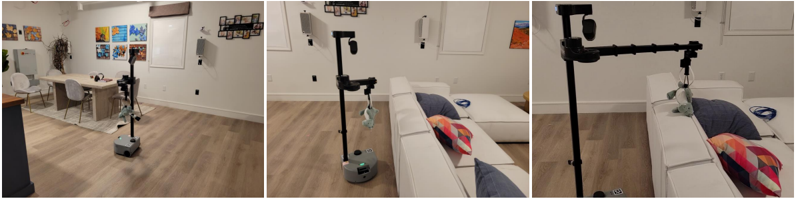
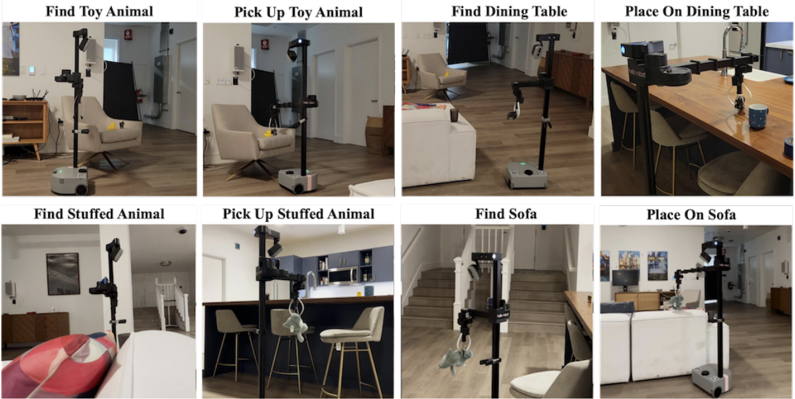
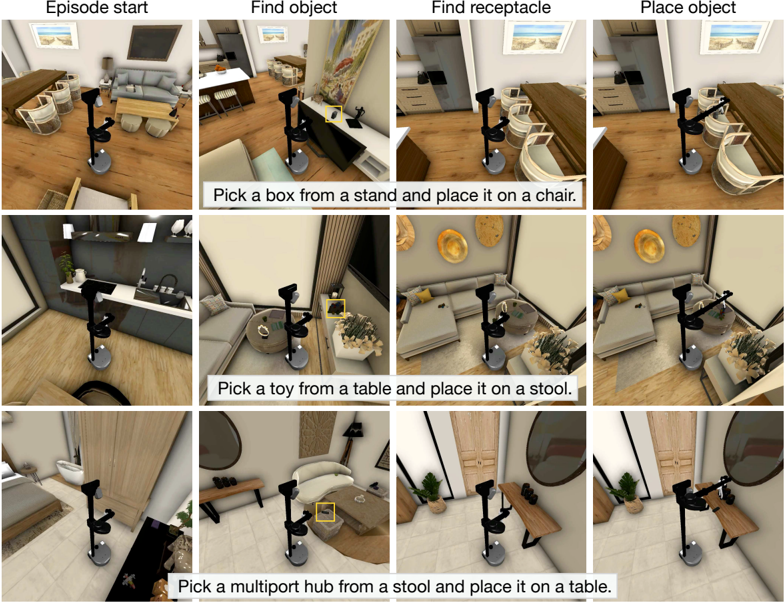
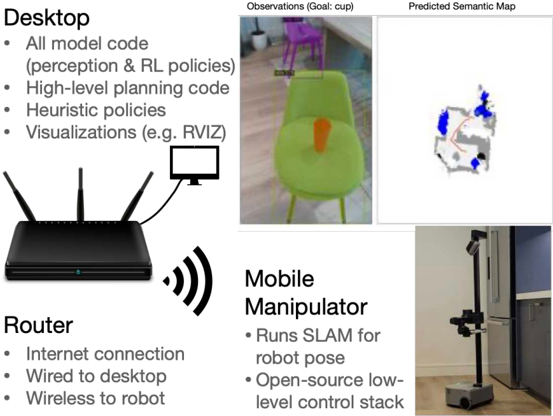
HomeRobot (noun): An affordable compliant robot that navigates homes and manipulates a wide range of objects in order to complete everyday tasks. Open-Vocabulary Mobile Manipulation (OVMM) is the problem of picking any object in any unseen environment, and placing it in a commanded location. This is a foundational challenge for robots to be useful assistants in human environments, because it involves tackling sub-problems from across robotics: perception, language understanding, navigation, and manipulation are all essential to OVMM. In addition, integration of the solutions to these sub-problems poses its own substantial challenges. To drive research in this area, we introduce the HomeRobot OVMM benchmark, where an agent navigates household environments to grasp novel objects and place them on target receptacles. HomeRobot has two components: a simulation component, which uses a large and diverse curated object set in new, high-quality multi-room home environments; and a real-world component, providing a software stack for the low-cost Hello Robot Stretch to encourage replication of real-world experiments across labs. We implement both reinforcement learning and heuristic (model-based) baselines and show evidence of sim-to-real transfer. Our baselines achieve a 20% success rate in the real world; our experiments identify ways future research work improve performance. See videos on our website: https://ovmm.github.io/.
Overview
The claims and statistics of this paper haven’t been checked yet.
Run the check — free, no account needed. It reads the open-access text and checks the sources it cites.
Integrity signals
Registry
Cites
Statistics
Figures
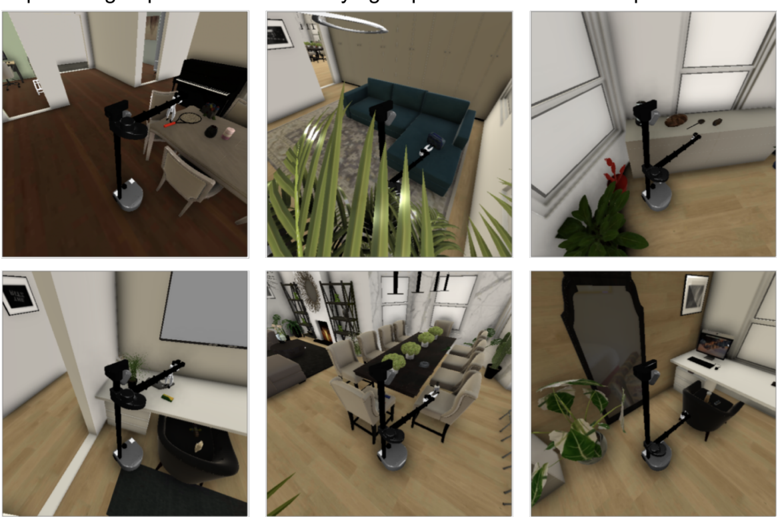
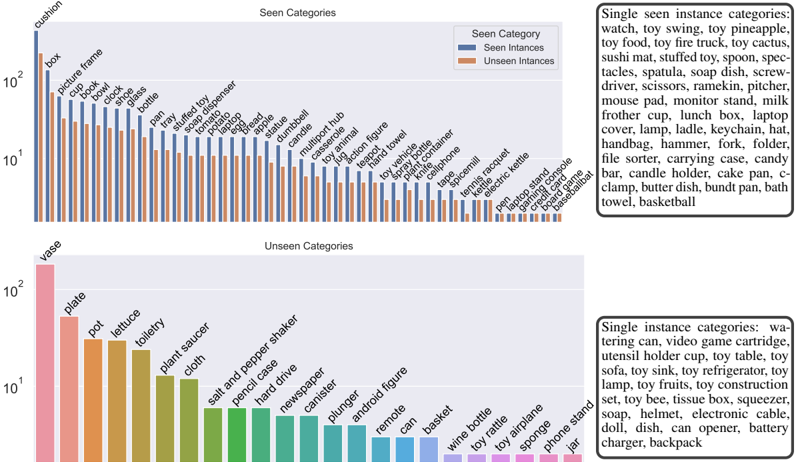
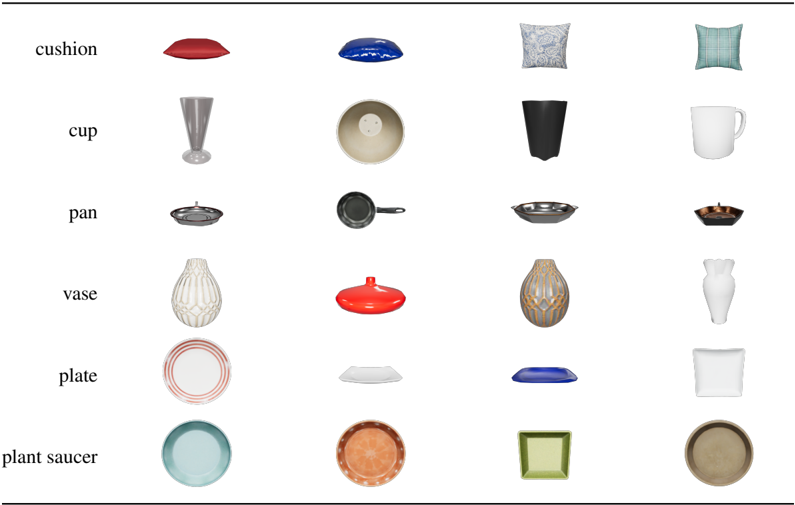
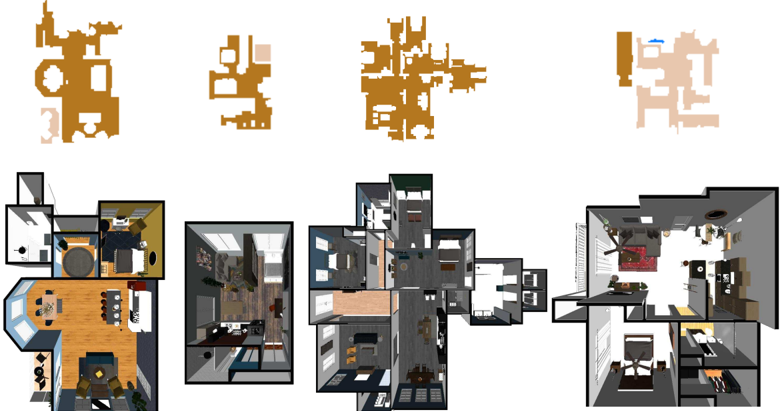
Verification
Claims the paper makes
The claims and statistics of this paper haven’t been checked yet.
Run the check — free, no account needed. It reads the open-access text and checks the sources it cites.
Claims other papers make about this one
Each is checked against this paper’s own text: does it say what the citing paper says it does?
In the citing paper
“Current benchmarks in embodied AI typically satisfy one or the other condition; either robots operate in isolation (Shridhar et al., 2020;Zhu et al., 2023;Krantz et al., 2020;Majumdar et al., 2024), or tasks are not specified in natural language (Yenamandra et al., 2023;Puig et al., 2024;Szot et al., 2023;Jain et al., 2020).”
From PARTNR: A Benchmark for Planning and Reasoning in Embodied Multi-agent Tasks (2024) · cites this paper as Yenamandra et al., 2023
Self-check
Percentages, sums and reported differences re-computed from the paper’s own numbers.
The self-check needs the paper’s full text.
Citations
Cites
No references could be resolved yet.
Research works printed but not linked: 103
- D. Batra, A. Gokaslan, A. Kembhavi, O. Maksymets, R. Mottaghi, M. Savva, A. Toshev, and E. Wijmans. Objectnav revisited: On evaluation of embodied agents navigating to objects. arXiv, 2020.
- T. Gervet, S. Chintala, D. Batra, J. Malik, and D. S. Chaplot. Navigating to objects in the real world. arXiv, 2022.
- J. Bohren, R. B. Rusu, E. G. Jones, E. Marder-Eppstein, C. Pantofaru, M. Wise, L. Mösenlech- ner, W. Meeussen, and S. Holzer. Towards autonomous robotic butlers: Lessons learned with the pr2. In ICRA, 2011.
- M. Shridhar, J. Thomason, D. Gordon, Y. Bisk, W. Han, R. Mottaghi, L. Zettlemoyer, and D. Fox. Alfred: A benchmark for interpreting grounded instructions for everyday tasks. In CVPR, 2020.
- X. Puig, K. Ra, M. Boben, J. Li, T. Wang, S. Fidler, and A. Torralba. Virtualhome: Simulating household activities via programs. In CVPR, 2018.
- C. R. Garrett, R. Chitnis, R. Holladay, B. Kim, T. Silver, L. P. Kaelbling, and T. Lozano-Pérez. Integrated task and motion planning. Annual Review of Control, Robotics, and Autonomous Systems, 4:265-293, 2021.
- B. Chen, F. Xia, B. Ichter, K. Rao, K. Gopalakrishnan, M. S. Ryoo, A. Stone, and D. Kappler. Open-vocabulary queryable scene representations for real world planning. arXiv, 2022.
- A. Stone, T. Xiao, Y. Lu, K. Gopalakrishnan, K.-H. Lee, Q. Vuong, P. Wohlhart, B. Zitkovich, F. Xia, C. Finn, et al. Open-world object manipulation using pre-trained vision-language models. arXiv, 2023.
- N. M. M. Shafiullah, C. Paxton, L. Pinto, S. Chintala, and A. Szlam. Clip-fields: Weakly supervised semantic fields for robotic memory. arXiv, 2022.
- B. Bolte, A. Wang, J. Yang, M. Mukadam, M. Kalakrishnan, and C. Paxton. Usa-net: Unified semantic and affordance representations for robot memory. arXiv, 2023.
- A. Curtis, X. Fang, L. P. Kaelbling, T. Lozano-Pérez, and C. R. Garrett. Long-horizon manipulation of unknown objects via task and motion planning with estimated affordances. In ICRA, 2022.
- A. Radford, J. W. Kim, C. Hallacy, A. Ramesh, G. Goh, S. Agarwal, G. Sastry, A. Askell, P. Mishkin, J. Clark, et al. Learning transferable visual models from natural language supervi- sion. In ICML, 2021.
- K. M. Jatavallabhula, A. Kuwajerwala, Q. Gu, M. Omama, T. Chen, S. Li, G. Iyer, S. Saryazdi, N. Keetha, A. Tewari, et al. Conceptfusion: Open-set multimodal 3d mapping. arXiv, 2023.
- J. Krantz, E. Wijmans, A. Majundar, D. Batra, and S. Lee. Beyond the nav-graph: Vision and language navigation in continuous environments. In European Conference on Computer Vision (ECCV), 2020.
- W. Liu, T. Hermans, S. Chernova, and C. Paxton. Structdiffusion: Object-centric diffusion for semantic rearrangement of novel objects. arXiv, 2022.
- D. Driess, F. Xia, M. S. Sajjadi, C. Lynch, A. Chowdhery, B. Ichter, A. Wahid, J. Tompson, Q. Vuong, T. Yu, et al. Palm-e: An embodied multimodal language model. arXiv, 2023.
- M. Khanna*, Y. Mao*, H. Jiang, S. Haresh, B. Shacklett, D. Batra, A. Clegg, E. Undersander, A. X. Chang, and M. Savva. Habitat Synthetic Scenes Dataset (HSSD-200): An Analysis of 3D Scene Scale and Realism Tradeoffs for ObjectGoal Navigation. arXiv preprint, 2023.
- M. Savva, A. Kadian, O. Maksymets, Y. Zhao, E. Wijmans, B. Jain, J. Straub, J. Liu, V. Koltun, J. Malik, D. Parikh, and D. Batra. Habitat: A Platform for Embodied AI Research. ICCV, 2019.
- A. Szot, A. Clegg, E. Undersander, E. Wijmans, Y. Zhao, J. Turner, N. Maestre, M. Mukadam, D. S. Chaplot, O. Maksymets, et al. Habitat 2.0: Training home assistants to rearrange their habitat. In NeurIPS, 2021.
- C. C. Kemp, A. Edsinger, H. M. Clever, and B. Matulevich. The design of stretch: A compact, lightweight mobile manipulator for indoor human environments. In ICRA, 2022.
- P. Parashar, J. Vakil, S. Powers, and C. Paxton. Spatial-language attention policies for efficient robot learning. arXiv, 2023.
- J. Krantz, T. Gervet, K. Yadav, A. Wang, C. Paxton, R. Mottaghi, D. Batra, J. Malik, S. Lee, and D. S. Chaplot. Navigating to objects specified by images. arXiv, 2023.
- X. Zhou, R. Girdhar, A. Joulin, P. Krähenbühl, and I. Misra. Detecting twenty-thousand classes using image-level supervision. In ECCV, 2022.
- L. Weihs, M. Deitke, A. Kembhavi, and R. Mottaghi. Visual room rearrangement. In CVPR, 2021.
- C. Gan, J. Schwartz, S. Alter, D. Mrowca, M. Schrimpf, J. Traer, J. De Freitas, J. Kubilius, A. Bhandwaldar, N. Haber, et al. Threedworld: A platform for interactive multi-modal physical simulation. NeurIPS Datasets and Benchmarks Track, 2021.
- X. Puig, K. Ra, M. Boben, J. Li, T. Wang, S. Fidler, and A. Torralba. Virtualhome: Simulating household activities via programs. In CVPR, 2018.
- M. Deitke, E. VanderBilt, A. Herrasti, L. Weihs, J. Salvador, K. Ehsani, W. Han, E. Kolve, A. Farhadi, A. Kembhavi, and R. Mottaghi. Procthor: Large-scale embodied ai using procedural generation. In NeurIPS, 2022.
- M. Deitke, W. Han, A. Herrasti, A. Kembhavi, E. Kolve, R. Mottaghi, J. Salvador, D. Schwenk, E. VanderBilt, M. Wallingford, L. Weihs, M. Yatskar, and A. Farhadi. RoboTHOR: An Open Simulation-to-Real Embodied AI Platform. In CVPR, 2020.
- C. Li, R. Zhang, J. Wong, C. Gokmen, S. Srivastava, R. Martín-Martín, C. Wang, G. Levine, M. Lingelbach, J. Sun, et al. Behavior-1k: A benchmark for embodied ai with 1,000 everyday activities and realistic simulation. In CoRL, 2023.
- T. Mu, Z. Ling, F. Xiang, D. C. Yang, X. Li, S. Tao, Z. Huang, Z. Jia, and H. Su. Maniskill: Generalizable manipulation skill benchmark with large-scale demonstrations. In NeurIPS Datasets and Benchmarks Track, 2021.
- M. Buehler, K. Iagnemma, and S. Singh. The DARPA urban challenge: autonomous vehicles in city traffic. Springer Berlin, Heidelberg, 2009.
- N. Correll, K. E. Bekris, D. Berenson, O. Brock, A. Causo, K. Hauser, K. Okada, A. Rodriguez, J. M. Romano, and P. R. Wurman. Analysis and observations from the first amazon picking challenge. IEEE Transactions on Automation Science and Engineering, 2016.
- L. D. Jackel, E. Krotkov, M. Perschbacher, J. Pippine, and C. Sullivan. The darpa lagr program: Goals, challenges, methodology, and phase i results. Journal of Field Robotics, 2006.
- M. Müller and V. Koltun. Openbot: Turning smartphones into robots. In ICRA, 2021.
- N. Kau, A. Schultz, N. Ferrante, and P. Slade. Stanford doggo: An open-source, quasi-direct- drive quadruped. In ICRA, 2019.
- F. Grimminger, A. Meduri, M. Khadiv, J. Viereck, M. Wüthrich, M. Naveau, V. Berenz, S. Heim, F. Widmaier, J. Fiene, A. Badri-Spröwitz, and L. Righetti. An open torque-controlled modular robot architecture for legged locomotion research. IEEE Robotics and Automation Letters, 2019.
- B. Yang, J. Zhang, V. H. Pong, S. Levine, and D. Jayaraman. Replab: A reproducible low-cost arm benchmark platform for robotic learning. arXiv, 2019.
- D. V. Gealy, S. McKinley, B. Yi, P. Wu, P. R. Downey, G. Balke, A. Zhao, M. Guo, R. Thomas- son, A. Sinclair, P. Cuellar, Z. McCarthy, and P. Abbeel. Quasi-direct drive for low-cost compliant robotic manipulation. In ICRA, 2019.
- M. Wüthrich, F. Widmaier, F. Grimminger, S. Joshi, V. Agrawal, B. Hammoud, M. Khadiv, M. Bogdanovic, V. Berenz, J. Viereck, M. Naveau, L. Righetti, B. Schölkopf, and S. Bauer. Trifinger: An open-source robot for learning dexterity. In CoRL, 2020.
- M. Ahn, H. Zhu, K. Hartikainen, H. Ponte, A. Gupta, S. Levine, and V. Kumar. ROBEL: RObotics BEnchmarks for Learning with low-cost robots. In CoRL, 2019.
- A. Murali, T. Chen, K. V. Alwala, D. Gandhi, L. Pinto, S. Gupta, and A. K. Gupta. Pyrobot: An open-source robotics framework for research and benchmarking. arXiv, 2019.
- L. Paull, J. Tani, H. Ahn, J. Alonso-Mora, L. Carlone, M. Cáp, Y. F. Chen, C. Choi, J. Dusek, Y. Fang, D. Hoehener, S. Liu, M. M. Novitzky, I. F. Okuyama, J. Pazis, G. Rosman, V. Varric- chio, H.-C. Wang, D. S. Yershov, H. Zhao, M. R. Benjamin, C. Carr, M. T. Zuber, S. Karaman, E. Frazzoli, D. D. Vecchio, D. Rus, J. P. How, J. J. Leonard, and A. Censi. Duckietown: An open, inexpensive and flexible platform for autonomy education and research. In ICRA, 2017.
- B. Calli, A. Singh, A. Walsman, S. Srinivasa, P. Abbeel, and A. M. Dollar. The ycb object and model set: Towards common benchmarks for manipulation research. In ICRA, 2015.
- D. Morrison, P. Corke, and J. Leitner. Egad! an evolved grasping analysis dataset for diversity and reproducibility in robotic manipulation. IEEE Robotics and Automation Letters, 2020.
- B. Yang, P. E. Lancaster, S. S. Srinivasa, and J. R. Smith. Benchmarking robot manipulation with the rubik's cube. IEEE Robotics and Automation Letters, 2020.
- A. Murali, T. Chen, K. V. Alwala, D. Gandhi, L. Pinto, S. Gupta, and A. Gupta. Pyrobot: An open-source robotics framework for research and benchmarking. arXiv, 2019.
- S. Dasari, J. Wang, J. Hong, S. Bahl, Y. Lin, A. S. Wang, A. Thankaraj, K. S. Chahal, B. Çalli, S. Gupta, D. Held, L. Pinto, D. Pathak, V. Kumar, and A. Gupta. Rb2: Robotic manipulation benchmarking with a twist. arXiv, 2022.
- G. Zhou, V. Dean, M. K. Srirama, A. Rajeswaran, J. Pari, K. B. Hatch, A. Jain, T. Yu, P. Abbeel, L. Pinto, C. Finn, and A. Gupta. Train offline, test online: A real robot learning benchmark. arXiv, 2022.
- K. Kimble, K. Van Wyk, J. Falco, E. Messina, Y. Sun, M. Shibata, W. Uemura, and Y. Yokoko- hji. Benchmarking protocols for evaluating small parts robotic assembly systems. IEEE Robotics and Automation Letters, 2020.
- W. Lian, T. Kelch, D. Holz, A. Norton, and S. Schaal. Benchmarking off-the-shelf solutions to robotic assembly tasks. In IROS, 2021.
- A. Kadian, J. Truong, A. Gokaslan, A. Clegg, E. Wijmans, S. Lee, M. Savva, S. Chernova, and D. Batra. Are we making real progress in simulated environments? measuring the sim2real gap in embodied visual navigation. arXiv, 2019.
- E. Kolve, R. Mottaghi, W. Han, E. VanderBilt, L. Weihs, A. Herrasti, D. Gordon, Y. Zhu, A. Gupta, and A. Farhadi. AI2-THOR: an interactive 3d environment for visual AI. arXiv, 2017.
- J. Collins, S. Goel, A. Luthra, L. Xu, K. Deng, X. Zhang, T. F. Y. Vicente, H. Arora, T. Diderik- sen, M. Guillaumin, et al. Abo: Dataset and benchmarks for real-world 3d object understanding. In CVPR, 2022.
- L. Downs, A. Francis, N. Koenig, B. Kinman, R. Hickman, K. Reymann, T. B. McHugh, and V. Vanhoucke. Google scanned objects: A high-quality dataset of 3d scanned household items. In ICRA, 2022.
- J. Wu, R. Antonova, A. Kan, M. Lepert, A. Zeng, S. Song, J. Bohg, S. Rusinkiewicz, and T. Funkhouser. Tidybot: Personalized robot assistance with large language models. arXiv, 2023.
- T. Zhou, R. Tucker, J. Flynn, G. Fyffe, and N. Snavely. Stereo magnification: Learning view synthesis using multiplane images. SIGGRAPH, 2018.
- E. Wijmans, A. Kadian, A. Morcos, S. Lee, I. Essa, D. Parikh, M. Savva, and D. Batra. Dd-ppo: Learning near-perfect pointgoal navigators from 2.5 billion frames. In ICLR, 2019.
- J. Deng, W. Dong, R. Socher, L.-J. Li, K. Li, and L. Fei-Fei. Imagenet: A large-scale hierarchical image database. In CVPR, 2009.
- A. Wang, A. Singh, J. Michael, F. Hill, O. Levy, and S. R. Bowman. GLUE: A multi-task benchmark and analysis platform for natural language understanding. In ICLR, 2019.
- Y. Bisk, R. Zellers, R. L. Bras, J. Gao, and Y. Choi. Piqa: Reasoning about physical common- sense in natural language. In AAAI, 2020.
- M. Sap, H. Rashkin, D. Chen, R. LeBras, and Y. Choi. SocialIQA: Commonsense reasoning about social interactions. In EMNLP, 2019.
- R. Zellers, A. Holtzman, Y. Bisk, A. Farhadi, and Y. Choi. Hellaswag: Can a machine really finish your sentence? In Proceedings of the 57th Annual Meeting of the Association for Computational Linguistics, 2019.
- S. Keisuke, L. B. Ronan, B. Chandra, and C. Yejin. Winogrande: An adversarial winograd schema challenge at scale. In AAAI, 2019.
- T.-Y. Lin, M. Maire, S. Belongie, J. Hays, P. Perona, D. Ramanan, P. Dollár, and C. L. Zitnick. Microsoft coco: Common objects in context. In ECCV, 2014.
- P. Rajpurkar, J. Zhang, K. Lopyrev, and P. Liang. Squad: 100,000+ questions for machine comprehension of text. In EMNLP, 2016.
- L. Pinto and A. Gupta. Supersizing self-supervision: Learning to grasp from 50k tries and 700 robot hours. In ICRA, 2016.
- M. Ahn, A. Brohan, N. Brown, Y. Chebotar, O. Cortes, B. David, C. Finn, C. Fu, K. Gopalakr- ishnan, K. Hausman, A. Herzog, D. Ho, J. Hsu, J. Ibarz, B. Ichter, A. Irpan, E. Jang, R. J. Ruano, K. Jeffrey, S. Jesmonth, N. Joshi, R. Julian, D. Kalashnikov, Y. Kuang, K.-H. Lee, S. Levine, Y. Lu, L. Luu, C. Parada, P. Pastor, J. Quiambao, K. Rao, J. Rettinghouse, D. Reyes, P. Sermanet, N. Sievers, C. Tan, A. Toshev, V. Vanhoucke, F. Xia, T. Xiao, P. Xu, S. Xu, M. Yan, and A. Zeng. Do as i can and not as i say: Grounding language in robotic affordances. In CoRL, 2022.
- A. Mandlekar, Y. Zhu, A. Garg, J. Booher, M. Spero, A. Tung, J. Gao, J. Emmons, A. Gupta, E. Orbay, S. Savarese, and L. Fei-Fei. Roboturk: A crowdsourcing platform for robotic skill learning through imitation. In CoRL, 2018.
- P. Sharma, L. Mohan, L. Pinto, and A. K. Gupta. Multiple interactions made easy (mime): Large scale demonstrations data for imitation. In CoRL, 2018.
- J. Mahler, J. Liang, S. Niyaz, M. Laskey, R. Doan, X. Liu, J. A. Ojea, and K. Goldberg. Dex-net 2.0: Deep learning to plan robust grasps with synthetic point clouds and analytic grasp metrics. arXiv, 2017.
- S. Dasari, F. Ebert, S. Tian, S. Nair, B. Bucher, K. Schmeckpeper, S. Singh, S. Levine, and C. Finn. Robonet: Large-scale multi-robot learning. arXiv, 2019.
- A. Gupta, A. Murali, D. P. Gandhi, and L. Pinto. Robot learning in homes: Improving generalization and reducing dataset bias. In NeurIPS, 2018.
- P. Anderson, Q. Wu, D. Teney, J. Bruce, M. Johnson, N. Sünderhauf, I. D. Reid, S. Gould, and A. van den Hengel. Vision-and-language navigation: Interpreting visually-grounded navigation instructions in real environments. In CVPR, 2017.
- H. Team. Habitat CVPR challenge, 2019. URL https://aihabitat.org/challenge/ 2019/.
- F. Xia, W. B. Shen, C. Li, P. Kasimbeg, M. Tchapmi, A. Toshev, R. Martín-Martín, and S. Savarese. Interactive gibson benchmark: A benchmark for interactive navigation in cluttered environments. IEEE Robotics and Automation Letters, 2020.
- C. Chen, U. Jain, C. Schissler, S. V. A. Gari, Z. Al-Halah, V. K. Ithapu, P. Robinson, and K. Grauman. Soundspaces: Audio-visual navigation in 3d environments. In ECCV, 2020.
- K. Ehsani, W. Han, A. Herrasti, E. VanderBilt, L. Weihs, E. Kolve, A. Kembhavi, and R. Mottaghi. Manipulathor: A framework for visual object manipulation. In CVPR, 2021.
- T. Yu, D. Quillen, Z. He, R. Julian, K. Hausman, C. Finn, and S. Levine. Meta-world: A benchmark and evaluation for multi-task and meta reinforcement learning. In CoRL, 2019.
- S. James, Z. Ma, D. R. Arrojo, and A. J. Davison. Rlbench: The robot learning benchmark & learning environment. IEEE Robotics and Automation Letters, 2020.
- A. Ku, P. Anderson, R. Patel, E. Ie, and J. Baldridge. Room-across-room: Multilingual vision-and-language navigation with dense spatiotemporal grounding. In EMNLP, 2020.
- A. Padmakumar, J. Thomason, A. Shrivastava, P. Lange, A. Narayan-Chen, S. Gella, R. Pi- ramithu, G. Tur, and D. Hakkani-Tur. TEACh: Task-driven embodied agents that chat. In AAAI, 2022.
- X. Gao, Q. Gao, R. Gong, K. Lin, G. Thattai, and G. S. Sukhatme. Dialfred: Dialogue-enabled agents for embodied instruction following. IEEE Robotics and Automation Letters, 2022.
- C. M. Kim, M. Danielczuk, I. Huang, and K. Goldberg. Simulation of parallel-jaw grasping using incremental potential contact models. In ICRA, 2022.
- A. Kurenkov, R. Martín-Martín, J. Ichnowski, K. Goldberg, and S. Savarese. Semantic and geometric modeling with neural message passing in 3d scene graphs for hierarchical mechanical search. In 2021 IEEE International Conference on Robotics and Automation (ICRA), pages 11227-11233. IEEE, 2021.
- K. Rana, J. Haviland, S. Garg, J. Abou-Chakra, I. Reid, and N. Suenderhauf. Sayplan: Grounding large language models using 3d scene graphs for scalable task planning. arXiv preprint arXiv:2307.06135, 2023. · arXiv
- J. Chen, G. Li, S. Kumar, B. Ghanem, and F. Yu. How to not train your dragon: Training-free embodied object goal navigation with semantic frontiers. arXiv preprint arXiv:2305.16925, 2023. · arXiv
- M. Sundermeyer, A. Mousavian, R. Triebel, and D. Fox. Contact-graspnet: Efficient 6-dof grasp generation in cluttered scenes. In ICRA, 2021.
- A. Murali, A. Mousavian, C. Eppner, C. Paxton, and D. Fox. 6-dof grasping for target-driven object manipulation in clutter. In ICRA, 2020.
- H.-S. Fang, C. Wang, M. Gou, and C. Lu. Graspnet-1billion: A large-scale benchmark for general object grasping. In CVPR, 2020.
- C. R. Garrett, C. Paxton, T. Lozano-Pérez, L. P. Kaelbling, and D. Fox. Online replanning in belief space for partially observable task and motion problems. In ICRA, 2020.
- A. Mousavian, C. Eppner, and D. Fox. 6-dof graspnet: Variational grasp generation for object manipulation. In ICCV, 2019.
- C. Paxton, C. Xie, T. Hermans, and D. Fox. Predicting stable configurations for semantic placement of novel objects. In CoRL, 2022.
- S. Kohlbrecher, J. Meyer, O. von Stryk, and U. Klingauf. A flexible and scalable slam system with full 3d motion estimation. In Proc. IEEE International Symposium on Safety, Security and Rescue Robotics (SSRR). IEEE, November 2011.
- J. J. Kuffner and S. M. LaValle. Rrt-connect: An efficient approach to single-query path planning. In ICRA, 2000.
- D. S. Chaplot, D. P. Gandhi, A. Gupta, and R. R. Salakhutdinov. Object goal navigation using goal-oriented semantic exploration. In NeurIPS, 2020.
- B. Yamauchi. A frontier-based approach for autonomous exploration. In IEEE International Symposium on Computational Intelligence in Robotics and Automation, 1997.
- J. A. Sethian. Fast marching methods. SIAM review, 1999.
- D. S. Chaplot, S. Gupta, A. Gupta, and R. Salakhutdinov. Learning to explore using active neural mapping. ICLR, 2020.
- M. Caron, H. Touvron, I. Misra, H. Jégou, J. Mairal, P. Bojanowski, and A. Joulin. Emerging properties in self-supervised vision transformers. CVPR, 2021.
- A. Kirillov, E. Mintun, N. Ravi, H. Mao, C. Rolland, L. Gustafson, T. Xiao, S. Whitehead, A. C. Berg, W.-Y. Lo, et al. Segment anything. arXiv preprint arXiv:2304.02643, 2023. · arXiv
- K. M. Jatavallabhula, S. Saryazdi, G. Iyer, and L. Paull. gradslam: Automagically differentiable slam. arXiv preprint arXiv:1910.10672, 2019. · arXiv
- Q. Gu, A. Kuwajerwala, S. Morin, K. M. Jatavallabhula, B. Sen, A. Agarwal, C. Rivera, W. Paul, K. Ellis, R. Chellappa, et al. Conceptgraphs: Open-vocabulary 3d scene graphs for perception and planning. arXiv preprint arXiv:2309.16650, 2023. · arXiv
- M. Quigley, K. Conley, B. Gerkey, J. Faust, T. Foote, J. Leibs, R. Wheeler, A. Y. Ng, et al. Ros: an open-source robot operating system. In ICRA Workshop on Open Source Software, 2009.
Cited by
Sorted by citations
PARTNR: A Benchmark for Planning and Reasoning in Embodied Multi-agent Tasks
Chang, M., Chhablani, G., Clegg, A., Cote, M. D., Desai, R., Hlavac, M., Karashchuk, V., Krantz, J., Mottaghi, R., Parashar, P., et al. (2024) · arXiv · doi:10.48550/arxiv.2411.00081
Self-citation
Metadata
- Authors
- Yenamandra, S., Ramachandran, A., Yadav, K., Wang, A., Khanna, M., Gervet, T., Yang, T.-Y., Jain, V., Clegg, A. W., Turner, J., Kira, Z., Savva, M., Chang, A., Chaplot, D. S., Batra, D., Mottaghi, R., Bisk, Y., & Paxton, C.
- Venue
- arXiv
- Publisher
- arXiv
- Published
- 2023
- arXiv
- 2306.11565
- References
- 0
- Type
- Preprint
About these checks
Registry, retraction, Cites and statistics results are computed, not judged, with one exception: a printed reference that no index lists is read once by a model before it counts as a citation error. Claims are extracted by a model and kept only when their quote appears verbatim in the text; each cited source is then checked, with a model’s help, for whether it says what the claim relies on. Those verdicts can be wrong — read the claim’s quote and the cited source before relying on one.
Statistics and arithmetic are recomputed, not judged.
Confidence bands are shown only for fields calibrated on our annotated test set. None is calibrated yet, so no band is shown.
What counts as a claim ›How we measure confidence ›How we check this ›
Are you an author, or do you see a problem with this page? Request a review
