

The DOI matches its DataCite record; 1 of the 1 references it cites were found in a registry or an index.
Discovering Variable Binding Circuitry with Desiderata
Open accessAbstract
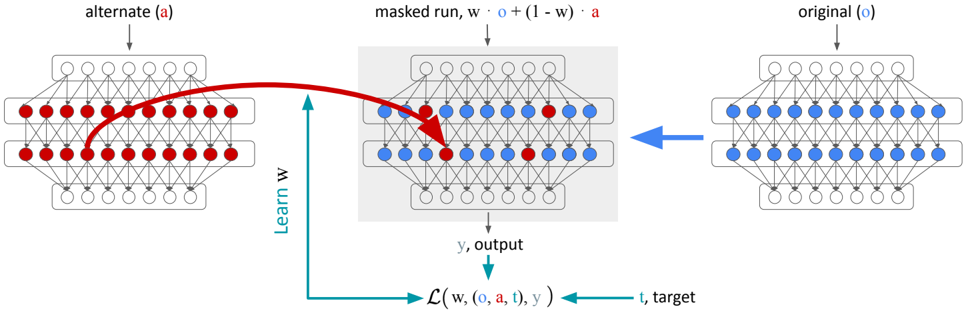
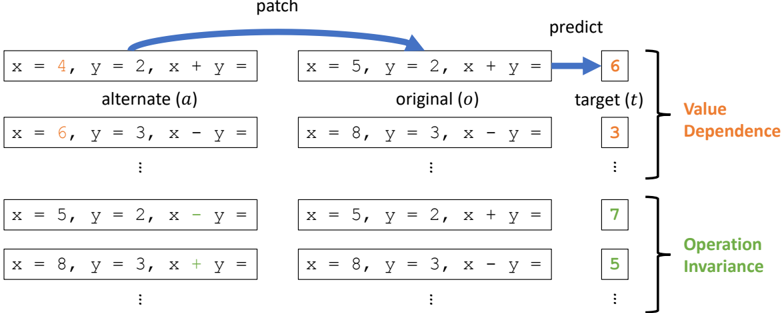
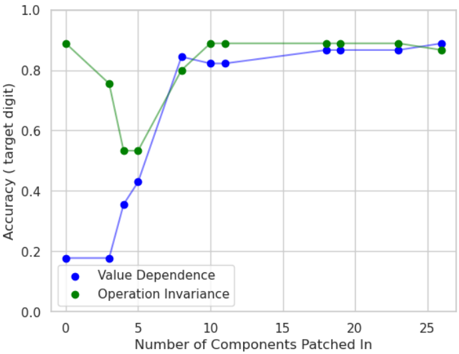
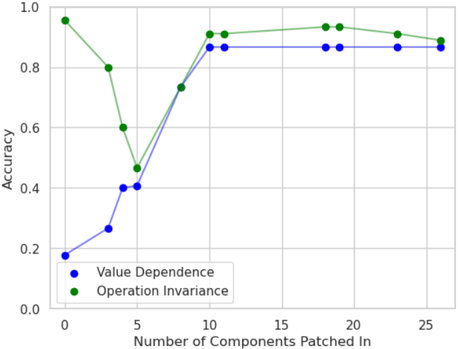
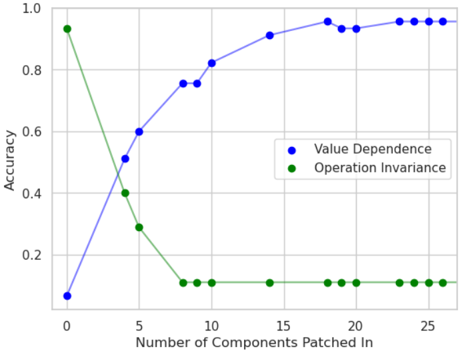
Recent work has shown that computation in language models may be human-understandable, with successful efforts to localize and intervene on both single-unit features and input-output circuits. Here, we introduce an approach which extends causal mediation experiments to automatically identify model components responsible for performing a specific subtask by solely specifying a set of \textit{desiderata}, or causal attributes of the model components executing that subtask. As a proof of concept, we apply our method to automatically discover shared \textit{variable binding circuitry} in LLaMA-13B, which retrieves variable values for multiple arithmetic tasks. Our method successfully localizes variable binding to only 9 attention heads (of the 1.6k) and one MLP in the final token's residual stream.
Overview
The claims and statistics of this paper haven’t been checked yet.
Run the check — free, no account needed. It reads the open-access text and checks the sources it cites.
Integrity signals
Registry
Cites
Statistics
Figures
Verification
Claims the paper makes
The claims and statistics of this paper haven’t been checked yet.
Run the check — free, no account needed. It reads the open-access text and checks the sources it cites.
Claims other papers make about this one
Each is checked against this paper’s own text: does it say what the citing paper says it does?
The source backs part of the claim, not all of it — or backs it for a different population, condition or comparison.
In the citing paper
“Other work learns masks over network components to remove irrelevant components (De Cao et al., 2020;Csordás et al., 2021;Davies et al., 2023).”
From Open Problems in Mechanistic Interpretability (2025) · cites this paper as Davies et al., 2023
Experimental — accuracy not yet measured
Self-check
Percentages, sums and reported differences re-computed from the paper’s own numbers.
The self-check needs the paper’s full text.
Citations
Cites
Emergent World Representations: Exploring a Sequence Model Trained on a Synthetic Task
Li, K., Hopkins, A. K., Bau, D., Viégas, F., Pfister, H., & Wattenberg, M. (2022) · arXiv · doi:10.48550/arxiv.2210.13382 · Cited by 61
Self-citation
Research works printed but not linked: 9
- Geiger, A., Wu, Z., Lu, H., Rozner, J., Kreiss, E., Icard, T., Goodman, N., and Potts, C. Inducing causal structure for interpretable neural networks. In International Con- ference on Machine Learning, pp. 7324-7338. PMLR, 2022.
- Geiger, A., Wu, Z., Potts, C., Icard, T., and Goodman, N. D. Finding alignments between interpretable causal variables and distributed neural representations. arXiv preprint arXiv:2303.02536, 2023. · arXiv
- Louizos, C., Welling, M., and Kingma, D. P. Learning Sparse Neural Networks through $L 0$ Regularization, June 2018. URL http://arxiv.org/abs/1712. 01312. arXiv:1712.01312 [cs, stat]. · arXiv
- Marcus, G. F. Relations between Variables. In The Algebraic Mind: Integrating Connectionism and Cognitive Science. The MIT Press, 04 2001. ISBN 9780262279086. doi: 10.7551/mitpress/1187.003.0005. URL https://doi. org/10.7551/mitpress/1187.003.0005. · DOI
- Meng, K., Bau, D., Andonian, A., and Belinkov, Y. Locating and editing factual associations in GPT. Advances in Neural Information Processing Systems, 36, 2022b.
- Olah, C., Cammarata, N., Schubert, L., Goh, G., Petrov, M., and Carter, S. Zoom in: An introduction to cir- cuits. Distill, 2020. doi: 10.23915/distill.00024.001. https://distill.pub/2020/circuits/zoom-in. · DOI · Paper page
- Räukur, T., Ho, A., Casper, S., and Hadfield-Menell, D. Toward transparent ai: A survey on interpreting the in- ner structures of deep neural networks. arXiv preprint arXiv:2207.13243, 2022. · arXiv
- Touvron, H., Lavril, T., Izacard, G., Martinet, X., Lachaux, M.-A., Lacroix, T., Rozière, B., Goyal, N., Hambro, E., Azhar, F., Rodriguez, A., Joulin, A., Grave, E., and Lample, G. Llama: Open and efficient foundation lan- guage models, 2023. URL https://arxiv.org/ abs/2302.13971. · arXiv
- Vig, J., Gehrmann, S., Belinkov, Y., Qian, S., Nevo, D., Singer, Y., and Shieber, S. Investigating gender bias in language models using causal mediation analysis. Ad- vances in neural information processing systems, 33: 12388-12401, 2020.
Cited by
Sorted by citations
Open Problems in Mechanistic Interpretability
Sharkey, L., Chughtai, B., Batson, J., Lindsey, J., Wu, J., Bushnaq, L., Goldowsky-Dill, N., Heimersheim, S., Ortega, A., Bloom, J., et al. (2025) · arXiv · doi:10.48550/arxiv.2501.16496 · Cited by 291
Self-citation
Metadata
- Authors
- Davies, X., Nadeau, M., Prakash, N., Shaham, T. R., & Bau, D.
- Affiliations
- Harvard University (US)
- Northeastern University (US)
- MIT Computer Science and Artificial Intelligence Laboratory (US)
- Venue
- arXiv
- Publisher
- arXiv
- Published
- 2023
- ISSN
- 2331-8422 (ISSN-L)
- arXiv
- 2307.03637
- OpenAlex
- W4383996906
- Cited by
- 27
- References
- 1
- Citations by year
- 2026: 13 · 2025: 7 · 2024: 3 · 2023: 4
- Type
- posted content
- Language
- en
- Open access
- green
- arxiv.org
- Licence
- Locations
- arXiv (Cornell University) (submittedVersion, cc-by)
- arXiv (Cornell University) (cc-by)
- Funders
- Open Philanthropy Project
- Topics
- Physical Sciences › Computer Science › Artificial Intelligence › Explainable Artificial Intelligence (XAI)
- Physical Sciences › Computer Science › Artificial Intelligence › Topic Modeling
- Physical Sciences › Computer Science › Software › Software Testing and Debugging Techniques
- Keywords
- variable binding, causal mediation analysis, desiderata, language model interpretability, arithmetic exercises, attention heads, residual stream
About these checks
Registry, retraction, Cites and statistics results are computed, not judged, with one exception: a printed reference that no index lists is read once by a model before it counts as a citation error. Claims are extracted by a model and kept only when their quote appears verbatim in the text; each cited source is then checked, with a model’s help, for whether it says what the claim relies on. Those verdicts can be wrong — read the claim’s quote and the cited source before relying on one.
Statistics and arithmetic are recomputed, not judged.
Confidence bands are shown only for fields calibrated on our annotated test set. None is calibrated yet, so no band is shown.
What counts as a claim ›How we measure confidence ›How we check this ›
Are you an author, or do you see a problem with this page? Request a review
