

The DOI matches its DataCite record; 2 of the 2 references it cites were found in a registry or an index.
ChatHaruhi: Reviving Anime Character in Reality via Large Language Model
Open accessAbstract
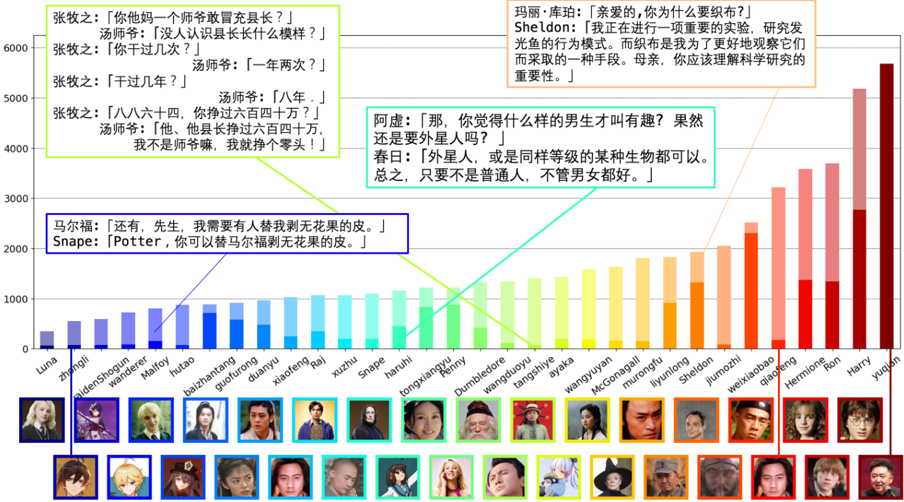
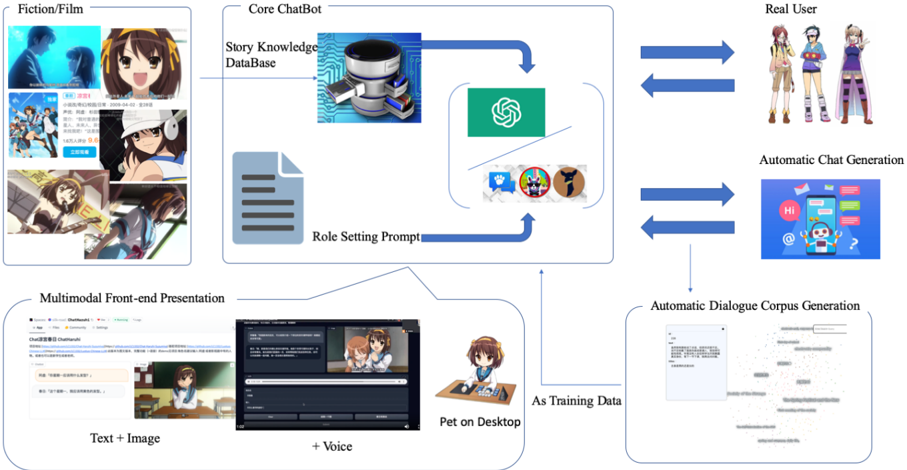
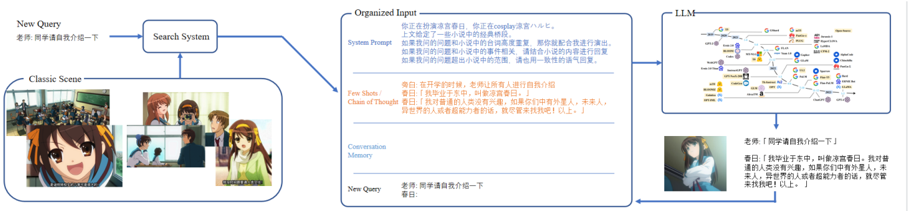
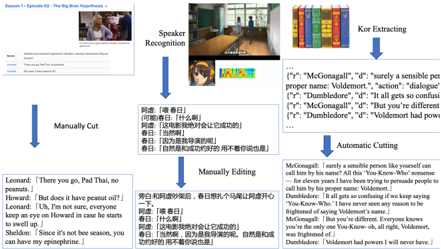
Role-playing chatbots built on large language models have drawn interest, but better techniques are needed to enable mimicking specific fictional characters. We propose an algorithm that controls language models via an improved prompt and memories of the character extracted from scripts. We construct ChatHaruhi, a dataset covering 32 Chinese / English TV / anime characters with over 54k simulated dialogues. Both automatic and human evaluations show our approach improves role-playing ability over baselines. Code and data are available at https://github.com/LC1332/Chat-Haruhi-Suzumiya .
Overview
The claims and statistics of this paper haven’t been checked yet.
Run the check — free, no account needed. It reads the open-access text and checks the sources it cites.
Integrity signals
Registry
Cites
Statistics
Figures


Verification
Claims the paper makes
The claims and statistics of this paper haven’t been checked yet.
Run the check — free, no account needed. It reads the open-access text and checks the sources it cites.
Claims other papers make about this one
Each is checked against this paper’s own text: does it say what the citing paper says it does?
In the citing paper
“Despite the potential of prompt engineering, there are few studies focusing on how it can be used to help LLMs imitate language styles.”
From Using Prompts to Guide Large Language Models in Imitating a Real Person's Language Style (2024) · cites this paper as [40]
Self-check
Percentages, sums and reported differences re-computed from the paper’s own numbers.
The self-check needs the paper’s full text.
Citations
Cites
LLaMA: Open and Efficient Foundation Language Models
Touvron, H., Lavril, T., Izacard, G., Martinet, X., Lachaux, M.-A., Lacroix, T., Rozière, B., Goyal, N., Hambro, E., Azhar, F., et al. (2023) · arXiv · doi:10.48550/arxiv.2302.13971 · Cited by 4,602
Fantastically Ordered Prompts and Where to Find Them: Overcoming Few-Shot Prompt Order Sensitivity
Lu, Y., Bartolo, M., Moore, A., Riedel, S., & Stenetorp, P. (2021) · arXiv · doi:10.48550/arxiv.2104.08786 · Cited by 615 · cited 3×
“…methods of posing questions (Zhao et al., 2021; Holtzman et al., 2021), better selection of token examples for demonstration (Liu et al., 2021; Lu et al., 2022; Rubin et al., 2022), meta-training with explicit contextual learning objectives (Chen et al., 2022), and a variant of context…”
BackgroundMethod
Research works printed but not linked: 7
- Tom Brown, Benjamin Mann, Nick Ryder, Melanie Subbiah, Jared D Kaplan, Prafulla Dhariwal, Arvind Neelakantan, Pranav Shyam, Girish Sastry, Amanda Askell, et al. 2020. Language models are few-shot learners. Advances in neural information processing systems, 33:1877-1901.
- Mingda Chen, Jingfei Du, Ramakanth Pasunuru, Todor Mihaylov, Srini Iyer, Veselin Stoyanov, and Zor- nitsa Kozareva. 2022. Improving in-context few-shot learning via self-supervised training. In Proceedings of the 2022 Conference of the North American Chap- ter of the Association for Computational Linguistics: Human Language Technologies, pages 3558-3573, Seattle, United States. Association for Computational Linguistics. · DOI
- Avia Efrat, Uri Shaham, Dan Kilman, and Omer Levy. 2021. Cryptonite: A cryptic crossword benchmark for extreme ambiguity in language. In Proceedings of the 2021 Conference on Empirical Methods in Nat- ural Language Processing, pages 4186-4192, Online and Punta Cana, Dominican Republic. Association for Computational Linguistics. · DOI
- Ari Holtzman, Peter West, Vered Shwartz, Yejin Choi, and Luke Zettlemoyer. 2021. Surface form com- petition: Why the highest probability answer isn't always right. In Proceedings of the 2021 Conference on Empirical Methods in Natural Language Process- ing, pages 7038-7051, Online and Punta Cana, Do- minican Republic. Association for Computational Linguistics. · DOI · Paper page
- Arvind Neelakantan, Tao Xu, Raul Puri, Alec Rad- ford, Jesse Michael Han, Jerry Tworek, Qiming Yuan, Nikolas Tezak, Jong Wook Kim, Chris Hallacy, et al. 2022. Text and code embeddings by contrastive pre- training. arXiv preprint arXiv:2201.10005. · arXiv
- Ohad Rubin, Jonathan Herzig, and Jonathan Berant. 2022. Learning to retrieve prompts for in-context learning. In Proceedings of the 2022 Conference of the North American Chapter of the Association for Computational Linguistics: Human Language Tech- nologies, pages 2655-2671, Seattle, United States. Association for Computational Linguistics. · DOI · Paper page
- Hongjin Su, Jungo Kasai, Yizhong Wang, Yushi Hu, Mari Ostendorf, Wen-tau Yih, Noah A Smith, Luke Zettlemoyer, Tao Yu, et al. 2022. One embedder, any task: Instruction-finetuned text embeddings. arXiv preprint arXiv:2212.09741. · arXiv
Cited by
Sorted by citations
Memory in the Age of AI Agents
Hu, Y., Liu, S., Yue, Y., Zhang, G., Liu, B., Zhu, F., Lin, J., Guo, H., Dou, S., Xi, Z., et al. (2025) · arXiv · doi:10.48550/arxiv.2512.13564 · Cited by 389
Self-citationA Survey on the Memory Mechanism of Large Language Model-based Agents
Zhang, Z., Dai, Q., Bo, X., Ma, C., Li, R., Chen, X., Zhu, J., Dong, Z., & Wen, J.-R. (2025) · ACM Transactions on Information Systems · doi:10.1145/3748302 · Cited by 592
A Survey on the Memory Mechanism of Large Language Model based Agents
Zhang, Z., Bo, X., Ma, C., Li, R., Chen, X., Dai, Q., Zhu, J., Dong, Z., & Wen, J.-R. (2024) · arXiv · doi:10.48550/arxiv.2404.13501 · Cited by 149
KARMA: Augmenting Embodied AI Agents with Long-and-Short Term Memory Systems
Wang, Z., Yu, B., Zhao, J., Sun, W., Hou, S., Liang, S., Hu, X., Han, Y., & Gan, Y. (2025) · 2025 IEEE International Conference on Robotics and Automation (ICRA) · doi:10.1109/icra55743.2025.11128047 · Cited by 11
Using Prompts to Guide Large Language Models in Imitating a Real Person's Language Style
Chen, Z., & Moscholios, S. (2024) · arXiv · doi:10.48550/arxiv.2410.03848
“[40] constructed a dataset containing dialogues from 32 fictional characters in film and tele-vision.”
Background
Metadata
- Authors
- Li, C., Leng, Z., Yan, C., Shen, J., Wang, H., MI, W., Fei, Y., Feng, X., Yan, S., Wang, H., Zhan, L., Jia, Y., Wu, P., & Sun, H.
- Venue
- arXiv
- Publisher
- arXiv
- Published
- 2023
- ISSN
- 2331-8422 (ISSN-L)
- arXiv
- 2308.09597
- OpenAlex
- W4386044041
- Cited by
- 12
- References
- 2
- Citations by year
- 2026: 2 · 2025: 6 · 2024: 3 · 2023: 1
- Type
- posted content
- Language
- en
- Open access
- green
- arxiv.org
- Licence
- Locations
- arXiv (Cornell University) (submittedVersion, cc-by-sa)
- arXiv (Cornell University)
- Topics
- Physical Sciences › Computer Science › Artificial Intelligence › Speech and dialogue systems
- Physical Sciences › Computer Science › Artificial Intelligence › Topic Modeling
- Social Sciences › Business, Management and Accounting › Marketing › AI in Service Interactions
- Keywords
- anime characters, large language models, prompt engineering, simulated dialogue
About these checks
Registry, retraction, Cites and statistics results are computed, not judged, with one exception: a printed reference that no index lists is read once by a model before it counts as a citation error. Claims are extracted by a model and kept only when their quote appears verbatim in the text; each cited source is then checked, with a model’s help, for whether it says what the claim relies on. Those verdicts can be wrong — read the claim’s quote and the cited source before relying on one.
Statistics and arithmetic are recomputed, not judged.
Confidence bands are shown only for fields calibrated on our annotated test set. None is calibrated yet, so no band is shown.
What counts as a claim ›How we measure confidence ›How we check this ›
Are you an author, or do you see a problem with this page? Request a review
