

The DOI matches its DataCite record.
ActiveAI: Introducing AI Literacy for Middle School Learners with Goal-based Scenario Learning
Open accessAbstract
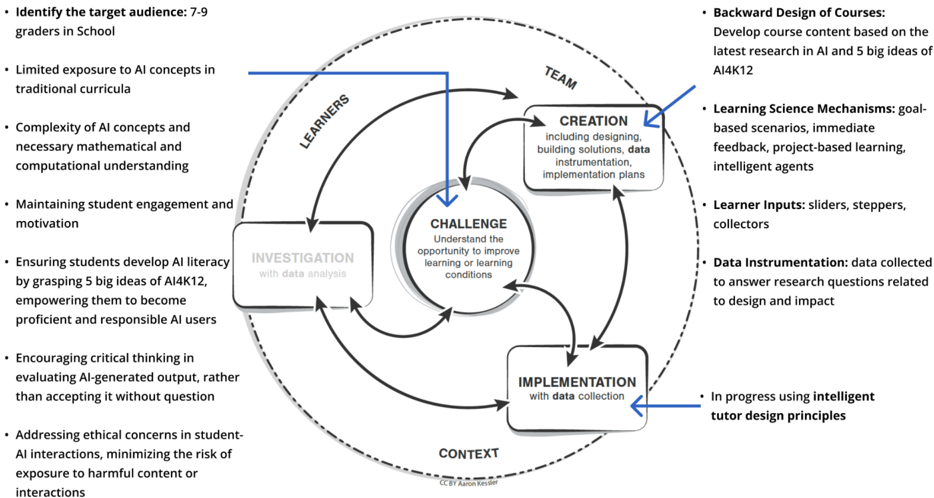
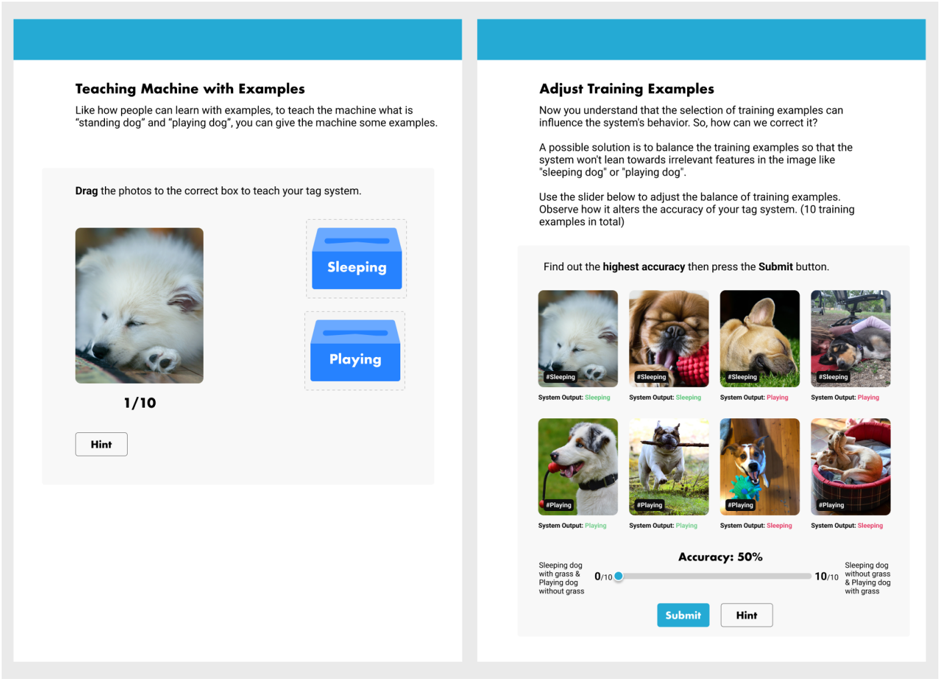
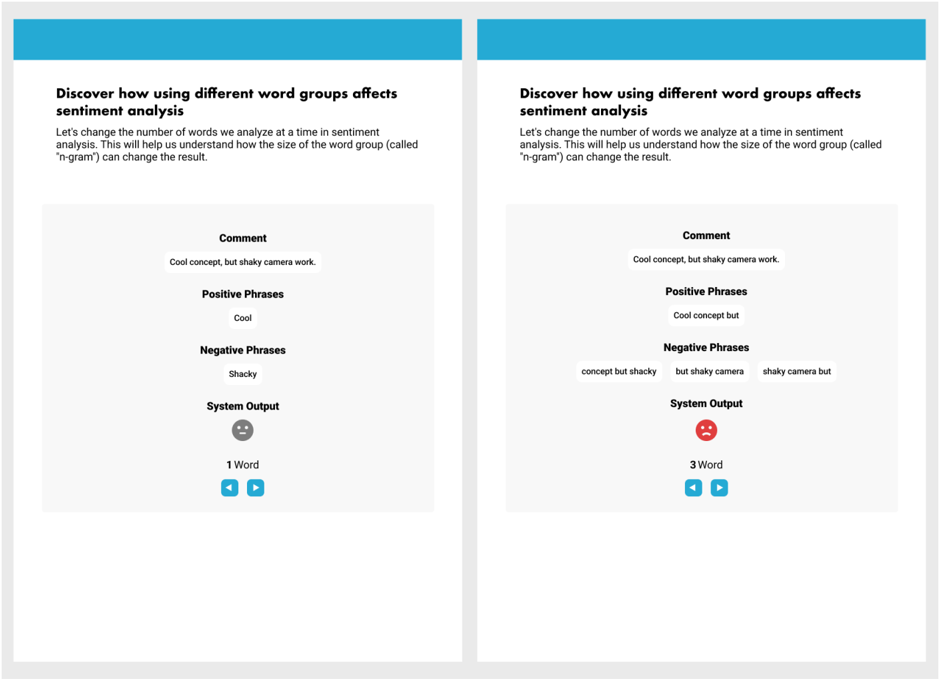
The ActiveAI project addresses key challenges in AI education for grades 7-9 students by providing an engaging AI literacy learning experience based on the AI4K12 knowledge framework. Utilizing learning science mechanisms such as goal-based scenarios, immediate feedback, project-based learning, and intelligent agents, the app incorporates a variety of learner inputs like sliders, steppers, and collectors to enhance understanding. In these courses, students work on real-world scenarios like analyzing sentiment in social media comments. This helps them learn to effectively engage with AI systems and develop their ability to evaluate AI-generated output. The Learning Engineering Process (LEP) guided the project's creation and data instrumentation, focusing on design and impact. The project is currently in the implementation stage, leveraging the intelligent tutor design principles for app development. The extended abstract presents the foundational design and development, with further evaluation and research to be conducted in the future.
Overview
The claims and statistics of this paper haven’t been checked yet.
Run the check — free, no account needed. It reads the open-access text and checks the sources it cites.
Integrity signals
Registry
Cites
Statistics
Figures
Verification
Claims the paper makes
The claims and statistics of this paper haven’t been checked yet.
Run the check — free, no account needed. It reads the open-access text and checks the sources it cites.
Claims other papers make about this one
Each is checked against this paper’s own text: does it say what the citing paper says it does?
In the citing paper
“At the moment, there are specific projects that attempt to implement AI literacy at school”
From Embracing the future of Artificial Intelligence in the classroom: the relevance of AI literacy, prompt engineering, and critical thinking in modern education (2024) · cites this paper as Tseng & Yadav, 2023
Self-check
Percentages, sums and reported differences re-computed from the paper’s own numbers.
The self-check needs the paper’s full text.
Citations
Cites
Still being checked.
Research works printed but not linked: 8
- Aleven, V., McLaren, B. M., Sewall, J., & Koedinger, K. R. (2006). The cognitive tutor authoring tools (CTAT): Preliminary evaluation of efficiency gains. In Intelligent Tutoring Systems: 8th International Conference, ITS 2006, Jhongli, Taiwan, June 26-30, 2006. Proceedings 8 (pp. 61-70). Springer Berlin Heidelberg.
- Corbett, A. T., Koedinger, K. R., & Anderson, J. R. (1997). Intelligent tutoring systems. In Handbook of human-computer interaction (pp. 849-874). North-Holland.
- Kessler, A., Craig, S.D., Goodell, J., Kurzweil, D., & Greenwald, S.W. (2022). Learning Engineering is a Process. In Goodell & Kolodner (Eds.), Learning Engineering Toolkit: Evidence-based Practices from the Learning Sciences, Instructional Design, and Beyond. Routledge: New York and London.
- Ng, D.T.K., Leung, J.K.L., Su, M.J., Yim, I.H.Y., Qiao, M.S., Chu, S.K.W. (2022). AI Literacy Education in Secondary Schools. In: AI Literacy in K-16 Classrooms. Springer, Cham.
- Rodríguez-García, J. D., Moreno-León, J., Román-González, M., & Robles, G. (2021). Introducing Artificial Intelligence Fundamentals with LearningML: Artificial Intelligence made easy. In TEEM'20: Eighth International Conference on Technological Ecosystems for Enhancing Multiculturality (pp. 18-20).
- Schank, R. C., Fano, A., Bell, B., & Jona, M. (1994). The design of goal-based scenarios. The journal of the learning sciences, 3(4), 305-345.
- Torrence, K., (2022, October 27) Building Better VR Solutions with Learning Engineering Practices (Conference presentation). DevLearn 2022 Conference & Expo. Las Vegas, NV, USA
- Touretzky, D., Gardner-McCune, C., & Seehorn, D. (2022). Machine Learning and the Five Big Ideas in AI. International Journal of Artificial Intelligence in Education, 1-34.
Cited by
Walter, Y. (2024) · International Journal of Educational Technology in Higher Education · doi:10.1186/s41239-024-00448-3 · Cited by 1,113
“In order to have a well-rounded and holistic class, an AI literacy program should entail several key components (Kong et al., 2021; Laupichler et al., 2022; Ng et al., 2023c At the moment, there are specific projects that attempt to implement AI literacy at school (Tseng & Yadav, 2023).”
Metadata
- Authors
- Tseng, Y. J., & Yadav, G.
- Affiliations
- Carnegie Mellon University (US)
- ORCID
- Tseng, Ying Jui
- Venue
- arXiv
- Publisher
- arXiv
- Published
- 2023
- ISSN
- 2331-8422 (ISSN-L)
- arXiv
- 2309.12337
- OpenAlex
- W4387030569
- Cited by
- 4
- References
- 0
- Citations by year
- 2026: 2 · 2025: 1 · 2024: 1
- Type
- posted content
- Language
- en
- Open access
- green
- arxiv.org
- Licence
- Locations
- arXiv (Cornell University) (submittedVersion, cc-by-nc-nd)
- arXiv (Cornell University)
- Topics
- Social Sciences › Education › Artificial Intelligence in Education
- Physical Sciences › Computer Science › Artificial Intelligence › Intelligent Tutoring Systems and Adaptive Learning
- Physical Sciences › Computer Science › Computer Science Applications › Teaching and Learning Programming
- Keywords
- AI literacy, artificial intelligence in education, junior high school students, intelligent tutoring systems, learning engineering, project-based learning, sentiment analysis, educational app design, learning sciences
About these checks
Registry, retraction, Cites and statistics results are computed, not judged, with one exception: a printed reference that no index lists is read once by a model before it counts as a citation error. Claims are extracted by a model and kept only when their quote appears verbatim in the text; each cited source is then checked, with a model’s help, for whether it says what the claim relies on. Those verdicts can be wrong — read the claim’s quote and the cited source before relying on one.
Statistics and arithmetic are recomputed, not judged.
Confidence bands are shown only for fields calibrated on our annotated test set. None is calibrated yet, so no band is shown.
What counts as a claim ›How we measure confidence ›How we check this ›
Are you an author, or do you see a problem with this page? Request a review
