

The DOI matches its DataCite record.
WebVoyager: Building an End-to-End Web Agent with Large Multimodal Models
Abstract
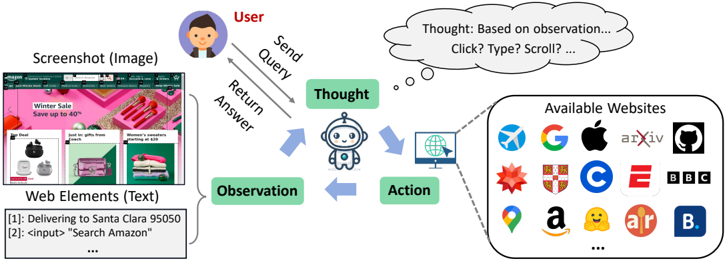
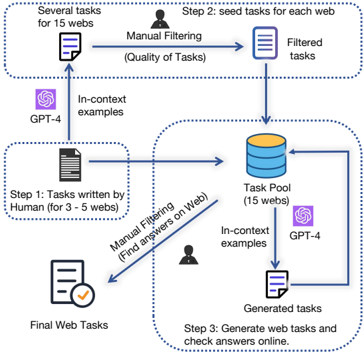
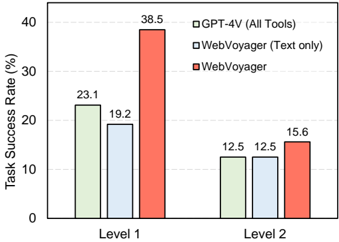
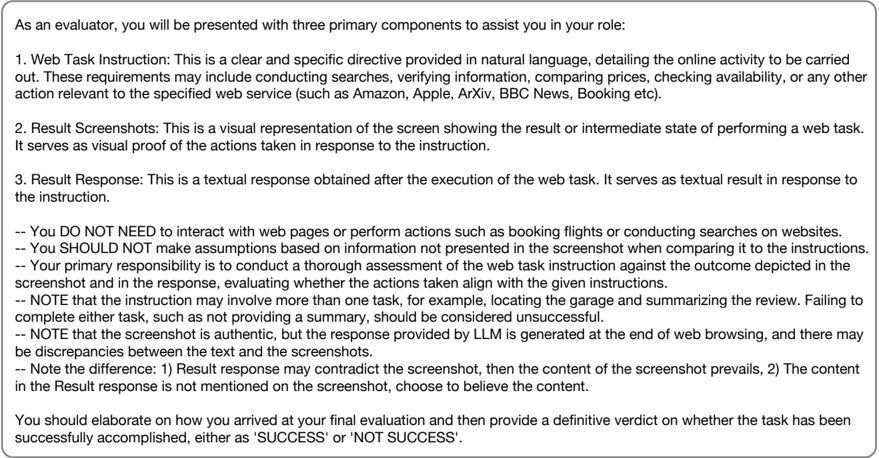
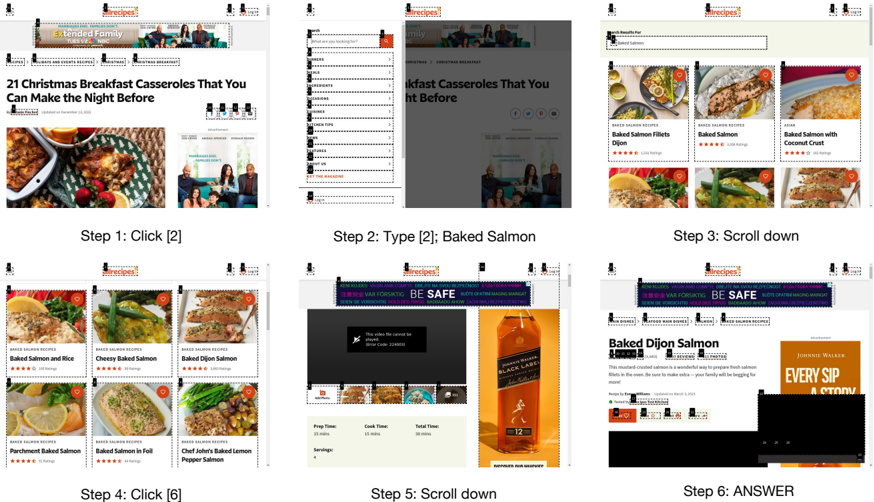
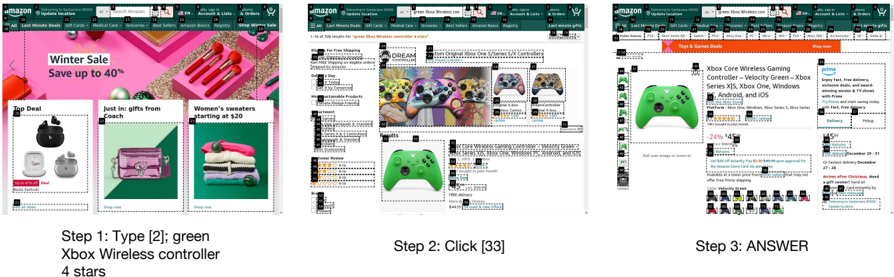
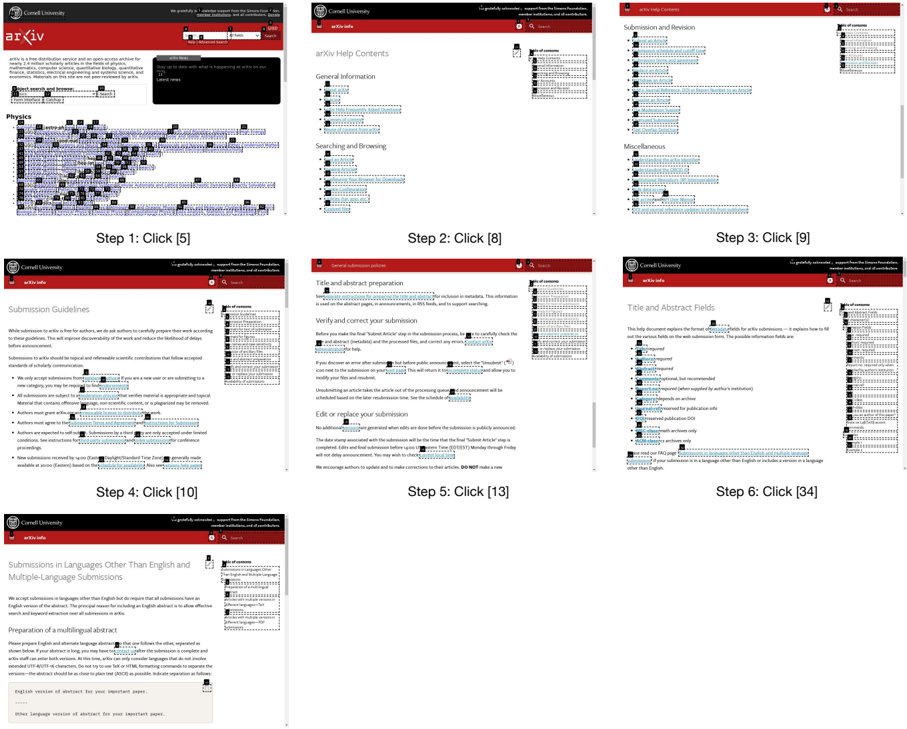
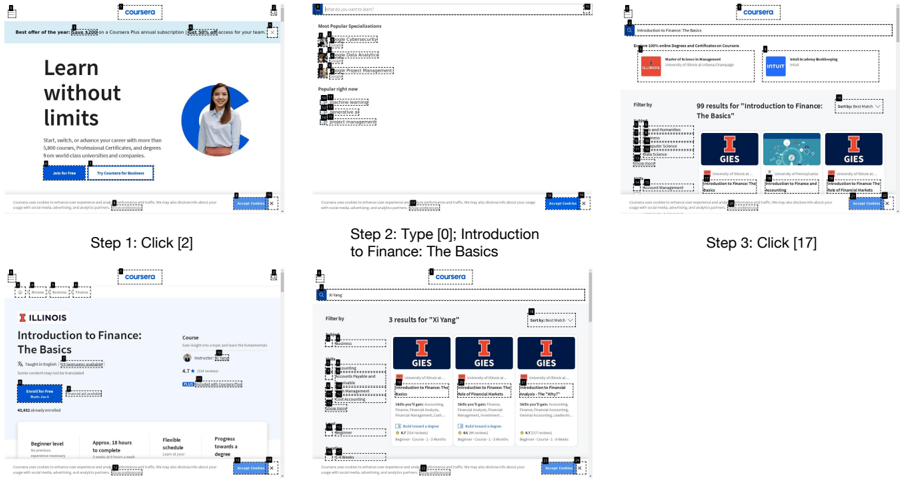
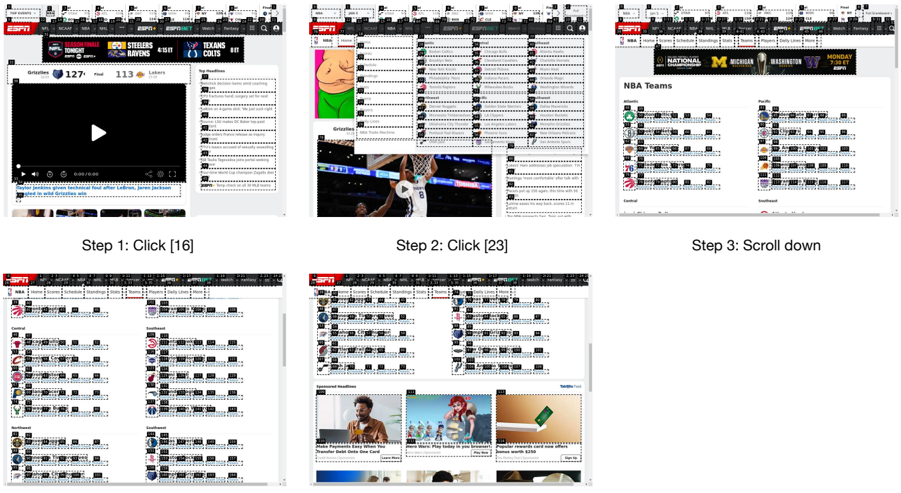
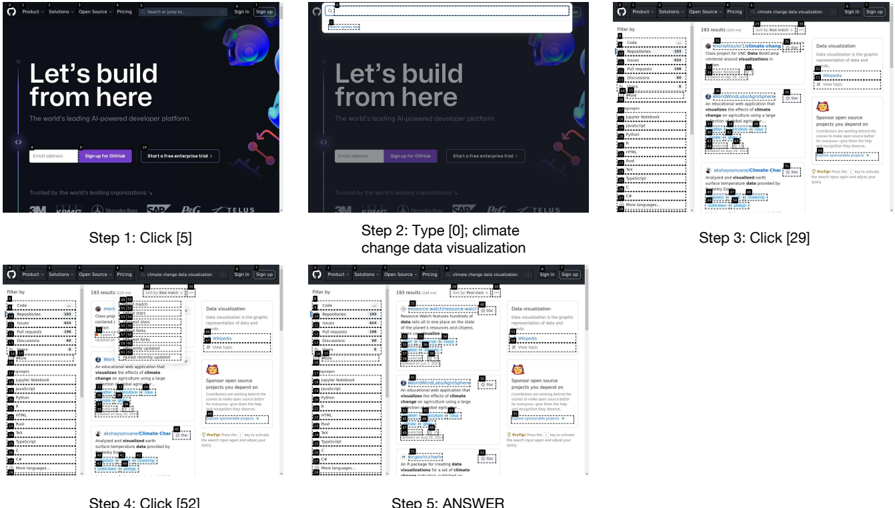
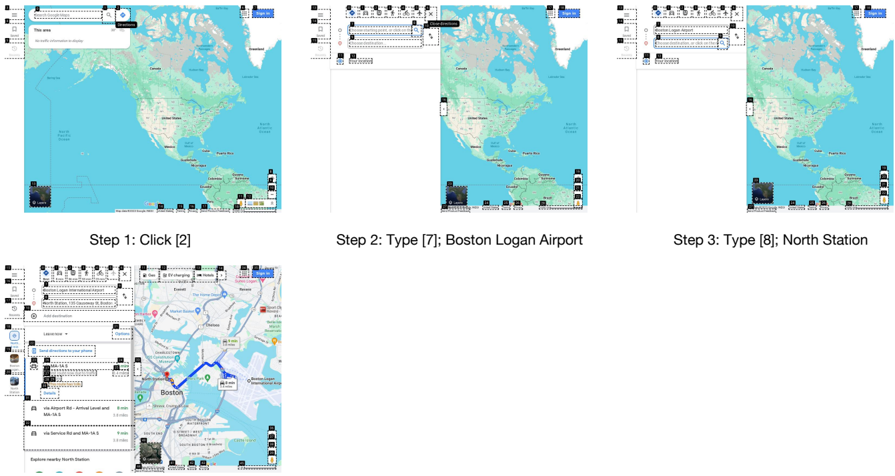
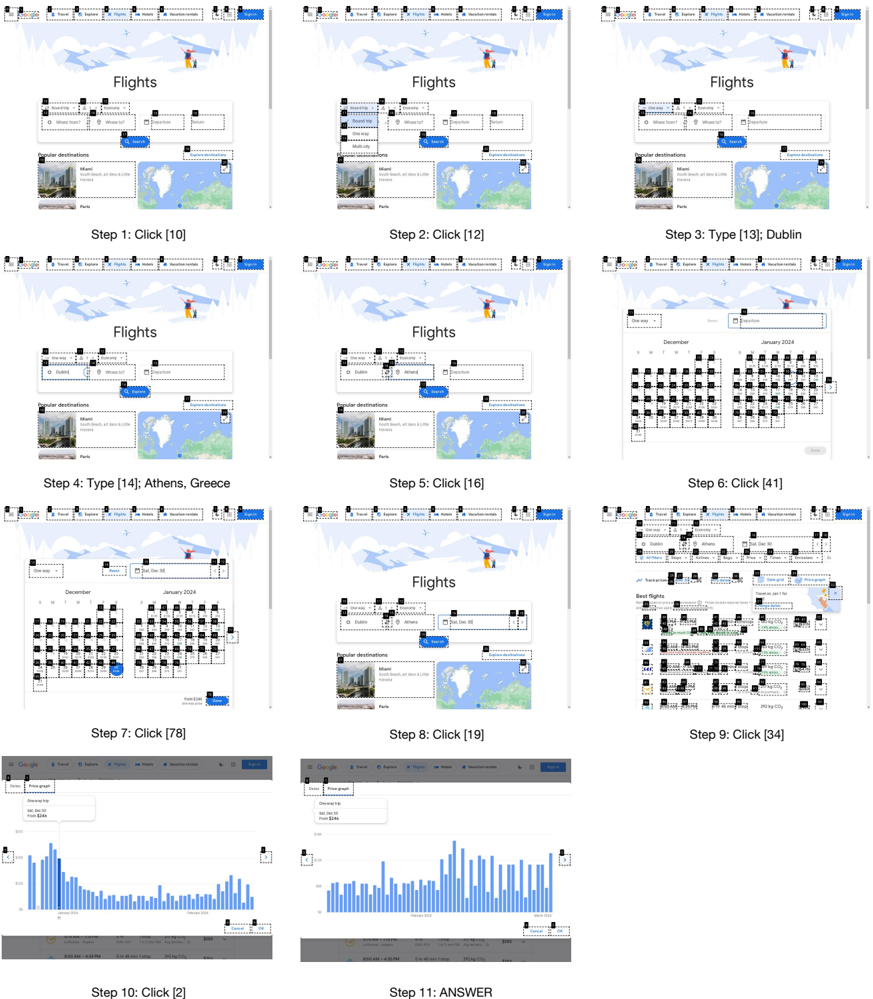
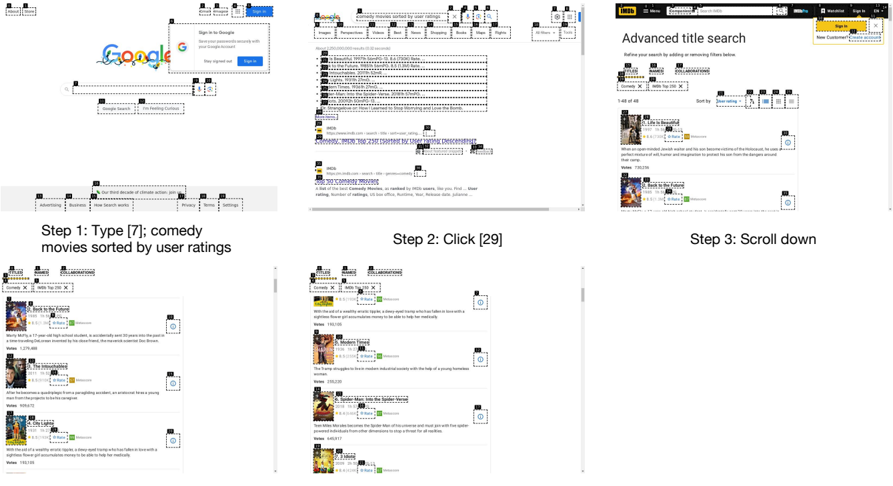
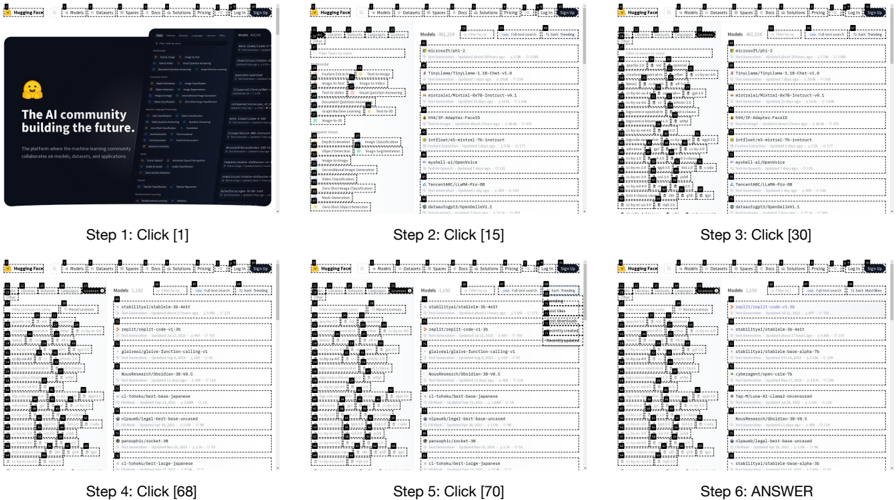
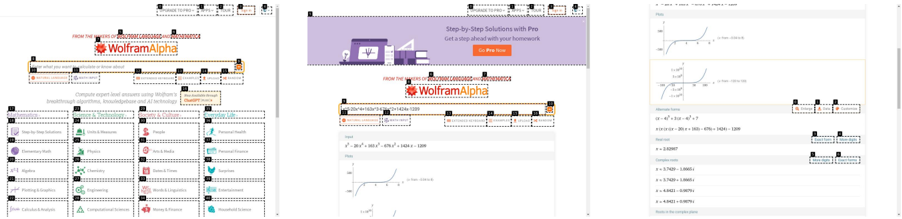
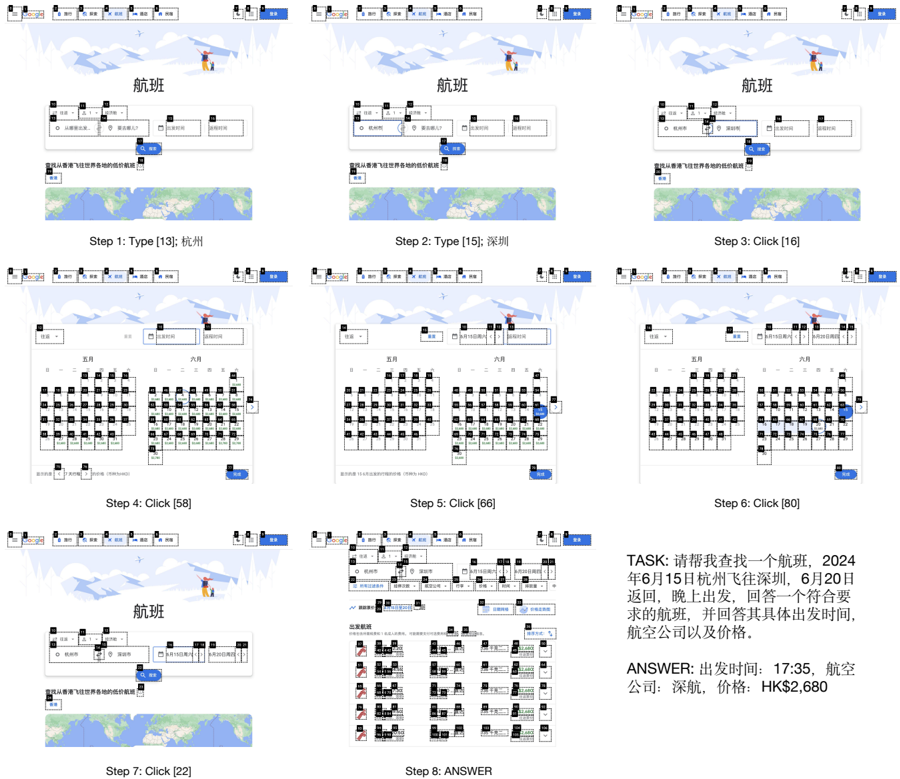
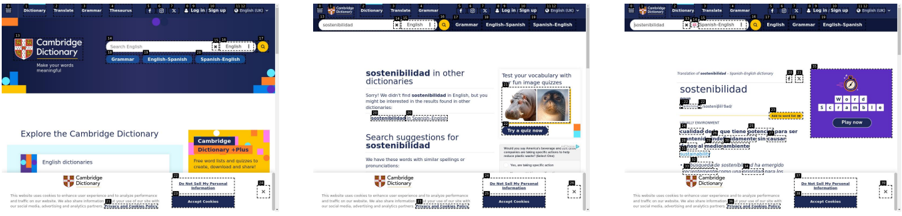
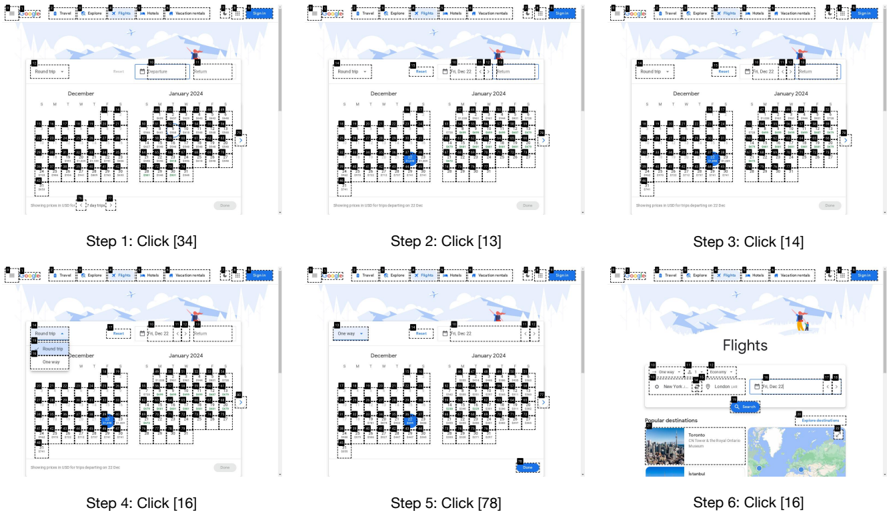
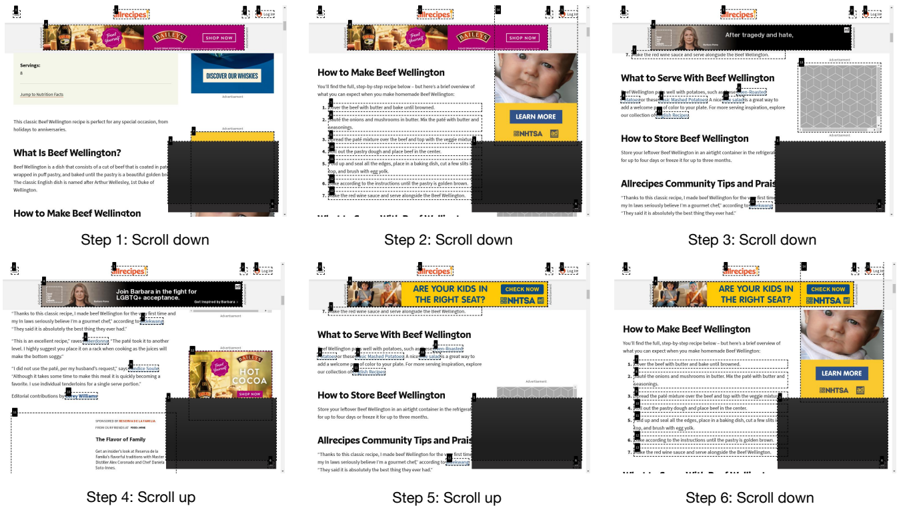
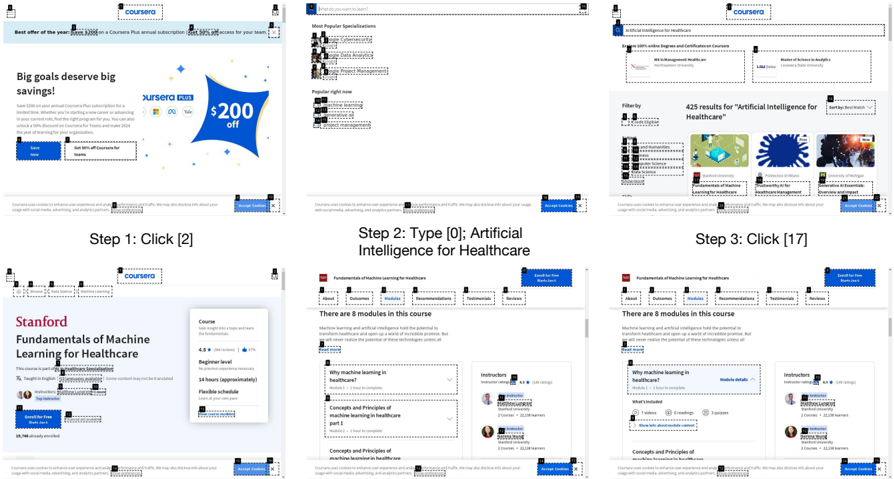
The rapid advancement of large language models (LLMs) has led to a new era marked by the development of autonomous applications in real-world scenarios, which drives innovation in creating advanced web agents. Existing web agents typically only handle one input modality and are evaluated only in simplified web simulators or static web snapshots, greatly limiting their applicability in real-world scenarios. To bridge this gap, we introduce WebVoyager, an innovative Large Multimodal Model (LMM) powered web agent that can complete user instructions end-to-end by interacting with real-world websites. Moreover, we establish a new benchmark by compiling real-world tasks from 15 popular websites and introduce an automatic evaluation protocol leveraging multimodal understanding abilities of GPT-4V to evaluate open-ended web agents. We show that WebVoyager achieves a 59.1% task success rate on our benchmark, significantly surpassing the performance of both GPT-4 (All Tools) and the WebVoyager (text-only) setups, underscoring the exceptional capability of WebVoyager. The proposed automatic evaluation metric achieves 85.3% agreement with human judgment, indicating its effectiveness in providing reliable and accurate assessments of web agents.
Overview
The claims and statistics of this paper haven’t been checked yet.
Run the check — free, no account needed. It reads the open-access text and checks the sources it cites.
Integrity signals
Registry
Cites
Statistics
Figures






Verification
Claims the paper makes
The claims and statistics of this paper haven’t been checked yet.
Run the check — free, no account needed. It reads the open-access text and checks the sources it cites.
Claims other papers make about this one
Each is checked against this paper’s own text: does it say what the citing paper says it does?
In the citing paper
“which contradicts the widely shown effectiveness of SoM in classic image understanding tasks [56], as well as in application areas like web agents [65, 16].”
From OSWorld: Benchmarking Multimodal Agents for Open-Ended Tasks in Real Computer Environments (2024) · cites this paper as [16]
Self-check
Percentages, sums and reported differences re-computed from the paper’s own numbers.
The self-check needs the paper’s full text.
Citations
Cites
No references could be resolved yet.
Research works printed but not linked: 41
- Armen Aghajanyan, Bernie Huang, Candace Ross, Vladimir Karpukhin, Hu Xu, Naman Goyal, Dmytro Okhonko, Mandar Joshi, Gargi Ghosh, Mike Lewis, et al. 2022. Cm3: A causal masked multi- modal model of the internet. arXiv preprint arXiv:2201.07520. · arXiv
- Tom Brown, Benjamin Mann, Nick Ryder, Melanie Subbiah, Jared D Kaplan, Prafulla Dhariwal, Arvind Neelakantan, Pranav Shyam, Girish Sastry, Amanda Askell, et al. 2020. Language models are few-shot learners. Advances in neural information processing systems, 33:1877-1901.
- Mark Chen, Jerry Tworek, Heewoo Jun, Qiming Yuan, Henrique Ponde de Oliveira Pinto, Jared Ka- plan, Harri Edwards, Yuri Burda, Nicholas Joseph, Greg Brockman, et al. 2021. Evaluating large language models trained on code. arXiv preprint arXiv:2107.03374. · arXiv
- Aakanksha Chowdhery, Sharan Narang, Jacob Devlin, Maarten Bosma, Gaurav Mishra, Adam Roberts, Paul Barham, Hyung Won Chung, Charles Sutton, Sebas- tian Gehrmann, et al. 2023. Palm: Scaling language modeling with pathways. Journal of Machine Learn- ing Research, 24(240):1-113.
- Jacob Cohen. 1960. A coefficient of agreement for nominal scales. Educational and psychological mea- surement, 20(1):37-46.
- Yong Dai, Duyu Tang, Liangxin Liu, Minghuan Tan, Cong Zhou, Jingquan Wang, Zhangyin Feng, Fan Zhang, Xueyu Hu, and Shuming Shi. 2022. One model, multiple modalities: A sparsely activated ap- proach for text, sound, image, video and code. arXiv preprint arXiv:2205.06126. · arXiv
- Xiang Deng, Yu Gu, Boyuan Zheng, Shijie Chen, Samuel Stevens, Boshi Wang, Huan Sun, and Yu Su. 2023. Mind2web: Towards a generalist agent for the web. arXiv preprint arXiv:2306.06070. · arXiv
- Qingxiu Dong, Lei Li, Damai Dai, Ce Zheng, Zhiy- ong Wu, Baobao Chang, Xu Sun, Jingjing Xu, and Zhifang Sui. 2022. A survey for in-context learning. arXiv preprint arXiv:2301.00234. · arXiv
- Alexey Dosovitskiy, Lucas Beyer, Alexander Kolesnikov, Dirk Weissenborn, Xiaohua Zhai, Thomas Unterthiner, Mostafa Dehghani, Matthias Minderer, Georg Heigold, Sylvain Gelly, et al. 2020. An image is worth 16x16 words: Transformers for image recognition at scale. arXiv preprint arXiv:2010.11929. · arXiv
- Joseph L Fleiss. 1971. Measuring nominal scale agree- ment among many raters. Psychological bulletin, 76(5):378.
- Hiroki Furuta, Ofir Nachum, Kuang-Huei Lee, Yu- taka Matsuo, Shixiang Shane Gu, and Izzeddin Gur. 2023. Multimodal web navigation with instruction-finetuned foundation models. arXiv preprint arXiv:2305.11854. · arXiv
- Yash Goyal, Tejas Khot, Douglas Summers-Stay, Dhruv Batra, and Devi Parikh. 2017. Making the v in vqa matter: Elevating the role of image understanding in visual question answering. In Proceedings of the IEEE conference on computer vision and pattern recognition, pages 6904-6913.
- Izzeddin Gur, Hiroki Furuta, Austin Huang, Mustafa Safdari, Yutaka Matsuo, Douglas Eck, and Aleksan- dra Faust. 2023. A real-world webagent with plan- ning, long context understanding, and program syn- thesis. arXiv preprint arXiv:2307.12856. · arXiv
- Jack Hessel, Jena D Hwang, Jae Sung Park, Rowan Zellers, Chandra Bhagavatula, Anna Rohrbach, Kate Saenko, and Yejin Choi. 2022. The abduction of sherlock holmes: A dataset for visual abductive rea- soning. In European Conference on Computer Vision, pages 558-575. Springer.
- Kenton Lee, Mandar Joshi, Iulia Raluca Turc, Hexi- ang Hu, Fangyu Liu, Julian Martin Eisenschlos, Ur- vashi Khandelwal, Peter Shaw, Ming-Wei Chang, and Kristina Toutanova. 2023. Pix2struct: Screen- shot parsing as pretraining for visual language under- standing. In International Conference on Machine Learning, pages 18893-18912.
- PMLR.
- Liunian Harold Li, Mark Yatskar, Da Yin, Cho-Jui Hsieh, and Kai-Wei Chang. 2019. Visualbert: A sim- ple and performant baseline for vision and language. arXiv preprint arXiv:1908.03557. · arXiv
- Haotian Liu, Chunyuan Li, Qingyang Wu, and Yong Jae Lee. 2024. Visual instruction tuning. Advances in neural information processing systems, 36.
- Pan Lu, Swaroop Mishra, Tanglin Xia, Liang Qiu, Kai- Wei Chang, Song-Chun Zhu, Oyvind Tafjord, Peter Clark, and Ashwin Kalyan. 2022. Learn to explain: Multimodal reasoning via thought chains for science question answering. Advances in Neural Information Processing Systems, 35:2507-2521.
- Pan Lu, Baolin Peng, Hao Cheng, Michel Galley, Kai- Wei Chang, Ying Nian Wu, Song-Chun Zhu, and Jian- feng Gao. 2023. Chameleon: Plug-and-play compo- sitional reasoning with large language models. arXiv preprint arXiv:2304.09842. · arXiv
- Kaixin Ma, Hongming Zhang, Hongwei Wang, Xiao- man Pan, and Dong Yu. 2023. Laser: Llm agent with state-space exploration for web navigation. arXiv preprint arXiv:2309.08172. · arXiv
- Grégoire Mialon, Clémentine Fourrier, Craig Swift, Thomas Wolf, Yann LeCun, and Thomas Scialom. 2023. Gaia: a benchmark for general ai assistants. arXiv preprint arXiv:2311.12983. · arXiv
- Reiichiro Nakano, Jacob Hilton, Suchir Balaji, Jeff Wu, Long Ouyang, Christina Kim, Christopher Hesse, Shantanu Jain, Vineet Kosaraju, William Saunders, et al. 2021. Webgpt: Browser-assisted question- answering with human feedback. arXiv preprint arXiv:2112.09332. · arXiv
- Long Ouyang, Jeffrey Wu, Xu Jiang, Diogo Almeida, Carroll Wainwright, Pamela Mishkin, Chong Zhang, Sandhini Agarwal, Katarina Slama, Alex Ray, et al. 2022. Training language models to follow instruc- tions with human feedback. Advances in Neural Information Processing Systems, 35:27730-27744.
- Yujia Qin, Shihao Liang, Yining Ye, Kunlun Zhu, Lan Yan, Yaxi Lu, Yankai Lin, Xin Cong, Xiangru Tang, Bill Qian, et al. 2023. Toolllm: Facilitating large language models to master 16000+ real-world apis. arXiv preprint arXiv:2307.16789. · arXiv
- Colin Raffel, Noam Shazeer, Adam Roberts, Katherine Lee, Sharan Narang, Michael Matena, Yanqi Zhou, Wei Li, and Peter J Liu. 2020. Exploring the limits of transfer learning with a unified text-to-text trans- former. The Journal of Machine Learning Research, 21(1):5485-5551.
- Timo Schick, Jane Dwivedi-Yu, Roberto Dessì, Roberta Raileanu, Maria Lomeli, Luke Zettlemoyer, Nicola Cancedda, and Thomas Scialom. 2023. Toolformer: Language models can teach themselves to use tools. arXiv preprint arXiv:2302.04761. · arXiv
- Peter Shaw, Mandar Joshi, James Cohan, Jonathan Be- rant, Panupong Pasupat, Hexiang Hu, Urvashi Khan- delwal, Kenton Lee, and Kristina Toutanova. 2023. From pixels to ui actions: Learning to follow instruc- tions via graphical user interfaces. arXiv preprint arXiv:2306.00245. · arXiv
- Tianlin Shi, Andrej Karpathy, Linxi Fan, Jonathan Her- nandez, and Percy Liang. 2017. World of bits: An open-domain platform for web-based agents. In In- ternational Conference on Machine Learning, pages 3135-3144. PMLR.
- Noah Shinn, Federico Cassano, Ashwin Gopinath, Karthik R Narasimhan, and Shunyu Yao. 2023. Re- flexion: Language agents with verbal reinforcement learning. In Thirty-seventh Conference on Neural Information Processing Systems.
- Gemini Team, Rohan Anil, Sebastian Borgeaud, Yonghui Wu, Jean-Baptiste Alayrac, Jiahui Yu, Radu Soricut, Johan Schalkwyk, Andrew M Dai, Anja Hauth, et al. 2023. Gemini: a family of highly capable multimodal models. arXiv preprint arXiv:2312.11805. · arXiv
- Yizhong Wang, Yeganeh Kordi, Swaroop Mishra, Al- isa Liu, Noah A Smith, Daniel Khashabi, and Han- naneh Hajishirzi. 2022. Self-instruct: Aligning lan- guage model with self generated instructions. arXiv preprint arXiv:2212.10560. · arXiv
- Zirui Wang, Jiahui Yu, Adams Wei Yu, Zihang Dai, Yu- lia Tsvetkov, and Yuan Cao. 2021. Simvlm: Simple visual language model pretraining with weak super- vision. arXiv preprint arXiv:2108.10904. · arXiv
- Jianwei Yang, Hao Zhang, Feng Li, Xueyan Zou, Chun- yuan Li, and Jianfeng Gao. 2023a. Set-of-mark prompting unleashes extraordinary visual grounding in gpt-4v. arXiv preprint arXiv:2310.11441. · arXiv
- Zhengyuan Yang, Linjie Li, Kevin Lin, Jianfeng Wang, Chung-Ching Lin, Zicheng Liu, and Lijuan Wang. 2023b. The dawn of lmms: Preliminary explorations with gpt-4v (ision). arXiv preprint arXiv:2309.17421, 9(1). · arXiv
- Shunyu Yao, Jeffrey Zhao, Dian Yu, Nan Du, Izhak Shafran, Karthik Narasimhan, and Yuan Cao. 2022b. React: Synergizing reasoning and acting in language models. arXiv preprint arXiv:2210.03629. · arXiv
- Da Yin, Faeze Brahman, Abhilasha Ravichander, Khy- athi Chandu, Kai-Wei Chang, Yejin Choi, and Bill Yuchen Lin. 2023. Lumos: Learning agents with unified data, modular design, and open-source llms. arXiv preprint arXiv:2311.05657. · arXiv
- Rowan Zellers, Yonatan Bisk, Ali Farhadi, and Yejin Choi. 2019. From recognition to cognition: Vi- sual commonsense reasoning. In Proceedings of the IEEE/CVF conference on computer vision and pat- tern recognition, pages 6720-6731.
- Boyuan Zheng, Boyu Gou, Jihyung Kil, Huan Sun, and Yu Su. 2024. Gpt-4v (ision) is a generalist web agent, if grounded. arXiv preprint arXiv:2401.01614. · arXiv
- Shuyan Zhou, Frank F Xu, Hao Zhu, Xuhui Zhou, Robert Lo, Abishek Sridhar, Xianyi Cheng, Yonatan Bisk, Daniel Fried, Uri Alon, et al. 2023. Webarena: A realistic web environment for building autonomous agents. arXiv preprint arXiv:2307.13854. · arXiv
- Zhengxia Zou, Keyan Chen, Zhenwei Shi, Yuhong Guo, and Jieping Ye. 2023. Object detection in 20 years: A survey. Proceedings of the IEEE.
Cited by
Sorted by citations
MM-LLMs: Recent Advances in MultiModal Large Language Models
Zhang, D., Yu, Y., Dong, J., Li, C., Su, D., Chu, C., & Yu, D. (2024) · Findings of the Association for Computational Linguistics ACL 2024 · doi:10.18653/v1/2024.findings-acl.738 · Cited by 260
Self-citationOSWorld: Benchmarking Multimodal Agents for Open-Ended Tasks in Real Computer Environments
Xie, T., Zhang, D., Chen, J., Li, X., Zhao, S., Cao, R., Hua, T. J., Cheng, Z., Shin, D., Lei, F., et al. (2024) · arXiv · doi:10.48550/arxiv.2404.07972 · Cited by 64
ScreenSpot-Pro: GUI Grounding for Professional High-Resolution Computer Use
Li, K., Meng, Z., Lin, H., Luo, Z., Tian, Y., Ma, J., Huang, Z., & Chua, T.-S. (2025) · Proceedings of the 33rd ACM International Conference on Multimedia · doi:10.1145/3746027.3755688 · Cited by 27
Survey on Evaluation of LLM-based Agents
Yehudai, A., Eden, L., Li, A., Uziel, G., Zhao, Y., Bar-Haim, R., Cohan, A., & Shmueli-Scheuer, M. (2025) · arXiv · doi:10.48550/arxiv.2503.16416 · Cited by 26
TheAgentCompany: Benchmarking LLM Agents on Consequential Real World Tasks
Xu, F. F., Song, Y., Li, B., Tang, Y., Jain, K., Bao, M., Wang, Z. Z., Zhou, X., Guo, Z., Cao, M., et al. (2024) · arXiv · doi:10.48550/arxiv.2412.14161 · Cited by 17
Metadata
- Authors
- He, H., Yao, W., Ma, K., Yu, W., Dai, Y., Zhang, H., Lan, Z., & Yu, D.
- Venue
- arXiv
- Publisher
- arXiv
- Published
- 2024
- arXiv
- 2401.13919
- References
- 0
- Type
- Preprint
About these checks
Registry, retraction, Cites and statistics results are computed, not judged, with one exception: a printed reference that no index lists is read once by a model before it counts as a citation error. Claims are extracted by a model and kept only when their quote appears verbatim in the text; each cited source is then checked, with a model’s help, for whether it says what the claim relies on. Those verdicts can be wrong — read the claim’s quote and the cited source before relying on one.
Statistics and arithmetic are recomputed, not judged.
Confidence bands are shown only for fields calibrated on our annotated test set. None is calibrated yet, so no band is shown.
What counts as a claim ›How we measure confidence ›How we check this ›
Are you an author, or do you see a problem with this page? Request a review
How to cite
Cite CoChat for the checks on this page, and the paper for its own findings.
- This page
- CoChat. (2026). Citation check: WebVoyager: Building an End-to-End Web Agent with Large Multimodal Models. https://app.cochat.ai/papers/10.48550/arxiv.2401.13919
- The paper
- He, H., Yao, W., Ma, K., Yu, W., Dai, Y., Zhang, H., Lan, Z., & Yu, D. (2024). WebVoyager: Building an End-to-End Web Agent with Large Multimodal Models. arXiv. https://doi.org/10.48550/arxiv.2401.13919
