

The DOI matches its DataCite record; 2 of the 2 references it cites were found in a registry or an index.
GISTEmbed: Guided In-sample Selection of Training Negatives for Text Embedding Fine-tuning
Abstract
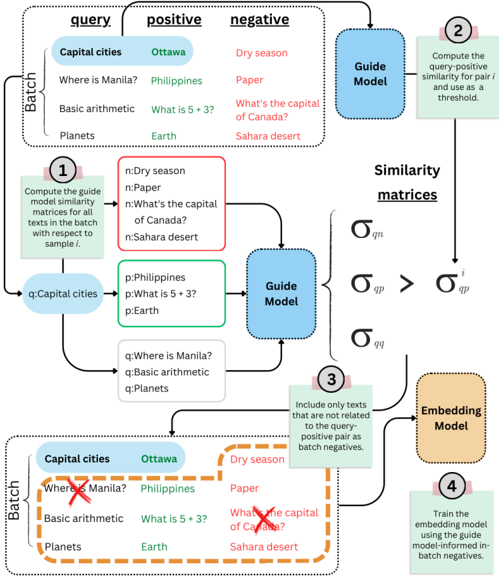
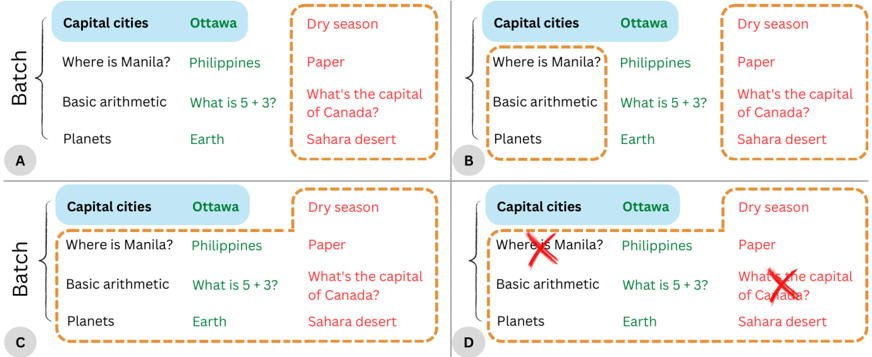
Embedding models are integral to AI applications like semantic search, personalized recommendations, and retrieval augmented generation for LLMs, necessitating high-quality training data. However, the limited scalability of manual data curation prompts the need for automated methods to ensure data integrity. Traditional unsupervised triplet mining automates training data generation, crucial for embedding model training, yet inadvertently injects biases and noise, thereby degrading model performance. Addressing this, we introduce GISTEmbed, a novel strategy that enhances in-batch negative selection during contrastive training through a guide model. This approach departs from reliance on random sampling and equal utility assumption of batch negatives, significantly reducing noise from data quality issues and improving model fine-tuning. Benchmarked against the Massive Text Embedding Benchmark (MTEB), GISTEmbed showcases consistent performance improvements across various model sizes and achieves state-of-the-art results in select categories. This framework enables significant enhancements for smaller models by leveraging the capabilities of powerful yet resource-intensive large models. GISTEmbed can potentially revolutionize the creation of highly efficient, smaller models, democratizing access to advanced AI technologies. Making these technologies more accessible and cost-effective, especially for applications constrained by resources, significantly expands the impact and accessibility of state-of-the-art AI solutions across diverse sectors.
Overview
The claims and statistics of this paper haven’t been checked yet.
Run the check — free, no account needed. It reads the open-access text and checks the sources it cites.
Integrity signals
Registry
Cites
Statistics
Figures
Verification
Claims the paper makes
The claims and statistics of this paper haven’t been checked yet.
Run the check — free, no account needed. It reads the open-access text and checks the sources it cites.
Claims other papers make about this one
Each is checked against this paper’s own text: does it say what the citing paper says it does?
In the citing paper
“We tuned our retrieval setup by optimizing ranking over a dev set of 500 synthetic queries (see Appendix C) and the top 1000 passages for each based on GIST embedding distance (Solatorio, 2024).”
From Ai2 Scholar QA: Organized Literature Synthesis with Attribution (2025) · cites this paper as Solatorio, 2024
Self-check
Percentages, sums and reported differences re-computed from the paper’s own numbers.
The self-check needs the paper’s full text.
Citations
Cites
MTEB: Massive Text Embedding Benchmark
Muennighoff, N., Tazi, N., Magne, L., & Reimers, N. (2023) · Proceedings of the 17th Conference of the European Chapter of the Association for Computational Linguistics · doi:10.18653/v1/2023.eacl-main.148 · Cited by 548
C-Pack: Packed Resources For General Chinese Embeddings
Xiao, S., Liu, Z., Zhang, P., Muennighoff, N., Lian, D., & Nie, J.-Y. (2023) · arXiv · doi:10.48550/arxiv.2309.07597 · Cited by 514
Research works printed but not linked: 29
- Cao, R., Wang, Y., Liang, Y., Gao, L., Zheng, J., Ren, J., and Wang, Z. Exploring the impact of negative samples of contrastive learning: A case study of sentence embedding. arXiv preprint arXiv:2202.13093, 2022. URL https: //arxiv.org/abs/2202.13093. · arXiv
- Chan, C.-M., Chen, W., Su, Y., Yu, J., Xue, W., Zhang, S., Fu, J., and Liu, Z. Chateval: Towards better llm- based evaluators through multi-agent debate, 2023. URL https://arxiv.org/abs/2308.07201. · arXiv
- Cheng, Q., Yang, X., Sun, T., Li, L., and Qiu, X. Improv- ing contrastive learning of sentence embeddings from ai feedback. arXiv preprint arXiv:2305.01918, 2023. URL https://arxiv.org/abs/2305.01918. · arXiv
- Gao, T., Yao, X., and Chen, D. SimCSE: Simple con- trastive learning of sentence embeddings. In Moens, M.-F., Huang, X., Specia, L., and Yih, S. W.-t. (eds.), Proceedings of the 2021 Conference on Empirical Meth- ods in Natural Language Processing, pp. 6894-6910, Online and Punta Cana, Dominican Republic, November 2021. Association for Computational Linguistics. doi: 10.18653/v1/2021.emnlp-main.552. URL https:// aclanthology.org/2021.emnlp-main.552. · DOI · Paper page
- Henderson, M., Al-Rfou, R., Strope, B., Sung, Y.-H., Lukács, L., Guo, R., Kumar, S., Miklos, B., and Kurzweil, R. Efficient natural language response suggestion for smart reply. arXiv preprint arXiv:1705.00652, 2017. URL https://arxiv.org/abs/1705.00652. · arXiv
- Hill, F., Cho, K., and Korhonen, A. Learning distributed representations of sentences from unlabelled data. In Knight, K., Nenkova, A., and Rambow, O. (eds.), Pro- ceedings of the 2016 Conference of the North American Chapter of the Association for Computational Linguis- tics: Human Language Technologies, pp. 1367-1377, San Diego, California, June 2016. Association for Computa- tional Linguistics. doi: 10.18653/v1/N16-1162. URL https://aclanthology.org/N16-1162. · DOI · Paper page
- Huang, J., Tang, D., Zhong, W., Lu, S., Shou, L., Gong, M., Jiang, D., and Duan, N. Whiteningbert: An easy unsupervised sentence embedding approach. arXiv preprint arXiv:2104.01767, 2021. URL https:// arxiv.org/abs/2104.01767. · arXiv
- Huang, J., Gu, S., Hou, L., Wu, Y., Wang, X., Yu, H., and Han, J. Large language models can self-improve. In Bouamor, H., Pino, J., and Bali, K. (eds.), Proceedings of the 2023 Conference on Empirical Methods in Natural Language Processing, pp. 1051-1068, Singapore, De- cember 2023. Association for Computational Linguistics. doi: 10.18653/v1/2023.emnlp-main.67. URL https: //aclanthology.org/2023.emnlp-main.67. · DOI · Paper page
- Karpukhin, V., Oguz, B., Min, S., Lewis, P., Wu, L., Edunov, S., Chen, D., and Yih, W.-t. Dense passage retrieval for open-domain question answering. arXiv preprint arXiv:2004.04906, 2020. URL https:// arxiv.org/abs/2004.04906. · arXiv
- Kiros, R., Zhu, Y., Salakhutdinov, R. R., Zemel, R., Urtasun, R., Torralba, A., and Fidler, S. Skip-thought vectors. In Cortes, C., Lawrence, N., Lee, D., Sugiyama, M., and Garnett, R. (eds.), Advances in Neural Information Processing Systems, volume 28.
- Curran Associates, Inc., 2015. URL https://proceedings.neurips. cc/paper_files/paper/2015/file/ f442d33fa06832082290ad8544a8da27-Paper. pdf.
- Lewis, P., Perez, E., Piktus, A., Petroni, F., Karpukhin, V., Goyal, N., Küttler, H., Lewis, M., Yih, W.-t., Rocktäschel, T., et al. Retrieval-augmented generation for knowledge- intensive nlp tasks. Advances in Neural Information Pro- cessing Systems, 33:9459-9474, 2020.
- Li, X. and Li, J. Angle-optimized text embeddings. arXiv preprint arXiv:2309.12871, 2023. URL https:// arxiv.org/abs/2309.12871. · arXiv
- Li, X., Li, Z., Li, J., Xie, H., and Li, Q. 2d matryoshka sentence embeddings. arXiv preprint arXiv:2402.14776, 2024. URL https://arxiv.org/abs/2402. 14776. · arXiv
- Li, Z., Zhang, X., Zhang, Y., Long, D., Xie, P., and Zhang, M. Towards general text embeddings with multi-stage contrastive learning. arXiv preprint arXiv:2308.03281, 2023. URL https://arxiv.org/abs/2308. 03281. · arXiv
- Ma, X., Wang, Z., Ng, P., Nallapati, R., and Xiang, B. Universal text representation from bert: An empirical study. arXiv preprint arXiv:1910.07973, 2019. URL https://arxiv.org/abs/1910.07973. · arXiv
- Mikolov, T., Chen, K., Corrado, G., and Dean, J. Effi- cient estimation of word representations in vector space. arXiv preprint arXiv:1301.3781, 2013. URL https: //arxiv.org/abs/1301.3781. · arXiv
- Muennighoff, N. Sgpt: Gpt sentence embeddings for se- mantic search. arXiv preprint arXiv:2202.08904, 2022. URL https://arxiv.org/abs/2202.08904. · arXiv
- Ni, J., Qu, C., Lu, J., Dai, Z., Ábrego, G. H., Ma, J., Zhao, V. Y., Luan, Y., Hall, K. B., Chang, M.-W., et al. Large dual encoders are generalizable retriev- ers. arXiv preprint arXiv:2112.07899, 2021. URL https://arxiv.org/abs/2112.07899. · arXiv
- Okura, S., Tagami, Y., Ono, S., and Tajima, A. Embedding- based news recommendation for millions of users. In Proceedings of the 23rd ACM SIGKDD international conference on knowledge discovery and data mining, pp. 1933-1942, 2017.
- Oord, A. v. d., Li, Y., and Vinyals, O. Representa- tion learning with contrastive predictive coding. arXiv preprint arXiv:1807.03748, 2018. URL https:// arxiv.org/abs/1807.03748. · arXiv
- Reimers, N. and Gurevych, I. Sentence-bert: Sentence em- beddings using siamese bert-networks. arXiv preprint arXiv:1908.10084, 2019. URL https://arxiv. org/abs/1908.10084. · arXiv
- Rosenberg, A. and Hirschberg, J. V-measure: A conditional entropy-based external cluster evaluation measure. In Proceedings of the 2007 joint conference on empirical methods in natural language processing and computa- tional natural language learning (EMNLP-CoNLL), pp. 410-420, 2007.
- Su, H., Shi, W., Kasai, J., Wang, Y., Hu, Y., Ostendorf, M., Yih, W.-t., Smith, N. A., Zettlemoyer, L., and Yu, T. One embedder, any task: Instruction-finetuned text em- beddings. 2022. URL https://arxiv.org/abs/ 2212.09741.
- Wu, X., Gao, C., Zang, L., Han, J., Wang, Z., and Hu, S. ES- imCSE: Enhanced sample building method for contrastive learning of unsupervised sentence embedding. In Calzo- lari, N., Huang, C.-R., Kim, H., Pustejovsky, J., Wanner, L., Choi, K.-S., Ryu, P.-M., Chen, H.-H., Donatelli, L., Ji, H., Kurohashi, S., Paggio, P., Xue, N., Kim, S., Hahm, Y., He, Z., Lee, T. K., Santus, E., Bond, F., and Na, S.-H. (eds.), Proceedings of the 29th International Conference on Computational Linguistics, pp. 3898-3907, Gyeongju, Republic of Korea, October 2022. International Com- mittee on Computational Linguistics. URL https: //aclanthology.org/2022.coling-1.342.
- Xu, L., Xie, H., Li, Z., Wang, F. L., Wang, W., and Li, Q. Contrastive learning models for sentence representations. ACM Transactions on Intelligent Systems and Technology, 14(4):1-34, 2023.
- Yan, Y., Li, R., Wang, S., Zhang, F., Wu, W., and Xu, W. ConSERT: A contrastive framework for self-supervised sentence representation transfer. In Zong, C., Xia, F., Li, W., and Navigli, R. (eds.), Proceedings of the 59th Annual Meeting of the Association for Computational Linguistics and the 11th International Joint Conference on Natu- ral Language Processing (Volume 1: Long Papers), pp. 5065-5075, Online, August 2021. Association for Com- putational Linguistics. doi: 10.18653/v1/2021.acl-long. 393. URL https://aclanthology.org/2021. acl-long.393. · DOI
- Zhang, P., Xiao, S., Liu, Z., Dou, Z., and Nie, J.-Y. Retrieve anything to augment large language models. arXiv preprint arXiv:2310.07554, 2023. URL https: //arxiv.org/abs/2310.07554. · arXiv
- Zhou, K., Zhang, B., Zhao, X., and Wen, J.-R. Debi- ased contrastive learning of unsupervised sentence repre- sentations. In Muresan, S., Nakov, P., and Villavicen- cio, A. (eds.), Proceedings of the 60th Annual Meet- ing of the Association for Computational Linguistics (Volume 1: Long Papers), pp. 6120-6130, Dublin, Ire- land, May 2022. Association for Computational Linguis- tics. doi: 10.18653/v1/2022.acl-long.423. URL https: //aclanthology.org/2022.acl-long.423. · DOI
Cited by
Retrieval augmented generation for large language models in healthcare: A systematic review
Amugongo, L. M., Mascheroni, P., Brooks, S., Doering, S., & Seidel, J. (2025) · PLOS Digital Health · doi:10.1371/journal.pdig.0000877 · Cited by 267
Ai2 Scholar QA: Organized Literature Synthesis with Attribution
Singh, A., Chang, J. C., Haddad, D., Naik, A., Hwang, J. D., Kinney, R., Weld, D. S., Downey, D., & Feldman, S. (2025) · Proceedings of the 63rd Annual Meeting of the Association for Computational Linguistics (Volume 3: System Demonstrations) · doi:10.18653/v1/2025.acl-demo.49 · Cited by 19
What Makes In-Context Examples Effective for Code Generation?
Li, D., Chen, S., Cao, J., & Cheung, S.-C. (2026) · Proceedings of the ACM on Software Engineering · doi:10.1145/3832275
Metadata
- Authors
- Solatorio, A. V.
- Venue
- arXiv
- Publisher
- arXiv
- Published
- 2024
- arXiv
- 2402.16829
- References
- 2
- Type
- Preprint
About these checks
Registry, retraction, Cites and statistics results are computed, not judged, with one exception: a printed reference that no index lists is read once by a model before it counts as a citation error. Claims are extracted by a model and kept only when their quote appears verbatim in the text; each cited source is then checked, with a model’s help, for whether it says what the claim relies on. Those verdicts can be wrong — read the claim’s quote and the cited source before relying on one.
Statistics and arithmetic are recomputed, not judged.
Confidence bands are shown only for fields calibrated on our annotated test set. None is calibrated yet, so no band is shown.
What counts as a claim ›How we measure confidence ›How we check this ›
Are you an author, or do you see a problem with this page? Request a review
How to cite
Cite CoChat for the checks on this page, and the paper for its own findings.
- This page
- CoChat. (2026). Citation check: GISTEmbed: Guided In-sample Selection of Training Negatives for Text Embedding Fine-tuning. https://app.cochat.ai/papers/10.48550/arxiv.2402.16829
- The paper
- Solatorio, A. V. (2024). GISTEmbed: Guided In-sample Selection of Training Negatives for Text Embedding Fine-tuning. arXiv. https://doi.org/10.48550/arxiv.2402.16829
