

The DOI matches its DataCite record; 4 of the 4 references it cites were found in a registry or an index.
Data Mixing Laws: Optimizing Data Mixtures by Predicting Language Modeling Performance
Open accessAbstract
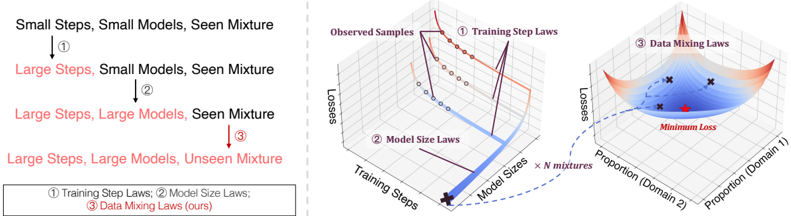
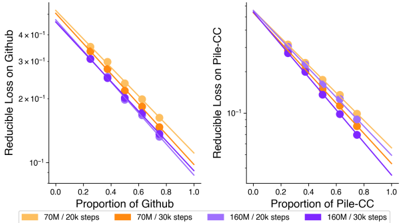
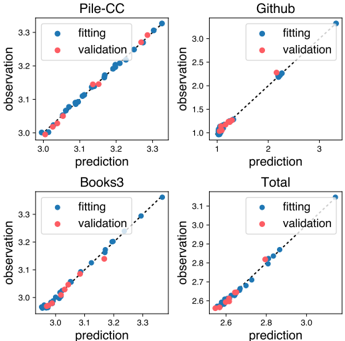
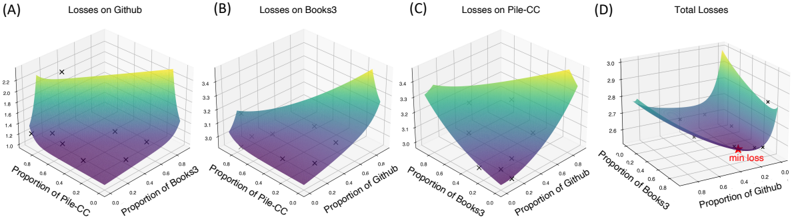
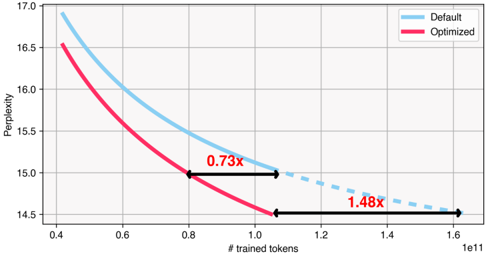
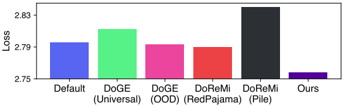
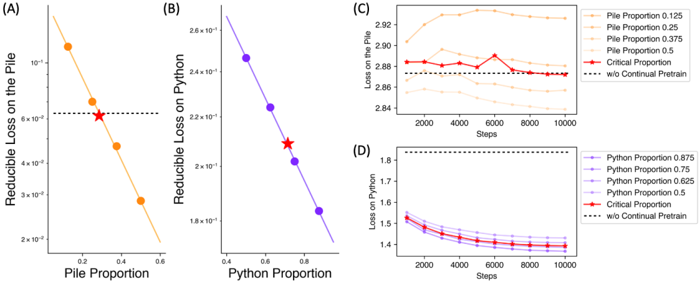
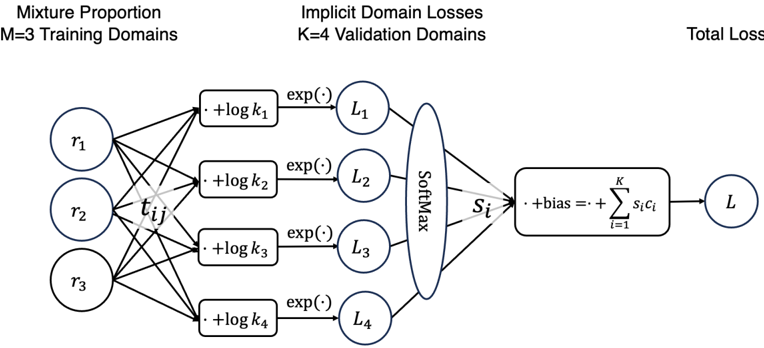
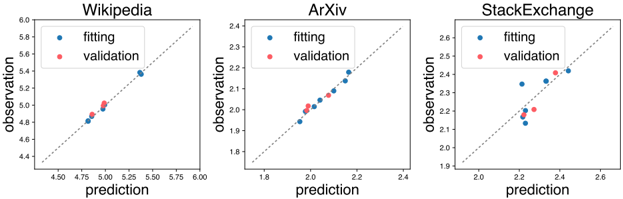
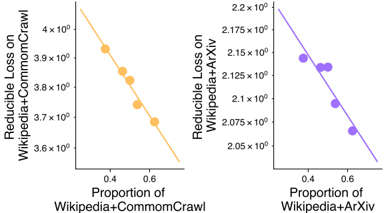
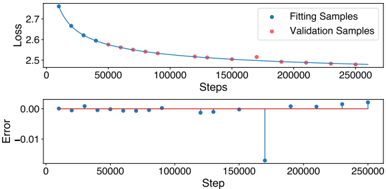
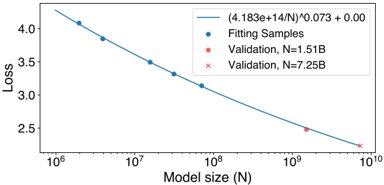
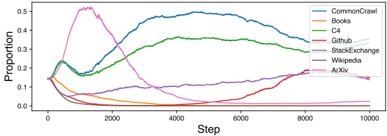
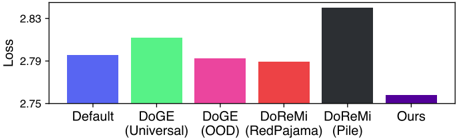
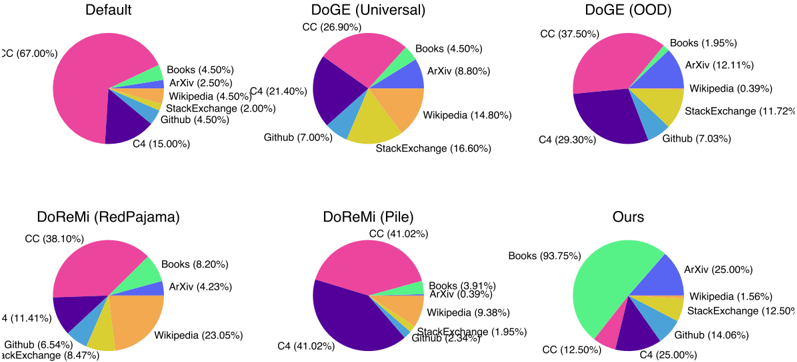
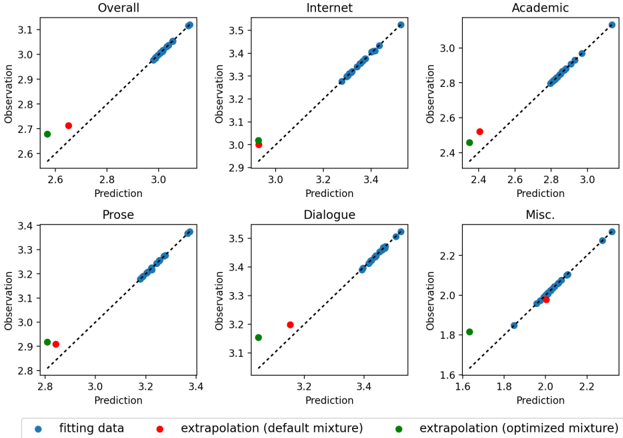
Pretraining data of large language models composes multiple domains (e.g., web texts, academic papers, codes), whose mixture proportions crucially impact the competence of outcome models. While existing endeavors rely on heuristics or qualitative strategies to tune the proportions, we discover the quantitative predictability of model performance regarding the mixture proportions in function forms, which we refer to as the data mixing laws. Fitting such functions on sample mixtures unveils model performance on unseen mixtures before actual runs, thus guiding the selection of an ideal data mixture. Furthermore, we propose nested use of the scaling laws of training steps, model sizes, and our data mixing law to enable predicting the performance of large models trained on massive data under various mixtures with only small-scale training. Moreover, experimental results verify that our method effectively optimizes the training mixture of a 1B model trained for 100B tokens in RedPajama, reaching a performance comparable to the one trained for 48% more steps on the default mixture. Extending the application of data mixing laws to continual training accurately predicts the critical mixture proportion that avoids catastrophic forgetting and outlooks the potential for dynamic data schedules
Overview
The claims and statistics of this paper haven’t been checked yet.
Run the check — free, no account needed. It reads the open-access text and checks the sources it cites.
Integrity signals
Registry
Cites
Statistics
Figures

Verification
Claims the paper makes
The claims and statistics of this paper haven’t been checked yet.
Run the check — free, no account needed. It reads the open-access text and checks the sources it cites.
Claims other papers make about this one
Each is checked against this paper’s own text: does it say what the citing paper says it does?
In the citing paper
“The correctness of scaling laws was first proposed in language modeling field and then validated in many other areas, including data mixture scaling laws [26], multimodal scaling laws [27], and scaling laws specific to information retrieval [28].”
From Foundations of GenIR (2025) · cites this paper as [26]
Self-check
Percentages, sums and reported differences re-computed from the paper’s own numbers.
The self-check needs the paper’s full text.
Citations
Cites
Scaling Laws for Neural Language Models
Kaplan, J., McCandlish, S., Henighan, T., Brown, T. B., Chess, B., Child, R., Gray, S., Radford, A., Wu, J., & Amodei, D. (2020) · arXiv · doi:10.48550/arxiv.2001.08361 · Cited by 9,550 · cited 5×
“Kaplan et al. (2020); Hoffmann et al. (2022); Henighan et al. (2020) conduct more comprehensive investigations on Transformer architecture (Vaswani et al., 2017), further highlighting the power-law relationship on test loss regarding model sizes, the amount of training data and computation across…”
BackgroundMethodInfluentialLLaMA: Open and Efficient Foundation Language Models
Touvron, H., Lavril, T., Izacard, G., Martinet, X., Lachaux, M.-A., Lacroix, T., Rozière, B., Goyal, N., Hambro, E., Azhar, F., et al. (2023) · arXiv · doi:10.48550/arxiv.2302.13971 · Cited by 4,602
Jiang, A. Q., Sablayrolles, A., Mensch, A., Bamford, C., Chaplot, D. S., Casas, D. D. L., Bressand, F., Lengyel, G., Lample, G., Saulnier, L., et al. (2023) · arXiv · doi:10.48550/arxiv.2310.06825 · Cited by 340
Chinchilla Scaling: A replication attempt
Besiroglu, T., Erdil, E., Barnett, M., & You, J. (2024) · arXiv · doi:10.48550/arxiv.2404.10102 · Cited by 1
Research works printed but not linked: 65
- Ibrahim M Alabdulmohsin, Behnam Neyshabur, and Xiaohua Zhai. Revisiting neural scaling laws in language and vision. Advances in Neural Information Processing Systems, 35: 22300-22312, 2022.
- Alon Albalak, Liangming Pan, Colin Raffel, and William Yang Wang. Efficient online data mixing for language model pre-training. arXiv preprint arXiv:2312.02406, 2023. · arXiv
- Shun-ichi Amari, Naotake Fujita, and Shigeru Shinomoto. Four types of learning curves. Neural Computation, 4(4):605-618, 1992.
- Yasaman Bahri, Ethan Dyer, Jared Kaplan, Jaehoon Lee, and Utkarsh Sharma. Explaining neural scaling laws. arXiv preprint arXiv:2102.06701, 2021. · arXiv
- Jinze Bai, Shuai Bai, Yunfei Chu, Zeyu Cui, Kai Dang, Xiaodong Deng, Yang Fan, Wenbin Ge, Yu Han, Fei Huang, et al. Qwen technical report. arXiv preprint arXiv:2309.16609, 2023. · arXiv
- Xiao Bi, Deli Chen, Guanting Chen, Shanhuang Chen, Damai Dai, Chengqi Deng, Honghui Ding, Kai Dong, Qiushi Du, Zhe Fu, et al. Deepseek llm: Scaling open-source language models with longtermism. arXiv preprint arXiv:2401.02954, 2024. · arXiv
- Stella Biderman, Hailey Schoelkopf, Quentin Gregory Anthony, Herbie Bradley, Kyle O'Brien, Eric Hallahan, Mohammad Aflah Khan, Shivanshu Purohit, USVSN Sai Prashanth, Edward Raff, et al. Pythia: A suite for analyzing large language models across training and scaling. In International Conference on Machine Learning, pp. 2397-2430.
- PMLR, 2023.
- Christopher Bishop. Pattern recognition and machine learning. Springer google schola, 2:5-43, 2006.
- Tom Brown, Benjamin Mann, Nick Ryder, Melanie Subbiah, Jared D Kaplan, Prafulla Dhariwal, Arvind Neelakantan, Pranav Shyam, Girish Sastry, Amanda Askell, et al. Language models are few-shot learners. Advances in neural information processing systems, 33:1877-1901, 2020.
- Ethan Caballero, Kshitij Gupta, Irina Rish, and David Krueger. Broken neural scaling laws. arXiv preprint arXiv:2210.14891, 2022. · arXiv
- Daoyuan Chen, Yilun Huang, Zhijian Ma, Hesen Chen, Xuchen Pan, Ce Ge, Dawei Gao, Yuexiang Xie, Zhaoyang Liu, Jinyang Gao, Yaliang Li, Bolin Ding, and Jingren Zhou. Data-juicer: A one-stop data processing system for large language models. In International Conference on Management of Data, 2024a.
- Mayee Chen, Nicholas Roberts, Kush Bhatia, Jue Wang, Ce Zhang, Frederic Sala, and Christopher Ré. Skill-it! a data-driven skills framework for understanding and training language models. Advances in Neural Information Processing Systems, 36, 2024b.
- Ian Connick Covert, Wenlong Ji, Tatsunori Hashimoto, and James Zou. Scaling laws for the value of individual data points in machine learning. In Forty-first International Conference on Machine Learning.
- Sumanth Doddapaneni, Gowtham Ramesh, Mitesh M Khapra, Anoop Kunchukuttan, and Pratyush Kumar. A primer on pretrained multilingual language models. arXiv preprint arXiv:2107.00676, 2021. · arXiv
- Nan Du, Yanping Huang, Andrew M Dai, Simon Tong, Dmitry Lepikhin, Yuanzhong Xu, Maxim Krikun, Yanqi Zhou, Adams Wei Yu, Orhan Firat, et al. Glam: Efficient scaling of language models with mixture-of-experts. In International Conference on Machine Learning, pp. 5547-5569. PMLR, 2022.
- Elias Frantar, Carlos Riquelme, Neil Houlsby, Dan Alistarh, and Utku Evci. Scaling laws for sparsely-connected foundation models. arXiv preprint arXiv:2309.08520, 2023. · arXiv
- Robert M French. Catastrophic forgetting in connectionist networks. Trends in cognitive sciences, 3(4):128-135, 1999.
- Paul Friedl. Dis/similarities in the design and development of legal and algorithmic normative systems: the case of perspective api. Law, Innovation and Technology, 15(1):25-59, 2023.
- Leo Gao, Stella Biderman, Sid Black, Laurence Golding, Travis Hoppe, Charles Foster, Jason Phang, Horace He, Anish Thite, Noa Nabeshima, et al. The pile: An 800gb dataset of diverse text for language modeling. arXiv preprint arXiv:2101.00027, 2020. · arXiv
- Sachin Goyal, Pratyush Maini, Zachary C Lipton, Aditi Raghunathan, and J Zico Kolter. Scaling laws for data filtering-data curation cannot be compute agnostic. In Proceedings of the IEEE/CVF Conference on Computer Vision and Pattern Recognition, pp. 22702-22711, 2024.
- Yuxian Gu, Li Dong, Yaru Hao, Qingxiu Dong, Minlie Huang, and Furu Wei. Towards optimal learning of language models. arXiv preprint arXiv:2402.17759, 2024. · arXiv
- Shangmin Guo, Yi Ren, Stefano V Albrecht, and Kenny Smith. Sample relationship from learning dynamics matters for generalisation. arXiv preprint arXiv:2401.08808, 2024. · arXiv
- Suchin Gururangan, Ana Marasović, Swabha Swayamdipta, Kyle Lo, Iz Beltagy, Doug Downey, and Noah A Smith. Don't stop pretraining: Adapt language models to domains and tasks. arXiv preprint arXiv:2004.10964, 2020. · arXiv
- Suchin Gururangan, Margaret Li, Mike Lewis, Weijia Shi, Tim Althoff, Noah A Smith, and Luke Zettlemoyer. Scaling expert language models with unsupervised domain discovery. arXiv preprint arXiv:2303.14177, 2023. · arXiv
- Tatsunori Hashimoto. Model performance scaling with multiple data sources. In International Conference on Machine Learning, pp. 4107-4116. PMLR, 2021.
- David Haussler. Quantifying inductive bias: Ai learning algorithms and valiant's learning framework. Artificial intelligence, 36(2):177-221, 1988.
- Tom Henighan, Jared Kaplan, Mor Katz, Mark Chen, Christopher Hesse, Jacob Jackson, Heewoo Jun, Tom B Brown, Prafulla Dhariwal, Scott Gray, et al. Scaling laws for autore- gressive generative modeling. arXiv preprint arXiv:2010.14701, 2020. · arXiv
- Danny Hernandez, Jared Kaplan, Tom Henighan, and Sam McCandlish. Scaling laws for transfer. arXiv preprint arXiv:2102.01293, 2021. · arXiv
- Joel Hestness, Sharan Narang, Newsha Ardalani, Gregory Diamos, Heewoo Jun, Hassan Kianinejad, Md Mostofa Ali Patwary, Yang Yang, and Yanqi Zhou. Deep learning scaling is predictable, empirically. arXiv preprint arXiv:1712.00409, 2017. · arXiv
- Jordan Hoffmann, Sebastian Borgeaud, Arthur Mensch, Elena Buchatskaya, Trevor Cai, Eliza Rutherford, Diego de Las Casas, Lisa Anne Hendricks, Johannes Welbl, Aidan Clark, et al. Training compute-optimal large language models. arXiv preprint arXiv:2203.15556, 2022. · arXiv
- Kurt Hornik, Maxwell Stinchcombe, and Halbert White. Multilayer feedforward networks are universal approximators. Neural networks, 2(5):359-366, 1989.
- Marcus Hutter. Learning curve theory. arXiv preprint arXiv:2102.04074, 2021. · arXiv
- Feiyang Kang, Yifan Sun, Bingbing Wen, Si Chen, Dawn Song, Rafid Mahmood, and Ruoxi Jia. Autoscale: Automatic prediction of compute-optimal data composition for training llms. arXiv preprint arXiv:2407.20177, 2024. · arXiv
- James Kirkpatrick, Razvan Pascanu, Neil Rabinowitz, Joel Veness, Guillaume Desjardins, Andrei A Rusu, Kieran Milan, John Quan, Tiago Ramalho, Agnieszka Grabska-Barwinska, et al. Overcoming catastrophic forgetting in neural networks. Proceedings of the national academy of sciences, 114(13):3521-3526, 2017.
- Aran Komatsuzaki, Joan Puigcerver, James Lee-Thorp, Carlos Riquelme Ruiz, Basil Mustafa, Joshua Ainslie, Yi Tay, Mostafa Dehghani, and Neil Houlsby. Sparse upcycling: Training mixture-of-experts from dense checkpoints. arXiv preprint arXiv:2212.05055, 2022. · arXiv
- Raymond Li, Loubna Ben Allal, Yangtian Zi, Niklas Muennighoff, Denis Kocetkov, Cheng- hao Mou, Marc Marone, Christopher Akiki, Jia Li, Jenny Chim, et al. Starcoder: may the source be with you! arXiv preprint arXiv:2305.06161, 2023. · arXiv
- Qian Liu, Xiaosen Zheng, Niklas Muennighoff, Guangtao Zeng, Longxu Dou, Tianyu Pang, Jing Jiang, and Min Lin. Regmix: Data mixture as regression for language model pre-training. arXiv preprint arXiv:2407.01492, 2024. · arXiv
- Xiaoran Liu, Hang Yan, Chenxin An, Xipeng Qiu, and Dahua Lin. Scaling laws of rope-based extrapolation. In The Twelfth International Conference on Learning Representations, 2023.
- Shayne Longpre, Gregory Yauney, Emily Reif, Katherine Lee, Adam Roberts, Barret Zoph, Denny Zhou, Jason Wei, Kevin Robinson, David Mimno, et al. A pretrainer's guide to training data: Measuring the effects of data age, domain coverage, quality, & toxicity. arXiv preprint arXiv:2305.13169, 2023. · arXiv
- Yun Luo, Zhen Yang, Fandong Meng, Yafu Li, Jie Zhou, and Yue Zhang. An empirical study of catastrophic forgetting in large language models during continual fine-tuning. arXiv preprint arXiv:2308.08747, 2023. · arXiv
- Roger Mead. The design of experiments: statistical principles for practical applications. Cambridge university press, 1990.
- Eric Michaud, Ziming Liu, Uzay Girit, and Max Tegmark. The quantization model of neural scaling. Advances in Neural Information Processing Systems, 36, 2024.
- S ören Mindermann, Jan M Brauner, Muhammed T Razzak, Mrinank Sharma, Andreas Kirsch, Winnie Xu, Benedikt H öltgen, Aidan N Gomez, Adrien Morisot, Sebastian Far- quhar, et al. Prioritized training on points that are learnable, worth learning, and not yet learnt. In International Conference on Machine Learning, pp. 15630-15649. PMLR, 2022.
- Niklas Muennighoff, Alexander Rush, Boaz Barak, Teven Le Scao, Nouamane Tazi, Aleksan- dra Piktus, Sampo Pyysalo, Thomas Wolf, and Colin A Raffel. Scaling data-constrained language models. Advances in Neural Information Processing Systems, 36, 2024.
- OpenAI. Gpt-4 technical report. arXiv preprint arXiv:2303.08774, 2023. · arXiv
- Guilherme Penedo, Quentin Malartic, Daniel Hesslow, Ruxandra Cojocaru, Alessandro Cappelli, Hamza Alobeidli, Baptiste Pannier, Ebtesam Almazrouei, and Julien Launay. The refinedweb dataset for falcon llm: outperforming curated corpora with web data, and web data only. arXiv preprint arXiv:2306.01116, 2023. · arXiv
- Tomer Porian, Mitchell Wortsman, Jenia Jitsev, Ludwig Schmidt, and Yair Carmon. Re- solving discrepancies in compute-optimal scaling of language models. arXiv preprint arXiv:2406.19146, 2024. · arXiv
- Jack W Rae, Sebastian Borgeaud, Trevor Cai, Katie Millican, Jordan Hoffmann, Francis Song, John Aslanides, Sarah Henderson, Roman Ring, Susannah Young, et al. Scaling language models: Methods, analysis & insights from training gopher. arXiv preprint arXiv:2112.11446, 2021. · arXiv
- Colin Raffel, Noam Shazeer, Adam Roberts, Katherine Lee, Sharan Narang, Michael Matena, Yanqi Zhou, Wei Li, and Peter J Liu. Exploring the limits of transfer learning with a unified text-to-text transformer. The Journal of Machine Learning Research, 21(1):5485-5551, 2020.
- Yunfan Shao, Linyang Li, Zhaoye Fei, Hang Yan, Dahua Lin, and Xipeng Qiu. Balanced data sampling for language model training with clustering. arXiv preprint arXiv:2402.14526, 2024. · arXiv
- Hui Su, Zhi Tian, Xiaoyu Shen, and Xunliang Cai. Unraveling the mystery of scaling laws: Part i. arXiv preprint arXiv:2403.06563, 2024. · arXiv
- Tianxiang Sun, Xiaotian Zhang, Zhengfu He, Peng Li, Qinyuan Cheng, Xiangyang Liu, Hang Yan, Yunfan Shao, Qiong Tang, Shiduo Zhang, Xingjian Zhao, Ke Chen, Yining Zheng, Zhejian Zhou, Ruixiao Li, Jun Zhan, Yunhua Zhou, Linyang Li, Xiaogui Yang, Lingling Wu, Zhangyue Yin, Xuanjing Huang, Yu-Gang Jiang, and Xipeng Qiu. Moss: An open conversational large language model. Machine Intelligence Research, 2024. ISSN 2731-5398. doi: 10.1007/s11633-024-1502-8. URL https://github.com/OpenMOSS/MOSS. · DOI
- Ross Taylor, Marcin Kardas, Guillem Cucurull, Thomas Scialom, Anthony Hartshorn, Elvis Saravia, Andrew Poulton, Viktor Kerkez, and Robert Stojnic. Galactica: A large language model for science. arXiv preprint arXiv:2211.09085, 2022. · arXiv
- Hugo Touvron, Louis Martin, Kevin Stone, Peter Albert, Amjad Almahairi, Yasmine Babaei, Nikolay Bashlykov, Soumya Batra, Prajjwal Bhargava, Shruti Bhosale, et al. Llama 2: Open foundation and fine-tuned chat models. arXiv preprint arXiv:2307.09288, 2023b. · arXiv
- Leslie G Valiant. A theory of the learnable. Communications of the ACM, 27(11):1134-1142, 1984.
- VN Vapnik and A Ya Chervonenkis. On the uniform convergence of relative frequencies of events to their probabilities. Theory of Probability and its Applications, 16(2):264, 1971.
- Ashish Vaswani, Noam Shazeer, Niki Parmar, Jakob Uszkoreit, Llion Jones, Aidan N Gomez, Ł ukasz Kaiser, and Illia Polosukhin. Attention is all you need. In Advances in Neural Information Processing Systems, volume 30.
- Curran Associates, Inc., 2017. URL https://proceedings.neurips.cc/paper_files/paper/2017/file/ 3f5ee243547dee91fbd053c1c4a845aa-Paper.pdf.
- Guillaume Wenzek, Marie-Anne Lachaux, Alexis Conneau, Vishrav Chaudhary, Francisco Guzmán, Armand Joulin, and Edouard Grave. Ccnet: Extracting high quality monolingual datasets from web crawl data. arXiv preprint arXiv:1911.00359, 2019. · arXiv
- Sang Michael Xie, Hieu Pham, Xuanyi Dong, Nan Du, Hanxiao Liu, Yifeng Lu, Percy S Liang, Quoc V Le, Tengyu Ma, and Adams Wei Yu. Doremi: Optimizing data mixtures speeds up language model pretraining. Advances in Neural Information Processing Systems, 36, 2024a.
- Sang Michael Xie, Shibani Santurkar, Tengyu Ma, and Percy S Liang. Data selection for language models via importance resampling. Advances in Neural Information Processing Systems, 36, 2024b.
- Wenhan Xiong, Jingyu Liu, Igor Molybog, Hejia Zhang, Prajjwal Bhargava, Rui Hou, Louis Martin, Rashi Rungta, Karthik Abinav Sankararaman, Barlas Oguz, et al. Effective long-context scaling of foundation models. arXiv preprint arXiv:2309.16039, 2023. · arXiv
- Chunting Zhou, Pengfei Liu, Puxin Xu, Srinivasan Iyer, Jiao Sun, Yuning Mao, Xuezhe Ma, Avia Efrat, Ping Yu, Lili Yu, et al. Lima: Less is more for alignment. Advances in Neural Information Processing Systems, 36, 2024.
- Kun Zhou, Yutao Zhu, Zhipeng Chen, Wentong Chen, Wayne Xin Zhao, Xu Chen, Yankai Lin, Ji-Rong Wen, and Jiawei Han. Don't make your llm an evaluation benchmark cheater. arXiv preprint arXiv:2311.01964, 2023. · arXiv
Cited by
Sorted by citations
A Survey of Large Language Models
Zhao, W. X., Zhou, K., Li, J., Tang, T., Dong, Z., Hou, Y., Zhang, B., Min, Y., Zhang, J., Liu, P., et al. (2026) · Frontiers of Computer Science · doi:10.1007/s11704-026-60308-3 · Cited by 2,093
Self-citationAi, Q., Zhan, J., & Liu, Y. (2025) · arXiv · doi:10.48550/arxiv.2501.02842
“The correctness of scaling laws was first proposed in language modeling field and then validated in many other areas, including data mixture scaling laws [26], multimodal scaling laws [27], and scaling laws specific to information retrieval [28].”
Self-citationMergeMix: Optimizing Mid-Training Data Mixtures via Learnable Model Merging
Wang, J., Tian, C., Chen, K., Liu, Z., Mao, J., Zhao, W. X., Zhang, Z., & Zhou, J. (2026) · arXiv · doi:10.48550/arxiv.2601.17858
Metadata
- Authors
- Ye, J., Liu, P., Sun, T., Zhan, J., Zhou, Y., & Qiu, X.
- Affiliations
- Fudan University (CN)
- Shanghai Artificial Intelligence Laboratory (CN)
- Venue
- arXiv
- Publisher
- arXiv
- Published
- 2024
- ISSN
- 2331-8422 (ISSN-L)
- arXiv
- 2403.16952
- OpenAlex
- W4393213783
- Cited by
- 2
- References
- 4
- Citations by year
- 2026: 1 · 2025: 1
- Type
- posted content
- Language
- en
- Open access
- green
- arxiv.org
- Licence
- Locations
- arXiv (Cornell University) (submittedVersion, cc-by-nc-sa)
- arXiv (Cornell University)
- Funders
- Fudan University
- Topics
- Physical Sciences › Computer Science › Artificial Intelligence › Topic Modeling
- Physical Sciences › Computer Science › Artificial Intelligence › Natural Language Processing Techniques
- Physical Sciences › Computer Science › Artificial Intelligence › Domain Adaptation and Few-Shot Learning
- Keywords
- mix proportion optimization, large language models, performance prediction, scaling laws, continuous training, catastrophic forgetting
About these checks
Registry, retraction, Cites and statistics results are computed, not judged, with one exception: a printed reference that no index lists is read once by a model before it counts as a citation error. Claims are extracted by a model and kept only when their quote appears verbatim in the text; each cited source is then checked, with a model’s help, for whether it says what the claim relies on. Those verdicts can be wrong — read the claim’s quote and the cited source before relying on one.
Statistics and arithmetic are recomputed, not judged.
Confidence bands are shown only for fields calibrated on our annotated test set. None is calibrated yet, so no band is shown.
What counts as a claim ›How we measure confidence ›How we check this ›
Are you an author, or do you see a problem with this page? Request a review
