

The DOI matches its DataCite record; the references it cites are not checked yet.
Diffusion for World Modeling: Visual Details Matter in Atari
Open accessAbstract
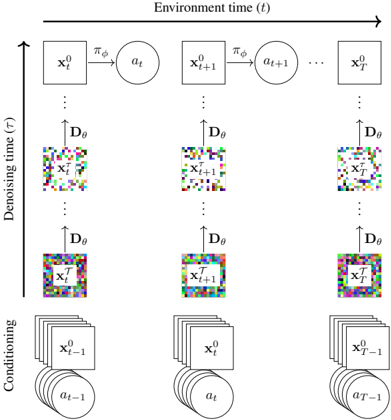
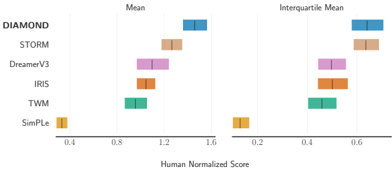
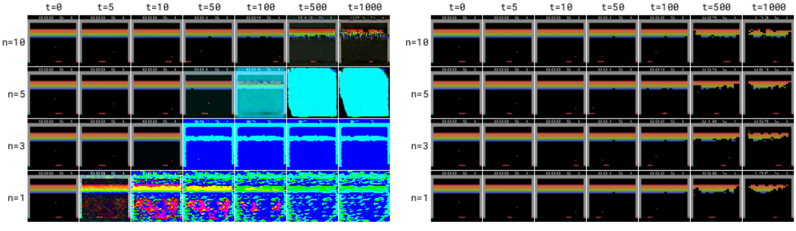
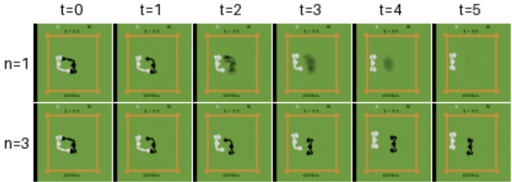
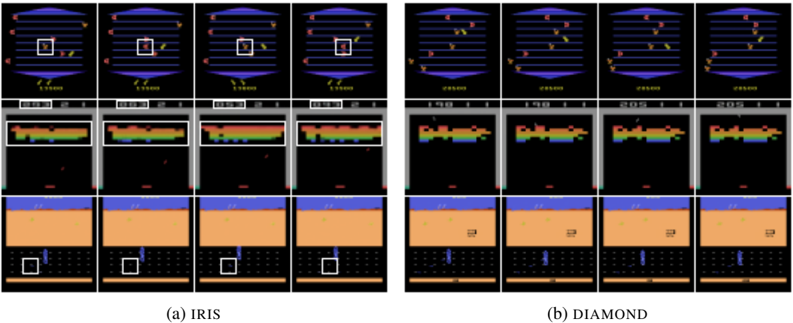
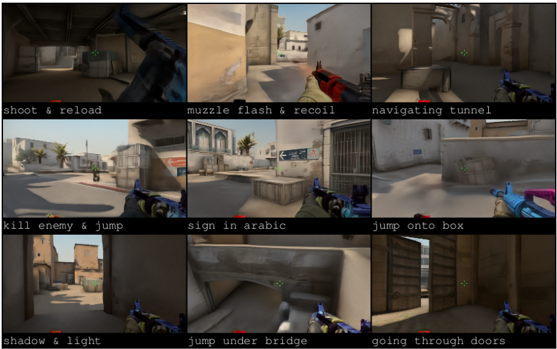
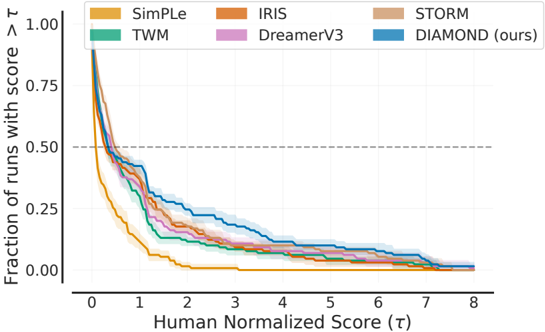
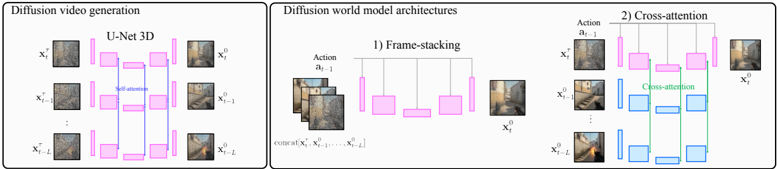
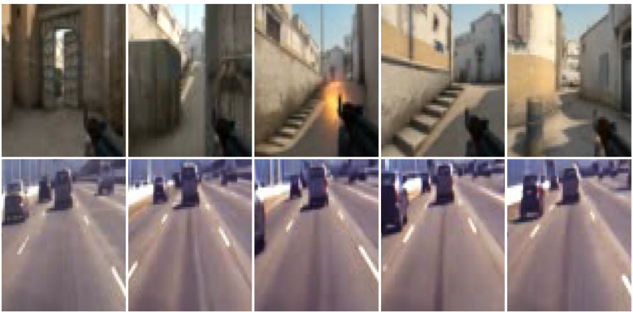
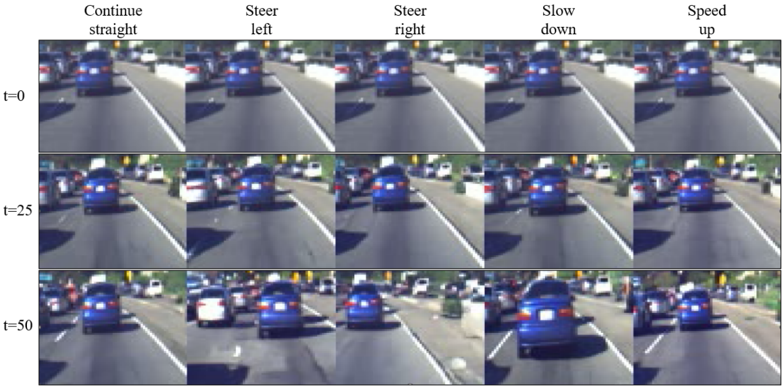
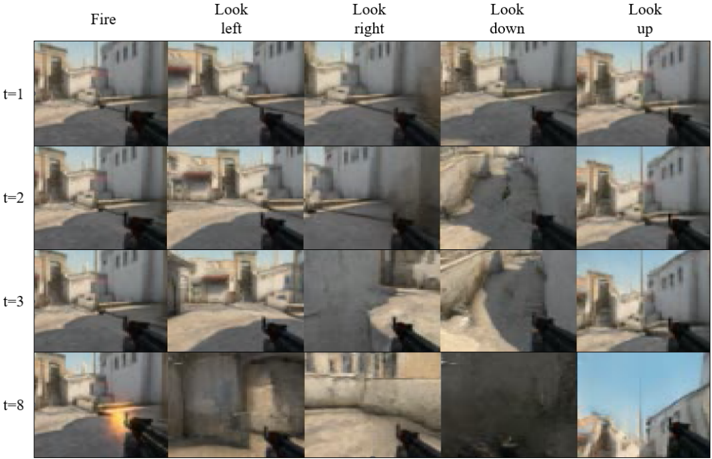
World models constitute a promising approach for training reinforcement learning agents in a safe and sample-efficient manner. Recent world models predominantly operate on sequences of discrete latent variables to model environment dynamics. However, this compression into a compact discrete representation may ignore visual details that are important for reinforcement learning. Concurrently, diffusion models have become a dominant approach for image generation, challenging well-established methods modeling discrete latents. Motivated by this paradigm shift, we introduce DIAMOND (DIffusion As a Model Of eNvironment Dreams), a reinforcement learning agent trained in a diffusion world model. We analyze the key design choices that are required to make diffusion suitable for world modeling, and demonstrate how improved visual details can lead to improved agent performance. DIAMOND achieves a mean human normalized score of 1.46 on the competitive Atari 100k benchmark; a new best for agents trained entirely within a world model. We further demonstrate that DIAMOND's diffusion world model can stand alone as an interactive neural game engine by training on static Counter-Strike: Global Offensive gameplay. To foster future research on diffusion for world modeling, we release our code, agents, videos and playable world models at https://diamond-wm.github.io.
Overview
The claims and statistics of this paper haven’t been checked yet.
Run the check — free, no account needed. It reads the open-access text and checks the sources it cites.
Integrity signals
Registry
Cites
Statistics
Figures
Verification
Claims the paper makes
The claims and statistics of this paper haven’t been checked yet.
Run the check — free, no account needed. It reads the open-access text and checks the sources it cites.
Claims other papers make about this one
Each is checked against this paper’s own text: does it say what the citing paper says it does?
The cited source says what the claim attributes to it.
In the citing paper
“Recent advances such as IRIS (Micheli et al., 2023) and DIAMOND (Alonso et al., 2024) achieve strong performance on the Atari 100k benchmark by learning to predict future observations entirely from experience.”
From What Do World Models Learn in RL? Probing Latent Representations in Learned Environment Simulators (2026) · cites this paper as Alonso et al., 2024
Self-check
Percentages, sums and reported differences re-computed from the paper’s own numbers.
The self-check needs the paper’s full text.
Citations
The citation lists haven’t been fetched yet
Cited by 48
Research works printed but not linked: 83
- Agarwal, R., Schwarzer, M., Castro, P. S., Courville, A. C., and Bellemare, M. (2021). Deep reinforcement learning at the edge of the statistical precipice. Advances in Neural Information Processing Systems, 34:29304-29320.
- Ajay, A., Du, Y., Gupta, A., Tenenbaum, J., Jaakkola, T., and Agrawal, P. (2022). Is conditional generative modeling all you need for decision-making? International Conference on Learning Representations.
- Anderson, B. D. (1982). Reverse-time diffusion equation models. Stochastic Processes and their Applications, 12(3):313-326.
- Bamford, C. and Lucas, S. M. (2020). Neural game engine: Accurate learning of generalizable forward models from pixels. In 2020 IEEE Conference on Games (CoG), pages 81-88. IEEE.
- Bar-Tal, O., Chefer, H., Tov, O., Herrmann, C., Paiss, R., Zada, S., Ephrat, A., Hur, J., Li, Y., Michaeli, T., et al. (2024). Lumiere: A space-time diffusion model for video generation. arXiv preprint arXiv:2401.12945. · arXiv
- Bruce, J., Dennis, M. D., Edwards, A., Parker-Holder, J., Shi, Y., Hughes, E., Lai, M., Mavalankar, A., Steigerwald, R., Apps, C., et al. (2024). Genie: Generative interactive environments. In Forty-first International Conference on Machine Learning.
- Chang, H., Zhang, H., Barber, J., Maschinot, A., Lezama, J., Jiang, L., Yang, M.-H., Murphy, K. P., Freeman, W. T., Rubinstein, M., Li, Y., and Krishnan, D. (2023). Muse: Text-to-image generation via masked generative transformers. In International Conference on Machine Learning, pages 4055-4075.
- PMLR.
- Chang, H., Zhang, H., Jiang, L., Liu, C., and Freeman, W. T. (2022). Maskgit: Masked generative image transformer. In Proceedings of the IEEE/CVF Conference on Computer Vision and Pattern Recognition, pages 11315-11325.
- Çiçek, Ö., Abdulkadir, A., Lienkamp, S. S., Brox, T., and Ronneberger, O. (2016). 3d u-net: learning dense volumetric segmentation from sparse annotation. In Medical Image Computing and Computer-Assisted Intervention-MICCAI 2016: 19th International Conference, Athens, Greece, October 17-21, 2016, Proceedings, Part II 19, pages 424-432. Springer.
- Devlin, J., Chang, M.-W., Lee, K., and Toutanova, K. (2018). Bert: Pre-training of deep bidirectional transformers for language understanding. arXiv preprint arXiv:1810.04805. · arXiv
- Dhariwal, P. and Nichol, A. (2021). Diffusion models beat gans on image synthesis. Advances in Neural Information Processing Systems, 34:8780-8794.
- Ding, Z., Zhang, A., Tian, Y., and Zheng, Q. (2024). Diffusion world model. arXiv preprint arXiv:2402.03570. · arXiv
- Esser, P., Rombach, R., and Ommer, B. (2021). Taming transformers for high-resolution image synthesis. In Proceedings of the IEEE/CVF conference on computer vision and pattern recognition, pages 12873-12883.
- Gers, F. A., Schmidhuber, J., and Cummins, F. (2000). Learning to forget: Continual prediction with LSTM. Neural Computation, 12(10):2451-2471.
- Goodfellow, I., Pouget-Abadie, J., Mirza, M., Xu, B., Warde-Farley, D., Ozair, S., Courville, A., and Bengio, Y. (2014). Generative adversarial nets. Advances in Neural Information Processing Systems, 27.
- Ha, D. and Schmidhuber, J. (2018). Recurrent world models facilitate policy evolution. Advances in Neural Information Processing Systems, 31:2451-2463.
- Hafner, D., Lillicrap, T., Ba, J., and Norouzi, M. (2020). Dream to control: Learning behaviors by latent imagination. In International Conference on Learning Representations.
- Hafner, D., Lillicrap, T. P., Norouzi, M., and Ba, J. (2021). Mastering atari with discrete world models. In International Conference on Learning Representations.
- Hafner, D., Pasukonis, J., Ba, J., and Lillicrap, T. (2023). Mastering diverse domains through world models. arXiv preprint arXiv:2301.04104. · arXiv
- He, K., Zhang, X., Ren, S., and Sun, J. (2015). Deep residual learning for image recognition. arXiv preprint arXiv:1512.03385. · arXiv
- Heusel, M., Ramsauer, H., Unterthiner, T., Nessler, B., and Hochreiter, S. (2017). Gans trained by a two time-scale update rule converge to a local nash equilibrium. Advances in Neural Information Processing Systems, 30.
- Ho, J., Jain, A., and Abbeel, P. (2020). Denoising diffusion probabilistic models. Advances in Neural Information Processing Systems, 33:6840-6851.
- Ho, J., Salimans, T., Gritsenko, A., Chan, W., Norouzi, M., and Fleet, D. J. (2022). Video diffusion models. URL https://arxiv. org/abs/2204.03458.
- Hochreiter, S. and Schmidhuber, J. (1997). Long short-term memory. Neural Computation, 9(8):1735- 1780.
- Hyvärinen, A. (2005). Estimation of non-normalized statistical models by score matching. Journal of Machine Learning Research, 6:695-709.
- Jackson, M. T., Matthews, M. T., Lu, C., Ellis, B., Whiteson, S., and Foerster, J. (2024). Policy-guided diffusion. arXiv preprint arXiv:2404.06356. · arXiv
- Janner, M., Du, Y., Tenenbaum, J., and Levine, S. (2022). Planning with diffusion for flexible behavior synthesis. In International Conference on Machine Learning, pages 9902-9915.
- PMLR.
- Kaiser, L., Babaeizadeh, M., Milos, P., Osinski, B., Campbell, R. H., Czechowski, K., Erhan, D., Finn, C., Kozakowski, P., Levine, S., et al. (2019). Model-based reinforcement learning for atari. arXiv preprint arXiv:1903.00374. · arXiv
- Kaiser, Ł. and Sutskever, I. (2015). Neural gpus learn algorithms. arXiv preprint arXiv:1511.08228. · arXiv
- Kapturowski, S., Ostrovski, G., Quan, J., Munos, R., and Dabney, W. (2018). Recurrent experience replay in distributed reinforcement learning. International Conference on Learning Representa- tions.
- Karras, T., Aittala, M., Aila, T., and Laine, S. (2022). Elucidating the design space of diffusion-based generative models. Advances in Neural Information Processing Systems, 35:26565-26577.
- Kim, S. W., Zhou, Y., Philion, J., Torralba, A., and Fidler, S. (2020). Learning to simulate dynamic environments with gamegan. In Proceedings of the IEEE/CVF Conference on Computer Vision and Pattern Recognition, pages 1231-1240.
- LeCun, Y., Boser, B., Denker, J. S., Henderson, D., Howard, R. E., Hubbard, W., and Jackel, L. D. (1989). Backpropagation applied to handwritten zip code recognition. Neural computation, 1(4):541-551.
- Liang, Z., Mu, Y., Ding, M., Ni, F., Tomizuka, M., and Luo, P. (2023). Adaptdiffuser: Diffusion models as adaptive self-evolving planners. International Conference on Machine Learning.
- Lu, C., Ball, P. J., and Parker-Holder, J. (2023). Synthetic experience replay. arXiv preprint arXiv:2303.06614. · arXiv
- Luo, G., Dunlap, L., Park, D. H., Holynski, A., and Darrell, T. (2023). Diffusion hyperfeatures: Searching through time and space for semantic correspondence. In Advances in Neural Information Processing Systems.
- Micheli, V., Alonso, E., and Fleuret, F. (2023). Transformers are sample-efficient world models. International Conference on Learning Representations.
- Mnih, V., Badia, A. P., Mirza, M., Graves, A., Lillicrap, T., Harley, T., Silver, D., and Kavukcuoglu, K. (2016). Asynchronous methods for deep reinforcement learning. In Balcan, M. F. and Weinberger, K. Q., editors, Proceedings of The 33rd International Conference on Machine Learning, volume 48 of Proceedings of Machine Learning Research, pages 1928-1937, New York, New York, USA.
- Mnih, V., Kavukcuoglu, K., Silver, D., Rusu, A. A., Veness, J., Bellemare, M. G., Graves, A., Riedmiller, M., Fidjeland, A. K., Ostrovski, G., et al. (2015). Human-level control through deep reinforcement learning. Nature, 518(7540):529-533.
- Nichol, A. Q. and Dhariwal, P. (2021). Improved denoising diffusion probabilistic models. Interna- tional Conference on Machine Learning.
- Nuti, F., Franzmeyer, T., and Henriques, J. F. (2023). Extracting reward functions from diffusion models. arXiv preprint arXiv:2306.01804. · arXiv
- Ouyang, L., Wu, J., Jiang, X., Almeida, D., Wainwright, C., Mishkin, P., Zhang, C., Agarwal, S., Slama, K., Ray, A., et al. (2022). Training language models to follow instructions with human feedback. Advances in Neural Information Processing Systems, 35:27730-27744.
- Pearce, T., Rashid, T., Kanervisto, A., Bignell, D., Sun, M., Georgescu, R., Macua, S. V., Tan, S. Z., Momennejad, I., Hofmann, K., and Devlin, S. (2023). Imitating human behaviour with diffusion models. The Eleventh International Conference on Learning Representations.
- Pearce, T. and Zhu, J. (2022). Counter-strike deathmatch with large-scale behavioural cloning. In 2022 IEEE Conference on Games (CoG), pages 104-111. IEEE.
- Peebles, W. and Xie, S. (2023). Scalable diffusion models with transformers. In Proceedings of the IEEE/CVF International Conference on Computer Vision (ICCV), pages 4195-4205.
- Podell, D., English, Z., Lacey, K., Blattmann, A., Dockhorn, T., Müller, J., Penna, J., and Rombach, R. (2023). Sdxl: Improving latent diffusion models for high-resolution image synthesis. arXiv preprint arXiv:2307.01952. · arXiv
- Ramesh, A., Dhariwal, P., Nichol, A., Chu, C., and Chen, M. (2022). Hierarchical text-conditional image generation with clip latents. arXiv preprint arXiv:2204.06125, 1(2):3. · arXiv
- Ramesh, A., Pavlov, M., Goh, G., Gray, S., Voss, C., Radford, A., Chen, M., and Sutskever, I. (2021). Zero-shot text-to-image generation. International Conference on Machine Learning.
- Robine, J., Höftmann, M., Uelwer, T., and Harmeling, S. (2023). Transformer-based world models are happy with 100k interactions. International Conference on Learning Representations.
- Rombach, R., Blattmann, A., Lorenz, D., Esser, P., and Ommer, B. (2022). High-resolution image synthesis with latent diffusion models. In Proceedings of the IEEE/CVF Conference on Computer Vision and Pattern Recognition (CVPR), pages 10684-10695.
- Ronneberger, O., Fischer, P., and Brox, T. (2015). U-net: Convolutional networks for biomedical image segmentation. In Medical Image Computing and Computer-Assisted Intervention-MICCAI 2015: 18th International Conference, Munich, Germany, October 5-9, 2015, Proceedings, Part III 18, pages 234-241. Springer.
- Saharia, C., Chan, W., Saxena, S., Li, L., Whang, J., Denton, E. L., Ghasemipour, K., Gontijo Lopes, R., Karagol Ayan, B., Salimans, T., et al. (2022a). Photorealistic text-to-image diffusion models with deep language understanding. Advances in Neural Information Processing Systems, 35:36479- 36494.
- Saharia, C., Ho, J., Chan, W., Salimans, T., Fleet, D. J., and Norouzi, M. (2022b). Image super- resolution via iterative refinement. IEEE transactions on pattern analysis and machine intelligence.
- Santana, E. and Hotz, G. (2016). Learning a driving simulator. arXiv preprint arXiv:1608.01230. · arXiv
- Schrittwieser, J., Antonoglou, I., Hubert, T., Simonyan, K., Sifre, L., Schmitt, S., Guez, A., Lockhart, E., Hassabis, D., Graepel, T., et al. (2020). Mastering atari, go, chess and shogi by planning with a learned model. Nature, 588(7839):604-609.
- Schwarzer, M., Ceron, J. S. O., Courville, A., Bellemare, M. G., Agarwal, R., and Castro, P. S. (2023). Bigger, better, faster: Human-level atari with human-level efficiency. International Conference on Machine Learning.
- Singer, U., Polyak, A., Hayes, T., Yin, X., An, J., Zhang, S., Hu, Q., Yang, H., Ashual, O., Gafni, O., et al. (2023). Make-a-video: Text-to-video generation without text-video data. International Conference on Learning Representations.
- Skorokhodov, I., Tulyakov, S., and Elhoseiny, M. (2022). Stylegan-v: A continuous video generator with the price, image quality and perks of stylegan2. In Proceedings of the IEEE/CVF Conference on Computer Vision and Pattern Recognition, pages 3626-3636.
- Sohl-Dickstein, J., Weiss, E., Maheswaranathan, N., and Ganguli, S. (2015). Deep unsupervised learning using nonequilibrium thermodynamics. International Conference on Machine Learning.
- Song, Y., Sohl-Dickstein, J., Kingma, D. P., Kumar, A., Ermon, S., and Poole, B. (2020). Score- based generative modeling through stochastic differential equations. International Conference on Learning Representations.
- Sutton, R. S. (1991). Dyna, an integrated architecture for learning, planning, and reacting. ACM Sigart Bulletin, 2(4):160-163.
- Sutton, R. S. and Barto, A. G. (2018). Reinforcement learning: An introduction. MIT press.
- Unterthiner, T., Van Steenkiste, S., Kurach, K., Marinier, R., Michalski, M., and Gelly, S. (2018). Towards accurate generative models of video: A new metric & challenges. arXiv preprint arXiv:1812.01717. · arXiv
- Van Den Oord, A., Vinyals, O., et al. (2017). Neural discrete representation learning. Advances in Neural Information Processing Systems, 30.
- Vaswani, A., Shazeer, N., Parmar, N., Uszkoreit, J., Jones, L., Gomez, A. N., Kaiser, Ł., and Polosukhin, I. (2017). Attention is all you need. Advances in Neural Information Processing Systems, 30.
- Villegas, R., Babaeizadeh, M., Kindermans, P.-J., Moraldo, H., Zhang, H., Saffar, M. T., Castro, S., Kunze, J., and Erhan, D. (2023). Phenaki: Variable length video generation from open domain textual descriptions. International Conference on Learning Representations.
- Vincent, P. (2011). A connection between score matching and denoising autoencoders. Neural computation, 23(7):1661-1674.
- Vincent, P., Larochelle, H., Bengio, Y., and Manzagol, P.-A. (2008). Extracting and composing robust features with denoising autoencoders. In International Conference on Machine learning.
- Wang, Z., Hunt, J. J., and Zhou, M. (2022). Diffusion policies as an expressive policy class for offline reinforcement learning. International Conference on Learning Representations.
- Wang, Z., Schaul, T., Hessel, M., Hasselt, H., Lanctot, M., and Freitas, N. (2016). Dueling network architectures for deep reinforcement learning. International Conference on Machine Learning.
- Wu, C., Huang, L., Zhang, Q., Li, B., Ji, L., Yang, F., Sapiro, G., and Duan, N. (2021). Godiva: Generating open-domain videos from natural descriptions. arXiv preprint arXiv:2104.14806. · arXiv
- Wu, P., Escontrela, A., Hafner, D., Abbeel, P., and Goldberg, K. (2023). Daydreamer: World models for physical robot learning. In Conference on Robot Learning, pages 2226-2240.
- PMLR.
- Wu, Y. and He, K. (2018). Group normalization. In Proceedings of the European Conference on Computer Vision (ECCV).
- Xu, J., Liu, S., Vahdat, A., Byeon, W., Wang, X., and De Mello, S. (2023). Open-vocabulary panoptic segmentation with text-to-image diffusion models. In Proceedings of the IEEE/CVF Conference on Computer Vision and Pattern Recognition, pages 2955-2966.
- Yan, W., Hafner, D., James, S., and Abbeel, P. (2023). Temporally consistent transformers for video generation. International Conference on Machine Learning.
- Yan, W., Zhang, Y., Abbeel, P., and Srinivas, A. (2021). Videogpt: Video generation using vq-vae and transformers. arXiv preprint arXiv:2104.10157. · arXiv
- Ye, W., Liu, S., Kurutach, T., Abbeel, P., and Gao, Y. (2021). Mastering atari games with limited data. Advances in Neural Information Processing Systems, 34.
- Zhang, R., Isola, P., Efros, A. A., Shechtman, E., and Wang, O. (2018). The unreasonable effectiveness of deep features as a perceptual metric. In Proceedings of the IEEE conference on computer vision and pattern recognition, pages 586-595.
- Zhang, W., Wang, G., Sun, J., Yuan, Y., and Huang, G. (2023). Storm: Efficient stochastic trans- former based world models for reinforcement learning. In Thirty-seventh Conference on Neural Information Processing Systems.
- Zheng, H., Fu, J., Zeng, Y., Luo, J., and Zha, Z.-J. (2020). Learning semantic-aware normalization for generative adversarial networks. In Advances in Neural Information Processing Systems.
Metadata
- Authors
- Alonso, E., Jelley, A., Micheli, V., Kanervisto, A., Storkey, A., Pearce, T., & Fleuret, F.
- Venue
- arXiv
- Publisher
- arXiv
- Published
- 2024
- Pages
- 58757-58791
- ISSN
- 1049-5258 (ISSN-L)
- arXiv
- 2405.12399
- OpenAlex
- W7103752023
- Cited by
- 48
- References
- 0
- Citations by year
- 2026: 35 · 2025: 12 · 2024: 1
- FWCI
- 14.16
- Type
- conference paper
- Language
- en
- Open access
- green
- arxiv.org
- Licence
- Locations
- neural information processing systems (publishedVersion)
- arXiv (Cornell University) (submittedVersion, cc-by)
- Edinburgh Research Explorer (University of Edinburgh) (submittedVersion, cc-by)
- arXiv (Cornell University) (cc-by)
- Funders
- Microsoft Research
- Yuhan
- Topics
- Physical Sciences › Computer Science › Artificial Intelligence › Reinforcement Learning in Robotics
- Physical Sciences › Computer Science › Artificial Intelligence › Artificial Intelligence in Games
- Physical Sciences › Computer Science › Computer Vision and Pattern Recognition › Generative Adversarial Networks and Image Synthesis
- Keywords
- diffusion models, world modeling, Atari games, visual detail
About these checks
Registry, retraction, Cites and statistics results are computed, not judged, with one exception: a printed reference that no index lists is read once by a model before it counts as a citation error. Claims are extracted by a model and kept only when their quote appears verbatim in the text; each cited source is then checked, with a model’s help, for whether it says what the claim relies on. Those verdicts can be wrong — read the claim’s quote and the cited source before relying on one.
Statistics and arithmetic are recomputed, not judged.
Confidence bands are shown only for fields calibrated on our annotated test set. None is calibrated yet, so no band is shown.
What counts as a claim ›How we measure confidence ›How we check this ›
Are you an author, or do you see a problem with this page? Request a review
How to cite
Cite CoChat for the checks on this page, and the paper for its own findings.
- This page
- CoChat. (2026). Citation check: Diffusion for World Modeling: Visual Details Matter in Atari. https://app.cochat.ai/papers/10.48550/arxiv.2405.12399
- The paper
- Alonso, E., Jelley, A., Micheli, V., Kanervisto, A., Storkey, A., Pearce, T., & Fleuret, F. (2024). Diffusion for World Modeling: Visual Details Matter in Atari. arXiv. https://doi.org/10.48550/arxiv.2405.12399
