

The DOI matches its DataCite record; 1 of the 1 references it cites were found in a registry or an index.
Peering into the Mind of Language Models: An Approach for Attribution in Contextual Question Answering
Abstract
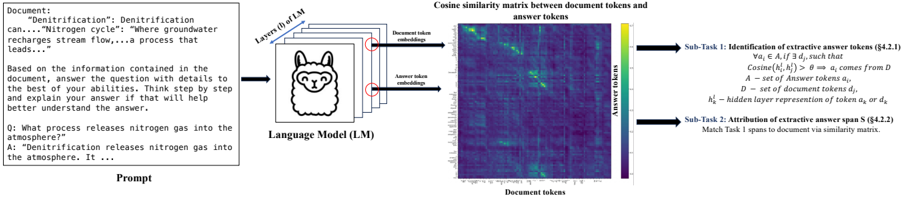
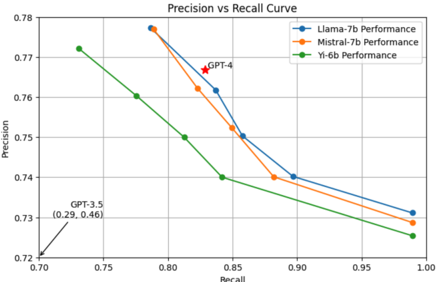
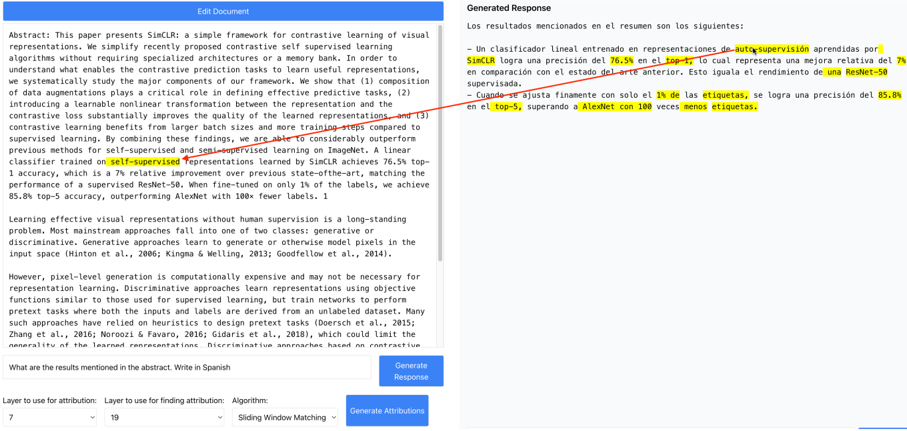
With the enhancement in the field of generative artificial intelligence (AI), contextual question answering has become extremely relevant. Attributing model generations to the input source document is essential to ensure trustworthiness and reliability. We observe that when large language models (LLMs) are used for contextual question answering, the output answer often consists of text copied verbatim from the input prompt which is linked together with "glue text" generated by the LLM. Motivated by this, we propose that LLMs have an inherent awareness from where the text was copied, likely captured in the hidden states of the LLM. We introduce a novel method for attribution in contextual question answering, leveraging the hidden state representations of LLMs. Our approach bypasses the need for extensive model retraining and retrieval model overhead, offering granular attributions and preserving the quality of generated answers. Our experimental results demonstrate that our method performs on par or better than GPT-4 at identifying verbatim copied segments in LLM generations and in attributing these segments to their source. Importantly, our method shows robust performance across various LLM architectures, highlighting its broad applicability. Additionally, we present Verifiability-granular, an attribution dataset which has token level annotations for LLM generations in the contextual question answering setup.
Overview
The claims and statistics of this paper haven’t been checked yet.
Run the check — free, no account needed. It reads the open-access text and checks the sources it cites.
Integrity signals
Registry
Cites
Statistics
Figures
Verification
Claims the paper makes
The claims and statistics of this paper haven’t been checked yet.
Run the check — free, no account needed. It reads the open-access text and checks the sources it cites.
Claims other papers make about this one
Each is checked against this paper’s own text: does it say what the citing paper says it does?
In the citing paper
“Existing contributive attribution methods for LLMs typically require extensive context ablations or other computationally expensive techniques, such as gradient-based analysis during inference (Cohen-Wang et al., 2024;Qi et al., 2024;Phukan et al., 2024).”
From SelfCite: Self-Supervised Alignment for Context Attribution in Large Language Models (2025) · cites this paper as Phukan et al., 2024
Self-check
Percentages, sums and reported differences re-computed from the paper’s own numbers.
The self-check needs the paper’s full text.
Citations
Cites
Evaluating Verifiability in Generative Search Engines
Liu, N. F., Zhang, T., & Liang, P. (2023) · arXiv · Cited by 143 · cited 1×
“While LLMs excel in generating informative responses, they often fall short in providing explicit references or attributions to the specific sections or sources within the context from which their answers derive (Liu et al., 2023b).”
Background
Research works printed but not linked: 35
- Marco Ancona, Enea Ceolini, A. Cengiz Öztireli, and Markus H. Gross. 2017. A unified view of gradient- based attribution methods for deep neural networks. CoRR, abs/1711.06104. · arXiv
- Bernd Bohnet, Vinh Q Tran, Pat Verga, Roee Aharoni, Daniel Andor, Livio Baldini Soares, Jacob Eisenstein, Kuzman Ganchev, Jonathan Herzig, Kai Hui, et al. 2022. Attributed question answering: Evaluation and modeling for attributed large language models. arXiv preprint arXiv:2212.08037. · arXiv
- Brooke Borel. 2023. The Chicago guide to fact- checking. University of Chicago Press.
- Danqi Chen, Adam Fisch, Jason Weston, and Antoine Bordes. 2017. Reading wikipedia to answer open- domain questions. arXiv preprint arXiv:1704.00051. · arXiv
- Nouha Dziri, Hannah Rashkin, Tal Linzen, and David Reitter. 2022. Evaluating attribution in dialogue sys- tems: The BEGIN benchmark. Transactions of the Association for Computational Linguistics, 10:1066- 1083. · DOI
- Owain Evans, Owen Cotton-Barratt, Lukas Finnve- den, Adam Bales, Avital Balwit, Peter Wills, Luca Righetti, and William Saunders. 2021. Truthful AI: developing and governing AI that does not lie. CoRR, abs/2110.06674. · arXiv
- William Ferreira and Andreas Vlachos. 2016. Emer- gent: a novel data-set for stance classification. In NAACL HLT 2016, The 2016 Conference of the North American Chapter of the Association for Computa- tional Linguistics: Human Language Technologies, San Diego California, USA, June 12-17, 2016, pages 1163-1168. The Association for Computational Lin- guistics. · DOI · Paper page
- Luyu Gao, Zhuyun Dai, Panupong Pasupat, Anthony Chen, Arun Tejasvi Chaganty, Yicheng Fan, Vin- cent Zhao, Ni Lao, Hongrae Lee, Da-Cheng Juan, et al. 2023a. Rarr: Researching and revising what language models say, using language models. In Proceedings of the 61st Annual Meeting of the As- sociation for Computational Linguistics (Volume 1: Long Papers), pages 16477-16508.
- Tianyu Gao, Howard Yen, Jiatong Yu, and Danqi Chen. 2023b. Enabling large language models to generate text with citations. arXiv preprint arXiv:2305.14627. · arXiv
- Andreas Holzinger, Bernd Malle, Anna Saranti, and Bastian Pfeifer. 2021. Towards multi-modal causabil- ity with graph neural networks enabling information fusion for explainable AI. Inf. Fusion, 71:28-37. · DOI · Paper page
- Jie Huang and Kevin Chen-Chuan Chang. 2023. Ci- tation: A key to building responsible and ac- countable large language models. arXiv preprint arXiv:2307.02185. · arXiv
- Siqing Huo, Negar Arabzadeh, and Charles Clarke. 2023. Retrieving supporting evidence for generative question answering. In Annual International ACM SIGIR Conference on Research and Development in Information Retrieval in the Asia Pacific Region, pages 11-20.
- Albert Q Jiang, Alexandre Sablayrolles, Arthur Men- sch, Chris Bamford, Devendra Singh Chaplot, Diego de las Casas, Florian Bressand, Gianna Lengyel, Guil- laume Lample, Lucile Saulnier, et al. 2023. Mistral 7b. arXiv preprint arXiv:2310.06825. · arXiv
- Ehsan Kamalloo, Aref Jafari, Xinyu Zhang, Nan- dan Thakur, and Jimmy Lin. 2023. Hagrid: A human-llm collaborative dataset for generative information-seeking with attribution. arXiv preprint arXiv:2307.16883. · arXiv
- Kenton Lee, Ming-Wei Chang, and Kristina Toutanova. 2019. Latent retrieval for weakly supervised open domain question answering. arXiv preprint arXiv:1906.00300. · arXiv
- Dongfang Li, Zetian Sun, Xinshuo Hu, Zhenyu Liu, Ziyang Chen, Baotian Hu, Aiguo Wu, and Min Zhang. 2023. A survey of large language models attribution. ArXiv, abs/2311.03731. · arXiv
- Yaliang Li, Jing Gao, Chuishi Meng, Qi Li, Lu Su, Bo Zhao, Wei Fan, and Jiawei Han. 2015. A survey on truth discovery. SIGKDD Explor., 17(2):1-16. · DOI · Paper page
- Nelson F Liu, Kevin Lin, John Hewitt, Ashwin Paran- jape, Michele Bevilacqua, Fabio Petroni, and Percy Liang. 2023a. Lost in the middle: How lan- guage models use long contexts. arXiv preprint arXiv:2307.03172. · arXiv
- Chaitanya Malaviya, Subin Lee, Sihao Chen, Elizabeth Sieber, Mark Yatskar, and Dan Roth. 2023. Ex- pertqa: Expert-curated questions and attributed an- swers. ArXiv, abs/2309.07852. · arXiv
- Tomas Mikolov, Kai Chen, Greg Corrado, and Jef- frey Dean. 2013. Efficient estimation of word representations in vector space. arXiv preprint arXiv:1301.3781. · arXiv
- Jianmo Ni, Chen Qu, Jing Lu, Zhuyun Dai, Gus- tavo Hernández Ábrego, Ji Ma, Vincent Y Zhao, Yi Luan, Keith B Hall, Ming-Wei Chang, et al. 2021. Large dual encoders are generalizable retriev- ers. arXiv preprint arXiv:2112.07899. · arXiv
- Rodrigo Nogueira, Zhiying Jiang, and Jimmy Lin. 2020. Document ranking with a pretrained sequence-to- sequence model. arXiv preprint arXiv:2003.06713. · arXiv
- Fabio Petroni, Samuel Broscheit, Aleksandra Piktus, Patrick S. H. Lewis, Gautier Izacard, Lucas Hosseini, Jane Dwivedi-Yu, Maria Lomeli, Timo Schick, Pierre- Emmanuel Mazaré, Armand Joulin, Edouard Grave, and Sebastian Riedel. 2022. Improving wikipedia verifiability with AI. CoRR, abs/2207.06220. · DOI
- Hannah Rashkin, Vitaly Nikolaev, Matthew Lamm, Lora Aroyo, Michael Collins, Dipanjan Das, Slav Petrov, Gaurav Singh Tomar, Iulia Turc, and David Reitter. 2023. Measuring attribution in natural lan- guage generation models. Computational Linguistics, pages 1-64.
- Stephen Robertson, Hugo Zaragoza, et al. 2009. The probabilistic relevance framework: Bm25 and be- yond. Foundations and Trends® in Information Re- trieval, 3(4):333-389.
- Gabriele Sarti, Grzegorz Chrupala, Malvina Nissim, and Arianna Bisazza. 2023a. Quantifying the plausibil- ity of context reliance in neural machine translation. CoRR, abs/2310.01188. · DOI
- Gabriele Sarti, Nils Feldhus, Ludwig Sickert, and Os- kar van der Wal. 2023b. Inseq: An interpretability toolkit for sequence generation models. In Proceed- ings of the 61st Annual Meeting of the Association for Computational Linguistics (Volume 3: System Demonstrations), pages 421-435, Toronto, Canada. Association for Computational Linguistics. · DOI
- Tal Schuster, Adam D Lelkes, Haitian Sun, Jai Gupta, Jonathan Berant, William W Cohen, and Donald Metzler. 2023. Semqa: Semi-extractive multi-source question answering. arXiv preprint arXiv:2311.04886. · arXiv
- James Thorne, Andreas Vlachos, Oana Cocarascu, Christos Christodoulopoulos, and Arpit Mittal. 2018. The fact extraction and verification (FEVER) shared task. CoRR, abs/1811.10971. · arXiv
- Hugo Touvron, Thibaut Lavril, Gautier Izacard, Xavier Martinet, Marie-Anne Lachaux, Timothée Lacroix, Baptiste Rozière, Naman Goyal, Eric Hambro, Faisal Azhar, et al. 2023. Llama: Open and effi- cient foundation language models. arXiv preprint arXiv:2302.13971. · arXiv
- Orion Weller, Marc Marone, Nathaniel Weir, Dawn Lawrie, Daniel Khashabi, and Benjamin Van Durme. 2023. " according to..." prompting language mod- els improves quoting from pre-training data. arXiv preprint arXiv:2305.13252. · arXiv
- Alex Young, Bei Chen, Chao Li, Chengen Huang, Ge Zhang, Guanwei Zhang, Heng Li, Jiangcheng Zhu, Jianqun Chen, Jing Chang, et al. 2024. Yi: Open foundation models by 01. ai. arXiv preprint arXiv:2403.04652. · arXiv
- Susan Zhang, Stephen Roller, Naman Goyal, Mikel Artetxe, Moya Chen, Shuohui Chen, Christopher De- wan, Mona Diab, Xian Li, Xi Victoria Lin, et al. 2022. Opt: Open pre-trained transformer language models. arXiv preprint arXiv:2205.01068. · arXiv
- Ruochen Zhao, Hailin Chen, Weishi Wang, Fangkai Jiao, Do Xuan Long, Chengwei Qin, Bosheng Ding, Xiaobao Guo, Minzhi Li, Xingxuan Li, and Shafiq Joty. 2023. Retrieving multimodal information for augmented generation: A survey. In Findings of the Association for Computational Linguistics: EMNLP 2023, Singapore, December 6-10, 2023, pages 4736- 4756. Association for Computational Linguistics.
- Andy Zou, Long Phan, Sarah Chen, James Campbell, Phillip Guo, Richard Ren, Alexander Pan, Xuwang Yin, Mantas Mazeika, Ann-Kathrin Dombrowski, et al. 2023. Representation engineering: A top- down approach to ai transparency. arXiv preprint arXiv:2310.01405. · arXiv
Cited by
SelfCite: Self-Supervised Alignment for Context Attribution in Large Language Models
Chuang, Y.-S., Cohen-Wang, B., Shen, S. Z., Wu, Z., Xu, H., Lin, X. V., Glass, J., Li, S.-W., & Yih, W.-T. (2025) · arXiv · doi:10.48550/arxiv.2502.09604
Metadata
- Authors
- Phukan, A., Somasundaram, S., Saxena, A., Goswami, K., & Srinivasan, B. V.
- Venue
- arXiv
- Publisher
- arXiv
- Published
- 2024
- arXiv
- 2405.17980
- References
- 1
- Type
- Preprint
About these checks
Registry, retraction, Cites and statistics results are computed, not judged, with one exception: a printed reference that no index lists is read once by a model before it counts as a citation error. Claims are extracted by a model and kept only when their quote appears verbatim in the text; each cited source is then checked, with a model’s help, for whether it says what the claim relies on. Those verdicts can be wrong — read the claim’s quote and the cited source before relying on one.
Statistics and arithmetic are recomputed, not judged.
Confidence bands are shown only for fields calibrated on our annotated test set. None is calibrated yet, so no band is shown.
What counts as a claim ›How we measure confidence ›How we check this ›
Are you an author, or do you see a problem with this page? Request a review
Data sources
Bibliographic data: Semantic Scholar, OpenAlex, Crossref.
Contains information from the Semantic Scholar Academic Graph Datasets, made available under the ODC Attribution License (ODC-BY 1.0).
Semantic Scholar’s data is described in: Kinney, R., et al. (2023). The Semantic Scholar Open Data Platform. arXiv:2301.10140.
