

Prompt Stability Scoring for Text Annotation with Large Language Models
Open accessThe DOI matches its DataCite record; 56 of the 56 references it cites were found in a registry or an index; 6 of the 15 sources its claims cite were checked for support.
Abstract
Researchers are increasingly using language models (LMs) for text annotation. These approaches rely only on a prompt telling the model to return a given output according to a set of instructions. The reproducibility of LM outputs may nonetheless be vulnerable to small changes in the prompt design. This calls into question the replicability of classification routines. To tackle this problem, researchers have typically tested a variety of semantically similar prompts to determine what we call ``prompt stability." These approaches remain ad-hoc and task specific. In this article, we propose a general framework for diagnosing prompt stability by adapting traditional approaches to intra- and inter-coder reliability scoring. We call the resulting metric the Prompt Stability Score (PSS) and provide a Python package \texttt{promptstability} for its estimation. Using six different datasets and twelve outcomes, we classify $\sim$3.1m rows of data and $\sim$300m input tokens to: a) diagnose when prompt stability is low; and b) demonstrate the functionality of the package. We conclude by providing best practice recommendations for applied researchers.
Overview
CoChat Summary
TL;DR
The paper proposes a Prompt Stability Score (PSS) that adapts intra- and inter-coder reliability to diagnose how sensitive LLM text annotations are to repeated runs and semantically similar prompt variants, and provides a Python package `promptstability`. Across six datasets and twelve outcomes, intra-prompt stability is often high (>0.8), but inter-prompt stability generally declines as prompts become more semantically distant, especially with ill-suited data or under-specified constructs.
Key findings
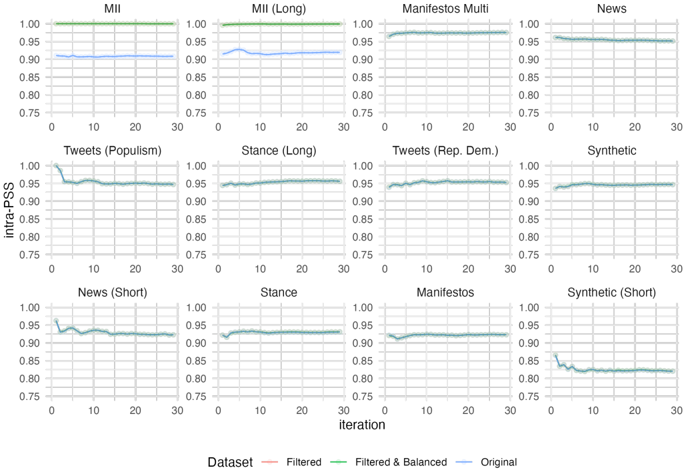
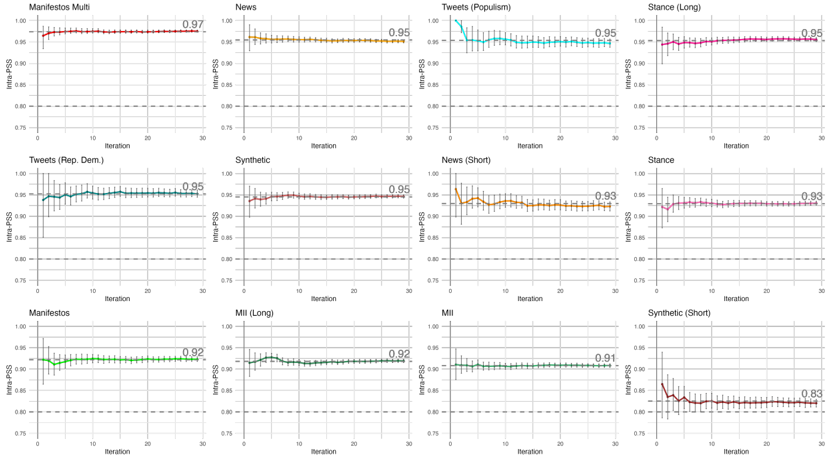
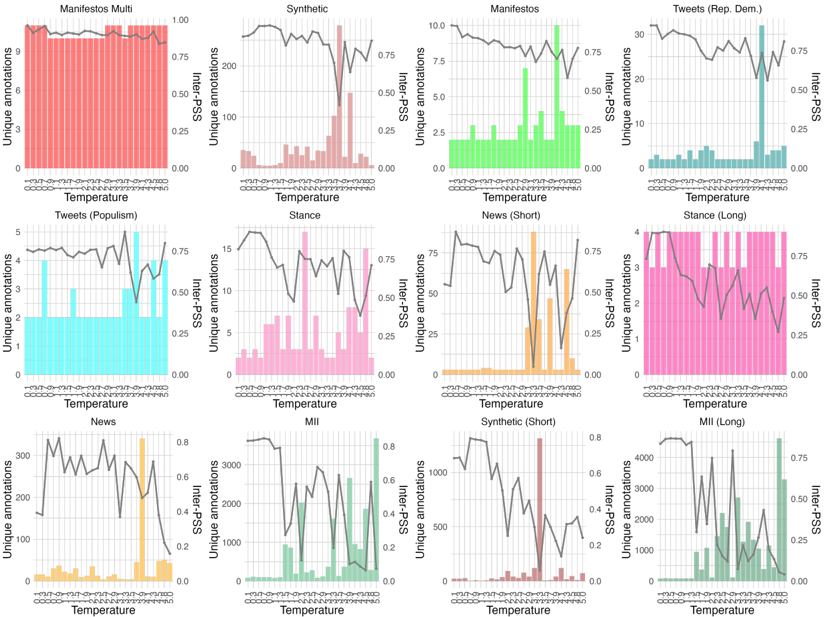
- The paper reports classifying ∼3.1m rows and ∼300m input tokens (abstract; Table 4 totals 3,144,022 rows and 306,390,955 input tokens). For most datasets, averaged intra-PSS is above 0.8 across runs; the shortened Synthetic data is among the least consistent.
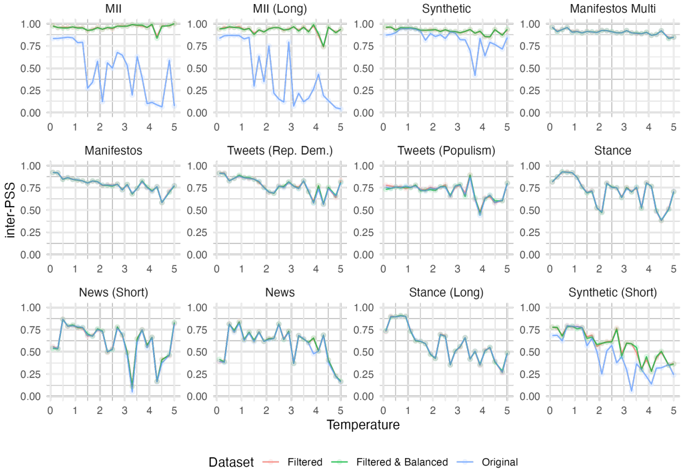
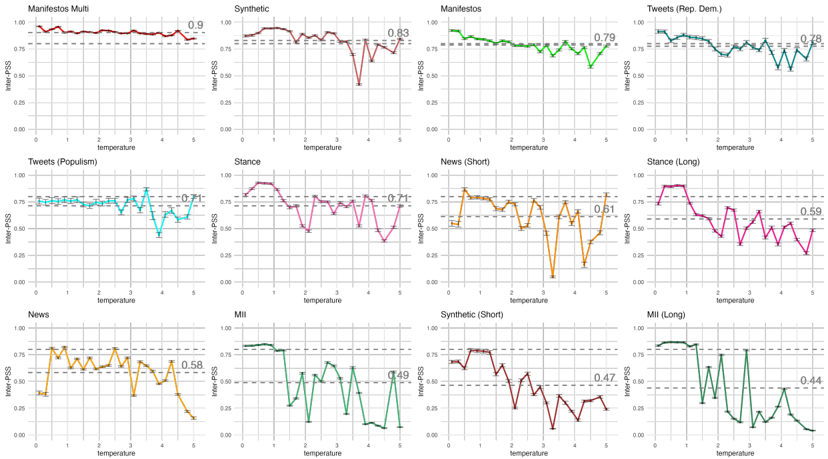
- Inter-PSS generally decreases as paraphrase temperature increases. The least stable datasets across temperatures are those where data are ill-suited or the outcome construct is imprecisely defined; for some data-outcome pairings, PSS rapidly decreases even at low temperatures.
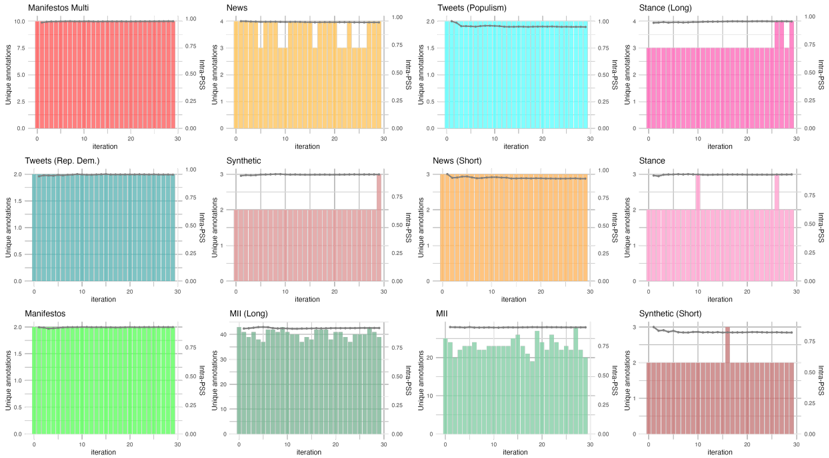
- Response formatting and filtering matter: MII and MII (Long) intra-PSS scores are lower on original annotations than on filtered data, and unique annotations increase as temperature increases.
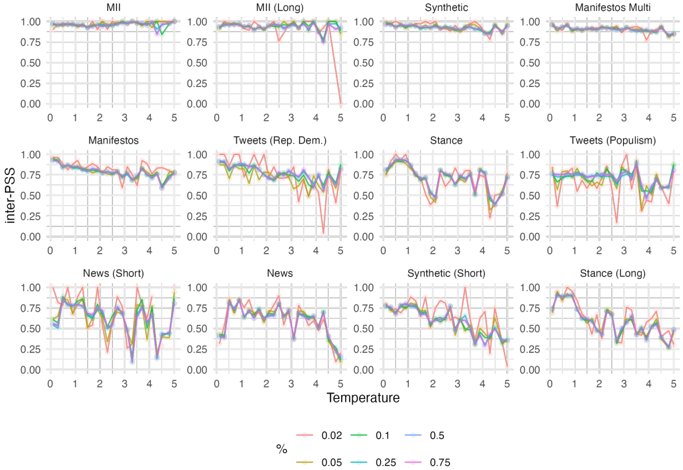
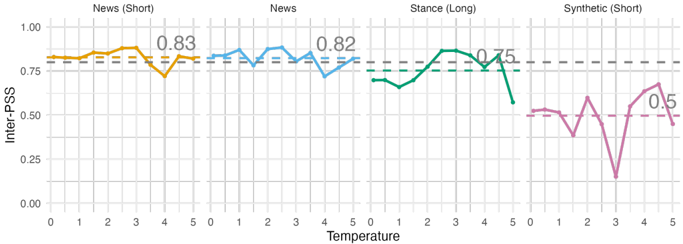
- Cost is modest: redoing the analyses could cost 3 to 150 USD depending on sample size, and even a 2% subsample recovers basic trends for most datasets. gpt-4o-mini is more stable than gpt-3.5-turbo for the four worst outcomes, but Synthetic (Short) is about as stable.
Methods
- Six datasets (US Senator Tweets, NYT News Articles, UK Manifestos, US Politics Tweets, BES Survey Responses, ANES Voter Profiles), each with two outcome operationalizations = twelve outcomes; modifications target data complexity/suitability and construct validity/outcome complexity.
- Intra-PSS: the original prompt classifies the same maximum 500 rows 30 times, with cumulative Krippendorff’s Alpha and bootstrap confidence intervals (1,000 samples). Inter-PSS: PEGASUS generates semantically similar prompts across 25 temperatures from 0.1 to 5.0, with 10 variations per temperature, 3 iterations, and a maximum of 500 rows; scores are averaged within temperature.
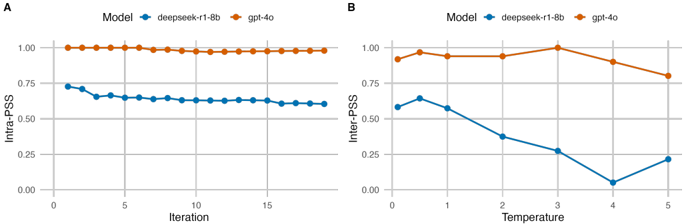
- Main analyses use GPT-3.5 (`gpt-3.5-turbo`); appendix examples compare gpt-4o and DeepSeek-R1. The package is LM-agnostic.
Limitations
- Stated: only one paraphrasing engine is used; the approach does not adapt or iterate other model parameters such as the classification engine’s temperature or top p; the main analyses do not compare different LMs (though the software is LM-agnostic and appendix examples compare gpt-4o and DeepSeek-R1); and the tests do not use the exact original prompts, so they are not explicit replication tests of published findings.
- Stated: no specific cutoff is recommended; 0.8 is used as a heuristic, and parameter stability is left to future research.
- Evident: automated paraphrases at higher temperatures may be garbled or inaccurate, and format failures require filtering/balancing, which can reduce annotations and complicate interpretation; the main empirical results rely primarily on one LM (GPT-3.5), limiting cross-model generalizability.
Model-written summary. Check it against the paper before relying on it.
Integrity signals
Registry
Cites
Statistics
Figures
Verification
Claims the paper makes
1 Valid · 10 Not valid · 6 Not checked · 56 Own results and interpretations
Some cited sources support this claim and some don’t — read each source’s verdict below.
In the paper
“Yet some more recent contributions have demonstrated a notable lack of outcome stability when prompting LMs to classify social scientific constructs [Dentella et al., 2023, Bisbee et al., 2023].”
§ Prompt Stability Scoring for Text Annotation with Large Language Models > 3 Current Approaches
What the sources say
- Supportedcites Dentella et al., 2023 matched to “Systematic testing of three Language Models reveals low language accuracy, absence of response stability, and a yes-response bias” (2023) source
The Discussion (p. n/a, 'The third finding of our experiment concerns the instability of responses') states the absence of decision stability, with all three LMs repeatedly giving different answers to the exact same prompt, and the Results ('Stability', 'Does stability improve over repetitions?') quantify it via oscillation and deviation with no improvement over repetitions. The task is precisely a prompting/classification paradigm — LMs asked to classify sentences as grammatical or ungrammatical (Materials and Methods, 'Sentence Material') — so the claim's substance (unstable outcomes when Lms are prompted to classify) is directly stated; the citing sentence's umbrella phrase 'social scientific constructs' generalises this paper's linguistic grammaticality construct, which is the framing shared with the second, co-cited source. (LLM, conf=0.85)
- Disputedcites Bisbee et al., 2023 matched to “Synthetic Replacements for Human Survey Data? The Perils of Large Language Models” (2023) sourceExperimental — accuracy not yet measured
Our copy of Bisbee et al. (2023) reports the opposite of a 'lack of outcome stability': the Abstract states synthetic data are 'artificially precise, with a standard deviation that is only 31% of the variation found in actual opinions among comparable humans,' and Section 6.3 (Exaggerated Confidence) adds that ChatGPT's standard deviations are consistently one-quarter to one-third of ANES values, that 95% of matched profiles are more precise via ChatGPT, and that 'the variation approaches zero when reducing ChatGPT's creativity parameter.' Section 1 (Research Design) likewise notes that even at the most 'creative' temperature setting the LLM's within-persona responses are far less variable than actual human opinion. The paper also measures opinion with feeling thermometers rather than prompting LMs to classify/label constructs — it explicitly assigns labeling applications to other works (Törnberg, 2023; Gilardi et al., 2023) — so the attributed instability-in-classification finding is not this paper's result. (LLM, conf=0.72)
Checked by a reasoning model — may be wrong.
boosted- Asserted: passes — The authors put it forward as true.
- Checkable: passes — It can be checked against evidence.
- Load-bearing: passes — The paper’s conclusions depend on it.
- Based: passes — The paper gives a reason why it holds.
- Supported
Some cited sources support this claim and some don’t — read each source’s verdict below.
In the paper
“Absent from recent contributions, however, is any equivalent concern with reliability scores when using LMs [Reiss, 2023, Ollion et al., 2023, Sclar et al., 2023].”
§ Prompt Stability Scoring for Text Annotation with Large Language Models > 1 Introduction
What the sources say
- Partly supportedcites Reiss, 2023 matched to “Testing the Reliability of ChatGPT for Text Annotation and Classification: A Cautionary Remark” (2023) sourceExperimental — accuracy not yet measured
The Introduction of Reiss (2023) does make a comparable point — 'What has been investigated less so far is the consistency of ChatGPT's zero-shot text classification and text annotation capabilities' — and frames the study as adding 'a more cautious perspective' to a body of research focused on capabilities (citing Huang et al. 2023, Gilardi et al. 2023, Kuzman et al. 2023). But the source hedges the gap as 'investigated less so far' rather than wholly absent, and bounds it to ChatGPT zero-shot text annotation/classification, not to LM use generally; the citing sentence's 'absent ... any equivalent concern with reliability scores when using LMs' overstates both the strength and the scope. No passage of our copy asserts that reliability scores were entirely lacking in recent contributions. (LLM, conf=0.75)
- Disputedcites Ollion et al., 2023 matched to “ChatGPT for Text Annotation? Mind the Hype!” (2023) sourceExperimental — accuracy not yet measured
Ollion et al.'s review does not say reliability concern is absent from recent LM-annotation work; on the contrary, Section 2 ('Ambivalent Results', finding 4) states that 'the metrics used to evaluate ChatGPT vary greatly from text to text. Some focus on model performance and others on consistency between annotators, almost each time with different indicators,' and calls for harmonising rather than for the absence of such concern. Their framing of the review itself is 'assessing GPT-4.0 or ChatGPT's performance and consistency' across 20 papers / 117 tasks (Section 2, opening). Table 1 ('Additional information') explicitly records agreement metrics (Krippendorff's alpha, Fleiss' kappa, ICC, JPA, correlations) for many of the cited contributions — including Reiss (2023) at α 0.50-0.95 — so reliability scores are documented, not absent. The strongest thing the source supports is heterogeneous, non-comparable reporting, which the citing sentence overstates as a total lack of concern. (LLM, conf=0.72)
Checked by a reasoning model — may be wrong.
- Disputedcites Sclar et al., 2023 matched to “Quantifying Language Models' Sensitivity to Spurious Features in Prompt Design or: How I learned to start worrying about prompt formatting” (2023) sourceExperimental — accuracy not yet measured
The claim casts Sclar et al. (2023) as a recent LM contribution lacking any equivalent concern with reliability, but our copy shows the paper's central purpose is exactly such a concern: its Introduction (p. 1, §1) argues that 'future research would benefit from reporting a performance spread over a sufficient sample of plausible formats, instead of simply reporting the formatting used and its performance, as is currently standard,' and §6 Discussion recommends 'reporting a range of performance across plausible formats' because formatting-induced spread 'may influence conclusions made about model performance.' The paper operationalizes this with a defined metric (§3.2 Measuring Sensitivity: spread = max - min over plausible formats) and reports distributional statistics such as median spread and standard deviation (Additional information, Figure 20; §4.5), i.e. it quantifies the reliability/stability of LM measurements rather than ignoring it. What our copy does not contain is any psychometric 'reliability score' (e.g. inter-rater agreement), so the citing sentence's narrow terminology is not the paper's, but the attributed absence of concern is contrary to what the source states. (LLM, conf=0.72)
Checked by a reasoning model — may be wrong.
plain- Asserted: passes — The authors put it forward as true.
- Checkable: passes — It can be checked against evidence.
- Load-bearing: passes — The paper’s conclusions depend on it.
- Based: passes — The paper gives a reason why it holds.
- Partly supported
Every source the paper cites for this claim was checked and supports it.
In the paper
“The reproducibility of LM outputs may nonetheless be vulnerable to small changes in the prompt design.”
§ Prompt Stability Scoring for Text Annotation with Large Language Models > Abstract
What the sources say
- Supportedcites Sclar et al., 2023 matched to “Quantifying Language Models' Sensitivity to Spurious Features in Prompt Design or: How I learned to start worrying about prompt formatting” (2023) source
The Abstract reports that 'several widely used open-source LLMs are extremely sensitive to subtle changes in prompt formatting in few-shot settings, with performance differences of up to 76 accuracy points when evaluated using LLaMA-2-13B,' and that sensitivity persists with scale, more shots and instruction tuning. Section 4.3 states directly that 'Small prompt variations often yield large performance differences,' with 24% of atomic changes (e.g. a space, separator, casing) shifting accuracy by at least 5 points under exact-prefix scoring. The Discussion (Sec. 6) ties this to reproducibility of conclusions, holding that spread from arbitrary formatting 'may influence conclusions made about model performance' and recommending reporting a range of performance instead of the standard single format. The citing sentence is hedged ('may be vulnerable') and narrower in confidence than the source, so it is supported; the source's scope is prompt formatting as a subclass of prompt-design choices, which it frames as such in the Abstract and Introduction. (LLM, conf=0.85)
hedgedstates a possible cause- Asserted: passes — The authors put it forward as true.
- Checkable: passes — It can be checked against evidence.
- Load-bearing: passes — The paper’s conclusions depend on it.
- Based: passes — The paper gives a reason why it holds.
- Supported
A result the paper reports from its own data — it cites no other source for it, so there is none to check. The quote shows it is in the paper.
In the paper
“To take the Synthetic (short) data as an example, we see that for this challenging task where the data are not well suited to the annotation task, intra-PSS decreases quickly.”
§ Prompt Stability Scoring for Text Annotation with Large Language Models > 5 Results
plainstates a causeSingle case- Asserted: passes — The authors put it forward as true.
- Checkable: passes — It can be checked against evidence.
- Load-bearing: unclear — It is unclear whether the paper’s conclusions depend on it.
- Based: passes — The paper gives a reason why it holds.
A result the paper reports from its own data — it cites no other source for it, so there is none to check. The quote shows it is in the paper.
In the paper
“For example, when estimating the intra-PSS on the original annotations, both MII and MII (long) scores are relatively a lot lower than their scores when estimating on the filtered data.”
§ Prompt Stability Scoring for Text Annotation with Large Language Models > 5 Results
plainstates an association- Asserted: passes — The authors put it forward as true.
- Checkable: passes — It can be checked against evidence.
- Load-bearing: passes — The paper’s conclusions depend on it.
- Based: passes — The paper gives a reason why it holds.
28 more claims
Create a free account to see all 73 claims and to verify the 5 references still open.
- It may state two separate claims as one. 12
- Probably not a substantial claim. 33
- The quote only partly states this claim. 1
Claims other papers make about this one
Each is checked against this paper’s own text: does it say what the citing paper says it does?
The source backs part of the claim, not all of it — or backs it for a different population, condition or comparison.
In the citing paper
“The potential lack of replicability is another hurdle that lowers social scientists' enthusiasm to adopt LLMs in their research (Barrie, Palaiologou, & Törnberg, 2024).”
From Navigating the Risks of Using Large Language Models for Text Annotation in Social Science Research (2026) · cites this paper as Barrie, Palaiologou, & Törnberg, 2024
Experimental — accuracy not yet measuredThe cited source says what the claim attributes to it.
In the citing paper
“A recent work conducted by Barrie et al. (2024) shows that the prompt stability of outputs generally decreases with increasing temperature due to the degradation in the quality of prompts.”
From Navigating the Risks of Using Large Language Models for Text Annotation in Social Science Research (2026) · cites this paper as Barrie et al. (2024)
Self-check
Percentages, sums and reported differences re-computed from the paper’s own numbers.
Each contradiction between two passages listed here was confirmed by an independent check.
Rated minor: it would not touch a result — a value no result rests on, a p-value that stays on the same side of the significance level, or a conflict that is clerical, resolved elsewhere in the paper, or outside its own findings.
In the paper
§ Prompt Stability Scoring for Text Annotation with Large Language Models > A10
“Your task is to read each article and label its overall sentiment as positive or negative .”
§ Prompt Stability Scoring for Text Annotation with Large Language Models > A10
“[ Respond 0 for negative , 1 for positive , and 2 for neutral .”
Rated minor: it would not touch a result — a value no result rests on, a p-value that stays on the same side of the significance level, or a conflict that is clerical, resolved elsewhere in the paper, or outside its own findings.
In the paper
§ Prompt Stability Scoring for Text Annotation with Large Language Models > 4.2.2 Inter-prompt stability
“We also provide results for poor performing tests using an updated OpenAI model (gpt-4o).”
§ Prompt Stability Scoring for Text Annotation with Large Language Models > 5.3 Are other LMs more stable?
“and Synthetic (Short) and re-estimate the inter-PSS using gpt-40-min.”
Rated minor: it would not touch a result — a value no result rests on, a p-value that stays on the same side of the significance level, or a conflict that is clerical, resolved elsewhere in the paper, or outside its own findings.
In the paper
§ Prompt Stability Scoring for Text Annotation with Large Language Models > A10
“s t a n c e _ l o n g _ w i t h i n .csv The text provided come from some tweets about Donald Trump .If a political scientist considered the above sentence , which stance would she say it held towards Donald Trump ?[ Respond 0 for negative , and 1 for positive .Respond nothing else .]”
§ Prompt Stability Scoring for Text Annotation with Large Language Models > A10
“s t a n c e _ l o n g _ w i t h i n .csv The text provided come from some tweets about Donald Trump .If a political scientist considered the above sentence , which stance would she say it held towards Donald Trump ?[ Respond 0 for negative , 1 for positive , and 2 for none .Respond nothing else .]”
Rated minor: it would not touch a result — a value no result rests on, a p-value that stays on the same side of the significance level, or a conflict that is clerical, resolved elsewhere in the paper, or outside its own findings.
In the paper
§ Prompt Stability Scoring for Text Annotation with Large Language Models > 4.1 Data
“We modify the data complexity or suitability in the US Senator Tweets, NYT News Articles, US Politics Tweets, BES Survey Responses, and ANES Voter Profiles;”
§ Prompt Stability Scoring for Text Annotation with Large Language Models > 4.1 Data
“US Senator Tweets van Vliet et al. (2020) • Binary: Republican/Democrat • Binary: Populist/Not Populist • Tweets (Rep.Dem.) • Tweets (Populism) • Construct validity/Outcome complexity”
Citations
Cites
Chain-Of-Thought Prompting Elicits Reasoning in Large Language Models
Wei, J., Wang, X., Schuurmans, D., Bosma, M., Ichter, B., Xia, F., Chi, E., Le, Q. V., & Zhou, D. (2022) · Advances in Neural Information Processing Systems 35 · doi:10.52202/068431-1800 · Cited by 4,505
Liu, P., Yuan, W., Fu, J., Jiang, Z., Hayashi, H., & Neubig, G. (2023) · ACM Computing Surveys · doi:10.1145/3560815 · Cited by 4,361
Intercoder Reliability in Qualitative Research: Debates and Practical Guidelines
O’Connor, C., & Joffe, H. (2020) · International Journal of Qualitative Methods · doi:10.1177/1609406919899220 · Cited by 3,871
Text as Data: The Promise and Pitfalls of Automatic Content Analysis Methods for Political Texts
Grimmer, J., & Stewart, B. M. (2013) · Political Analysis · doi:10.1093/pan/mps028 · Cited by 3,297
Content Analysis in Mass Communication: Assessment and Reporting of Intercoder Reliability
Lombard, M., Snyder-Duch, J., & Bracken, C. C. (2002) · Human Communication Research · doi:10.1111/j.1468-2958.2002.tb00826.x · Cited by 3,068
Self-Refine: Iterative Refinement with Self-Feedback
Madaan, A., Tandon, N., Gupta, P., Hallinan, S., Gao, L., Wiegreffe, S., Alon, U., Dziri, N., Prabhumoye, S., Yang, Y., et al. (2023) · arXiv · doi:10.48550/arxiv.2303.17651 · Cited by 2,314
Exploiting Cloze-Questions for Few-Shot Text Classification and Natural Language Inference
Schick, T., & Schütze, H. (2020) · Conference of the European Chapter of the Association for Computational Linguistics · doi:10.48550/arxiv.2001.07676 · Cited by 1,944
Exploiting Cloze-Questions for Few-Shot Text Classification and Natural Language Inference
Schick, T., & Schütze, H. (2021) · Proceedings of the 16th Conference of the European Chapter of the Association for Computational Linguistics: Main Volume · doi:10.18653/v1/2021.eacl-main.20 · Cited by 1,305
AutoPrompt: Eliciting Knowledge from Language Models with Automatically Generated Prompts
Shin, T., Razeghi, Y., Logan IV, R. L., Wallace, E., & Singh, S. (2020) · Proceedings of the 2020 Conference on Empirical Methods in Natural Language Processing (EMNLP) · doi:10.18653/v1/2020.emnlp-main.346 · Cited by 1,279
ChatGPT outperforms crowd workers for text-annotation tasks
Gilardi, F., Alizadeh, M., & Kubli, M. (2023) · Proceedings of the National Academy of Sciences · doi:10.1073/pnas.2305016120 · Cited by 1,197
Research works printed but not linked: 3
- Ethan Perez, Douwe Kiela, and Kyunghyun Cho. True few-shot learning with language models. Advances in neural information processing systems, 34: 11054-11070, 2021.
- Jonathan Chang, Sean Gerrish, Chong Wang, Jordan Boyd-Graber, and David Blei. Reading tea leaves: How humans interpret topic models. Advances in neural information processing systems, 22, 2009.
- DeepSeek-AI, Daya Guo, Dejian Yang, Haowei Zhang, Junxiao Song, Ruoyu Zhang, Runxin Xu, Qihao Zhu, Shirong Ma, Peiyi Wang, Xiao Bi, Xiaokang Zhang, Xingkai Yu, Yu Wu, Z. F. Wu, Zhibin Gou, Zhihong Shao, Zhuoshu Li, Ziyi Gao, Aixin Liu, Bing Xue, Bingxuan Wang, Bochao Wu, Bei Feng, Chengda Lu, Chenggang Zhao, Chengqi Deng, Chenyu Zhang, Chong Ruan, Damai Dai, Deli Chen, Dongjie Ji, Erhang Li, Fangyun Lin, Fucong Dai, Fuli Luo, Guangbo Hao, Guanting Chen, Guowei Li, H. Zhang, Han Bao, Hanwei Xu, Haocheng Wang, Honghui Ding, Huajian Xin, Huazuo Gao, Hui Qu, Hui Li, Jianzhong Guo, Jiashi Li, Jiawei Wang, Jingchang Chen, Jingyang Yuan, Junjie Qiu, Junlong Li, J. L. Cai, Jiaqi Ni, Jian Liang, Jin Chen, Kai Dong, Kai Hu, Kaige Gao, Kang Guan, Kexin Huang, Kuai Yu, Lean Wang, Lecong Zhang, Liang Zhao, Litong Wang, Liyue Zhang, Lei Xu, Leyi Xia, Mingchuan Zhang, Minghua Zhang, Minghui Tang, Meng Li, Miaojun Wang, Mingming Li, Ning Tian, Panpan Huang, Peng Zhang, Qiancheng Wang, Qinyu Chen, Qiushi Du, Ruiqi Ge, Ruisong Zhang, Ruizhe Pan, Runji Wang, R. J. Chen, R. L. Jin, Ruyi Chen, Shanghao Lu, Shangyan Zhou, Shanhuang Chen, Shengfeng Ye, Shiyu Wang, Shuiping Yu, Shunfeng Zhou, Shuting Pan, S. S. Li, Shuang Zhou, Shaoqing Wu, Shengfeng Ye, Tao Yun, Tian Pei, Tianyu Sun, T. Wang, Wangding Zeng, Wanjia Zhao, Wen Liu, Wenfeng Liang, Wenjun Gao, Wenqin Yu, Wentao Zhang, W. L. Xiao, Wei An, Xiaodong Liu, Xiaohan Wang, Xiaokang Chen, Xiaotao Nie, Xin Cheng, Xin Liu, Xin Xie, Xingchao Liu, Xinyu Yang, Xinyuan Li, Xuecheng Su, Xuheng Lin, X. Q. Li, Xiangyue Jin, Xiaojin Shen, Xiaosha Chen, Xiaowen Sun, Xiaoxiang Wang, Xinnan Song, Xinyi Zhou, Xianzu Wang, Xinxia Shan, Y. K. Li, Y. Q. Wang, Y. X. Wei, Yang Zhang, Yanhong Xu, Yao Li, Yao Zhao, Yaofeng Sun, Yaohui Wang, Yi Yu, Yichao Zhang, Yifan Shi, Yiliang Xiong, Ying He, Yishi Piao, Yisong Wang, Yixuan Tan, Yiyang Ma, Yiyuan Liu, Yongqiang Guo, Yuan Ou, Yuduan Wang, Yue Gong, Yuheng Zou, Yujia He, Yunfan Xiong, Yuxiang Luo, Yuxiang You, Yuxuan Liu, Yuyang Zhou, Y. X. Zhu, Yanhong Xu, Yanping Huang, Yaohui Li, Yi Zheng, Yuchen Zhu, Yunxian Ma, Ying Tang, Yukun Zha, Yuting Yan, Z. Z. Ren, Zehui Ren, Zhangli Sha, Zhe Fu, Zhean Xu, Zhenda Xie, Zhengyan Zhang, Zhewen Hao, Zhicheng Ma, Zhigang Yan, Zhiyu Wu, Zihui Gu, Zijia Zhu, Zijun Liu, Zilin Li, Ziwei Xie, Ziyang Song, Zizheng Pan, Zhen Huang, Zhipeng Xu, Zhongyu Zhang, and Zhen Zhang. Deepseek-r1: Incentivizing reasoning capability in llms via reinforcement learning, 2025. URL https://arxiv.org/abs/2501. 12948.
Cited by
Large Language Model Hacking: Quantifying the Hidden Risks of Using LLMs for Text AnnotationPreprint
Baumann, J., Röttger, P., Urman, A., Wendsjö, A., Plaza-del-Arco, F. M., Gruber, J. B., & Hovy, D. (2025) · arXiv (Cornell University) · doi:10.48550/arxiv.2509.08825 · Cited by 109
Machine Bias. How Do Generative Language Models Answer Opinion Polls?
Boelaert, J., Coavoux, S., Ollion, É., Petev, I. D., & Präg, P. (2025) · Sociological Methods & Research · doi:10.1177/00491241251330582 · Cited by 88
Navigating the Risks of Using Large Language Models for Text Annotation in Social Science Research
Lin, H., & Zhang, Y. (2026) · Social Science Computer Review · doi:10.1177/08944393251366243 · Cited by 33
Carammia, M., Iacus, S. M., & Porro, G. (2026) · Social Science Computer Review · doi:10.1177/08944393261485320 · Cited by 19
Interactive Data Harmonization with LLM Agents: Opportunities and ChallengesPreprint
Santos, A. S. R., Pena, E. H. M., López, R., & Freire, J. (2025) · arXiv (Cornell University) · doi:10.48550/arxiv.2502.07132 · Cited by 19
Harmful YouTube Video Detection: A Taxonomy of Online Harm and MLLMs as Alternative Annotators
Jo, W., Wesołowska, M., & Wojcieszak, M. (2026) · Computational Communication Research · doi:10.5117/ccr2026.4.7.jo · Cited by 19
Carandang, K. A. M., Arana, J. M., Casin, E. R., Monterola, C. P., Tan, D. S., Valenzuela, J. F., & Alis, C. (2025) · Proceedings of the conference - Association for Computational Linguistics. Meeting · doi:10.18653/v1/2025.acl-industry.99 · Cited by 16
A bias towards neutrality? How LLM guardrail sensitivity affects classification
Rogers, R., & Zhang, X. (2025) · Communication and Change · doi:10.1007/s44382-025-00013-0 · Cited by 11
Depth and Autonomy: A Framework for Evaluating LLM Applications in Social Science ResearchPreprint
Sanaei, A., & Rajabzadeh, A. M. (2025) · SSRN Electronic Journal · doi:10.2139/ssrn.5653771 · Cited by 6
TextClass Benchmark: A Continuous Elo Rating of LLMs in Social SciencesPreprint
González‐Bustamante, B. (2024) · arXiv (Cornell University) · doi:10.48550/arxiv.2412.00539 · Cited by 6
Newer, Larger, Better? A Critique of the Unreflective LLM Adoption in Communication Research
Balluff, P., Ho, J. C., Gruber, J. B., Palicki, S.-K., Palmer, A., Rossi, L., Shklovski, I., & Chan, C. (2026) · Political Communication · doi:10.1080/10584609.2026.2618486 · Cited by 5
MetaHarm: Harmful YouTube Video Dataset Annotated by Domain Experts, GPT-4-Turbo, and Crowdworkers
Jo, W., & Wojcieszak, M. (2025) · Proceedings of the International AAAI Conference on Web and Social Media · doi:10.1609/icwsm.v19i1.35951 · Cited by 5
PoSSUM: a protocol for surveying social-media users with multimodal LLMs
Cerina, R. (2026) · EPJ Data Science · doi:10.1140/epjds/s13688-026-00705-7 · Cited by 5
Machine Bias. How Do Generative Language Models Answer Opinion Polls?Preprint
Boelaert, J., Ollion, É., Coavoux, S., Petev, I. D., & Präg, P. (2025) · SocArXiv (OSF Preprints) · doi:10.31235/osf.io/r2pnb_v2 · Cited by 5
Semantic stability protocol: intercoder reliability for zero-shot classification via AI coders
Hsu, H.-Y., & Hsu, M. (2026) · Quality & Quantity · doi:10.1007/s11135-026-02832-9 · Cited by 4
McLaren, L., Cross, J., Krakowska, Z., Rauner, R., & Schoonvelde, M. (2026) · arXiv (Cornell University) · doi:10.48550/arxiv.2603.26898 · Cited by 4
Jo, C. W., Wesołowska, M., & Wojcieszak, M. (2024) · OSF Preprints (OSF Preprints) · doi:10.31219/osf.io/2dn8s · Cited by 3
Wu, P. Y. (2025) · ACM Web Science Conference (WebSci) · doi:10.1145/3717867.3717913 · Cited by 3
Classifying illicit dark web content through zero-shot prompting: An empirical study with GPT models
Domínguez‐Díaz, A., de‐Marcos, L., Sánchez, V. P. P., Rodríguez, D., & Martínez-Herráiz, J.-J. (2025) · Information Processing & Management · doi:10.1016/j.ipm.2025.104476 · Cited by 2
Economic Policy Narratives: A Taxonomy and Application
Besley, T., Brzezinski, A., & Fazzio, J. (2026) · LSE Public Policy Review · doi:10.31389/lseppr.147 · Cited by 2
Törnberg, A. (2025) · SocArXiv (OSF Preprints) · doi:10.31235/osf.io/ew5zq_v1 · Cited by 2
How Persuasive Is Your Context?
Nguyen, T. N., Du, K., Hoyle, A., & Cotterell, R. (2025) · Conference on Empirical Methods in Natural Language Processing (EMNLP) · doi:10.18653/v1/2025.emnlp-main.1633 · Cited by 2
Marques-Pita, M. (2026) · arXiv (Cornell University) · doi:10.48550/arxiv.2606.28574 · Cited by 2
Guidance over guidelines? Unpacking the uses and concerns of generative AI in communication science
Ho, J. C., Cools, H., Strycharz, J., Möller, A. M., van Berlo, Z. M. C., Stolwijk, S. B., Trilling, D., & Araujo, T. (2026) · Information Communication & Society · doi:10.1080/1369118x.2026.2736810 · Cited by 1
Zhou, J., Adeseye, A., Virtanen, S., Hakkala, A., & Isoaho, J. (2026) · Lecture notes in networks and systems · doi:10.1007/978-3-032-32732-1_9 · Cited by 1
Ko, H., & Williams, N. W. (2025) · SSRN Electronic Journal · doi:10.2139/ssrn.5118151 · Cited by 1
A Human-Centered Workflow for Using Large Language Models in Content AnalysisPreprint
Župič, I. (2026) · arXiv (Cornell University) · doi:10.48550/arxiv.2603.19271 · Cited by 1
Ventirozos, F., Appleby, P. A., & Shardlow, M. (2025) · Workshop for Research on Agent Language Models (REALM) · doi:10.18653/v1/2025.realm-1.22 · Cited by 1
Hong, A., Potteiger, J., & Zapata, L. E. (2026) · arXiv (Cornell University) · doi:10.48550/arxiv.2604.19645 · Cited by 1
ELARA: A Framework for Empirical Legal Research With AI Agents
Choi, J. H. (2026) · Journal of law & empirical analysis. · doi:10.2139/ssrn.7349078
Intelligent Narrative Summaries and Risk Scoring of Laboratory Panels with Large Language Models
Hanumanthgari, R. R. (2026) · EPJ Web of Conferences · doi:10.1051/epjconf/202638100002
Lodrant, K. (2026) · Repository of the University of Ljubljana (University of Ljubljana)
Can Large Language Models Replace Human Coders? Introducing ContentBenchPreprint
Haman, M. (2026) · arXiv · doi:10.48550/arxiv.2602.19467
Flaws in the LLM Automation NarrativePreprint
Perrett, G., Elliott, J., Hill, J., & Scott, M. (2026) · arXiv (Cornell University) · doi:10.48550/arxiv.2606.11166
Patterson, S. (2025) · eScholarship@McGill (McGill) · doi:10.82308/18818
Inductive Claims Extraction at ScalePreprint
Chausson, S., & Roß, B. (2026) · arXiv (Cornell University) · doi:10.48550/arxiv.2610.05275
MetaHarm: Harmful YouTube Video Dataset Annotated by Domain Experts, GPT-4-Turbo, and CrowdworkersPreprint
Jo, W., & Wojcieszak, M. (2025) · arXiv (Cornell University) · doi:10.48550/arxiv.2504.16304
Luck, S. (2026) · AMS Dottorato Institutional Doctoral Theses Repository (University of Bologna) · doi:10.48676/unibo/amsdottorato/13145
PromptResponse: Optimizing Prompts for LLM Coding TasksPreprint
Thureck, E., Kühnen, R., & Jacobowitz, T. (2026) · arXiv (Cornell University) · doi:10.48550/arxiv.2608.21074
Data-Driven Lobbying: When Firms Want Data RegulationPreprint
Nebbiai, M. (2026) · SSRN Electronic Journal · doi:10.2139/ssrn.6710898
Beyond accuracy: what AI assurance needs to establish in public servicesPreprint
Yorke, L. (2026) · arXiv (Cornell University) · doi:10.48550/arxiv.2611.06655
Shared Option-Order Errors in LLM-Based Social Measurement: Evidence and Design RulesPreprint
Olah, T., Nádasi, L., Abuczki, M., & Tőkés, T. (2026) · Research Square · doi:10.21203/rs.3.rs-11720269/v1
Liu, Z., Chieh, T., & Kuo, C. (2026) · medRxiv · doi:10.64898/2026.11.17.26365957
Metadata
- Authors
- Barrie, C., Palaiologou, E., & Törnberg, P.
- Affiliations
- New York University (US)
- University of Amsterdam (NL)
- Venue
- arXiv
- Publisher
- arXiv
- Published
- 2024
- ISSN
- 2331-8422 (ISSN-L)
- arXiv
- 2407.02039
- OpenAlex
- W4400377925
- Semantic Scholar
- a523a7b890e720634bf63aea6df63d7e47c731ef
- Cited by
- 44
- References
- 42
- Citations by year
- 2026: 25 · 2025: 17 · 2024: 2
- Type
- posted content
- Language
- en
- Open access
- green
- arxiv.org
- Licence
- Locations
- arXiv (Cornell University) (submittedVersion, cc-by)
- arXiv (Cornell University) (cc-by)
- Topics
- Social Sciences › General Social Sciences › Computational and Text Analysis Methods
- Physical Sciences › Computer Science › Artificial Intelligence › Topic Modeling
- Physical Sciences › Computer Science › Artificial Intelligence › Natural Language Processing Techniques
- Keywords
- prompt engineering, large language models, textual annotation, intercoder reliability, reproducibility, text classification
About these checks
Registry, retraction, Cites and statistics results are computed, not judged, with one exception: a printed reference that no index lists is read once by a model before it counts as a citation error. Claims are extracted by a model and kept only when their quote appears verbatim in the text; each cited source is then checked, with a model’s help, for whether it says what the claim relies on. Those verdicts can be wrong — read the claim’s quote and the cited source before relying on one.
The claim verdicts this report counts are experimental: their accuracy is not yet measured.
A language model drew the claims from the paper on 2026-11-21, under version 3 of the claim definition (model deepseek-v4.1-flash, prompt extract-v3).
A second model labelled each claim on 2026-11-21 (model jev-1.13-20260917, definition revision gold-guideline-v0.2).
Cited sources are checked with a language model’s help (qwen3.8-omni-flash).
Statistics and arithmetic are recomputed, not judged.
Confidence bands are shown only for fields calibrated on our annotated test set. None is calibrated yet, so no band is shown.
What counts as a claim ›How we measure confidence ›How we check this ›
Are you an author, or do you see a problem with this page? Request a review
Data sources
Bibliographic data: Semantic Scholar, OpenAlex, Crossref.
Contains information from the Semantic Scholar Academic Graph Datasets, made available under the ODC Attribution License (ODC-BY 1.0).
Semantic Scholar’s data is described in: Kinney, R., et al. (2023). The Semantic Scholar Open Data Platform. arXiv:2301.10140.
