

The DOI matches its DataCite record; the references it cites are not checked yet.
Risks, Causes, and Mitigations of Widespread Deployments of Large Language Models (LLMs): A Survey
Abstract
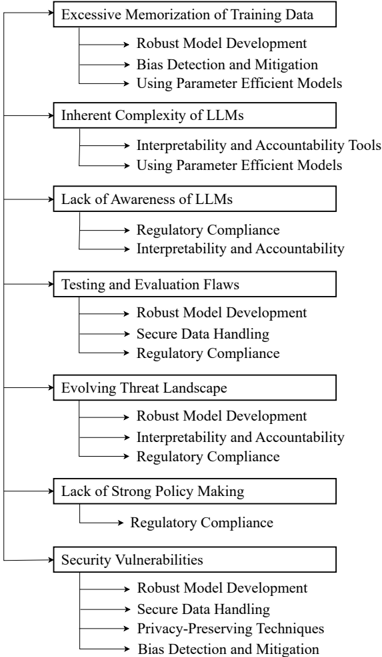
Recent advancements in Large Language Models (LLMs), such as ChatGPT and LLaMA, have significantly transformed Natural Language Processing (NLP) with their outstanding abilities in text generation, summarization, and classification. Nevertheless, their widespread adoption introduces numerous challenges, including issues related to academic integrity, copyright, environmental impacts, and ethical considerations such as data bias, fairness, and privacy. The rapid evolution of LLMs also raises concerns regarding the reliability and generalizability of their evaluations. This paper offers a comprehensive survey of the literature on these subjects, systematically gathered and synthesized from Google Scholar. Our study provides an in-depth analysis of the risks associated with specific LLMs, identifying sub-risks, their causes, and potential solutions. Furthermore, we explore the broader challenges related to LLMs, detailing their causes and proposing mitigation strategies. Through this literature analysis, our survey aims to deepen the understanding of the implications and complexities surrounding these powerful models.
Overview
The claims and statistics of this paper haven’t been checked yet.
Run the check — free, no account needed. It reads the open-access text and checks the sources it cites.
Integrity signals
Registry
Cites
Statistics
Figures
Verification
Claims the paper makes
The claims and statistics of this paper haven’t been checked yet.
Run the check — free, no account needed. It reads the open-access text and checks the sources it cites.
Claims other papers make about this one
Each is checked against this paper’s own text: does it say what the citing paper says it does?
In the citing paper
“Overall, it is generally valid to say that there are two primary sources of training materials (Sakib et al., 2024): . Dataset created by the AI company itself, often collecting data via web scraping; . Datasets curated by third parties: they can be both licensed or open-source (e.g., the ones hosted on Hugging Face, a large platform allowing the GenAI community to share a variety of tools (https”
From Generative AI and intellectual property: a systematic literature review of possible issues and mitigations (2026) · cites this paper as Sakib et al., 2024
In the citing paper
“As models increase in size, it becomes more difficult to properly ensure that input data is not used without authorisation (Sakib et al., 2024).”
From Generative AI and intellectual property: a systematic literature review of possible issues and mitigations (2026) · cites this paper as Sakib et al., 2024
In the citing paper
“In contrast, global methods analyse the model's overall behaviour by probing its internal states and training data distribution (Sakib et al., 2024).”
From Generative AI and intellectual property: a systematic literature review of possible issues and mitigations (2026) · cites this paper as Sakib et al., 2024
In the citing paper
“These compact architectures should be preferred because their reduced tendency to overfit makes them more secure (Sakib et al., 2024).”
From Generative AI and intellectual property: a systematic literature review of possible issues and mitigations (2026) · cites this paper as Sakib et al., 2024
In the citing paper
“It has 40% fewer parameters and retains 97% of the original performance while offering faster inference and better interpretability.”
From Generative AI and intellectual property: a systematic literature review of possible issues and mitigations (2026) · cites this paper as Sakib et al., 2024
Self-check
Percentages, sums and reported differences re-computed from the paper’s own numbers.
The self-check needs the paper’s full text.
Citations
The citation lists haven’t been fetched yet
Research works printed but not linked: 28
- E. M. Bender, T. Gebru, A. McMillan-Major, and S. Shmitchell. On the dangers of stochastic parrots: Can language models be too big? In Proceedings of the 2021 ACM Conference on Fairness, Accountability, and Transparency, FAccT '21, page 610-623, New York, NY, USA, 2021. Association for Computing Machinery.
- I. Chalkidis, E. Fergadiotis, P. Malakasiotis, and I. Androutsopoulos. Large-scale multi-label text classification on EU legislation. In A. Ko- rhonen, D. Traum, and L. Màrquez, editors, Proceedings of the 57th Annual Meeting of the Association for Computational Linguistics, pages 6314-6322, Florence, Italy, July 2019. Association for Computational Linguistics.
- T. Chu, Z. Song, and C. Yang. How to protect copyright data in optimization of large language models? Proceedings of the AAAI Conference on Artificial Intelligence, 38(16):17871-17879, Mar. 2024.
- A. Elrod. Uncovering theological and ethical biases in llms: An integrated hermeneutical approach employing texts from the hebrew bible. HIPHIL Novum, 9(1):2-45, Feb. 2024.
- A. Esmradi, D. W. Yip, and C. F. Chan. A comprehensive survey of attack techniques, implementation, and mitigation strategies in large language models. In G. Wang, H. Wang, G. Min, N. Georgalas, and W. Meng, editors, Ubiquitous Security, pages 76-95, Singapore, 2024. Springer Nature Singapore.
- K. Greshake, S. Abdelnabi, S. Mishra, C. Endres, T. Holz, and M. Fritz. Not what you've signed up for: Compromising real-world llm-integrated applications with indirect prompt injection. In Proceedings of the 16th ACM Workshop on Artificial Intelligence and Security, AISec '23, page 79-90, New York, NY, USA, 2023. Association for Computing Machinery.
- Y. Guo, Y. Yang, and A. Abbasi. Auto-debias: Debiasing masked language models with automated biased prompts. In S. Muresan, P. Nakov, and A. Villavicencio, editors, Proceedings of the 60th Annual Meeting of the Association for Computational Linguistics (Volume 1: Long Papers), pages 1012-1023, Dublin, Ireland, May 2022. Association for Computational Linguistics.
- M. Gupta, C. Akiri, K. Aryal, E. Parker, and L. Praharaj. From chatgpt to threatgpt: Impact of generative ai in cybersecurity and privacy. IEEE Access, 11:80218-80245, 2023.
- X. He, L. Lyu, L. Sun, and Q. Xu. Model extraction and adver- sarial transferability, your BERT is vulnerable! In K. Toutanova, A. Rumshisky, L. Zettlemoyer, D. Hakkani-Tur, I. Beltagy, S. Bethard, R. Cotterell, T. Chakraborty, and Y. Zhou, editors, Proceedings of the 2021 Conference of the North American Chapter of the Association for Computational Linguistics: Human Language Technologies, pages 2006-2012, Online, June 2021. Association for Computational Linguis- tics.
- T. Ishida, I. Yamane, T. Sakai, G. Niu, and M. Sugiyama. Do we need zero training loss after achieving zero training error? In H. D. III and A. Singh, editors, Proceedings of the 37th International Conference on Machine Learning, volume 119 of Proceedings of Machine Learning Research, pages 4604-4614. PMLR, 13-18 Jul 2020.
- D. Jin, Z. Jin, J. T. Zhou, and P. Szolovits. Is BERT really robust? A strong baseline for natural language attack on text classification and entailment. In Proceedings of the AAAI conference on artificial intelligence, volume 34, pages 8018-8025, 2020.
- E. Jo, D. A. Epstein, H. Jung, and Y.-H. Kim. Understanding the benefits and challenges of deploying conversational ai leveraging large language models for public health intervention. In Proceedings of the 2023 CHI Conference on Human Factors in Computing Systems, CHI '23, New York, NY, USA, 2023. Association for Computing Machinery.
- S. Katsarou, B. Rodríguez-Gálvez, and J. Shanahan. Measuring gender bias in contextualized embeddings. Computer Sciences & Mathe- matics Forum, 3(1), 2022.
- T. Le, N. Park, and D. Lee. SHIELD: Defending textual neural networks against multiple black-box adversarial attacks with stochastic multi-expert patcher. In S. Muresan, P. Nakov, and A. Villavicencio, editors, Proceedings of the 60th Annual Meeting of the Association for Computational Linguistics (Volume 1: Long Papers), pages 6661-6674, Dublin, Ireland, May 2022. Association for Computational Linguistics.
- L. Li, R. Ma, Q. Guo, X. Xue, and X. Qiu. BERT-ATTACK: Adversarial attack against BERT using BERT. In B. Webber, T. Cohn, Y. He, and Y. Liu, editors, Proceedings of the 2020 Conference on Empirical Methods in Natural Language Processing (EMNLP), pages 6193-6202, Online, Nov. 2020. Association for Computational Linguistics.
- Q. Liu, R. Zheng, B. Rong, J. Liu, Z. Liu, Z. Cheng, L. Qiao, T. Gui, Q. Zhang, and X. Huang. Flooding-X: Improving BERT's resistance to adversarial attacks via loss-restricted fine-tuning. In S. Muresan, P. Nakov, and A. Villavicencio, editors, Proceedings of the 60th Annual Meeting of the Association for Computational Linguistics (Volume 1: Long Papers), pages 5634-5644, Dublin, Ireland, May 2022. Association for Computational Linguistics.
- V. Liu and Y. Yin. Green ai: Exploring carbon footprints, mitigation strategies, and trade offs in large language model training. arXiv preprint arXiv:2404.01157, 2024. · arXiv
- X. Pan, M. Zhang, S. Ji, and M. Yang. Privacy risks of general-purpose language models. In 2020 IEEE Symposium on Security and Privacy (SP), pages 1314-1331, 2020.
- M. C. Rillig, M. Ågerstrand, M. Bi, K. A. Gould, and U. Sauerland. Risks and benefits of large language models for the environment. Environmental Science & Technology, 57(9):3464-3466, 2023.
- K. Takeoka, K. Akimoto, and M. Oyamada. Low-resource taxonomy enrichment with pretrained language models. In M.-F. Moens, X. Huang, L. Specia, and S. W.-t. Yih, editors, Proceedings of the 2021 Conference on Empirical Methods in Natural Language Processing, pages 2747- 2758, Online and Punta Cana, Dominican Republic, Nov. 2021. Asso- ciation for Computational Linguistics.
- Z. Tian, L. Cui, J. Liang, and S. Yu. A comprehensive survey on poisoning attacks and countermeasures in machine learning. ACM Comput. Surv., 55(8), dec 2022.
- T. Trust, J. Whalen, and C. Mouza. Editorial: Chatgpt: Challenges, opportunities, and implications for teacher education. Contemporary Issues in Technology and Teacher Education, 23(1):1-23, March 2023.
- Y. Wang, Y. Pan, M. Yan, Z. Su, and T. H. Luan. A survey on chatgpt: Ai-generated contents, challenges, and solutions. IEEE Open Journal of the Computer Society, 4(01):280-302, jan 2023.
- X. Wu, R. Duan, and J. Ni. Unveiling security, privacy, and ethical concerns of chatgpt. Journal of Information and Intelligence, 2(2):102- 115, 2024.
- J. Yang, H. Jin, R. Tang, X. Han, Q. Feng, H. Jiang, S. Zhong, B. Yin, and X. Hu. Harnessing the power of llms in practice: A survey on chatgpt and beyond. ACM Trans. Knowl. Discov. Data, 18(6), apr 2024.
- Y. Yao, J. Duan, K. Xu, Y. Cai, Z. Sun, and Y. Zhang. A survey on large language model (llm) security and privacy: The good, the bad, and the ugly. High-Confidence Computing, 4(2):100211, 2024.
- J. Zeng, J. Xu, X. Zheng, and X. Huang. Certified robustness to text adversarial attacks by randomized [MASK]. Computational Linguistics, 49(2):395-427, June 2023.
- Z. Zhou, J. Xiang, C. Chen, and S. Su. Quantifying and analyzing entity-level memorization in large language models. Proceedings of the AAAI Conference on Artificial Intelligence, 38(17):19741-19749, Mar. 2024.
Metadata
- Authors
- Sakib, M. N., Islam, M. A., Pathak, R., & Arifin, M. M.
- Venue
- arXiv
- Publisher
- arXiv
- Published
- 2024
- arXiv
- 2408.04643
- Type
- Preprint
About these checks
Registry, retraction, Cites and statistics results are computed, not judged, with one exception: a printed reference that no index lists is read once by a model before it counts as a citation error. Claims are extracted by a model and kept only when their quote appears verbatim in the text; each cited source is then checked, with a model’s help, for whether it says what the claim relies on. Those verdicts can be wrong — read the claim’s quote and the cited source before relying on one.
Statistics and arithmetic are recomputed, not judged.
Confidence bands are shown only for fields calibrated on our annotated test set. None is calibrated yet, so no band is shown.
What counts as a claim ›How we measure confidence ›How we check this ›
Are you an author, or do you see a problem with this page? Request a review
How to cite
Cite CoChat for the checks on this page, and the paper for its own findings.
- This page
- CoChat. (2026). Citation check: Risks, Causes, and Mitigations of Widespread Deployments of Large Language Models (LLMs): A Survey. https://app.cochat.ai/papers/10.48550/arxiv.2408.04643
- The paper
- Sakib, M. N., Islam, M. A., Pathak, R., & Arifin, M. M. (2024). Risks, Causes, and Mitigations of Widespread Deployments of Large Language Models (LLMs): A Survey. arXiv. https://doi.org/10.48550/arxiv.2408.04643
