

The DOI matches its DataCite record.
Eigen Attention: Attention in Low-Rank Space for KV Cache Compression
Open accessAbstract
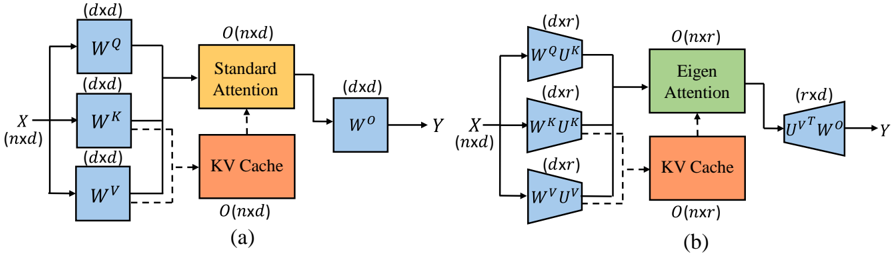
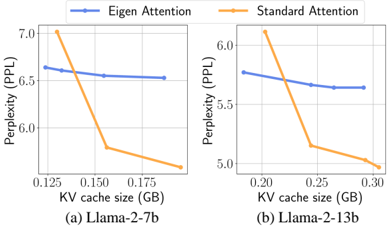
Large language models (LLMs) represent a groundbreaking advancement in the domain of natural language processing due to their impressive reasoning abilities. Recently, there has been considerable interest in increasing the context lengths for these models to enhance their applicability to complex tasks. However, at long context lengths and large batch sizes, the key-value (KV) cache, which stores the attention keys and values, emerges as the new bottleneck in memory usage during inference. To address this, we propose Eigen Attention, which performs the attention operation in a low-rank space, thereby reducing the KV cache memory overhead. Our proposed approach is orthogonal to existing KV cache compression techniques and can be used synergistically with them. Through extensive experiments over OPT, MPT, and Llama model families, we demonstrate that Eigen Attention results in up to 40% reduction in KV cache sizes and up to 60% reduction in attention operation latency with minimal drop in performance. Code is available at https://github.com/UtkarshSaxena1/EigenAttn.
Overview
The claims and statistics of this paper haven’t been checked yet.
Run the check — free, no account needed. It reads the open-access text and checks the sources it cites.
Integrity signals
Registry
Cites
Statistics
Figures
Verification
Claims the paper makes
The claims and statistics of this paper haven’t been checked yet.
Run the check — free, no account needed. It reads the open-access text and checks the sources it cites.
Claims other papers make about this one
Each is checked against this paper’s own text: does it say what the citing paper says it does?
The cited source says what the claim attributes to it.
In the citing paper
“Palu (Chang et al. 2025) and Eigen Attention (Saxena et al. 2024) project the cache onto a fixed low-rank subspace: they discard no token, but assign every token the same rank.”
From VarRate: Training-Free Variable-Rate KV Cache Compression for Long-Context LLMs (2026) · cites this paper as Saxena et al. 2024
The check wasn’t confident either way, so it gives no verdict — never disputed.
In the citing paper
“None of these works has considered assigning different ranks to tokens with varying levels of importance.”
From Beyond Token Eviction: Mixed-Dimension Budget Allocation for Efficient KV Cache Compression (2026) · cites this paper as Saxena et al., 2024
Experimental — accuracy not yet measured
Self-check
Percentages, sums and reported differences re-computed from the paper’s own numbers.
The self-check needs the paper’s full text.
Citations
Cites
Still being checked.
Research works printed but not linked: 40
- Josh Achiam, Steven Adler, Sandhini Agarwal, Lama Ahmad, Ilge Akkaya, Florencia Leoni Aleman, Diogo Almeida, Janko Altenschmidt, Sam Altman, Shyamal Anadkat, et al. 2023. Gpt-4 technical report. arXiv preprint arXiv:2303.08774. · arXiv
- Muhammad Adnan, Akhil Arunkumar, Gaurav Jain, Prashant J. Nair, Ilya Soloveychik, and Purushotham Kamath. 2024. Keyformer: Kv cache reduction through key tokens selection for efficient generative inference. Preprint, arXiv:2403.09054. · arXiv
- Joshua Ainslie, James Lee-Thorp, Michiel de Jong, Yury Zemlyanskiy, Federico Lebrón, and Sumit Sanghai. 2023. Gqa: Training generalized multi-query trans- former models from multi-head checkpoints. arXiv preprint arXiv:2305.13245. · arXiv
- Iz Beltagy, Matthew E. Peters, and Arman Cohan. 2020. Longformer: The long-document transformer. CoRR, abs/2004.05150. · arXiv
- Yonatan Bisk, Rowan Zellers, Jianfeng Gao, Yejin Choi, et al. 2020. Piqa: Reasoning about physical com- monsense in natural language. In Proceedings of the AAAI conference on artificial intelligence, volume 34, pages 7432-7439.
- Peter Clark, Isaac Cowhey, Oren Etzioni, Tushar Khot, Ashish Sabharwal, Carissa Schoenick, and Oyvind Tafjord. 2018. Think you have solved question an- swering? try arc, the ai2 reasoning challenge. arXiv preprint arXiv:1803.05457. · arXiv
- Yiran Ding, Li Lyna Zhang, Chengruidong Zhang, Yuanyuan Xu, Ning Shang, Jiahang Xu, Fan Yang, and Mao Yang. 2024. Longrope: Extending llm con- text window beyond 2 million tokens. arXiv preprint arXiv:2402.13753. · arXiv
- Jesse Dodge, Maarten Sap, Ana Marasović, William Agnew, Gabriel Ilharco, Dirk Groeneveld, Margaret Mitchell, and Matt Gardner. 2021. Documenting large webtext corpora: A case study on the colossal clean crawled corpus. Preprint, arXiv:2104.08758. · arXiv
- Ruili Feng, Kecheng Zheng, Yukun Huang, Deli Zhao, Michael Jordan, and Zheng-Jun Zha. 2022. Rank diminishing in deep neural networks. In Proceedings of the 36th International Conference on Neural In- formation Processing Systems, NIPS '22, Red Hook, NY, USA.
- Coleman Hooper, Sehoon Kim, Hiva Mohammadzadeh, Michael W. Mahoney, Yakun Sophia Shao, Kurt Keutzer, and Amir Gholami. 2024. Kvquant: To- wards 10 million context length llm inference with kv cache quantization. Preprint, arXiv:2401.18079. · arXiv
- Yen-Chang Hsu, Ting Hua, Sungen Chang, Qian Lou, Yilin Shen, and Hongxia Jin. 2022. Language model compression with weighted low-rank factorization. In International Conference on Learning Representa- tions.
- Edward J Hu, Yelong Shen, Phillip Wallis, Zeyuan Allen-Zhu, Yuanzhi Li, Shean Wang, Lu Wang, and Weizhu Chen. 2022. LoRA: Low-rank adaptation of large language models. In International Conference on Learning Representations.
- Hao Kang, Qingru Zhang, Souvik Kundu, Geonhwa Jeong, Zaoxing Liu, Tushar Krishna, and Tuo Zhao. 2024. Gear: An efficient kv cache compression recipe for near-lossless generative inference of llm. Preprint, arXiv:2403.05527. · arXiv
- Ayush Kaushal, Tejas Vaidhya, and Irina Rish. 2023. Lord: Low rank decomposition of monolingual code llms for one-shot compression. Preprint, arXiv:2309.14021. · arXiv
- Woosuk Kwon, Zhuohan Li, Siyuan Zhuang, Ying Sheng, Lianmin Zheng, Cody Hao Yu, Joseph E. Gonzalez, Hao Zhang, and Ion Stoica. 2023a. Ef- ficient memory management for large language model serving with pagedattention. Preprint, arXiv:2309.06180. · arXiv
- Woosuk Kwon, Zhuohan Li, Siyuan Zhuang, Ying Sheng, Lianmin Zheng, Cody Hao Yu, Joseph E. Gonzalez, Hao Zhang, and Ion Stoica. 2023b. Effi- cient memory management for large language model serving with pagedattention. In Proceedings of the ACM SIGOPS 29th Symposium on Operating Systems Principles.
- Yixiao Li, Yifan Yu, Qingru Zhang, Chen Liang, Pengcheng He, Weizhu Chen, and Tuo Zhao. 2023. LoSparse: Structured compression of large language models based on low-rank and sparse approximation. In Proceedings of the 40th International Conference on Machine Learning, volume 202 of Proceedings of Machine Learning Research, pages 20336-20350.
- PMLR.
- Yuhong Li, Yingbing Huang, Bowen Yang, Bharat Venkitesh, Acyr Locatelli, Hanchen Ye, Tianle Cai, Patrick Lewis, and Deming Chen. 2024. Snapkv: Llm knows what you are looking for before genera- tion. arXiv preprint arXiv:2404.14469. · arXiv
- Ji Lin, Jiaming Tang, Haotian Tang, Shang Yang, Wei-Ming Chen, Wei-Chen Wang, Guangxuan Xiao, Xingyu Dang, Chuang Gan, and Song Han. 2024. Awq: Activation-aware weight quantization for llm compression and acceleration. Preprint, arXiv:2306.00978. · arXiv
- Zichang Liu, Aditya Desai, Fangshuo Liao, Weitao Wang, Victor Xie, Zhaozhuo Xu, Anastasios Kyril- lidis, and Anshumali Shrivastava. 2024. Scis- sorhands: Exploiting the persistence of importance hypothesis for llm kv cache compression at test time. Advances in Neural Information Processing Systems, 36. Llama-3. Introducing meta llama 3: The most capable openly available llm to date. Accessed: 2010-06-07.
- Stephen Merity, Caiming Xiong, James Bradbury, and Richard Socher. 2016. Pointer sentinel mixture mod- els. arXiv preprint arXiv:1609.07843. · arXiv
- Yue Niu, Saurav Prakash, and Salman Avestimehr. 2024. Atp: Enabling fast llm serving via attention on top principal keys. Preprint, arXiv:2403.02352. · arXiv
- Adam Paszke, Sam Gross, Francisco Massa, Adam Lerer, James Bradbury, Gregory Chanan, Trevor Killeen, Zeming Lin, Natalia Gimelshein, Luca Antiga, et al. 2019. Pytorch: An imperative style, high-performance deep learning library. Advances in neural information processing systems, 32.
- Reiner Pope, Sholto Douglas, Aakanksha Chowdhery, Jacob Devlin, James Bradbury, Anselm Levskaya, Jonathan Heek, Kefan Xiao, Shivani Agrawal, and Jeff Dean. 2022. Efficiently scaling transformer in- ference. Preprint, arXiv:2211.05102. · arXiv
- Ofir Press, Noah A Smith, and Mike Lewis. 2021. Train short, test long: Attention with linear biases enables input length extrapolation. arXiv preprint arXiv:2108.12409. · arXiv
- Gobinda Saha, Isha Garg, and Kaushik Roy. 2021. Gra- dient projection memory for continual learning. In International Conference on Learning Representa- tions.
- Keisuke Sakaguchi, Ronan Le Bras, Chandra Bhagavat- ula, and Yejin Choi. 2021. Winogrande: An adver- sarial winograd schema challenge at scale. Commu- nications of the ACM, 64(9):99-106.
- Noam Shazeer. 2019. Fast transformer decoding: One write-head is all you need. arXiv preprint arXiv:1911.02150. · arXiv
- Hugo Touvron, Louis Martin, Kevin Stone, Peter Al- bert, Amjad Almahairi, Yasmine Babaei, Nikolay Bashlykov, Soumya Batra, Prajjwal Bhargava, Shruti Bhosale, Dan Bikel, Lukas Blecher, Cristian Canton Ferrer, Moya Chen, Guillem Cucurull, David Esiobu, Jude Fernandes, Jeremy Fu, Wenyin Fu, Brian Fuller, Cynthia Gao, Vedanuj Goswami, Naman Goyal, An- thony Hartshorn, Saghar Hosseini, Rui Hou, Hakan Inan, Marcin Kardas, Viktor Kerkez, Madian Khabsa, Isabel Kloumann, Artem Korenev, Punit Singh Koura, Marie-Anne Lachaux, Thibaut Lavril, Jenya Lee, Di- ana Liskovich, Yinghai Lu, Yuning Mao, Xavier Mar- tinet, Todor Mihaylov, Pushkar Mishra, Igor Moly- bog, Yixin Nie, Andrew Poulton, Jeremy Reizen- stein, Rashi Rungta, Kalyan Saladi, Alan Schelten, Ruan Silva, Eric Michael Smith, Ranjan Subrama- nian, Xiaoqing Ellen Tan, Binh Tang, Ross Tay- lor, Adina Williams, Jian Xiang Kuan, Puxin Xu, Zheng Yan, Iliyan Zarov, Yuchen Zhang, Angela Fan, Melanie Kambadur, Sharan Narang, Aurelien Ro- driguez, Robert Stojnic, Sergey Edunov, and Thomas Scialom. 2023. Llama 2: Open foundation and fine- tuned chat models. Preprint, arXiv:2307.09288. · arXiv
- Thomas Wolf, Lysandre Debut, Victor Sanh, Julien Chaumond, Clement Delangue, Anthony Moi, Pier- ric Cistac, Tim Rault, Rémi Louf, Morgan Funtow- icz, Joe Davison, Sam Shleifer, Patrick von Platen, Clara Ma, Yacine Jernite, Julien Plu, Canwen Xu, Teven Le Scao, Sylvain Gugger, Mariama Drame, Quentin Lhoest, and Alexander M. Rush. 2020. Hug- gingface's transformers: State-of-the-art natural lan- guage processing. Preprint, arXiv:1910.03771. · arXiv
- Haoyi Wu and Kewei Tu. 2024. Layer-condensed kv cache for efficient inference of large language models. Preprint, arXiv:2405.10637. · arXiv
- June Yong Yang, Byeongwook Kim, Jeongin Bae, Beomseok Kwon, Gunho Park, Eunho Yang, Se Jung Kwon, and Dongsoo Lee. 2024. No token left be- hind: Reliable kv cache compression via importance- aware mixed precision quantization. Preprint, arXiv:2402.18096. · arXiv
- Hao Yu and Jianxin Wu. 2023. Compressing trans- formers: Features are low-rank, but weights are not! Proceedings of the AAAI Conference on Artificial Intelligence, 37(9):11007-11015. · DOI
- Rowan Zellers, Ari Holtzman, Yonatan Bisk, Ali Farhadi, and Yejin Choi. 2019. Hellaswag: Can a machine really finish your sentence? arXiv preprint arXiv:1905.07830. · arXiv
- Peitian Zhang, Zheng Liu, Shitao Xiao, Ninglu Shao, Qiwei Ye, and Zhicheng Dou. 2024a. Soaring from 4k to 400k: Extending llm's context with activation beacon. arXiv preprint arXiv:2401.03462. · arXiv
- Susan Zhang, Stephen Roller, Naman Goyal, Mikel Artetxe, Moya Chen, Shuohui Chen, Christopher De- wan, Mona Diab, Xian Li, Xi Victoria Lin, et al. 2022. Opt: Open pre-trained transformer language models. arXiv preprint arXiv:2205.01068. · arXiv
- Yichi Zhang, Bofei Gao, Tianyu Liu, Keming Lu, Wayne Xiong, Yue Dong, Baobao Chang, Junjie Hu, Wen Xiao, et al. 2024b. Pyramidkv: Dynamic kv cache compression based on pyramidal information funneling. arXiv preprint arXiv:2406.02069. · arXiv
- Zhenyu Zhang, Ying Sheng, Tianyi Zhou, Tianlong Chen, Lianmin Zheng, Ruisi Cai, Zhao Song, Yuan- dong Tian, Christopher Ré, Clark Barrett, Zhangyang Wang, and Beidi Chen. 2023. H 2 o: Heavy-hitter ora- cle for efficient generative inference of large language models. Preprint, arXiv:2306.14048. · arXiv
- Zirui Liu, Jiayi Yuan, Hongye Jin, Shaochen Zhong, Zhaozhuo Xu, Vladimir Braverman, Beidi Chen, and Xia Hu. 2024. Kivi : Plug-and-play 2bit kv cache quantization with streaming asymmetric quantiza- tion. · DOI · Paper page
Cited by
Sorted by citations
Beyond Token Eviction: Mixed-Dimension Budget Allocation for Efficient KV Cache Compression
Miao, R., Wang, Z., Li, W., Wu, S., Liu, S., Jiang, Y., & Yang, T. (2026) · arXiv · doi:10.48550/arxiv.2603.20616
“In this section, we implement our solution in FlashAttention (Dao, 2023) and evaluate the inference efficiency on Llama-3-8B-Instruct-1048K.”
VarRate: Training-Free Variable-Rate KV Cache Compression for Long-Context LLMs
Esmat, S., Shah, D., & Jannesari, A. (2026) · arXiv · doi:10.48550/arxiv.2607.15498
OjaKV: Context-Aware Online Low-Rank KV Cache Compression
Zhu, Y., Yang, D. H., Amiri, M. M., Murugesan, K., Pedapati, T., & Chen, P.-Y. (2025) · arXiv · doi:10.48550/arxiv.2509.21623
Cartridges: Lightweight and general-purpose long context representations via self-study
Eyuboglu, S., Ehrlich, R., Arora, S., Guha, N., Zinsley, D., Liu, E., Tennien, W., Rudra, A., Zou, J., Mirhoseini, A., et al. (2025) · arXiv · doi:10.48550/arxiv.2506.06266
Metadata
- Authors
- Saxena, U., Saha, G., Choudhary, S., & Roy, K.
- Affiliations
- Purdue University West Lafayette (US)
- Venue
- arXiv
- Publisher
- arXiv
- Published
- 2024
- Pages
- 15332-15344
- arXiv
- 2408.05646
- OpenAlex
- W4404781139
- Cited by
- 4
- References
- 0
- Citations by year
- 2026: 3 · 2025: 1
- FWCI
- 1.18
- Type
- conference paper
- Language
- en
- Open access
- hybrid
- doi.org
- Licence
- Locations
- Findings of the Association for Computational Linguistics: EMNLP (Findings of EMNLP) (publishedVersion, cc-by)
- arXiv (Cornell University) (submittedVersion, cc-by)
- arXiv (Cornell University) (cc-by)
- Funders
- National Science Foundation
- U.S. Department of Energy
- Semiconductor Research Corporation
- Defense Advanced Research Projects Agency
- Topics
- Physical Sciences › Computer Science › Artificial Intelligence › Topic Modeling
- Physical Sciences › Computer Science › Artificial Intelligence › Natural Language Processing Techniques
- Physical Sciences › Computer Science › Computer Vision and Pattern Recognition › Advanced Neural Network Applications
- Keywords
- key-value cache compression, large language models
About these checks
Registry, retraction, Cites and statistics results are computed, not judged, with one exception: a printed reference that no index lists is read once by a model before it counts as a citation error. Claims are extracted by a model and kept only when their quote appears verbatim in the text; each cited source is then checked, with a model’s help, for whether it says what the claim relies on. Those verdicts can be wrong — read the claim’s quote and the cited source before relying on one.
Statistics and arithmetic are recomputed, not judged.
Confidence bands are shown only for fields calibrated on our annotated test set. None is calibrated yet, so no band is shown.
What counts as a claim ›How we measure confidence ›How we check this ›
Are you an author, or do you see a problem with this page? Request a review
How to cite
Cite CoChat for the checks on this page, and the paper for its own findings.
- This page
- CoChat. (2026). Citation check: Eigen Attention: Attention in Low-Rank Space for KV Cache Compression. https://app.cochat.ai/papers/10.48550/arxiv.2408.05646
- The paper
- Saxena, U., Saha, G., Choudhary, S., & Roy, K. (2024). Eigen Attention: Attention in Low-Rank Space for KV Cache Compression. arXiv. https://doi.org/10.48550/arxiv.2408.05646
