

The DOI matches its DataCite record; 2 of the 2 references it cites were found in a registry or an index.
Mutual Reasoning Makes Smaller LLMs Stronger Problem-Solvers
Open accessAbstract
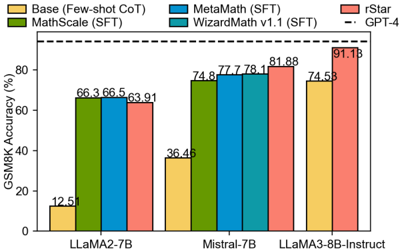
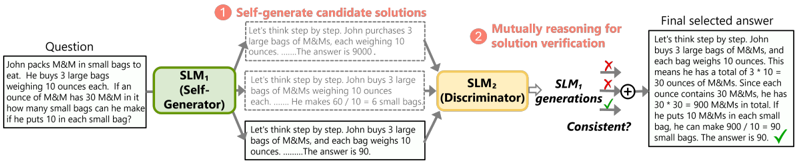
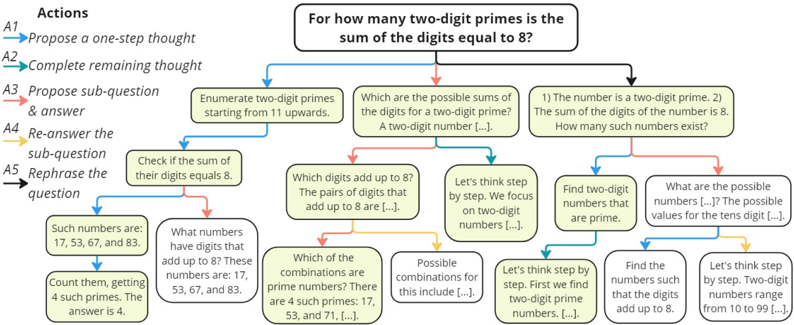
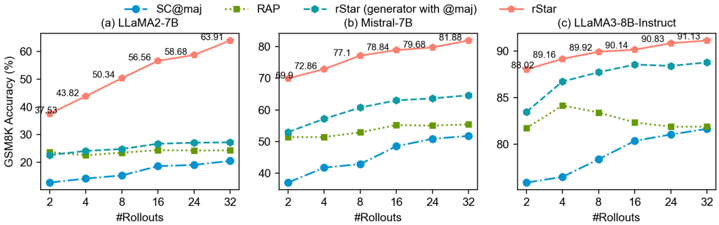
This paper introduces rStar, a self-play mutual reasoning approach that significantly improves reasoning capabilities of small language models (SLMs) without fine-tuning or superior models. rStar decouples reasoning into a self-play mutual generation-discrimination process. First, a target SLM augments the Monte Carlo Tree Search (MCTS) with a rich set of human-like reasoning actions to construct higher quality reasoning trajectories. Next, another SLM, with capabilities similar to the target SLM, acts as a discriminator to verify each trajectory generated by the target SLM. The mutually agreed reasoning trajectories are considered mutual consistent, thus are more likely to be correct. Extensive experiments across five SLMs demonstrate rStar can effectively solve diverse reasoning problems, including GSM8K, GSM-Hard, MATH, SVAMP, and StrategyQA. Remarkably, rStar boosts GSM8K accuracy from 12.51% to 63.91% for LLaMA2-7B, from 36.46% to 81.88% for Mistral-7B, from 74.53% to 91.13% for LLaMA3-8B-Instruct. Code will be available at https://github.com/zhentingqi/rStar.
Overview
The claims and statistics of this paper haven’t been checked yet.
Run the check — free, no account needed. It reads the open-access text and checks the sources it cites.
Integrity signals
Registry
Cites
Statistics
Figures
Verification
Claims the paper makes
The claims and statistics of this paper haven’t been checked yet.
Run the check — free, no account needed. It reads the open-access text and checks the sources it cites.
Self-check
Percentages, sums and reported differences re-computed from the paper’s own numbers.
The self-check needs the paper’s full text.
Citations
Cites
Jiang, A. Q., Sablayrolles, A., Mensch, A., Bamford, C., Chaplot, D. S., Casas, D. D. L., Bressand, F., Lengyel, G., Lample, G., Saulnier, L., et al. (2023) · arXiv · doi:10.48550/arxiv.2310.06825 · Cited by 340
Large Language Models Can Self-Correct with Key Condition Verification
Wu, Z., Zeng, Q., Zhang, Z., Tan, Z., Shen, C., & Jiang, M. (2024) · Proceedings of the 2024 Conference on Empirical Methods in Natural Language Processing · doi:10.18653/v1/2024.emnlp-main.714 · Cited by 36
Research works printed but not linked: 37
- Marah Abdin, Sam Ade Jacobs, Ammar Ahmad Awan, Jyoti Aneja, Ahmed Awadallah, Hany Awadalla, Nguyen Bach, Amit Bahree, Arash Bakhtiari, Harkirat Behl, et al. Phi-3 technical report: A highly capable language model locally on your phone. arXiv preprint arXiv:2404.14219, 2024. · arXiv
- Maciej Besta, Nils Blach, Ales Kubicek, Robert Gerstenberger, Michal Podstawski, Lukas Gianinazzi, Joanna Gajda, Tomasz Lehmann, Hubert Niewiadomski, Piotr Nyczyk, et al. Graph of thoughts: Solving elaborate problems with large language models. In Proceedings of the AAAI Conference on Artificial Intelligence, volume 38, pp. 17682-17690, 2024.
- Bradley Brown, Jordan Juravsky, Ryan Ehrlich, Ronald Clark, Quoc V Le, Christopher Ré, and Azalia Mirhoseini. Large language monkeys: Scaling inference compute with repeated sampling. arXiv preprint arXiv:2407.21787, 2024. · arXiv
- Wenhu Chen, Xueguang Ma, Xinyi Wang, and William W Cohen. Program of thoughts prompt- ing: Disentangling computation from reasoning for numerical reasoning tasks. arXiv preprint arXiv:2211.12588, 2022. · arXiv
- Zixiang Chen, Yihe Deng, Huizhuo Yuan, Kaixuan Ji, and Quanquan Gu. Self-play fine-tuning converts weak language models to strong language models. arXiv preprint arXiv:2401.01335, 2024b. · arXiv
- Karl Cobbe, Vineet Kosaraju, Mohammad Bavarian, Mark Chen, Heewoo Jun, Lukasz Kaiser, Matthias Plappert, Jerry Tworek, Jacob Hilton, Reiichiro Nakano, et al. Training verifiers to solve math word problems. arXiv preprint arXiv:2110.14168, 2021. · arXiv
- Ruomeng Ding, Chaoyun Zhang, Lu Wang, Yong Xu, Minghua Ma, Wei Zhang, Si Qin, Saravan Rajmohan, Qingwei Lin, and Dongmei Zhang. Everything of thoughts: Defying the law of penrose triangle for thought generation. arXiv preprint arXiv:2311.04254, 2023. · arXiv
- Xidong Feng, Ziyu Wan, Muning Wen, Ying Wen, Weinan Zhang, and Jun Wang. Alphazero-like tree- search can guide large language model decoding and training. arXiv preprint arXiv:2309.17179, 2023. · arXiv
- Luyu Gao, Aman Madaan, Shuyan Zhou, Uri Alon, Pengfei Liu, Yiming Yang, Jamie Callan, and Graham Neubig. Pal: Program-aided language models. arXiv preprint arXiv:2211.10435, 2022. · arXiv
- Zelalem Gero, Chandan Singh, Hao Cheng, Tristan Naumann, Michel Galley, Jianfeng Gao, and Hoifung Poon. Self-verification improves few-shot clinical information extraction. arXiv preprint arXiv:2306.00024, 2023. · arXiv
- Mor Geva, Daniel Khashabi, Elad Segal, Tushar Khot, Dan Roth, and Jonathan Berant. Did aristotle use a laptop? a question answering benchmark with implicit reasoning strategies. Transactions of the Association for Computational Linguistics, 9:346-361, 2021. URL https://huggingface. co/datasets/ChilleD/StrategyQA.
- Zhibin Gou, Zhihong Shao, Yeyun Gong, Yujiu Yang, Minlie Huang, Nan Duan, Weizhu Chen, et al. Tora: A tool-integrated reasoning agent for mathematical problem solving. arXiv preprint arXiv:2309.17452, 2023. · arXiv
- Shibo Hao, Yi Gu, Haodi Ma, Joshua Jiahua Hong, Zhen Wang, Daisy Zhe Wang, and Zhiting Hu. Reasoning with language model is planning with world model. arXiv preprint arXiv:2305.14992, 2023. · arXiv
- Dan Hendrycks, Collin Burns, Saurav Kadavath, Akul Arora, Steven Basart, Eric Tang, Dawn Song, and Jacob Steinhardt. Measuring mathematical problem solving with the math dataset. arXiv preprint arXiv:2103.03874, 2021. · arXiv
- Jie Huang, Xinyun Chen, Swaroop Mishra, Huaixiu Steven Zheng, Adams Wei Yu, Xinying Song, and Denny Zhou. Large language models cannot self-correct reasoning yet. arXiv preprint arXiv:2310.01798, 2023. · arXiv
- Jikun Kang, Xin Zhe Li, Xi Chen, Amirreza Kazemi, and Boxing Chen. Mindstar: Enhancing math reasoning in pre-trained llms at inference time. arXiv preprint arXiv:2405.16265, 2024. · arXiv
- Tushar Khot, Harsh Trivedi, Matthew Finlayson, Yao Fu, Kyle Richardson, Peter Clark, and Ashish Sabharwal. Decomposed prompting: A modular approach for solving complex tasks. arXiv preprint arXiv:2210.02406, 2022. · arXiv
- Levente Kocsis and Csaba Szepesvári. Bandit based monte-carlo planning. volume 2006, pp. 282-293, 09 2006. ISBN 978-3-540-45375-8. doi: 10.1007/11871842_29. · DOI
- Takeshi Kojima, Shixiang Shane Gu, Machel Reid, Yutaka Matsuo, and Yusuke Iwasawa. Large language models are zero-shot reasoners. Advances in neural information processing systems, 35: 22199-22213, 2022.
- Chen Li, Weiqi Wang, Jingcheng Hu, Yixuan Wei, Nanning Zheng, Han Hu, Zheng Zhang, and Houwen Peng. Common 7b language models already possess strong math capabilities. arXiv preprint arXiv:2403.04706, 2024. · arXiv
- Hunter Lightman, Vineet Kosaraju, Yura Burda, Harri Edwards, Bowen Baker, Teddy Lee, Jan Leike, John Schulman, Ilya Sutskever, and Karl Cobbe. Let's verify step by step. arXiv preprint arXiv:2305.20050, 2023. · arXiv
- Aman Madaan, Niket Tandon, Prakhar Gupta, Skyler Hallinan, Luyu Gao, Sarah Wiegreffe, Uri Alon, Nouha Dziri, Shrimai Prabhumoye, Yiming Yang, et al. Self-refine: Iterative refinement with self-feedback. Advances in Neural Information Processing Systems, 36, 2024.
- Arkil Patel, Satwik Bhattamishra, and Navin Goyal. Are nlp models really able to solve simple math word problems? In Proceedings of the 2021 Conference of the North American Chapter of the Association for Computational Linguistics: Human Language Technologies, pp. 2080-2094, 2021.
- Subhro Roy and Dan Roth. Solving General Arithmetic Word Problems. In Proc. of the Conference on Empirical Methods in Natural Language Processing (EMNLP), 2015. URL http://cogcomp. org/papers/arithmetic.pdf.
- David Silver, Thomas Hubert, Julian Schrittwieser, Ioannis Antonoglou, Matthew Lai, Arthur Guez, Marc Lanctot, Laurent Sifre, Dharshan Kumaran, Thore Graepel, et al. Mastering chess and shogi by self-play with a general reinforcement learning algorithm. arXiv preprint arXiv:1712.01815, 2017. · arXiv
- Charlie Snell, Jaehoon Lee, Kelvin Xu, and Aviral Kumar. Scaling llm test-time compute optimally can be more effective than scaling model parameters, 2024. URL https://arxiv.org/abs/2408. 03314.
- Karthik Valmeekam, Alberto Olmo, Sarath Sreedharan, and Subbarao Kambhampati. Large language models still can't plan (a benchmark for LLMs on planning and reasoning about change). In NeurIPS 2022 Foundation Models for Decision Making Workshop, 2022. URL https://openreview.net/forum?id=wUU-7XTL5XO.
- Ke Wang, Houxing Ren, Aojun Zhou, Zimu Lu, Sichun Luo, Weikang Shi, Renrui Zhang, Linqi Song, Mingjie Zhan, and Hongsheng Li. Mathcoder: Seamless code integration in LLMs for enhanced mathematical reasoning. In The Twelfth International Conference on Learning Representations, 2024a. URL https://openreview.net/forum?id=z8TW0ttBPp.
- Xuezhi Wang, Jason Wei, Dale Schuurmans, Quoc V Le, Ed H. Chi, Sharan Narang, Aakanksha Chowdhery, and Denny Zhou. Self-consistency improves chain of thought reasoning in language models. In The Eleventh International Conference on Learning Representations, 2023. URL https://openreview.net/forum?id=1PL1NIMMrw.
- Jason Wei, Xuezhi Wang, Dale Schuurmans, Maarten Bosma, Fei Xia, Ed Chi, Quoc V Le, Denny Zhou, et al. Chain-of-thought prompting elicits reasoning in large language models. Advances in Neural Information Processing Systems, 35:24824-24837, 2022.
- Zhenyu Wu, Qingkai Zeng, Zhihan Zhang, Zhaoxuan Tan, Chao Shen, and Meng Jiang. Large language models can self-correct with minimal effort. arXiv preprint arXiv:2405.14092, 2024. · arXiv
- Shunyu Yao, Dian Yu, Jeffrey Zhao, Izhak Shafran, Tom Griffiths, Yuan Cao, and Karthik Narasimhan. Tree of thoughts: Deliberate problem solving with large language models. Advances in Neural Information Processing Systems, 36, 2024.
- Di Zhang, Jiatong Li, Xiaoshui Huang, Dongzhan Zhou, Yuqiang Li, and Wanli Ouyang. Accessing gpt-4 level mathematical olympiad solutions via monte carlo tree self-refine with llama-3 8b. arXiv preprint arXiv:2406.07394, 2024. · arXiv
- Huaixiu Steven Zheng, Swaroop Mishra, Xinyun Chen, Heng-Tze Cheng, Ed H Chi, Quoc V Le, and Denny Zhou. Take a step back: Evoking reasoning via abstraction in large language models. arXiv preprint arXiv:2310.06117, 2023. · arXiv
- Aojun Zhou, Ke Wang, Zimu Lu, Weikang Shi, Sichun Luo, Zipeng Qin, Shaoqing Lu, Anya Jia, Linqi Song, Mingjie Zhan, et al. Solving challenging math word problems using gpt-4 code interpreter with code-based self-verification. arXiv preprint arXiv:2308.07921, 2023. · arXiv
- Denny Zhou, Nathanael Schärli, Le Hou, Jason Wei, Nathan Scales, Xuezhi Wang, Dale Schuurmans, Claire Cui, Olivier Bousquet, Quoc V Le, et al. Least-to-most prompting enables complex reasoning in large language models. In The Eleventh International Conference on Learning Representations, 2022.
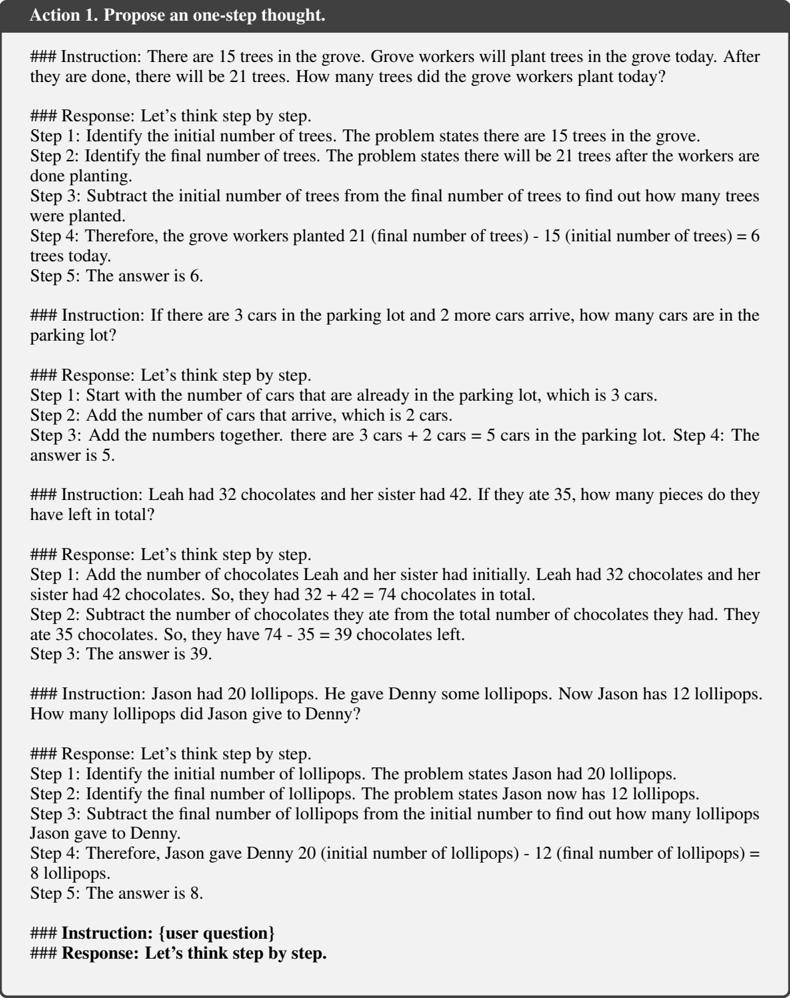
- Pei Zhou, Jay Pujara, Xiang Ren, Xinyun Chen, Heng-Tze Cheng, Quoc V Le, Ed H Chi, Denny Zhou, Swaroop Mishra, and Huaixiu Steven Zheng. Self-discover: Large language models self-compose reasoning structures. arXiv preprint arXiv:2402.03620, 2024. Action 2: Propose the remaining thought steps /A4: Answer the sub-question again. ### Instruction: There are 15 trees in the grove. Grove workers will plant trees in the grove today. After they are done, there will be 21 trees. How many trees did the grove workers plant today? ### Response: Let's think step by step. There are 15 trees originally. Then there were 21 trees after some more were planted. So there must have been 21 -15 = 6. The answer is: 6. ### Instruction: If there are 3 cars in the parking lot and 2 more cars arrive, how many cars are in the parking lot? ### Response: Let's think step by step. There are originally 3 cars. 2 more cars arrive. 3 + 2 = 5. The answer is: 5. ### Instruction: Leah had 32 chocolates and her sister had 42. If they ate 35, how many pieces do they have left in total? ### Response: Let's think step by step. Originally, Leah had 32 chocolates. Her sister had 42. So in total they had 32 + 42 = 74. After eating 35, they had 74 -35 = 39. The answer is: 39. ### Instruction: Jason had 20 lollipops. He gave Denny some lollipops. Now Jason has 12 lollipops. How many lollipops did Jason give to Denny? ### Response: Let's think step by step. Jason started with 20 lollipops. Then he had 12 after giving some to Denny. So he gave Denny 20 -12 = 8. The answer is: 8. ### Instruction: Shawn has five toys. For Christmas, he got two toys each from his mom and dad. How many toys does he have now? ### Response: Let's think step by step. Shawn started with 5 toys. If he got 2 toys each from his mom and dad, then that is 4 more toys. 5 + 4 = 9. The answer is: 9. ### Instruction: There were nine computers in the server room. Five more computers were installed each day, from monday to thursday. How many computers are now in the server room? ### Response: Let's think step by step. There were originally 9 computers. For each of 4 days, 5 more computers were added. So 5 * 4 = 20 computers were added. 9 + 20 is 29. The answer is: 29. ### Instruction: Michael had 58 golf balls. On tuesday, he lost 23 golf balls. On wednesday, he lost 2 more. How many golf balls did he have at the end of wednesday? ### Response: Let's think step by step. Michael started with 58 golf balls. After losing 23 on tuesday, he had 58 -23 = 35. After losing 2 more, he had 35 -2 = 33 golf balls. The answer is: 33. ### Instruction: Olivia has $23. She bought five bagels for $3 each. How much money does she have left? ### Response: Let's think step by step. Olivia had 23 dollars. 5 bagels for 3 dollars each will be 5 x 3 = 15 dollars. So she has 23 -15 dollars left. 23 -15 is 8. The answer is: 8. ### Instruction: {user question} ### Response: · arXiv
Cited by
Sorted by citations
Unveiling the Key Factors for Distilling Chain-of-Thought Reasoning
Chen, X., Sun, Z., Wenjin, G., Zhang, M., Chen, Y., Sun, Y., Su, H., Pan, Y., Klakow, D., Li, W., et al. (2025) · Findings of the Association for Computational Linguistics: ACL 2025 · doi:10.18653/v1/2025.findings-acl.782 · Cited by 7
Self-Critique Guided Iterative Reasoning for Multi-hop Question Answering
Chu, Z., Fan, H., Chen, J., Wang, Q., Yang, M., Liang, J., Wang, Z., Li, H., Tang, G., Liu, M., et al. (2025) · Findings of the Association for Computational Linguistics: ACL 2025 · doi:10.18653/v1/2025.findings-acl.123 · Cited by 2
Self-citationEmpowering Large Language Model Agent through Step-Level Self-Critique and Self-Training
Zhai, Y., Liu, H., Zhang, Z., Lin, T., Xu, K., Yang, C., Feng, D., Ding, B., & Wang, H. (2025) · Proceedings of the 48th International ACM SIGIR Conference on Research and Development in Information Retrieval · doi:10.1145/3726302.3729965 · Cited by 3
Metadata
- Authors
- Qi, Z., Ma, M., Xu, J., Zhang, L. L., Yang, F., & Yang, M.
- Affiliations
- Microsoft Research Asia (China) (CN)
- Harvard University (US)
- ORCID
- Xu, Jiahang
- Venue
- arXiv
- Publisher
- arXiv
- Published
- 2024
- ISSN
- 2331-8422 (ISSN-L)
- arXiv
- 2408.06195
- OpenAlex
- W4402387391
- Cited by
- 4
- References
- 2
- Citations by year
- 2025: 4
- Type
- posted content
- Language
- en
- Open access
- green
- arxiv.org
- Licence
- Locations
- arXiv (Cornell University) (submittedVersion, cc-by)
- arXiv (Cornell University) (cc-by)
- Topics
- Physical Sciences › Computer Science › Artificial Intelligence › Topic Modeling
- Physical Sciences › Computer Science › Artificial Intelligence › Natural Language Processing Techniques
- Physical Sciences › Computer Science › Artificial Intelligence › AI-based Problem Solving and Planning
- Keywords
- small language models, reasoning paths, Monte Carlo tree search, mathematical reasoning, GSM8K, MATH, StrategyQA, LLM-as-a-judge
About these checks
Registry, retraction, Cites and statistics results are computed, not judged, with one exception: a printed reference that no index lists is read once by a model before it counts as a citation error. Claims are extracted by a model and kept only when their quote appears verbatim in the text; each cited source is then checked, with a model’s help, for whether it says what the claim relies on. Those verdicts can be wrong — read the claim’s quote and the cited source before relying on one.
Statistics and arithmetic are recomputed, not judged.
Confidence bands are shown only for fields calibrated on our annotated test set. None is calibrated yet, so no band is shown.
What counts as a claim ›How we measure confidence ›How we check this ›
Are you an author, or do you see a problem with this page? Request a review
How to cite
Cite CoChat for the checks on this page, and the paper for its own findings.
- This page
- CoChat. (2026). Citation check: Mutual Reasoning Makes Smaller LLMs Stronger Problem-Solvers. https://app.cochat.ai/papers/10.48550/arxiv.2408.06195
- The paper
- Qi, Z., Ma, M., Xu, J., Zhang, L. L., Yang, F., & Yang, M. (2024). Mutual Reasoning Makes Smaller LLMs Stronger Problem-Solvers. arXiv. https://doi.org/10.48550/arxiv.2408.06195
