

Moshi: a speech-text foundation model for real-time dialogue
Open accessThe DOI matches its DataCite record; 103 of the 103 references it cites were found in a registry or an index; none of the 66 sources its claims cite is checked for support yet.
Abstract
We introduce Moshi, a speech-text foundation model and full-duplex spoken dialogue framework. Current systems for spoken dialogue rely on pipelines of independent components, namely voice activity detection, speech recognition, textual dialogue and text-to-speech. Such frameworks cannot emulate the experience of real conversations. First, their complexity induces a latency of several seconds between interactions. Second, text being the intermediate modality for dialogue, non-linguistic information that modifies meaning -- such as emotion or non-speech sounds -- is lost in the interaction. Finally, they rely on a segmentation into speaker turns, which does not take into account overlapping speech, interruptions and interjections. Moshi solves these independent issues altogether by casting spoken dialogue as speech-to-speech generation. Starting from a text language model backbone, Moshi generates speech as tokens from the residual quantizer of a neural audio codec, while modeling separately its own speech and that of the user into parallel streams. This allows for the removal of explicit speaker turns, and the modeling of arbitrary conversational dynamics. We moreover extend the hierarchical semantic-to-acoustic token generation of previous work to first predict time-aligned text tokens as a prefix to audio tokens. Not only this "Inner Monologue" method significantly improves the linguistic quality of generated speech, but we also illustrate how it can provide streaming speech recognition and text-to-speech. Our resulting model is the first real-time full-duplex spoken large language model, with a theoretical latency of 160ms, 200ms in practice, and is available at https://github.com/kyutai-labs/moshi.
Overview
CoChat Summary
TL;DR
Moshi is a speech-text foundation model that casts spoken dialogue as full-duplex speech-to-speech generation, combining a 7B text LLM (Helium), a streaming semantic-acoustic codec (Mimi), multi-stream modeling, and Inner Monologue. It reports the first real-time full-duplex spoken LLM with 160 ms theoretical latency (200 ms practical), state-of-the-art spoken QA among compared speech-text models, and streaming ASR/TTS derived by changing text-audio delay.
Key findings
- Moshi achieves 160 ms theoretical latency and 200 ms in practice, models 5 min of context, and is full-duplex; Inner Monologue nearly triples spoken QA accuracy: Web Questions 26.6 vs 9.2 without it, LlaMA Questions 62.3 vs 21.0, and Trivia QA 22.8 vs 7.3.
- Mimi is a 24 kHz, 12.5 Hz, 1.1 kbps causal codec; adversarial-only training reaches MUSHRA 81.0 vs 58.8 for an Encodec-style loss mix, and split RVQ improves MUSHRA from 57.8 to 64.0 while ABX degrades from 6.5% to 8.1%.
- Helium, a 7B text LLM pretrained on 2.1T tokens, reaches MMLU 54.3; Moshi reaches MMLU 49.7 after audio training. Safety results include ALERT overall safety score 83.05, 98.7% voice consistency toward the intended speaker, and zero regurgitation of the most frequent training segment after deduplication/fine-tuning.
- Changing the text-audio delay yields streaming ASR at 5.7% WER and streaming TTS at 4.7% WER on LibriSpeech test-clean.
Methods
- Architecture: Helium text LLM backbone; Mimi neural audio codec with split RVQ and WavLM distillation; RQ-Transformer with Temporal and Depth Transformers; multi-stream modeling of user and Moshi; Inner Monologue predicts time-aligned text tokens as a prefix to semantic/acoustic audio tokens.
- Training: Helium pretrained on 2.1T tokens; Moshi trained in four phases—unsupervised audio pretraining on 7M hours, diarization-based simulated multi-stream post-training, Fisher 2000h finetuning, and instruction finetuning on >20k hours of synthetic speech; TTS trained on 170h supervised multi-stream data.
- Evaluation: text benchmarks, codec ABX/VisQOL/MOSNet/MUSHRA, textless NLP metrics, spoken QA (Web Questions, LlaMA Questions, TriviaQA), dialogue turn-taking statistics, streaming ASR/TTS WER, quantization, and safety/toxicity/regurgitation/watermarking analyses.
Limitations
- Stated: ASR/TTS experiments are limited and not intended to compete with state-of-the-art systems; TTS evaluation on LibriSpeech test-clean does not showcase multistream or expressive dialogue, and thorough streaming TTS evaluation is left for future work.
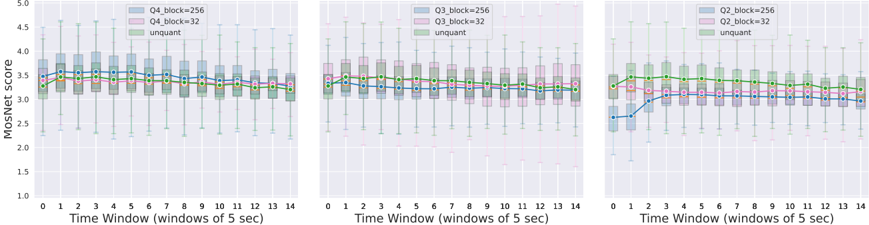
- Stated: post-training quantization causes significant MMLU drops below 6 bits; quantized-aware finetuning may help but requires further investigation. Audio quality remains close to floating point down to 4 bits, but artifacts appear at 3 and 2 bits.
- Stated/evident: signal-based Audioseal watermarking is not robust to compression, and generative watermarking was a negative result due to codec non-idempotence; the paper states there is no way to fully prevent regurgitation and fine-tuning could be over-ridden. Moshi is weaker than Helium on spoken QA, especially TriviaQA, attributed to oral-style finetuning. Evident: full-duplex dialogue evaluation uses generated dialogues and automatic metrics (DialoGPT perplexity, turn-taking statistics), not human ratings of conversational naturalness.
Model-written summary. Check it against the paper before relying on it.
Integrity signals
Registry
Cites
Statistics
Figures







Verification
Claims the paper makes
0 Valid · 11 Not valid · 51 Not checked · 231 Own results and interpretations
A result the paper reports from its own data — it cites no other source for it, so there is none to check. The quote shows it is in the paper.
In the paper
“While removing reconstruction losses majorly degrades objective metrics, we observed during development that the resulting audio sounded much better than expected based on aforementioned metrics.”
§ Moshi: a speech-text foundation model for real-time dialogue Moshi: a speech-text foundation model for real-time dialogue > Causality and streaming.
plain- Asserted: passes — The authors put it forward as true.
- Checkable: passes — It can be checked against evidence.
- Load-bearing: passes — The paper’s conclusions depend on it.
- Based: passes — The paper gives a reason why it holds.
A result the paper reports from its own data — it cites no other source for it, so there is none to check. The quote shows it is in the paper.
In the paper
“Ablation studies in Section 5.3 show that among the design choices made for Moshi, Inner Monologue has one of the most critical impacts on the quality of generated speech.”
§ Moshi: a speech-text foundation model for real-time dialogue Moshi: a speech-text foundation model for real-time dialogue > 3.4.4 Inner Monologue
plainstates a cause- Asserted: passes — The authors put it forward as true.
- Checkable: passes — It can be checked against evidence.
- Load-bearing: passes — The paper’s conclusions depend on it.
- Based: passes — The paper gives a reason why it holds.
A result the paper reports from its own data — it cites no other source for it, so there is none to check. The quote shows it is in the paper.
In the paper
“While not strictly necessary, we observed this provided a useful guidance to the model by splitting the decision of ending a word, and which one should follow, into two steps.”
§ Moshi: a speech-text foundation model for real-time dialogue Moshi: a speech-text foundation model for real-time dialogue > Aligning text and audio tokens.
hedgedstates a cause- Asserted: passes — The authors put it forward as true.
- Checkable: passes — It can be checked against evidence.
- Load-bearing: unclear — It is unclear whether the paper’s conclusions depend on it.
- Based: passes — The paper gives a reason why it holds.
A result the paper reports from its own data — it cites no other source for it, so there is none to check. The quote shows it is in the paper.
In the paper
“Interestingly, we observed that it was critical for performance to perform this average pooling in a non-causal way, which is compatible with streaming inference as these embeddings are only used during training.”
§ Moshi: a speech-text foundation model for real-time dialogue Moshi: a speech-text foundation model for real-time dialogue > 3.3.2 Learning semantic-acoustic tokens with a split RVQ
plainstates a cause- Asserted: passes — The authors put it forward as true.
- Checkable: passes — It can be checked against evidence.
- Load-bearing: passes — The paper’s conclusions depend on it.
- Based: passes — The paper gives a reason why it holds.
A result the paper reports from its own data — it cites no other source for it, so there is none to check. The quote shows it is in the paper.
In the paper
“Figure 2 illustrates this architecture and Table 3 shows that this solution provides a better semantic-acoustic trade-off overall.”
§ Moshi: a speech-text foundation model for real-time dialogue Moshi: a speech-text foundation model for real-time dialogue > 3.3.2 Learning semantic-acoustic tokens with a split RVQ
plainstates a cause- Asserted: passes — The authors put it forward as true.
- Checkable: passes — It can be checked against evidence.
- Load-bearing: passes — The paper’s conclusions depend on it.
- Based: passes — The paper gives a reason why it holds.
173 more claims
Create a free account to see all 293 claims and to verify the 37 references still open.
- It may state two separate claims as one. 65
- The quote only partly states this claim. 7
- Probably not a substantial claim. 66
Claims other papers make about this one
Each is checked against this paper’s own text: does it say what the citing paper says it does?
In the citing paper
“Moshi [Défossez et al., 2024] starts from a 7B-parameter text LLM pretrained on 2.1T tokens, then pretrains on 7 million hours of transcribed audio before post-training on diarized multi-speaker audio, the 2,000-hour Fisher telephone corpus, and more than 20,000 hours of synthesized instruction dialogue.”
From An LLM Is All You Need: Data-Efficient Adaptation to Full-Duplex, Word-Level Spoken Dialogue (2026) · cites this paper as Défossez et al., 2024
In the citing paper
“End-to-end models such as dGSLM [Nguyen et al., 2022] and Moshi leave turn-taking implicit in the audio streams they generate, with no explicit decision that can be inspected or constrained.”
From An LLM Is All You Need: Data-Efficient Adaptation to Full-Duplex, Word-Level Spoken Dialogue (2026) · cites this paper as Défossez et al., 2024
In the citing paper
“In contrast, full-duplex speech LLMs such as Moshi (Défossez et al., 2024), Freeze-Omni (Wang et al., 2025), MiniCPM-o-4.5 (Cui et al., 2026), and SALMONN-omni (Yu et al., 2025) support an alwayson mode that allows them to listen and speak simultaneously.”
From SALMONN-duo: Adaptive Dual-System Coordination for Full-Duplex Voice Agents (2026) · cites this paper as Défossez et al., 2024
In the citing paper
“Full-duplex speech large language models (Défossez et al., 2024;Yu et al., 2025;Liu et al., 2026) address this mismatch by processing the user's speech stream while simultaneously generating the assistant's response, enabling conversational dynamics including barge-in and low-latency turn taking.”
From SALMONN-duo: Adaptive Dual-System Coordination for Full-Duplex Voice Agents (2026) · cites this paper as Défossez et al., 2024
Self-check
Percentages, sums and reported differences re-computed from the paper’s own numbers.
Each contradiction between two passages listed here was confirmed by an independent check.
Rated minor: it would not touch a result — a value no result rests on, a p-value that stays on the same side of the significance level, or a conflict that is clerical, resolved elsewhere in the paper, or outside its own findings.
In the paper
“We use C = 64 in practice, which corresponds to roughly 4.5 seconds of audio once decoded”
§ Moshi: a speech-text foundation model for real-time dialogue Moshi: a speech-text foundation model for real-time dialogue > Additional information
Reported 4.5 · recomputed 5.12
Rated minor: it would not touch a result — a value no result rests on, a p-value that stays on the same side of the significance level, or a conflict that is clerical, resolved elsewhere in the paper, or outside its own findings.
In the paper
§ Moshi: a speech-text foundation model for real-time dialogue Moshi: a speech-text foundation model for real-time dialogue > Hash encoding.
“In our case we set m = 4 and M = 20.Therefore the maximum time-span of the signature is 2 • M , i.e., about 3.2 seconds.”
§ Moshi: a speech-text foundation model for real-time dialogue Moshi: a speech-text foundation model for real-time dialogue > Additional information
“where the time is discretized with frequency 40Hz and the frequency range into 64 bins.”
Rated minor: it would not touch a result — a value no result rests on, a p-value that stays on the same side of the significance level, or a conflict that is clerical, resolved elsewhere in the paper, or outside its own findings.
In the paper
§ Moshi: a speech-text foundation model for real-time dialogue Moshi: a speech-text foundation model for real-time dialogue > Bad audio quality.
“We measure in 500 audio samples the presence or absence of different audio degradations caused by model weight quantization on 2, 3 or 8 bits with block granularity of 32 or 256”
§ Moshi: a speech-text foundation model for real-time dialogue Moshi: a speech-text foundation model for real-time dialogue > Bad audio quality.
“At a bitwidth of 4, there is still little difference in behavior between the unquantized model and the quantized ones.For a bitwidth of 3, artifacts occur more often for quantized models”
Rated minor: it would not touch a result — a value no result rests on, a p-value that stays on the same side of the significance level, or a conflict that is clerical, resolved elsewhere in the paper, or outside its own findings.
In the paper
§ Moshi: a speech-text foundation model for real-time dialogue Moshi: a speech-text foundation model for real-time dialogue > Inference of Moshi.
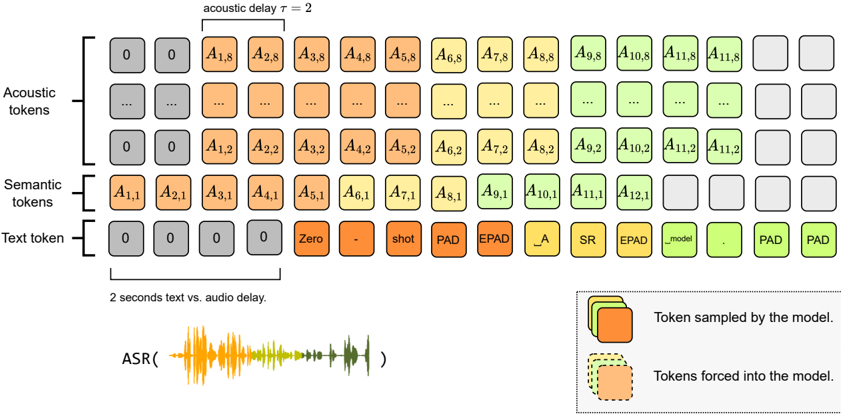
“for k ∈ {2, . . ., 2+Q} for Moshi's audio tokens.In an application setting, prediction for the audio coming from the user (k > 2+Q) is actually ignored, as the actual user audio is used instead.”
§ Moshi: a speech-text foundation model for real-time dialogue Moshi: a speech-text foundation model for real-time dialogue > Deriving streaming ASR and TTS.
“V s,1+Q+1 = A ′ s,1 semantic tokens of other.”
Rated minor: it would not touch a result — a value no result rests on, a p-value that stays on the same side of the significance level, or a conflict that is clerical, resolved elsewhere in the paper, or outside its own findings.
In the paper
§ Moshi: a speech-text foundation model for real-time dialogue Moshi: a speech-text foundation model for real-time dialogue > Additional information
“We use C = 64 in practice”
§ Moshi: a speech-text foundation model for real-time dialogue Moshi: a speech-text foundation model for real-time dialogue > Quantization Format.
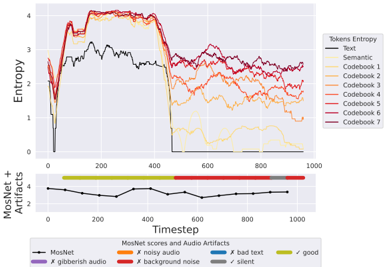
“For each timestep, we compute the entropy over the past 128 tokens, independently for the text and audio codebooks tokens.”
Citations
Cites
BERT: Pre-training of Deep Bidirectional Transformers for Language Understanding
Devlin, J., Chang, M.-W., Lee, K., & Toutanova, K. (2019) · Proceedings of the 2019 Conference of the North American Chapter of the Association for Computational Linguistics: Human Language Technologies, Volume 1 (Long and Short Papers) · doi:10.18653/v1/n19-1423 · Cited by 54,325
Decoupled Weight Decay Regularization
Loshchilov, I., & Hutter, F. (2017) · arXiv · doi:10.48550/arxiv.1711.05101 · Cited by 12,522
“Librispeech: an ASR corpus based on public domain audio books,”
Panayotov, V., Chen, G., Povey, D., & Khudanpur, S. (2015) · 2015 IEEE International Conference on Acoustics, Speech and Signal Processing (ICASSP) · doi:10.1109/icassp.2015.7178964 · Cited by 6,072
SGDR: Stochastic Gradient Descent with Warm Restarts
Loshchilov, I., & Hutter, F. (2016) · arXiv · doi:10.48550/arxiv.1608.03983 · Cited by 5,309
WaveNet: a generative model for raw audio
Oord, A. V. D., Dieleman, S., Zen, H., Simonyan, K., Vinyals, O., Graves, A., Kalchbrenner, N., Senior, A., & Kavukcuoglu, K. (2016) · arXiv · doi:10.48550/arxiv.1609.03499 · Cited by 4,911
LLaMA: Open and Efficient Foundation Language Models
Touvron, H., Lavril, T., Izacard, G., Martinet, X., Lachaux, M.-A., Lacroix, T., Rozière, B., Goyal, N., Hambro, E., Azhar, F., et al. (2023) · arXiv · doi:10.48550/arxiv.2302.13971 · Cited by 4,602
Bag of Tricks for Efficient Text Classification
Joulin, A., Grave, E., Bojanowski, P., & Mikolov, T. (2017) · Proceedings of the 15th Conference of the European Chapter of the Association for Computational Linguistics: Volume 2, Short Papers · doi:10.18653/v1/e17-2068 · Cited by 4,545
Bag of Tricks for Efficient Text Classification
Joulin, A., Grave, E., Bojanowski, P., & Mikolov, T. (2016) · arXiv · doi:10.48550/arxiv.1607.01759 · Cited by 4,542
Gaussian Error Linear Units (GELUs)
Hendrycks, D., & Gimpel, K. (2016) · arXiv · doi:10.48550/arxiv.1606.08415 · Cited by 3,537
HuBERT: Self-Supervised Speech Representation Learning by Masked Prediction of Hidden Units
Hsu, W.-N., Bolte, B., Tsai, Y.-H. H., Lakhotia, K., Salakhutdinov, R., & Mohamed, A. (2021) · IEEE/ACM Transactions on Audio, Speech, and Language Processing · doi:10.1109/taslp.2021.3122291 · Cited by 2,983
Research works printed but not linked: 21
- Tom B. Brown, Benjamin Mann, Nick Ryder, Melanie Subbiah, Jared Kaplan, Prafulla Dhariwal, Arvind Neelakantan, Pranav Shyam, Girish Sastry, Amanda Askell, Sandhini Agarwal, Ariel Herbert-Voss, Gretchen Krueger, Tom Henighan, Rewon Child, Aditya Ramesh, Daniel M. Ziegler, Jeffrey Wu, Clemens Winter, Christopher Hesse, Mark Chen, Eric Sigler, Mateusz Litwin, Scott Gray, Benjamin Chess, Jack Clark, Christopher Berner, Sam McCandlish, Alec Radford, Ilya Sutskever, and Dario Amodei. Language models are few-shot learners. In Advances in Neural Information Processing Systems (NeurIPS), 2020.
- Djork-Arné Clevert, Thomas Unterthiner, and Sepp Hochreiter. Fast and accurate deep network learning by exponential linear units (elus). In Yoshua Bengio and Yann Le- Cun, editors, 4th International Conference on Learning Representations, ICLR 2016, San Juan, Puerto Rico, May 2-4, 2016, Conference Track Proceedings, 2016.
- Tim Dettmers and Luke Zettlemoyer. The case for 4-bit precision: k-bit inference scaling laws. In Andreas Krause, Emma Brunskill, Kyunghyun Cho, Barbara Engelhardt, Sivan Sabato, and Jonathan Scarlett, editors, Proceedings of the 40th International Conference on Machine Learning, volume 202 of Proceedings of Machine Learning Research, pages 7750-7774. PMLR, 23-29 Jul 2023.
- Elias Frantar, Saleh Ashkboos, Torsten Hoefler, and Dan Alistarh. OPTQ: Accurate post- training quantization for generative pre-trained transformers. In ICLR, 2023.
- Dan Hendrycks and Kevin Gimpel. Gaussian error linear units (gelus). arXiv preprint arXiv:1606.08415, 2016b. · arXiv
- Jonathan Ho, Ajay Jain, and Pieter Abbeel. Denoising diffusion probabilistic models. In Advances in neural information processing systems, 2020.
- Eugene Kharitonov, Damien Vincent, Zalán Borsos, Raphaël Marinier, Sertan Girgin, Olivier Pietquin, Matt Sharifi, Marco Tagliasacchi, and Neil Zeghidour. Speak, read and prompt: High-fidelity text-to-speech with minimal supervision. Trans. Assoc. Comput. Linguistics, 11:1703-1718, 2023. doi: 10.1162/TACL\ A\ 00618. · doi:10.1162/tacl\a\00618
- Diederik P. Kingma and Jimmy Ba. Adam: A method for stochastic optimization. In Yoshua Bengio and Yann LeCun, editors, 3rd International Conference on Learning Rep- resentations, 2015. 11
- Rithesh Kumar, Prem Seetharaman, Alejandro Luebs, Ishaan Kumar, and Kundan Kumar. High-fidelity audio compression with improved rvqgan. In Advances in Neural Informa- tion Processing Systems, 2024. 23, 24
- Ilya Loshchilov and Frank Hutter. Decoupled weight decay regularization. In 7th Inter- national Conference on Learning Representations, ICLR 2019, New Orleans, LA, USA, May 6-9, 2019, 2019. 11, 20
- Eliya Nachmani, Alon Levkovitch, Roy Hirsch, Julian Salazar, Chulayuth Asawaroengchai, Soroosh Mariooryad, Ehud Rivlin, RJ Skerry-Ryan, and Michelle Tadmor Ramanovich. Spoken question answering and speech continuation using spectrogram-powered LLM. In The Twelfth International Conference on Learning Representations, 2024. 5, 29
- Tu Anh Nguyen, Eugene Kharitonov, Jade Copet, Yossi Adi, Wei-Ning Hsu, Ali Elkahky, Paden Tomasello, Robin Algayres, Benoît Sagot, Abdelrahman Mohamed, and Emmanuel Dupoux. Generative spoken dialogue language modeling. Transactions of the Association for Computational Linguistics, 11:250-266, 2023. doi: 10.1162/tacl a 00545. 6, 30, 31 · doi:10.1162/tacla00545.6,30
- Alec Radford, Jong Wook Kim, Tao Xu, Greg Brockman, Christine McLeavey, and Ilya Sutskever. Robust speech recognition via large-scale weak supervision. In Andreas Krause, Emma Brunskill, Kyunghyun Cho, Barbara Engelhardt, Sivan Sabato, and Jonathan Scarlett, editors, International Conference on Machine Learning, ICML 2023, 23-29 July 2023, Honolulu, Hawaii, USA, volume 202 of Proceedings of Machine Learning Research, pages 28492-28518. PMLR, 2023. 4, 16, 18, 25, 26
- Tim Salimans and Diederik P. Kingma. Weight normalization: A simple reparameterization to accelerate training of deep neural networks. In Daniel D. Lee, Masashi Sugiyama, Ulrike von Luxburg, Isabelle Guyon, and Roman Garnett, editors, Advances in Neural Information Processing Systems 29, 2016. 10
- Robin San Roman, Pierre Fernandez, Antoine Deleforge, Yossi Adi, and Romain Serizel. La- tent watermarking of audio generative models. arXiv e-prints, pages arXiv-2409, 2024a.
- Marco Tagliasacchi, Yunpeng Li, Karolis Misiunas, and Dominik Roblek. SEANet: A multi-modal speech enhancement network. In Interspeech, 2020. 10, 11
- Aäron van den Oord, Oriol Vinyals, and Koray Kavukcuoglu. Neural discrete representation learning. In Advances in Neural Information Processing Systems (NeurIPS), 2017.
- Ashish Vaswani, Noam Shazeer, Niki Parmar, Jakob Uszkoreit, Llion Jones, Aidan N. Gomez, and Lukasz Kaiser and. Attention is all you need. In Advances in Neural Infor- mation Processing Systems (NeurIPS), pages 5998-6008, 2017. 3, 5, 7
- Lili Yu, Dániel Simig, Colin Flaherty, Armen Aghajanyan, Luke Zettlemoyer, and Mike Lewis. Megabyte: Predicting million-byte sequences with multiscale transformers. Ad- vances in Neural Information Processing Systems, 2024. 4, 13
- Neil Zeghidour, Alejandro Luebs, Ahmed Omran, Jan Skoglund, and Marco Tagliasacchi. Soundstream: An end-to-end neural audio codec. IEEE ACM Trans. Audio Speech Lang. Process., 30, 2022. 3, 4, 9, 10, 11
- Xin Zhang, Dong Zhang, Shimin Li, Yaqian Zhou, and Xipeng Qiu. Speechtokenizer: Unified speech tokenizer for speech language models. In The Twelfth International Conference on Learning Representations, 2024b. 3, 9, 12, 23, 24
Cited by
SmolVLA: A Vision-Language-Action Model for Affordable and Efficient Robotics
Shukor, M., Aubakirova, D., Capuano, F., Kooijmans, P., Palma, S., Zouitine, A., Aractingi, M., Pascal, C., Russi, M., Marafioti, A., et al. (2025) · arXiv · doi:10.48550/arxiv.2506.01844 · Cited by 695
“…other modalities, sparking interest towards multi-modal vision-language (VLMs) (Alayrac et al., 2022; Chen et al., 2023; Huang et al., 2023; Liu et al., 2023b; Chen et al., 2024; Shukor et al., 2023b) and audio-language models (ALMs) (Défossez et al., 2024; Das et al., 2024; Borsos et al., 2023).”
Kimi-Audio Technical ReportPreprint
KimiTeam, Ding, D., Ju, Z., Leng, Y., Liu, S., Liu, T., Shang, Z., Shen, K., Song, W., Xu, T., et al. (2025) · arXiv (Cornell University) · doi:10.48550/arxiv.2504.18425 · Cited by 519
GLM-4-Voice: Towards Intelligent and Human-Like End-to-End Spoken Chatbot
Zeng, A., Du, Z., Liu, M., Wang, K., Jiang, S., Zhao, L., Dong, Y., & Tang, J. (2024) · arXiv · doi:10.48550/arxiv.2412.02612
LLaMA-Omni: Seamless Speech Interaction with Large Language Models
Fang, Q., Guo, S., Yan, Z., Ma, Z., Zhang, S., & Yang, F. (2025) · International Conference on Learning Representations · doi:10.48550/arxiv.2409.06666 · Cited by 309
VoiceBench: Benchmarking LLM-Based Voice Assistants
Chen, Y., Yue, X., Zhang, C., Gao, X., Tan, R. T., & Li, H. (2026) · Transactions of the Association for Computational Linguistics · doi:10.1162/tacl.a.628 · Cited by 302
Metadata
- Authors
- Défossez, A., Mazaré, L., Orsini, M., Royer, A., Pérez, P., Jégou, H., Grave, E., & Zeghidour, N.
- Venue
- arXiv
- Publisher
- arXiv
- Published
- 2024
- ISSN
- 2331-8422 (ISSN-L)
- arXiv
- 2410.00037
- OpenAlex
- W4403883071
- Semantic Scholar
- ae4aa7b0c5a327dae63ad20e00b58bcc6176b3b8
- Cited by
- 1,027
- References
- 81
- Citations by year
- 2026: 696 · 2025: 307 · 2024: 24
- Type
- posted content
- Language
- en
- Open access
- green
- arxiv.org
- Licence
- Locations
- arXiv (Cornell University) (submittedVersion, cc-by-nc-sa)
- arXiv (Cornell University) (cc-by-nc-sa)
- Topics
- Physical Sciences › Computer Science › Artificial Intelligence › Speech Recognition and Synthesis
- Physical Sciences › Computer Science › Artificial Intelligence › Speech and dialogue systems
- Physical Sciences › Computer Science › Signal Processing › Speech and Audio Processing
- Keywords
- spoken dialogue systems, neural audio codecs, streaming speech recognition, text-to-speech, real-time latency, overlapping speech, conversational dynamics, inner speech, large language models
About these checks
Registry, retraction, Cites and statistics results are computed, not judged, with one exception: a printed reference that no index lists is read once by a model before it counts as a citation error. Claims are extracted by a model and kept only when their quote appears verbatim in the text; each cited source is then checked, with a model’s help, for whether it says what the claim relies on. Those verdicts can be wrong — read the claim’s quote and the cited source before relying on one.
A language model drew the claims from the paper on 2026-11-22, under version 3 of the claim definition (model deepseek-v4.1-flash, prompt extract-v3).
A second model labelled each claim on 2026-11-22 (model jev-1.13-20260917, definition revision gold-guideline-v0.2).
Statistics and arithmetic are recomputed, not judged.
Confidence bands are shown only for fields calibrated on our annotated test set. None is calibrated yet, so no band is shown.
What counts as a claim ›How we measure confidence ›How we check this ›
Are you an author, or do you see a problem with this page? Request a review
How to cite
Cite CoChat for the checks on this page, and the paper for its own findings.
- This page
- CoChat. (2026). Citation check: Moshi: a speech-text foundation model for real-time dialogue. https://app.cochat.ai/papers/10.48550/arxiv.2410.00037
- The paper
- Défossez, A., Mazaré, L., Orsini, M., Royer, A., Pérez, P., Jégou, H., Grave, E., & Zeghidour, N. (2024). Moshi: a speech-text foundation model for real-time dialogue. arXiv. https://doi.org/10.48550/arxiv.2410.00037
Data sources
Bibliographic data: Semantic Scholar, OpenAlex, Crossref.
Contains information from the Semantic Scholar Academic Graph Datasets, made available under the ODC Attribution License (ODC-BY 1.0).
Semantic Scholar’s data is described in: Kinney, R., et al. (2023). The Semantic Scholar Open Data Platform. arXiv:2301.10140.
