

The DOI matches its DataCite record.
Towards Efficient Neurally-Guided Program Induction for ARC-AGI
Abstract
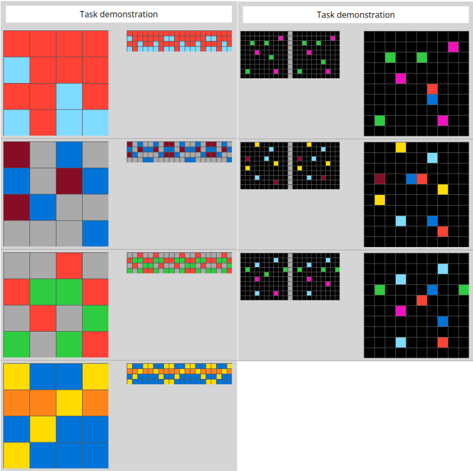
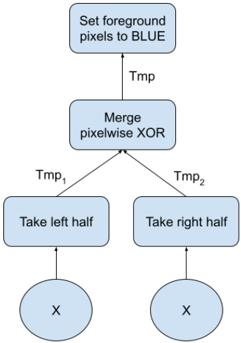
ARC-AGI is an open-world problem domain in which the ability to generalize out-of-distribution is a crucial quality. Under the program induction paradigm, we present a series of experiments that reveal the efficiency and generalization characteristics of various neurally-guided program induction approaches. The three paradigms we consider are Learning the grid space, Learning the program space, and Learning the transform space. We implement and experiment thoroughly on the first two, and retain the second one for ARC-AGI submission. After identifying the strengths and weaknesses of both of these approaches, we suggest the third as a potential solution, and run preliminary experiments.
Overview
The claims and statistics of this paper haven’t been checked yet.
Run the check — free, no account needed. It reads the open-access text and checks the sources it cites.
Integrity signals
Registry
Cites
Statistics
Figures
Verification
Claims the paper makes
The claims and statistics of this paper haven’t been checked yet.
Run the check — free, no account needed. It reads the open-access text and checks the sources it cites.
Claims other papers make about this one
Each is checked against this paper’s own text: does it say what the citing paper says it does?
In the citing paper
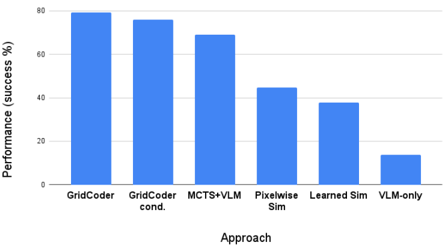
“Ouellette et al. 's neural-guided synthesis achieves 79.3% on ARC-AGI-1 [Ouellette 2024] by learning program representations, but discovered primitives function as optimized parameters rather than understood concepts: they cannot be explained or transferred to novel domains.”
From The ARC of Progress towards AGI: A Living Survey of Abstraction and Reasoning (2026) · cites this paper as Ouellette 2024
Self-check
Percentages, sums and reported differences re-computed from the paper’s own numbers.
The self-check needs the paper’s full text.
Citations
Cites
No references could be resolved yet.
Research works printed but not linked: 11
- Alford, S. 2021. A Neurosymbolic Approach to Abstrac- tion and Reasoning. Ph.D. thesis, Massachusetts Institute of Technology.
- Chen, X.; Liu, C.; and Song, D. 2018. Execution-guided neural program synthesis. In International Conference on Learning Representations.
- Chen, X.; Song, D.; and Tian, Y. 2021. Latent execution for neural program synthesis beyond domain-specific lan- guages. Advances in Neural Information Processing Sys- tems, 34: 22196-22208.
- Devlin, J.; Uesato, J.; Bhupatiraju, S.; Singh, R.; Mohamed, A.-r.; and Kohli, P. 2017. Robustfill: Neural program learn- ing under noisy i/o. In International conference on machine learning, 990-998.
- PMLR.
- Ellis, K.; Wong, C.; Nye, M.; Sablé-Meyer, M.; Morales, L.; Hewitt, L.; Cary, L.; Solar-Lezama, A.; and Tenenbaum, J. B. 2021. DreamCoder: Bootstrapping Inductive Pro- gram Synthesis with Wake-Sleep Library Learning. In Pro- ceedings of the 42nd ACM SIGPLAN International Confer- ence on Programming Language Design and Implementa- tion, PLDI 2021, 835-850. New York, NY, USA: Associa- tion for Computing Machinery. ISBN 9781450383912.
- Fijalkow, N.; Lagarde, G.; Matricon, T.; Ellis, K.; Ohlmann, P.; and Potta, A. 2021. Scaling Neural Program Synthesis with Distribution-based Search. CoRR, abs/2110.12485. · arXiv
- Hocquette, C.; and Cropper, A. 2024. Relational de- composition for program synthesis. arXiv preprint arXiv:2408.12212. · arXiv
- Kapur, S.; Jenner, E.; and Russell, S. 2024. Diffusion On Syntax Trees For Program Synthesis. arXiv preprint arXiv:2405.20519. · arXiv
- Nye, M.; Pu, Y.; Bowers, M.; Andreas, J.; Tenenbaum, J. B.; and Solar-Lezama, A. 2020. Representing partial programs with blended abstract semantics. arXiv preprint arXiv:2012.12964. · arXiv
- Schrittwieser, J.; Antonoglou, I.; Hubert, T.; Simonyan, K.; Sifre, L.; Schmitt, S.; Guez, A.; Lockhart, E.; Hassabis, D.; Graepel, T.; et al. 2020. Mastering atari, go, chess and shogi by planning with a learned model. Nature, 588(7839): 604- 609.
Cited by
The ARC of Progress towards AGI: A Living Survey of Abstraction and Reasoning
Vahdati, S., Aioanei, A., Suresh, H., & Lehmann, J. (2026) · arXiv · doi:10.48550/arxiv.2603.13372
Metadata
- Authors
- Ouellette, S.
- Venue
- arXiv
- Publisher
- arXiv
- Published
- 2024
- arXiv
- 2411.17708
- References
- 0
- Type
- Preprint
About these checks
Registry, retraction, Cites and statistics results are computed, not judged, with one exception: a printed reference that no index lists is read once by a model before it counts as a citation error. Claims are extracted by a model and kept only when their quote appears verbatim in the text; each cited source is then checked, with a model’s help, for whether it says what the claim relies on. Those verdicts can be wrong — read the claim’s quote and the cited source before relying on one.
Statistics and arithmetic are recomputed, not judged.
Confidence bands are shown only for fields calibrated on our annotated test set. None is calibrated yet, so no band is shown.
What counts as a claim ›How we measure confidence ›How we check this ›
Are you an author, or do you see a problem with this page? Request a review
How to cite
Cite CoChat for the checks on this page, and the paper for its own findings.
- This page
- CoChat. (2026). Citation check: Towards Efficient Neurally-Guided Program Induction for ARC-AGI. https://app.cochat.ai/papers/10.48550/arxiv.2411.17708
- The paper
- Ouellette, S. (2024). Towards Efficient Neurally-Guided Program Induction for ARC-AGI. arXiv. https://doi.org/10.48550/arxiv.2411.17708
Data sources
Bibliographic data: Semantic Scholar, OpenAlex, Crossref.
Contains information from the Semantic Scholar Academic Graph Datasets, made available under the ODC Attribution License (ODC-BY 1.0).
Semantic Scholar’s data is described in: Kinney, R., et al. (2023). The Semantic Scholar Open Data Platform. arXiv:2301.10140.
