

The DOI matches its DataCite record.
Wikipedia Contributions in the Wake of ChatGPT
Abstract
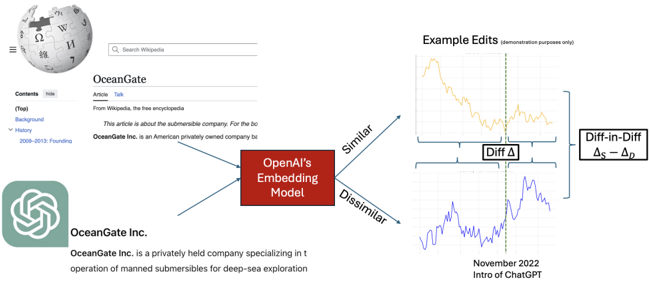
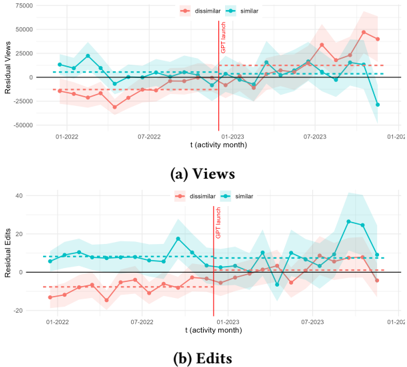
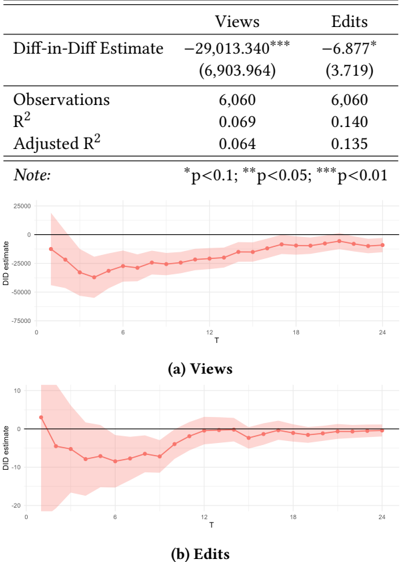
How has Wikipedia activity changed for articles with content similar to ChatGPT following its introduction? We estimate the impact using differences-in-differences models, with dissimilar Wikipedia articles as a baseline for comparison, to examine how changes in voluntary knowledge contributions and information-seeking behavior differ by article content. Our analysis reveals that newly created, popular articles whose content overlaps with ChatGPT 3.5 saw a greater decline in editing and viewership after the November 2022 launch of ChatGPT than dissimilar articles did. These findings indicate heterogeneous substitution effects, where users selectively engage less with existing platforms when AI provides comparable content. This points to potential uneven impacts on the future of human-driven online knowledge contributions.
Overview
The claims and statistics of this paper haven’t been checked yet.
Run the check — free, no account needed. It reads the open-access text and checks the sources it cites.
Integrity signals
Registry
Cites
Statistics
Figures
Verification
Claims the paper makes
The claims and statistics of this paper haven’t been checked yet.
Run the check — free, no account needed. It reads the open-access text and checks the sources it cites.
Claims other papers make about this one
Each is checked against this paper’s own text: does it say what the citing paper says it does?
In the citing paper
“Recent studies have observed reduced user engagement with traditional search platforms (Sommerfeld et al., 2025; Toscano, 2025), especially when generative engines can deliver comparable content (Lyu et al., 2025).”
From E-GEO: A Testbed for Generative Engine Optimization in E-Commerce (2025) · cites this paper as Lyu et al., 2025
Self-check
Percentages, sums and reported differences re-computed from the paper’s own numbers.
The self-check needs the paper’s full text.
Citations
Cites
No references could be resolved yet.
Research works printed but not linked: 11
- Gordon Burtch, Dokyun Lee, and Zhichen Chen. 2024. The consequences of generative AI for online knowledge communities. Scientific Reports 14, 1 (2024), 10413.
- Sumit Kumar Dam, Choong Seon Hong, Yu Qiao, and Chaoning Zhang. 2024. A complete survey on llm-based ai chatbots. arXiv preprint arXiv:2406.16937 (2024). · arXiv
- Maria del Rio-Chanona, Nadzeya Laurentsyeva, and Johannes Wachs. 2023. Are Large Language Models a Threat to Digital Public Goods? Evidence from Activity on Stack Overflow. arXiv preprint arXiv:2307.07367 (2023). arXiv:2307.07367 [cs.SI] https://arxiv.org/abs/2307.07367 · arXiv
- Mark Glickman and Yi Zhang. 2024. AI and generative AI for research discovery and summarization. Harvard Data Science Review 6, 2 (2024).
- Sook Lim. 2009. How and why do college students use Wikipedia? Journal of the American Society for Information Sci- ence and Technology 60, 11 (2009), 2189-2202. doi:10.1002/asi.21142 arXiv:https://onlinelibrary.wiley.com/doi/pdf/10.1002/asi.21142 · DOI
- Neal Reeves, Wenjie Yin, and Elena Simperl. 2024. Exploring the Impact of ChatGPT on Wikipedia Engagement. arXiv preprint arXiv:2405.10205 (2024). arXiv:2405.10205 [cs.HC] https://arxiv.org/abs/2405.10205 · arXiv
- Guohou Shan and Liangfei Qiu. 2023. Examining the impact of generative AI on users' voluntary knowledge contribution: Evidence from a natural experiment on Stack Overflow. Available at SSRN 4462976 (2023).
- Ilia Shumailov, Zakhar Shumaylov, Yiren Zhao, Nicolas Papernot, Ross Anderson, and Yarin Gal. 2024. AI models collapse when trained on recursively generated data. Nature 631, 8022 (2024), 755-759.
- Philipp Singer, Florian Lemmerich, Robert West, Leila Zia, Ellery Wulczyn, Markus Strohmaier, and Jure Leskovec. 2017. Why we read Wikipedia. In Pro- ceedings of the 26th international conference on world wide web. 1591-1600.
- Bo Xu and Dahui Li. 2015. An empirical study of the motivations for content con- tribution and community participation in Wikipedia. Information & Management 52, 3 (2015), 275-286. doi:10.1016/j.im.2014.12.003 · DOI
- Heng-Li Yang and Cheng-Yu Lai. 2010. Motivations of Wikipedia content con- tributors. Computers in human behavior 26, 6 (2010), 1377-1383.
Cited by
E-GEO: A Testbed for Generative Engine Optimization in E-Commerce
Bagga, P. S., Farias, V. F., Korkotashvili, T., Peng, T., & Wu, Y. (2025) · arXiv · doi:10.48550/arxiv.2511.20867 · Cited by 1
Metadata
- Authors
- Lyu, L., Siderius, J., Li, H., Acemoglu, D., Huttenlocher, D., & Ozdaglar, A.
- Venue
- arXiv
- Publisher
- arXiv
- Published
- 2025
- arXiv
- 2503.00757
- References
- 0
- Type
- Preprint
About these checks
Registry, retraction, Cites and statistics results are computed, not judged, with one exception: a printed reference that no index lists is read once by a model before it counts as a citation error. Claims are extracted by a model and kept only when their quote appears verbatim in the text; each cited source is then checked, with a model’s help, for whether it says what the claim relies on. Those verdicts can be wrong — read the claim’s quote and the cited source before relying on one.
Statistics and arithmetic are recomputed, not judged.
Confidence bands are shown only for fields calibrated on our annotated test set. None is calibrated yet, so no band is shown.
What counts as a claim ›How we measure confidence ›How we check this ›
Are you an author, or do you see a problem with this page? Request a review
How to cite
Cite CoChat for the checks on this page, and the paper for its own findings.
- This page
- CoChat. (2026). Citation check: Wikipedia Contributions in the Wake of ChatGPT. https://app.cochat.ai/papers/10.48550/arxiv.2503.00757
- The paper
- Lyu, L., Siderius, J., Li, H., Acemoglu, D., Huttenlocher, D., & Ozdaglar, A. (2025). Wikipedia Contributions in the Wake of ChatGPT. arXiv. https://doi.org/10.48550/arxiv.2503.00757
