

The DOI matches its DataCite record.
Trapped by Expectations: Functional Fixedness in LLM-Enabled Chat Search
Abstract
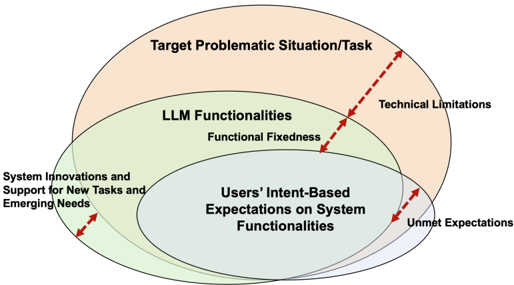
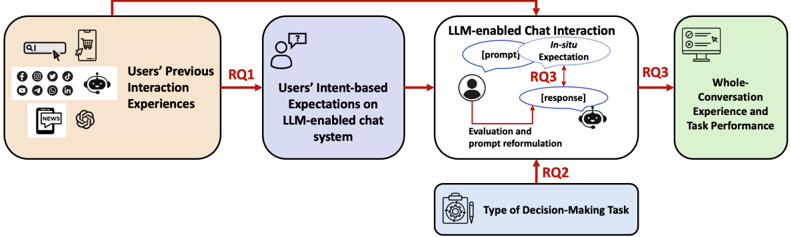
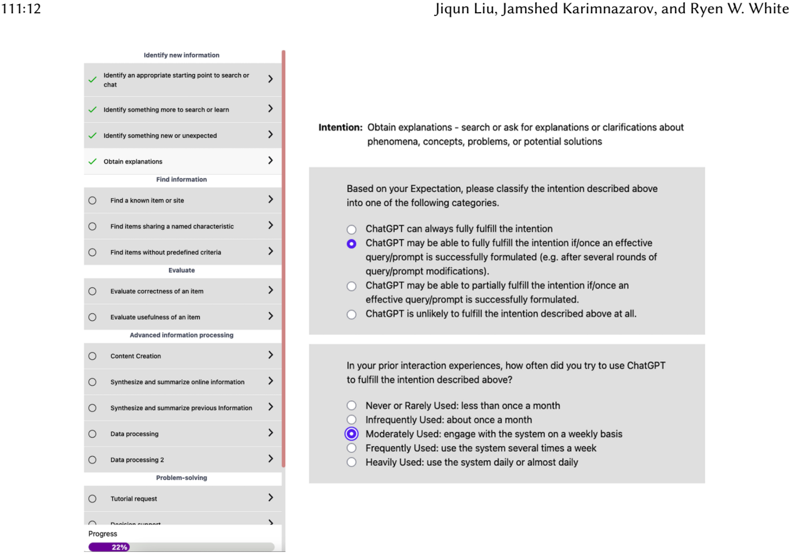
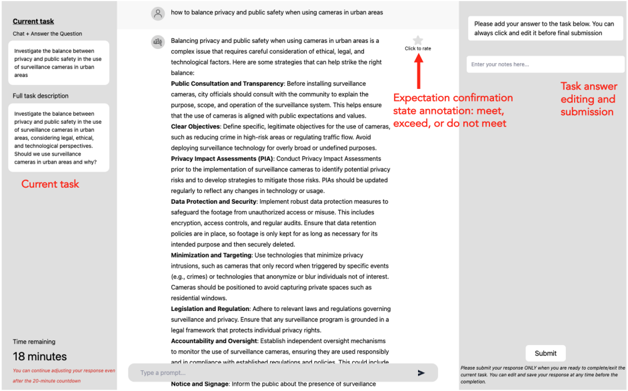
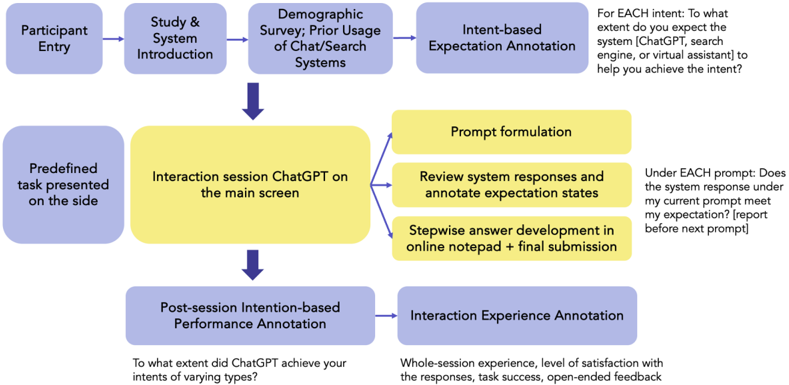
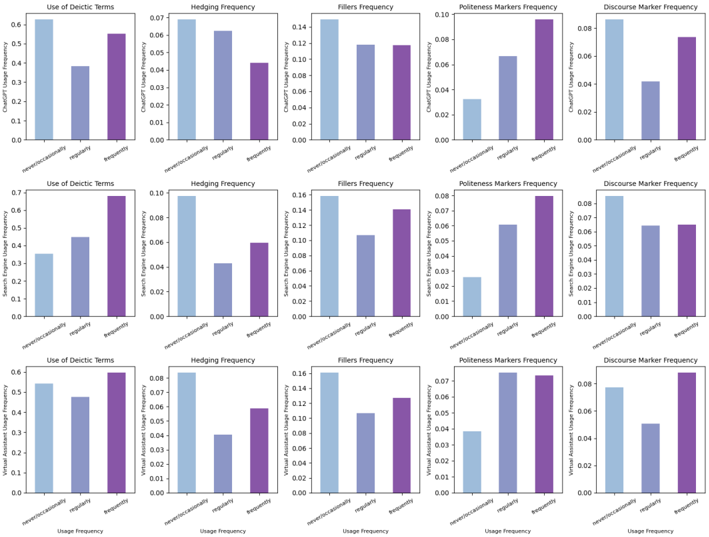
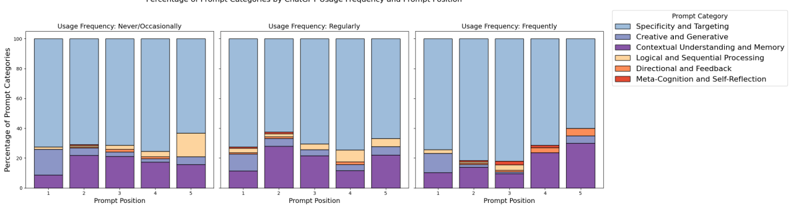
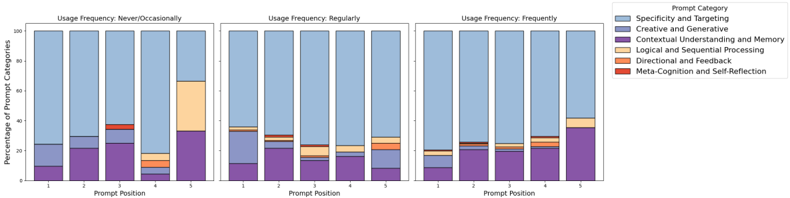
Functional fixedness, a cognitive bias that restricts users' interactions with a new system or tool to expected or familiar ways, limits the full potential of Large Language Model (LLM)-enabled chat search, especially in complex and exploratory tasks. To investigate its impact, we conducted a crowdsourcing study with 450 participants, each completing one of six decision-making tasks spanning public safety, diet and health management, sustainability, and AI ethics. Participants engaged in a multi-prompt conversation with ChatGPT to address the task, allowing us to compare pre-chat intent-based expectations with observed interactions. We found that: 1) Several aspects of pre-chat expectations are closely associated with users' prior experiences with ChatGPT, search engines, and virtual assistants; 2) Prior system experience shapes language use and prompting behavior. Frequent ChatGPT users reduced deictic terms and hedge words and frequently adjusted prompts. Users with rich search experience maintained structured, less-conversational queries with minimal modifications. Users of virtual assistants favored directive, command-like prompts, reinforcing functional fixedness; 3) When the system failed to meet expectations, participants generated more detailed prompts with increased linguistic diversity, reflecting adaptive shifts. These findings suggest that while preconceived expectations constrain early interactions, unmet expectations can motivate behavioral adaptation. With appropriate system support, this may promote broader exploration of LLM capabilities. This work also introduces a typology for user intents in chat search and highlights the importance of mitigating functional fixedness to support more creative and analytical use of LLMs.
Overview
The claims and statistics of this paper haven’t been checked yet.
Run the check — free, no account needed. It reads the open-access text and checks the sources it cites.
Integrity signals
Registry
Cites
Statistics
Figures
Verification
Claims the paper makes
The claims and statistics of this paper haven’t been checked yet.
Run the check — free, no account needed. It reads the open-access text and checks the sources it cites.
Claims other papers make about this one
Each is checked against this paper’s own text: does it say what the citing paper says it does?
The cited source says what the claim attributes to it.
In the citing paper
“Together, these studies show that LLM-based systems elicit rich behaviors that are strongly mediated by users' mental models and prior tool use, but they primarily investigate general-purpose search or everyday LLM services rather than domain-specific scientific research tools.”
From Understanding Usage and Engagement in AI-Powered Scientific Research Tools: The Asta Interaction Dataset (2026) · cites this paper as Liu et al., 2025
Self-check
Percentages, sums and reported differences re-computed from the paper’s own numbers.
The self-check needs the paper’s full text.
Citations
Cites
No references could be resolved yet.
Research works printed but not linked: 107
- Robert E Adamson. 1952. Functional fixedness as related to problem solving: a repetition of three experiments. Journal of experimental psychology 44, 4 (1952), 288.
- Leif Azzopardi. 2021. Cognitive biases in search: a review and reflection of cognitive biases in Information Retrieval. In Proceedings of the 2021 conference on human information interaction and retrieval. 27-37.
- Leif Azzopardi and Jiqun Liu. 2024. Evaluating Cognitive Biases in Conversational and Generative IIR: A Tutorial. In Proceedings of the 2024 Annual International ACM SIGIR Conference on Research and Development in Information Retrieval in the Asia Pacific Region. 287-290.
- Leif Azzopardi and Jiqun Liu. 2024. Search under Uncertainty: Cognitive Biases and Heuristics-Tutorial on Modeling Search Interaction using Behavioral Economics. In Proceedings of the 2024 Conference on Human Information Interaction and Retrieval. 427-430.
- Anna Bodonhelyi, Efe Bozkir, Shuo Yang, Enkelejda Kasneci, and Gjergji Kasneci. 2024. User intent recognition and satisfaction with large language models: A user study with chatgpt. arXiv preprint arXiv:2402.02136 (2024). · arXiv
- Stephen Brade, Bryan Wang, Mauricio Sousa, Sageev Oore, and Tovi Grossman. 2023. Promptify: Text-to-image generation through interactive prompt exploration with large language models. In Proceedings of the 36th Annual ACM Symposium on User Interface Software and Technology. 1-14.
- Andrei Broder. 2002. A taxonomy of web search. In ACM Sigir forum, Vol. 36. ACM New York, NY, USA, 3-10.
- Josef Buchner, Katja Buntins, and Michael Kerres. 2022. The impact of augmented reality on cognitive load and performance: A systematic review. Journal of Computer Assisted Learning 38, 1 (2022), 285-303.
- Stefan Buttcher, Charles LA Clarke, and Gordon V Cormack. 2016. Information retrieval: Implementing and evaluating search engines. Mit Press.
- Anaëlle Camarda, Emilie Salvia, Julie Vidal, Benoit Weil, Nicolas Poirel, Olivier Houde, Gregoire Borst, and Mathieu Cassotti. 2018. Neural basis of functional fixedness during creative idea generation: an EEG study. Neuropsychologia 118 (2018), 4-12.
- Robert Capra, Jaime Arguello, Heather O'Brien, Yuan Li, and Bogeum Choi. 2018. The effects of manipulating task determinability on search behaviors and outcomes. In The 41st international ACM SIGIR conference on research & development in information retrieval. 445-454.
- Marco Cascella, Jonathan Montomoli, Valentina Bellini, and Elena Bignami. 2023. Evaluating the feasibility of ChatGPT in healthcare: an analysis of multiple clinical and research scenarios. Journal of medical systems 47, 1 (2023), 33.
- Carlos Castillo. 2019. Fairness and transparency in ranking. In Acm sigir forum, Vol. 52. ACM New York, NY, USA, 64-71.
- Lingjiao Chen, Jared Quincy Davis, Boris Hanin, Peter Bailis, Ion Stoica, Matei A Zaharia, and James Y Zou. 2024. Are more LLM calls all you need? towards the scaling properties of compound AI systems. Advances in Neural Information Processing Systems 37 (2024), 45767-45790.
- Nuo Chen, Jiqun Liu, Xiaoyu Dong, Qijiong Liu, Tetsuya Sakai, and Xiao-Ming Wu. 2024. Ai can be cognitively biased: An exploratory study on threshold priming in llm-based batch relevance assessment. In Proceedings of the 2024 Annual International ACM SIGIR Conference on Research and Development in Information Retrieval in the Asia Pacific Region. 54-63.
- Nuo Chen, Jiqun Liu, Hanpei Fang, Yuankai Luo, Tetsuya Sakai, and Xiao-Ming Wu. 2024. Decoy Effect In Search Interaction: Understanding User Behavior and Measuring System Vulnerability. arXiv preprint arXiv:2403.18462 (2024). · arXiv
- Nuo Chen, Jiqun Liu, and Tetsuya Sakai. 2023. A reference-dependent model for web search evaluation: Understanding and measuring the experience of boundedly rational users. In Proceedings of the ACM web conference 2023. 3396-3405.
- Nuo Chen, Fan Zhang, and Tetsuya Sakai. 2022. Constructing Better Evaluation Metrics by Incorporating the Anchoring Effect into the User Model. In Proceedings of the 45th international ACM SIGIR conference on Research and Development in Information Retrieval.
- Zeya Chen and Ruth Schmidt. 2024. Exploring a Behavioral Model of "Positive Friction" in Human-AI Interaction. In International Conference on Human-Computer Interaction. Springer, 3-22.
- Bogeum Choi, Austin Ward, Yuan Li, Jaime Arguello, and Robert Capra. 2019. The effects of task complexity on the use of different types of information in a search assistance tool. ACM Transactions on Information Systems (TOIS) 38, 1 (2019), 1-28.
- Evangelia G Chrysikou, Katharine Motyka, Cristina Nigro, Song-I Yang, and Sharon L Thompson-Schill. 2016. Functional fixedness in creative thinking tasks depends on stimulus modality. Psychology of aesthetics, creativity, and the arts 10, 4 (2016), 425.
- Evangelia G Chrysikou and Sharon L Thompson-Schill. 2011. Dissociable brain states linked to common and creative object use. Human brain mapping 32, 4 (2011), 665-675.
- Charlene H Chu, Rune Nyrup, Kathleen Leslie, Jiamin Shi, Andria Bianchi, Alexandra Lyn, Molly McNicholl, Shehroz Khan, Samira Rahimi, and Amanda Grenier. 2022. Digital ageism: challenges and opportunities in artificial intelligence for older adults. The Gerontologist 62, 7 (2022), 947-955.
- Ovidiu Dan and Brian D Davison. 2016. Measuring and predicting search engine users' satisfaction. ACM Computing Surveys (CSUR) 49, 1 (2016), 1-35.
- Tilman Dingler, Benjamin Tag, Evangelos Karapanos, Koichi Kise, and Andreas Dengel. 2020. Workshop on detection and design for cognitive biases in people and computing systems. In Extended Abstracts of the 2020 CHI Conference on Human Factors in Computing Systems. 1-6.
- Tim Draws, Nava Tintarev, Ujwal Gadiraju, Alessandro Bozzon, and Benjamin Timmermans. 2021. This is not what we ordered: Exploring why biased search result rankings affect user attitudes on debated topics. In Proceedings of the 44th international ACM SIGIR conference on research and development in information retrieval. 295-305.
- Karl Duncker and Lynne S Lees. 1945. On problem-solving. Psychological monographs 58, 5 (1945), i.
- Jessica Echterhoff, Yao Liu, Abeer Alessa, Julian McAuley, and Zexue He. 2024. Cognitive bias in decision-making with LLMs. In Findings of the Association for Computational Linguistics: EMNLP 2024. 12640-12653.
- Ashlee Edwards and Diane Kelly. 2017. Engaged or frustrated? Disambiguating emotional state in search. In Proceedings of the 40th international ACM SIGIR conference on research and development in information retrieval. 125-134.
- Carsten Eickhoff. 2018. Cognitive biases in crowdsourcing. In Proceedings of the eleventh ACM international conference on web search and data mining. 162-170.
- Oluwole Fagbohun, Rachel M Harrison, and Anton Dereventsov. 2024. An empirical categorization of prompting techniques for large language models: A practitioner's guide. arXiv preprint arXiv:2402.14837 (2024). · arXiv
- Henry A Feild, James Allan, and Rosie Jones. 2010. Predicting searcher frustration. In Proceedings of the 33rd international ACM SIGIR conference on Research and development in information retrieval. 34-41.
- Zhe Fu and Xi Niu. 2024. The art of asking: Prompting large language models for serendipity recommendations. In Proceedings of the 2024 ACM SIGIR International Conference on Theory of Information Retrieval. 157-166.
- C Furió, Mª L Calatayud, SL Bárcenas, and OM Padilla. 2000. Functional fixedness and functional reduction as common sense reasonings in chemical equilibrium and in geometry and polarity of molecules. Science Education 84, 5 (2000), 545-565.
- Lucie Galland, Catherine Pelachaud, and Florian Pecune. 2022. Adapting conversational strategies in information- giving human-agent interaction. Frontiers in Artificial Intelligence 5 (2022), 1029340.
- Jianfeng Gao, Chenyan Xiong, and Paul Bennett. 2020. Recent advances in conversational information retrieval. In Proceedings of the 43rd International ACM SIGIR Conference on Research and Development in Information Retrieval. 2421-2424.
- Ruoyuan Gao, Yingqiang Ge, and Chirag Shah. 2022. FAIR: Fairness-aware information retrieval evaluation. Journal of the Association for Information Science and Technology 73, 10 (2022), 1461-1473.
- Tim P German and H Clark Barrett. 2005. Functional fixedness in a technologically sparse culture. Psychological science 16, 1 (2005), 1-5.
- Robert L Goldstone and David Landy. 2010. Domain-creating constraints. Cognitive Science 34, 7 (2010), 1357-1377.
- Ahmed Hassan, Ryen W White, Susan T Dumais, and Yi-Min Wang. 2014. Struggling or exploring? Disambiguating long search sessions. In Proceedings of the 7th ACM international conference on Web search and data mining. 53-62.
- Jiangen He and Jiqun Liu. 2025. Investigating the Impact of LLM Personality on Cognitive Bias Manifestation in Automated Decision-Making Tasks. arXiv preprint arXiv:2502.14219 (2025). · arXiv
- Cornelius Herstatt and Katharina Kalogerakis. 2005. How to use analogies for breakthrough innovations. International Journal of Innovation and Technology Management 2, 03 (2005), 331-347.
- Peter Ingwersen and Kalervo Järvelin. 2005. Information retrieval in context: IRiX. In Acm sigir forum, Vol. 39. ACM New York, NY, USA, 31-39.
- Kaixin Ji, Sachin Pathiyan Cherumanal, Johanne R Trippas, Danula Hettiachchi, Flora D Salim, Falk Scholer, and Damiano Spina. 2024. Towards Detecting and Mitigating Cognitive Bias in Spoken Conversational Search. In Adjunct Proceedings of the 26th International Conference on Mobile Human-Computer Interaction. 1-10.
- Daniel Kahneman. 2003. Maps of bounded rationality: Psychology for behavioral economics. American economic review 93, 5 (2003), 1449-1475.
- Evangelos Kanoulas, Panagiotis Eustratiadis, Yongkang Li, Yougang Lyu, Vaishali Pal, Gabrielle Poerwawinata, Jingfen Qiao, and Zihan Wang. 2025. Agent-centric Information Access. arXiv preprint arXiv:2502.19298 (2025). · arXiv
- Diane Kelly, Jaime Arguello, Ashlee Edwards, and Wan-ching Wu. 2015. Development and evaluation of search tasks for IIR experiments using a cognitive complexity framework. In Proceedings of the 2015 international conference on the theory of information retrieval. 101-110.
- Hyunwoo Kim, Melanie Sclar, Tan Zhi-Xuan, Lance Ying, Sydney Levine, Yang Liu, Joshua B Tenenbaum, and Yejin Choi. 2025. Hypothesis-Driven Theory-of-Mind Reasoning for Large Language Models. arXiv preprint arXiv:2502.11881 (2025). · arXiv
- Michal Kosinski. 2024. Evaluating large language models in theory of mind tasks. Proceedings of the National Academy of Sciences 121, 45 (2024), e2405460121.
- Antonios Minas Krasakis, Andrew Yates, and Evangelos Kanoulas. 2023. Contextualizing and Expanding Conversa- tional Queries without Supervision. ACM Transactions on Information Systems 42, 3 (2023), 1-30.
- Weronika Łajewska, Krisztian Balog, Damiano Spina, and Johanne Trippas. 2024. Can Users Detect Biases or Factual Errors in Generated Responses in Conversational Information-Seeking?. In Proceedings of the 2024 Annual International ACM SIGIR Conference on Research and Development in Information Retrieval in the Asia Pacific Region. 92-102.
- Yuelin Li and Nicholas J Belkin. 2008. A faceted approach to conceptualizing tasks in information seeking. Information processing & management 44, 6 (2008), 1822-1837.
- Aldo Lipani. 2019. On Biases in Information retrieval models and evaluation. In ACM SIGIR Forum, Vol. 52. ACM New York, NY, USA, 172-173.
- Jiqun Liu. 2021. Deconstructing search tasks in interactive information retrieval: A systematic review of task dimensions and predictors. Information Processing & Management 58, 3 (2021), 102522.
- Jiqun Liu. 2023. Toward A Two-Sided Fairness Framework in Search and Recommendation. In Proceedings of the 2023 Conference on Human Information Interaction and Retrieval. 236-246.
- Jiqun Liu and Leif Azzopardi. 2024. Search under uncertainty: Cognitive biases and heuristics: a tutorial on testing, mitigating and accounting for cognitive biases in search experiments. In Proceedings of the 47th International ACM SIGIR Conference on Research and Development in Information Retrieval. 3013-3016.
- Jiqun Liu and Fangyuan Han. 2020. Investigating reference dependence effects on user search interaction and satisfaction: A behavioral economics perspective. In Proceedings of the 43rd international ACM SIGIR conference on research and development in information retrieval. 1141-1150.
- Jiqun Liu and Fangyuan Han. 2022. Matching search result diversity with user diversity acceptance in Web search sessions. In Proceedings of the 45th international ACM SIGIR conference on research and development in information retrieval. 2473-2477.
- Jiqun Liu and Jiangen He. 2024. The Decoy Dilemma in Online Medical Information Evaluation: A Comparative Study of Credibility Assessments by LLM and Human Judges. arXiv preprint arXiv:2411.15396 (2024). · arXiv
- Jiqun Liu, Matthew Mitsui, Nicholas J Belkin, and Chirag Shah. 2019. Task, information seeking intentions, and user behavior: Toward a multi-level understanding of web search. In Proceedings of the 2019 conference on human information interaction and retrieval. 123-132.
- Jiqun Liu, Shawon Sarkar, and Chirag Shah. 2020. Identifying and predicting the states of complex search tasks. In Proceedings of the 2020 conference on human information interaction and retrieval. 193-202.
- Jiqun Liu and Chirag Shah. 2022. Leveraging user interaction signals and task state information in adaptively optimizing usefulness-oriented search sessions. In Proceedings of the 22nd ACM/IEEE Joint Conference on Digital Libraries. 1-11.
- Mengyang Liu, Yiqun Liu, Jiaxin Mao, Cheng Luo, and Shaoping Ma. 2018. Towards designing better session search evaluation metrics. In The 41st International ACM SIGIR Conference on Research & Development in Information Retrieval. 1121-1124.
- Mengyang Liu, Jiaxin Mao, Yiqun Liu, Min Zhang, and Shaoping Ma. 2019. Investigating cognitive effects in session- level search user satisfaction. In Proceedings of the 25th acm sigkdd international conference on knowledge discovery & data mining. 923-931.
- Gary Marchionini. 2006. Exploratory search: from finding to understanding. Commun. ACM 49, 4 (2006), 41-46.
- Marco Markwald, Jiqun Liu, and Ran Yu. 2023. Constructing and meta-evaluating state-aware evaluation metrics for interactive search systems. Information Retrieval Journal 26, 1 (2023), 10.
- David Maxwell, Leif Azzopardi, and Yashar Moshfeghi. 2019. The impact of result diversification on search behaviour and performance. Information Retrieval Journal 22, 5 (2019), 422-446.
- Tony McCaffrey. 2012. Innovation relies on the obscure: A key to overcoming the classic problem of functional fixedness. Psychological science 23, 3 (2012), 215-218.
- Miriam J Metzger and Andrew J Flanagin. 2013. Credibility and trust of information in online environments: The use of cognitive heuristics. Journal of pragmatics 59 (2013), 210-220.
- Matthew Mitsui, Jiqun Liu, Nicholas J Belkin, and Chirag Shah. 2017. Predicting information seeking intentions from search behaviors. In Proceedings of the 40th international acm sigir conference on research and development in information retrieval. 1121-1124.
- Steven Moore, Richard Tong, Anjali Singh, Zitao Liu, Xiangen Hu, Yu Lu, Joleen Liang, Chen Cao, Hassan Khosravi, Paul Denny, et al. 2023. Empowering education with llms-the next-gen interface and content generation. In International Conference on Artificial Intelligence in Education. Springer, 32-37.
- Felipe Munoz-Rubke, Devon Olson, Russell Will, and Karin H James. 2018. Functional fixedness in tool use: Learning modality, limitations and individual differences. Acta psychologica 190 (2018), 11-26.
- Mohammad Naiseh, Reem S Al-Mansoori, Dena Al-Thani, Nan Jiang, and Raian Ali. 2021. Nudging through friction: an approach for calibrating trust in explainable AI. In 2021 8th International Conference on Behavioral and Social Computing (BESC). IEEE, 1-5.
- Marc Najork. 2023. Generative information retrieval. In Proceedings of the 46th International ACM SIGIR Conference on Research and Development in Information Retrieval. 1-1.
- Zabir Al Nazi and Wei Peng. 2024. Large language models in healthcare and medical domain: A review. In Informatics, Vol. 11. MDPI, 57.
- Michael Öllinger, Gary Jones, and Günther Knoblich. 2008. Investigating the effect of mental set on insight problem solving. Experimental psychology 55, 4 (2008), 269-282.
- Eben Otuteye and Mohammad Siddiquee. 2015. Overcoming cognitive biases: A heuristic for making value investing decisions. Journal of Behavioral Finance 16, 2 (2015), 140-149.
- Wenjing Pan, Diyi Liu, and Jie Fang. 2021. An examination of factors contributing to the acceptance of online health misinformation. Frontiers in psychology 12 (2021), 630268.
- Stephen J Payne and Andrew Howes. 2022. Adaptive interaction: A utility maximization approach to understanding human interaction with technology. Springer Nature.
- Chen Qu, Liu Yang, W Bruce Croft, Johanne R Trippas, Yongfeng Zhang, and Minghui Qiu. 2018. Analyzing and characterizing user intent in information-seeking conversations. In The 41st international acm sigir conference on research & development in information retrieval. 989-992.
- Charvi Rastogi, Yunfeng Zhang, Dennis Wei, Kush R Varshney, Amit Dhurandhar, and Richard Tomsett. 2022. Deciding fast and slow: The role of cognitive biases in ai-assisted decision-making. Proceedings of the ACM on Human-Computer Interaction 6, CSCW1 (2022), 1-22.
- Eun Youp Rha, Matthew Mitsui, Nicholas J Belkin, and Chirag Shah. 2016. Exploring the relationships between search intentions and query reformulations. Proceedings of the Association for Information Science and Technology 53, 1 (2016), 1-9.
- Daniel E Rose and Danny Levinson. 2004. Understanding user goals in web search. In Proceedings of the 13th international conference on World Wide Web. 13-19.
- Sashank Santhanam, Alireza Karduni, and Samira Shaikh. 2020. Studying the effects of cognitive biases in evaluation of conversational agents. In Proceedings of the 2020 CHI Conference on Human Factors in Computing Systems. 1-13.
- Rodrygo LT Santos, Craig Macdonald, Iadh Ounis, et al. 2015. Search result diversification. Foundations and Trends® in Information Retrieval 9, 1 (2015), 1-90.
- Falk Scholer, Diane Kelly, Wan-Ching Wu, Hanseul S Lee, and William Webber. 2013. The effect of threshold priming and need for cognition on relevance calibration and assessment. In Proceedings of the 36th international ACM SIGIR conference on Research and development in information retrieval. 623-632.
- Chirag Shah and Emily M Bender. 2024. Envisioning information access systems: What makes for good tools and a healthy Web? ACM Transactions on the Web 18, 3 (2024), 1-24.
- Dilip Kumar Sharma, Rajendra Pamula, and DS Chauhan. 2024. A hybrid evolutionary algorithm based automatic query expansion for enhancing document retrieval system. Journal of ambient intelligence and humanized computing 15, 1 (2024), 829-848.
- Alexander Skulmowski and Kate Man Xu. 2022. Understanding cognitive load in digital and online learning: A new perspective on extraneous cognitive load. Educational psychology review 34, 1 (2022), 171-196.
- Mark Steyvers, Heliodoro Tejeda, Aakriti Kumar, Catarina Belem, Sheer Karny, Xinyue Hu, Lukas Mayer, and Padhraic Smyth. 2024. The calibration gap between model and human confidence in large language models. arXiv preprint arXiv:2401.13835 (2024). · arXiv
- James WA Strachan, Dalila Albergo, Giulia Borghini, Oriana Pansardi, Eugenio Scaliti, Saurabh Gupta, Krati Saxena, Alessandro Rufo, Stefano Panzeri, Guido Manzi, et al. 2024. Testing theory of mind in large language models and humans. Nature Human Behaviour 8, 7 (2024), 1285-1295.
- Masaki Suzuki and Yusuke Yamamoto. 2021. Characterizing the influence of confirmation bias on web search behavior. Frontiers in psychology 12 (2021), 771948.
- Christoph Johannes Voelter, F Rossano, and Josep Call. 2017. Social manipulation in nonhuman primates: Cognitive and motivational determinants. Neuroscience & Biobehavioral Reviews 82 (2017), 76-94.
- Ben Wang and Jiqun Liu. 2023. Investigating the role of in-situ user expectations in Web search. Information Processing & Management 60, 3 (2023), 103300.
- Ben Wang and Jiqun Liu. 2024. Cognitively Biased Users Interacting with Algorithmically Biased Results in Whole- Session Search on Debated Topics. In Proceedings of the 2024 ACM SIGIR International Conference on Theory of Information Retrieval. 227-237.
- Ben Wang and Jiqun Liu. 2024. Understanding users' dynamic perceptions of search gain and cost in sessions: An expectation confirmation model. Journal of the Association for Information Science and Technology (2024).
- Ben Wang, Jiqun Liu, Jamshed Karimnazarov, and Nicolas Thompson. 2024. Task supportive and personalized human-large language model interaction: A user study. In Proceedings of the 2024 Conference on Human Information Interaction and Retrieval. 370-375.
- Jiayin Wang, Fengran Mo, Weizhi Ma, Peijie Sun, Min Zhang, and Jian-Yun Nie. 2024. A User-Centric Multi-Intent Benchmark for Evaluating Large Language Models. arXiv preprint arXiv:2404.13940 (2024). · arXiv
- Dawn R Weatherford, Lemira V Esparza, Laura J Tedder, and Olivia KH Smith. 2021. Using a fork as a hairbrush: Investigating dual routes to release from functional fixedness. The Journal of Creative Behavior 55, 1 (2021), 154-167.
- Ryen White. 2013. Beliefs and biases in web search. In Proceedings of the 36th international ACM SIGIR conference on Research and development in information retrieval. 3-12.
- Robert J Youmans and Thomaz Arciszewski. 2014. Design fixation: Classifications and modern methods of prevention. AI EDAM 28, 2 (2014), 129-137.
- Hamed Zamani, Johanne R Trippas, Jeff Dalton, Filip Radlinski, et al. 2023. Conversational information seeking. Foundations and Trends® in Information Retrieval 17, 3-4 (2023), 244-456.
- Fan Zhang, Jiaxin Mao, Yiqun Liu, Weizhi Ma, Min Zhang, and Shaoping Ma. 2020. Cascade or recency: Constructing better evaluation metrics for session search. In Proceedings of the 43rd international acm sigir conference on research and development in information retrieval. 389-398.
- Yongfeng Zhang, Xu Chen, Qingyao Ai, Liu Yang, and W Bruce Croft. 2018. Towards conversational search and recommendation: System ask, user respond. In Proceedings of the 27th acm international conference on information and knowledge management. 177-186.
- Yuhao Zhang and Jiqun Liu. 2025. Falling behind again? Characterizing and assessing older adults' algorithm literacy in interactions with video recommendations. Journal of the Association for Information Science and Technology (2025).
- Yuhao Zhang and Jiqun Liu. 2025. Falling behind again? Characterizing and assessing older adults' algorithm literacy in interactions with video recommendations. Journal of the Association for Information Science and Technology 76, 3 (2025), 604-620.
- Yutao Zhu, Huaying Yuan, Shuting Wang, Jiongnan Liu, Wenhan Liu, Chenlong Deng, Haonan Chen, Zheng Liu, Zhicheng Dou, and Ji-Rong Wen. 2023. Large language models for information retrieval: A survey. arXiv preprint arXiv:2308.07107 (2023). · arXiv
Cited by
Sorted by citations
Haddad, D., Bareket, D., Chang, J. C., DeYoung, J., Hwang, J. D., Katz, U., Polak, M., Suh, S., Surana, H., Tiktinsky, A., et al. (2026) · arXiv · doi:10.48550/arxiv.2602.23335 · Cited by 4
Metadata
- Authors
- Liu, J., Karimnazarov, J., & White, R. W.
- Venue
- arXiv
- Publisher
- arXiv
- Published
- 2025
- arXiv
- 2504.02074
- References
- 0
- Type
- Preprint
About these checks
Registry, retraction, Cites and statistics results are computed, not judged, with one exception: a printed reference that no index lists is read once by a model before it counts as a citation error. Claims are extracted by a model and kept only when their quote appears verbatim in the text; each cited source is then checked, with a model’s help, for whether it says what the claim relies on. Those verdicts can be wrong — read the claim’s quote and the cited source before relying on one.
Statistics and arithmetic are recomputed, not judged.
Confidence bands are shown only for fields calibrated on our annotated test set. None is calibrated yet, so no band is shown.
What counts as a claim ›How we measure confidence ›How we check this ›
Are you an author, or do you see a problem with this page? Request a review
How to cite
Cite CoChat for the checks on this page, and the paper for its own findings.
- This page
- CoChat. (2026). Citation check: Trapped by Expectations: Functional Fixedness in LLM-Enabled Chat Search. https://app.cochat.ai/papers/10.48550/arxiv.2504.02074
- The paper
- Liu, J., Karimnazarov, J., & White, R. W. (2025). Trapped by Expectations: Functional Fixedness in LLM-Enabled Chat Search. arXiv. https://doi.org/10.48550/arxiv.2504.02074
