

The DOI matches its DataCite record; 2 of the 2 references it cites were found in a registry or an index.
A Sober Look at Progress in Language Model Reasoning: Pitfalls and Paths to Reproducibility
Abstract
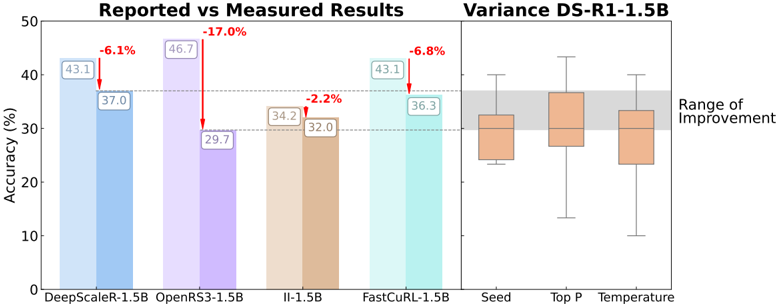
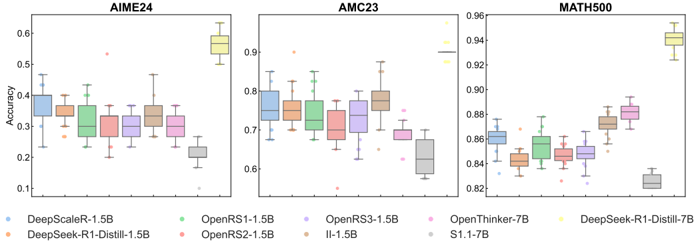
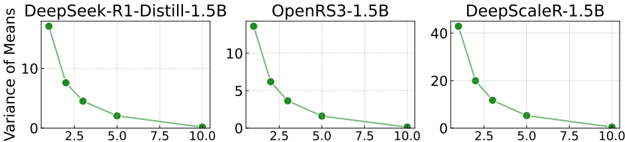
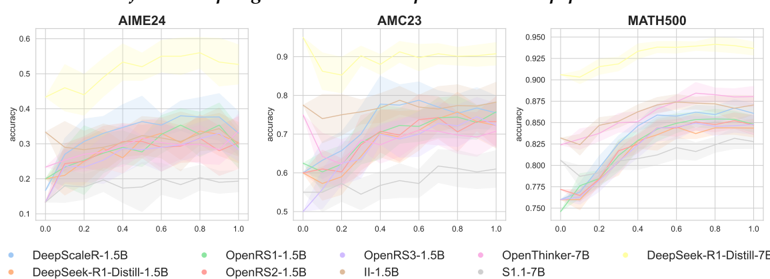
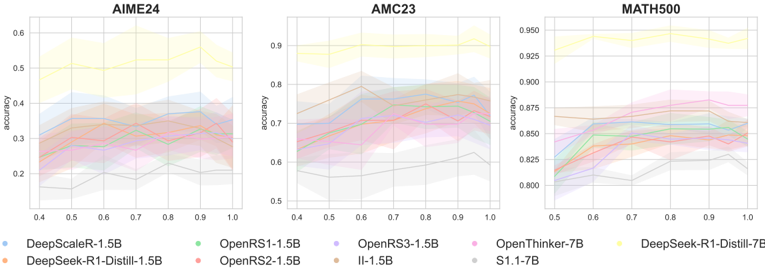
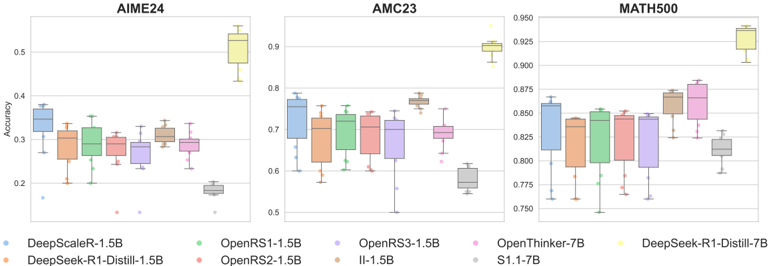
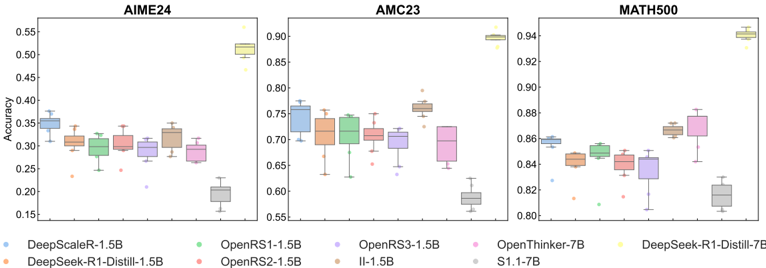
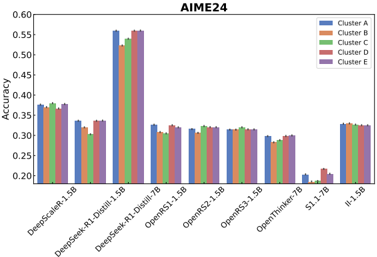
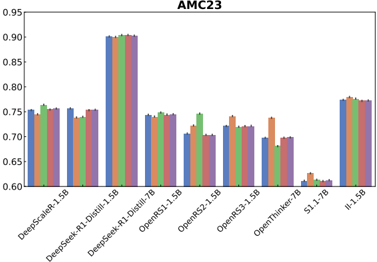
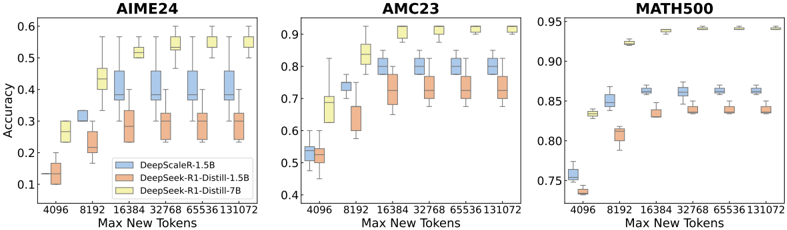
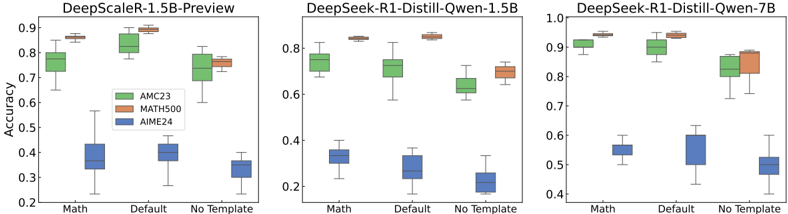
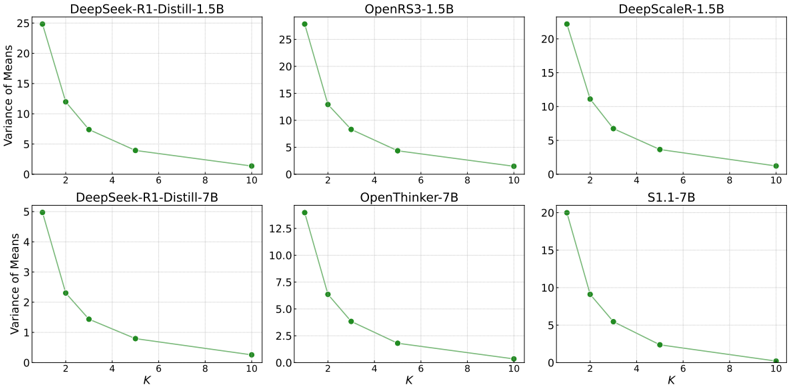
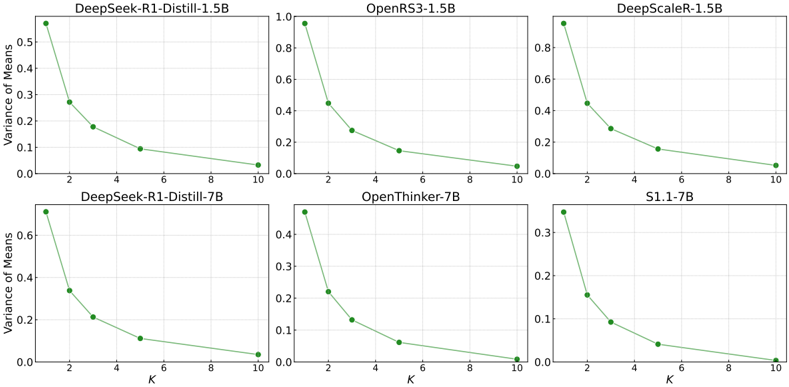
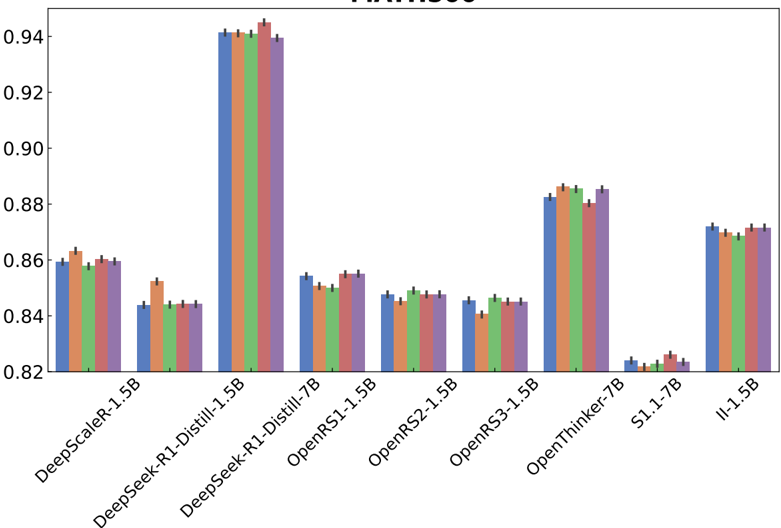
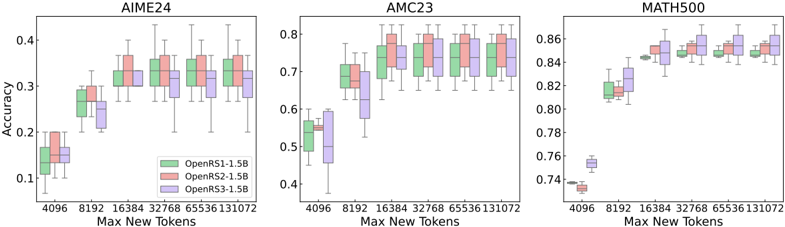
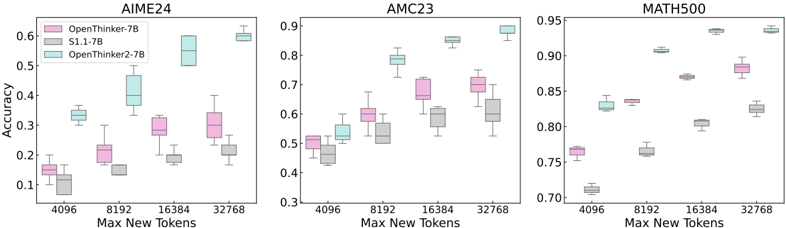
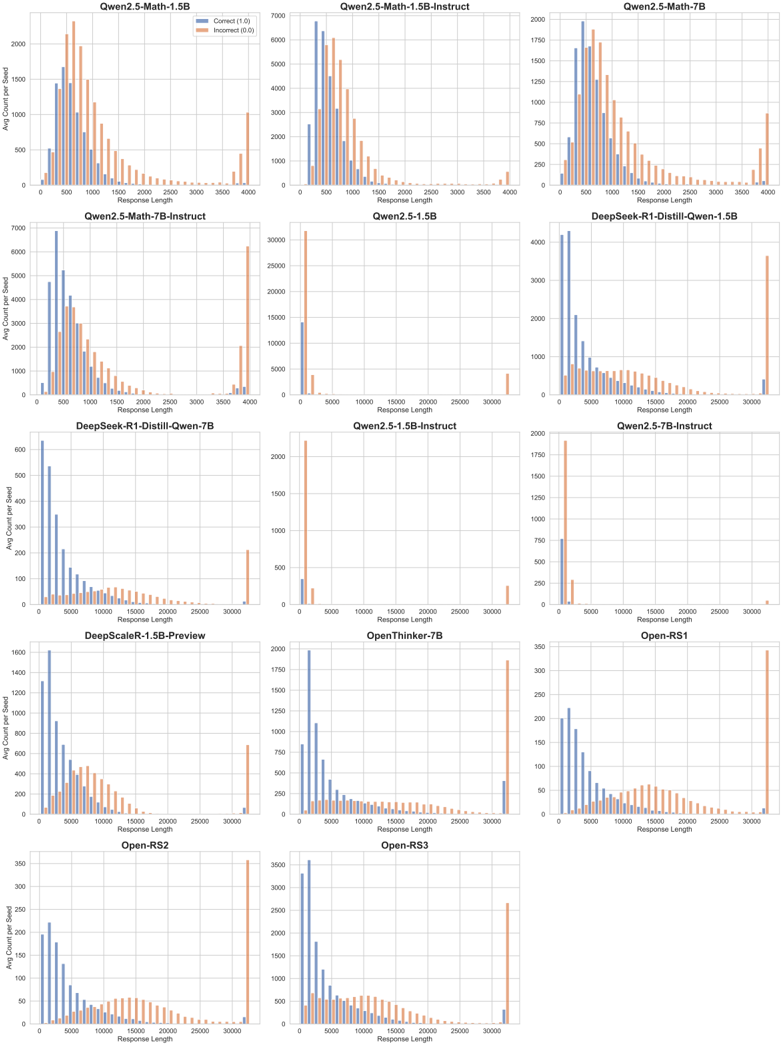
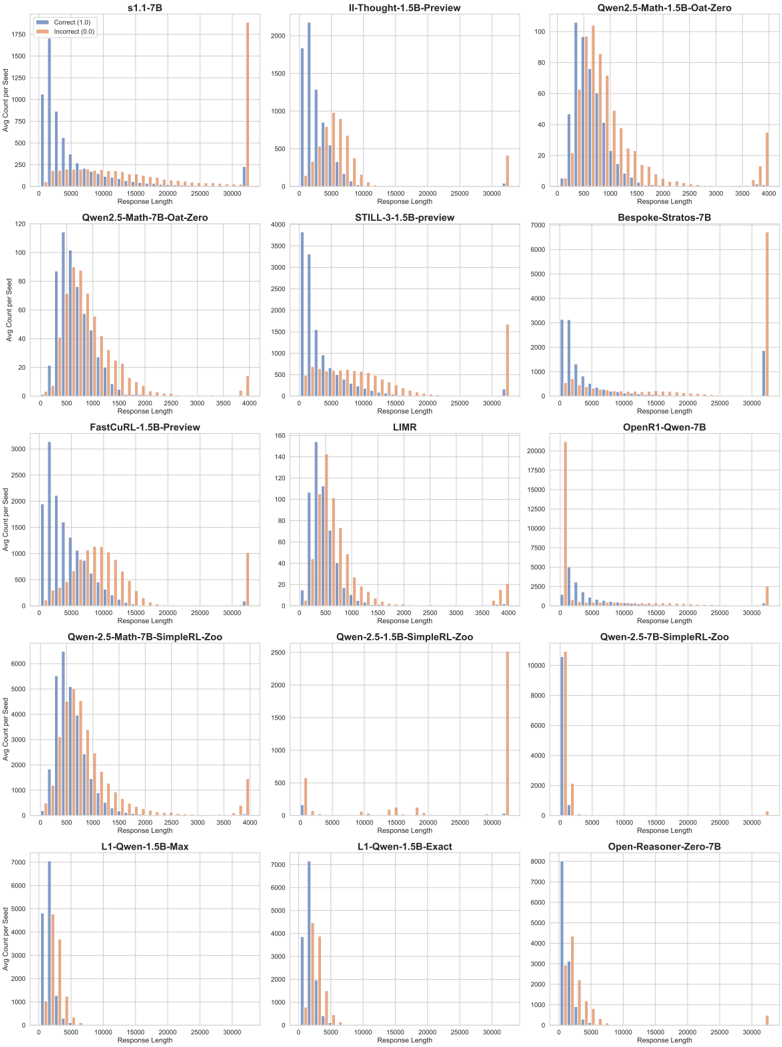
Reasoning has emerged as the next major frontier for language models (LMs), with rapid advances from both academic and industrial labs. However, this progress often outpaces methodological rigor, with many evaluations relying on benchmarking practices that lack transparency, robustness, or statistical grounding. In this work, we conduct a comprehensive empirical study and find that current mathematical reasoning benchmarks are highly sensitive to subtle implementation choices--including decoding parameters, random seeds, prompt formatting, and even hardware and software configurations. Performance gains reported in recent studies frequently hinge on unclear comparisons or unreported sources of variance. To address these issues, we propose a standardized evaluation framework with clearly defined best practices and reporting standards. Using this framework, we reassess recent methods and find that most reinforcement learning (RL) approaches yield only modest improvements--far below prior claims--and are prone to overfitting, especially on small-scale benchmarks like AIME'24. In contrast, supervised finetuning (SFT) methods show consistently stronger generalization in the settings we study. To foster reproducibility, we release all code, prompts, and model outputs, for reasoning benchmarks, establishing more rigorous foundations for future work.
Overview
The claims and statistics of this paper haven’t been checked yet.
Run the check — free, no account needed. It reads the open-access text and checks the sources it cites.
Integrity signals
Registry
Cites
Statistics
Figures
Verification
Claims the paper makes
The claims and statistics of this paper haven’t been checked yet.
Run the check — free, no account needed. It reads the open-access text and checks the sources it cites.
Claims other papers make about this one
Each is checked against this paper’s own text: does it say what the citing paper says it does?
In the citing paper
“Similar findings were made in the reasoning domain, where models were shown to overfit on small benchmarks like AIME'24 [9].”
From Generalizing Verifiable Instruction Following (2025) · cites this paper as [9]
Self-check
Percentages, sums and reported differences re-computed from the paper’s own numbers.
The self-check needs the paper’s full text.
Citations
Cites
Understanding R1-Zero-Like Training: A Critical Perspective
Liu, Z., Chen, C., Li, W., Qi, P., Pang, T., Du, C., Lee, W. S., & Lin, M. (2025) · arXiv · doi:10.48550/arxiv.2503.20783 · Cited by 8
Process Reinforcement through Implicit Rewards
Cui, G., Yuan, L., Wang, Z., Wang, H., Zhang, Y., Chen, J., Li, W., He, B., Fan, Y., Yu, T., et al. (2025) · arXiv · doi:10.48550/arxiv.2502.01456 · Cited by 3
Research works printed but not linked: 95
- Rishabh Agarwal, Max Schwarzer, Pablo Samuel Castro, Aaron C Courville, and Marc Bellemare. Deep reinforcement learning at the edge of the statistical precipice. Advances in neural information processing systems, 34:29304-29320, 2021.
- Pranjal Aggarwal and Sean Welleck. L1: Controlling how long a reasoning model thinks with reinforcement learning. arXiv preprint arXiv:2503.04697, 2025. · arXiv
- Marcin Andrychowicz, Anton Raichuk, Piotr Sta ńczyk, Manu Orsini, Sertan Girgin, Raphael Marinier, Léonard Hussenot, Matthieu Geist, Olivier Pietquin, Marcin Michalski, et al. What matters in on-policy reinforcement learning? a large-scale empirical study. arXiv preprint arXiv:2006.05990, 2020. · arXiv
- Chetan Arora, Ahnaf Ibn Sayeed, Sherlock Licorish, Fanyu Wang, and Christoph Treude. Optimizing large language model hyperparameters for code generation. arXiv preprint arXiv:2408.10577, 2024. · arXiv
- David Balduzzi, Karl Tuyls, Julien Perolat, and Thore Graepel. Re-evaluating evaluation. Advances in Neural Information Processing Systems, 31, 2018.
- Stella Biderman, Hailey Schoelkopf, Lintang Sutawika, Leo Gao, Jonathan Tow, Baber Abbasi, Alham Fikri Aji, Pawan Sasanka Ammanamanchi, Sidney Black, Jordan Clive, et al. Lessons from the trenches on reproducible evaluation of language models. arXiv preprint arXiv:2405.14782, 2024. · arXiv
- Sam Bowyer, Laurence Aitchison, and Desi R Ivanova. Position: Don't use the CLT in LLM evals with fewer than a few hundred datapoints. arXiv preprint arXiv:2503.01747, 2025. · arXiv
- Xin Cai. One framework to rule them all: Unifying rl-based and rl-free methods in rlhf. arXiv preprint arXiv:2503.19523, 2025. · arXiv
- Gavin C Cawley. Baseline methods for active learning. In Active Learning and Experimen- tal Design workshop In conjunction with AISTATS 2010, pp. 47-57. JMLR Workshop and Conference Proceedings, 2011.
- Gavin C Cawley and Nicola LC Talbot. On over-fitting in model selection and subsequent selection bias in performance evaluation. The Journal of Machine Learning Research, 11: 2079-2107, 2010.
- Stephanie CY Chan, Samuel Fishman, John Canny, Anoop Korattikara, and Sergio Guadar- rama. Measuring the reliability of reinforcement learning algorithms. arXiv preprint arXiv:1912.05663, 2019. · arXiv
- Cédric Colas, Olivier Sigaud, and Pierre-Yves Oudeyer. How many random seeds? sta- tistical power analysis in deep reinforcement learning experiments. arXiv preprint arXiv:1806.08295, 2018. · arXiv
- Quy-Anh Dang and Chris Ngo. Reinforcement learning for reasoning in small llms: What works and what doesn't, 2025. URL https://arxiv.org/abs/2503.16219. · arXiv
- DeepSeek-AI. DeepSeek-R1: Incentivizing Reasoning Capability in LLMs via Reinforcement Learning, 2025. URL https://arxiv.org/abs/2501.12948. · arXiv
- Mostafa Dehghani, Yi Tay, Alexey A Gritsenko, Zhe Zhao, Neil Houlsby, Fernando Diaz, Donald Metzler, and Oriol Vinyals. The benchmark lottery. arXiv preprint arXiv:2107.07002, 2021. · arXiv
- Yihe Deng, Hritik Bansal, Fan Yin, Nanyun Peng, Wei Wang, and Kai-Wei Chang. Open- vlthinker: An early exploration to complex vision-language reasoning via iterative self- improvement. arXiv preprint arXiv:2503.17352, 2025. · arXiv
- Ricardo Dominguez-Olmedo, Florian E Dorner, and Moritz Hardt. Training on the test task confounds evaluation and emergence. arXiv preprint arXiv:2407.07890, 2024. · arXiv
- Kaituo Feng, Kaixiong Gong, Bohao Li, Zonghao Guo, Yibing Wang, Tianshuo Peng, Benyou Wang, and Xiangyu Yue. Video-r1: Reinforcing video reasoning in mllms. arXiv preprint arXiv:2503.21776, 2025. · arXiv
- Jiaxuan Gao, Shusheng Xu, Wenjie Ye, Weilin Liu, Chuyi He, Wei Fu, Zhiyu Mei, Guangju Wang, and Yi Wu. On designing effective rl reward at training time for llm reasoning. arXiv preprint arXiv:2410.15115, 2024a. · arXiv
- Adhiraj Ghosh, Sebastian Dziadzio, Ameya Prabhu, Vishaal Udandarao, Samuel Albanie, and Matthias Bethge. Onebench to test them all: Sample-level benchmarking over open- ended capabilities. arXiv preprint arXiv:2412.06745, 2024. · arXiv
- Shahriar Golchin and Mihai Surdeanu. Time travel in llms: Tracing data contamination in large language models. arXiv preprint arXiv:2308.08493, 2023. · arXiv
- Rihab Gorsane, Omayma Mahjoub, Ruan John de Kock, Roland Dubb, Siddarth Singh, and Arnu Pretorius. Towards a standardised performance evaluation protocol for cooperative marl. Advances in Neural Information Processing Systems, 35:5510-5521, 2022.
- Chaoqun He, Renjie Luo, Yuzhuo Bai, Shengding Hu, Zhen Leng Thai, Junhao Shen, Jinyi Hu, Xu Han, Yujie Huang, Yuxiang Zhang, Jie Liu, Lei Qi, Zhiyuan Liu, and Maosong Sun. Olympiadbench: A challenging benchmark for promoting agi with olympiad-level bilingual multimodal scientific problems, 2024. URL https://arxiv.org/abs/2402. 14008.
- Peter Henderson, Riashat Islam, Philip Bachman, Joelle Pineau, Doina Precup, and David Meger. Deep reinforcement learning that matters. In Proceedings of the AAAI conference on artificial intelligence, volume 32, 2018.
- Dan Hendrycks, Collin Burns, Saurav Kadavath, Akul Arora, Steven Basart, Eric Tang, Dawn Song, and Jacob Steinhardt. Measuring mathematical problem solving with the math dataset. arXiv preprint arXiv:2103.03874, 2021. · arXiv
- Jian Hu. Reinforce++: A simple and efficient approach for aligning large language models. arXiv preprint arXiv:2501.03262, 2025. · arXiv
- Wenxuan Huang, Bohan Jia, Zijie Zhai, Shaosheng Cao, Zheyu Ye, Fei Zhao, Yao Hu, and Shaohui Lin. Vision-r1: Incentivizing reasoning capability in multimodal large language models. arXiv preprint arXiv:2503.06749, 2025. · arXiv
- Ben Hutchinson, Negar Rostamzadeh, Christina Greer, Katherine Heller, and Vinodkumar Prabhakaran. Evaluation gaps in machine learning practice. In Proceedings of the 2022 ACM conference on fairness, accountability, and transparency, pp. 1859-1876, 2022.
- Aaron Jaech, Adam Kalai, Adam Lerer, Adam Richardson, Ahmed El-Kishky, Aiden Low, Alec Helyar, Aleksander Madry, Alex Beutel, Alex Carney, et al. Openai o1 system card. arXiv preprint arXiv:2412.16720, 2024. · arXiv
- Piyush Jha, Prithwish Jana, Pranavkrishna Suresh, Arnav Arora, and Vijay Ganesh. Rlsf: Reinforcement learning via symbolic feedback. arXiv preprint arXiv:2405.16661, 2024. · arXiv
- Scott Jordan, Yash Chandak, Daniel Cohen, Mengxue Zhang, and Philip Thomas. Evaluating the performance of reinforcement learning algorithms. In International Conference on Machine Learning, pp. 4962-4973. PMLR, 2020.
- Scott M Jordan, Adam White, Bruno Castro Da Silva, Martha White, and Philip S Thomas. Position: Benchmarking is limited in reinforcement learning research. arXiv preprint arXiv:2406.16241, 2024. · arXiv
- Nikhil Kandpal, Haikang Deng, Adam Roberts, Eric Wallace, and Colin Raffel. Large language models struggle to learn long-tail knowledge. In International Conference on Machine Learning, pp. 15696-15707. PMLR, 2023.
- Amirhossein Kazemnejad, Milad Aghajohari, Eva Portelance, Alessandro Sordoni, Siva Reddy, Aaron Courville, and Nicolas Le Roux. Vineppo: Unlocking rl potential for llm reasoning through refined credit assignment. arXiv preprint arXiv:2410.01679, 2024. Preprint Knovel Engineering. Amc-23 dataset, 2025. URL https://huggingface.co/ datasets/knoveleng/AMC-23. · arXiv
- Woosuk Kwon, Zhuohan Li, Siyuan Zhuang, Ying Sheng, Lianmin Zheng, Cody Hao Yu, Joseph E. Gonzalez, Hao Zhang, and Ion Stoica. Efficient memory management for large language model serving with pagedattention. In Proceedings of the ACM SIGOPS 29th Symposium on Operating Systems Principles, 2023.
- Aitor Lewkowycz, Anders Andreassen, David Dohan, Ethan Dyer, Henryk Michalewski, Vinay Ramasesh, Ambrose Slone, Cem Anil, Imanol Schlag, Theo Gutman-Solo, Yuhuai Wu, Behnam Neyshabur, Guy Gur-Ari, and Vedant Misra. Solving quan- titative reasoning problems with language models. In S. Koyejo, S. Mohamed, A. Agarwal, D. Belgrave, K. Cho, and A. Oh (eds.), Advances in Neural In- formation Processing Systems, volume 35, pp. 3843-3857.
- Curran Associates, Inc., 2022. URL https://proceedings.neurips.cc/paper_files/paper/2022/ file/18abbeef8cfe9203fdf9053c9c4fe191-Paper-Conference.pdf.
- Xuefeng Li, Haoyang Zou, and Pengfei Liu. LIMR: Less is More for RL Scaling. arXiv preprint arXiv:2502.11886, 2025a. · arXiv
- Zhong-Zhi Li, Duzhen Zhang, Ming-Liang Zhang, Jiaxin Zhang, Zengyan Liu, Yuxuan Yao, Haotian Xu, Junhao Zheng, Pei-Jie Wang, Xiuyi Chen, et al. From system 1 to system 2: A survey of reasoning large language models. arXiv preprint arXiv:2502.17419, 2025b. · arXiv
- Thomas Liao, Rohan Taori, Inioluwa Deborah Raji, and Ludwig Schmidt. Are we learning yet? A meta review of evaluation failures across machine learning. In Thirty-fifth Conference on Neural Information Processing Systems Datasets and Benchmarks Track (Round 2), 2021.
- Hunter Lightman, Vineet Kosaraju, Yuri Burda, Harrison Edwards, Bowen Baker, Teddy Lee, Jan Leike, John Schulman, Ilya Sutskever, and Karl Cobbe. Let's verify step by step. In The Twelfth International Conference on Learning Representations, 2023.
- Zhihang Lin, Mingbao Lin, Yuan Xie, and Rongrong Ji. Cppo: Accelerating the train- ing of group relative policy optimization-based reasoning models. arXiv preprint arXiv:2503.22342, 2025a. · arXiv
- Zhiyu Lin, Yifei Gao, Xian Zhao, Yunfan Yang, and Jitao Sang. Mind with eyes: from language reasoning to multimodal reasoning. arXiv preprint arXiv:2503.18071, 2025b. · arXiv
- Zachary C Lipton and Jacob Steinhardt. Troubling trends in machine learning scholarship: Some ml papers suffer from flaws that could mislead the public and stymie future research. Queue, 17(1):45-77, 2019.
- Junnan Liu, Hongwei Liu, Linchen Xiao, Ziyi Wang, Kuikun Liu, Songyang Gao, Wenwei Zhang, Songyang Zhang, and Kai Chen. Are your llms capable of stable reasoning? arXiv preprint arXiv:2412.13147, 2024. · arXiv
- Ziyu Liu, Zeyi Sun, Yuhang Zang, Xiaoyi Dong, Yuhang Cao, Haodong Duan, Dahua Lin, and Jiaqi Wang. Visual-rft: Visual reinforcement fine-tuning. arXiv preprint arXiv:2503.01785, 2025c. · arXiv
- Chengqi Lyu, Songyang Gao, Yuzhe Gu, Wenwei Zhang, Jianfei Gao, Kuikun Liu, Ziyi Wang, Shuaibin Li, Qian Zhao, Haian Huang, et al. Exploring the limit of outcome reward for learning mathematical reasoning. arXiv preprint arXiv:2502.06781, 2025. · arXiv
- Yan Ma, Steffi Chern, Xuyang Shen, Yiran Zhong, and Pengfei Liu. Rethinking rl scaling for vision language models: A transparent, from-scratch framework and comprehensive evaluation scheme. arXiv preprint arXiv:2504.02587, 2025. · arXiv
- Yecheng Jason Ma, William Liang, Guanzhi Wang, De-An Huang, Osbert Bastani, Dinesh Jayaraman, Yuke Zhu, Linxi Fan, and Anima Anandkumar. Eureka: Human-level reward design via coding large language models. arXiv preprint arXiv:2310.12931, 2023. · arXiv
- Marlos C Machado, Marc G Bellemare, Erik Talvitie, Joel Veness, Matthew Hausknecht, and Michael Bowling. Revisiting the arcade learning environment: Evaluation protocols and open problems for general agents. Journal of Artificial Intelligence Research, 61:523-562, 2018.
- Lovish Madaan, Aaditya K Singh, Rylan Schaeffer, Andrew Poulton, Sanmi Koyejo, Pontus Stenetorp, Sharan Narang, and Dieuwke Hupkes. Quantifying variance in evaluation benchmarks, 2024. URL https://arxiv. org/abs/2406.10229.
- Benjamin Marie, Atsushi Fujita, and Raphael Rubino. Scientific credibility of machine translation research: A meta-evaluation of 769 papers. arXiv preprint arXiv:2106.15195, 2021. · arXiv
- Fanqing Meng, Lingxiao Du, Zongkai Liu, Zhixiang Zhou, Quanfeng Lu, Daocheng Fu, Botian Shi, Wenhai Wang, Junjun He, Kaipeng Zhang, et al. Mm-eureka: Exploring visual aha moment with rule-based large-scale reinforcement learning. arXiv preprint arXiv:2503.07365, 2025. · arXiv
- Yingqian Min, Zhipeng Chen, Jinhao Jiang, Jie Chen, Jia Deng, Yiwen Hu, Yiru Tang, Jiapeng Wang, Xiaoxue Cheng, Huatong Song, Wayne Xin Zhao, Zheng Liu, Zhongyuan Wang, and Ji-Rong Wen. Imitate, explore, and self-improve: A reproduction report on slow- thinking reasoning systems, 2024. URL https://arxiv.org/abs/2412.09413. · arXiv
- Iman Mirzadeh, Keivan Alizadeh, Hooman Shahrokhi, Oncel Tuzel, Samy Bengio, and Mehrdad Farajtabar. Gsm-symbolic: Understanding the limitations of mathematical reasoning in large language models. arXiv preprint arXiv:2410.05229, 2024. · arXiv
- Niklas Muennighoff, Zitong Yang, Weijia Shi, Xiang Lisa Li, Li Fei-Fei, Hannaneh Hajishirzi, Luke Zettlemoyer, Percy Liang, Emmanuel Candès, and Tatsunori Hashimoto. s1: Simple test-time scaling, 2025. URL https://arxiv.org/abs/2501.19393. · arXiv
- Kevin Musgrave, Serge Belongie, and Ser-Nam Lim. A metric learning reality check. In Computer Vision-ECCV 2020: 16th European Conference, Glasgow, UK, August 23-28, 2020, Proceedings, Part XXV 16, pp. 681-699. Springer, 2020.
- Marianna Nezhurina, Lucia Cipolina-Kun, Mehdi Cherti, and Jenia Jitsev. Alice in won- derland: Simple tasks showing complete reasoning breakdown in state-of-the-art large language models. arXiv preprint arXiv:2406.02061, 2024. · arXiv
- Shubham Parashar, Zhiqiu Lin, Tian Liu, Xiangjue Dong, Yanan Li, Deva Ramanan, James Caverlee, and Shu Kong. The neglected tails in vision-language models. In Proceedings of the IEEE/CVF Conference on Computer Vision and Pattern Recognition, pp. 12988-12997, 2024.
- Andrew Patterson, Samuel Neumann, Martha White, and Adam White. Empirical design in reinforcement learning. Journal of Machine Learning Research, 25(318):1-63, 2024.
- Yingzhe Peng, Gongrui Zhang, Miaosen Zhang, Zhiyuan You, Jie Liu, Qipeng Zhu, Kai Yang, Xingzhong Xu, Xin Geng, and Xu Yang. Lmm-r1: Empowering 3b lmms with strong reasoning abilities through two-stage rule-based rl. arXiv preprint arXiv:2503.07536, 2025. · arXiv
- Ivo Petrov, Jasper Dekoninck, Lyuben Baltadzhiev, Maria Drencheva, Kristian Minchev, Mislav Balunović, Nikola Jovanović, and Martin Vechev. Proof or bluff? evaluating llms on 2025 usa math olympiad. arXiv preprint arXiv:2503.21934, 2025. · arXiv
- Ameya Prabhu, Philip HS Torr, and Puneet K Dokania. Gdumb: A simple approach that questions our progress in continual learning. In Computer Vision-ECCV 2020: 16th European Conference, Glasgow, UK, August 23-28, 2020, Proceedings, Part II 16, pp. 524-540. Springer, 2020.
- Ameya Prabhu, Shiven Sinha, Ponnurangam Kumaraguru, Philip HS Torr, Ozan Sener, and Puneet K Dokania. Randumb: A simple approach that questions the efficacy of continual representation learning. arXiv e-prints, pp. arXiv-2402, 2024a.
- Ameya Prabhu, Vishaal Udandarao, Philip Torr, Matthias Bethge, Adel Bibi, and Samuel Albanie. Efficient lifelong model evaluation in an era of rapid progress. arXiv preprint arXiv:2402.19472, 2024b. · arXiv
- Ori Press, Steffen Schneider, Matthias Kümmerer, and Matthias Bethge. Rdumb: A simple approach that questions our progress in continual test-time adaptation. Advances in Neural Information Processing Systems, 36:39915-39935, 2023.
- Matthew Renze. The effect of sampling temperature on problem solving in large language models. In Findings of the Association for Computational Linguistics: EMNLP 2024, pp. 7346-7356, 2024.
- Anka Reuel, Amelia Hardy, Chandler Smith, Max Lamparth, Malcolm Hardy, and Mykel J Kochenderfer. BetterBench: Assessing AI Benchmarks, Uncovering Issues, and Establish- ing Best Practices. arXiv preprint arXiv:2411.12990, 2024. · arXiv
- Jonathan Roberts, Mohammad Reza Taesiri, Ansh Sharma, Akash Gupta, Samuel Roberts, Ioana Croitoru, Simion-Vlad Bogolin, Jialu Tang, Florian Langer, Vyas Raina, et al. Ze- robench: An impossible visual benchmark for contemporary large multimodal models. arXiv preprint arXiv:2502.09696, 2025. · arXiv
- Manley Roberts, Himanshu Thakur, Christine Herlihy, Colin White, and Samuel Dooley. To the cutoff... and beyond? a longitudinal perspective on llm data contamination. In The Twelfth International Conference on Learning Representations, 2023.
- Nicolas Le Roux, Marc G Bellemare, Jonathan Lebensold, Arnaud Bergeron, Joshua Greaves, Alex Fréchette, Carolyne Pelletier, Eric Thibodeau-Laufer, Sándor Toth, and Sam Work. Tapered off-policy reinforce: Stable and efficient reinforcement learning for llms. arXiv preprint arXiv:2503.14286, 2025. · arXiv
- Zhihong Shao, Peiyi Wang, Qihao Zhu, Runxin Xu, Junxiao Song, Xiao Bi, Haowei Zhang, Mingchuan Zhang, YK Li, Y Wu, et al. Deepseekmath: Pushing the limits of mathematical reasoning in open language models. arXiv preprint arXiv:2402.03300, 2024. · arXiv
- Wei Shen, Guanlin Liu, Zheng Wu, Ruofei Zhu, Qingping Yang, Chao Xin, Yu Yue, and Lin Yan. Exploring data scaling trends and effects in reinforcement learning from human feedback. arXiv preprint arXiv:2503.22230, 2025. · arXiv
- Shamus Sim and Tyrone Chen. Critique of impure reason: Unveiling the reasoning behaviour of medical large language models. arXiv preprint arXiv:2412.15748, 2024. · arXiv
- Mingyang Song, Mao Zheng, Zheng Li, Wenjie Yang, Xuan Luo, Yue Pan, and Feng Zhang. FastCuRL: Curriculum Reinforcement Learning with Progressive Context Extension for Efficient Training R1-like Reasoning Models, 2025. URL https://arxiv.org/abs/ 2503.17287.
- Saurabh Srivastava, Anto PV, Shashank Menon, Ajay Sukumar, Alan Philipose, Stevin Prince, Sooraj Thomas, et al. Functional benchmarks for robust evaluation of reasoning performance, and the reasoning gap. arXiv preprint arXiv:2402.19450, 2024. · arXiv
- Yi Su, Dian Yu, Linfeng Song, Juntao Li, Haitao Mi, Zhaopeng Tu, Min Zhang, and Dong Yu. Expanding rl with verifiable rewards across diverse domains. arXiv preprint arXiv:2503.23829, 2025. · arXiv
- Kimi Team, Angang Du, Bofei Gao, Bowei Xing, Changjiu Jiang, Cheng Chen, Cheng Li, Chenjun Xiao, Chenzhuang Du, Chonghua Liao, et al. Kimi k1. 5: Scaling reinforcement learning with llms. arXiv preprint arXiv:2501.12599, 2025. · arXiv
- Songjun Tu, Jiahao Lin, Xiangyu Tian, Qichao Zhang, Linjing Li, Yuqian Fu, Nan Xu, Wei He, Xiangyuan Lan, Dongmei Jiang, et al. Enhancing llm reasoning with iterative dpo: A comprehensive empirical investigation. arXiv preprint arXiv:2503.12854, 2025. · arXiv
- Vishaal Udandarao, Ameya Prabhu, Adhiraj Ghosh, Yash Sharma, Philip Torr, Adel Bibi, Samuel Albanie, and Matthias Bethge. No" zero-shot" without exponential data: Pretrain- ing concept frequency determines multimodal model performance. In The Thirty-eighth Annual Conference on Neural Information Processing Systems, 2024.
- Jonathan Uesato, Nate Kushman, Ramana Kumar, Francis Song, Noah Siegel, Lisa Wang, Antonia Creswell, Geoffrey Irving, and Irina Higgins. Solving math word problems with process-and outcome-based feedback. arXiv preprint arXiv:2211.14275, 2022. · arXiv
- Yue Wang, Qiuzhi Liu, Jiahao Xu, Tian Liang, Xingyu Chen, Zhiwei He, Linfeng Song, Dian Yu, Juntao Li, Zhuosheng Zhang, et al. Thoughts are all over the place: On the underthinking of o1-like llms. arXiv preprint arXiv:2501.18585, 2025. · arXiv
- Liang Wen, Yunke Cai, Fenrui Xiao, Xin He, Qi An, Zhenyu Duan, Yimin Du, Junchen Liu, Lifu Tang, Xiaowei Lv, Haosheng Zou, Yongchao Deng, Shousheng Jia, and Xiangzheng Zhang. Light-r1: Curriculum sft, dpo and rl for long cot from scratch and beyond, 2025a. URL https://arxiv.org/abs/2503.10460. · arXiv
- Liang Wen, Yunke Cai, Fenrui Xiao, Xin He, Qi An, Zhenyu Duan, Yimin Du, Junchen Liu, Lifu Tang, Xiaowei Lv, et al. Light-r1: Curriculum sft, dpo and rl for long cot from scratch and beyond. arXiv preprint arXiv:2503.10460, 2025b. · arXiv
- Tian Xie, Zitian Gao, Qingnan Ren, Haoming Luo, Yuqian Hong, Bryan Dai, Joey Zhou, Kai Qiu, Zhirong Wu, and Chong Luo. Logic-rl: Unleashing llm reasoning with rule-based reinforcement learning. arXiv preprint arXiv:2502.14768, 2025. · arXiv
- Kai Yan, Yufei Xu, Zhengyin Du, Xuesong Yao, Zheyu Wang, Xiaowen Guo, and Jiecao Chen. Recitation over reasoning: How cutting-edge language models can fail on elementary school-level reasoning problems? arXiv preprint arXiv:2504.00509, 2025. · arXiv
- An Yang, Baosong Yang, Beichen Zhang, Binyuan Hui, Bo Zheng, Bowen Yu, Chengyuan Li, Dayiheng Liu, Fei Huang, Haoran Wei, et al. Qwen2. 5 technical report. arXiv preprint arXiv:2412.15115, 2024a. · arXiv
- An Yang, Beichen Zhang, Binyuan Hui, Bofei Gao, Bowen Yu, Chengpeng Li, Dayiheng Liu, Jianhong Tu, Jingren Zhou, Junyang Lin, et al. Qwen2.5-math technical report: Toward mathematical expert model via self-improvement. arXiv preprint arXiv:2409.12122, 2024b. · arXiv
- Huimu Yu, Xing Wu, Weidong Yin, Debing Zhang, and Songlin Hu. Codepmp: Scal- able preference model pretraining for large language model reasoning. arXiv preprint arXiv:2410.02229, 2024. · arXiv
- Qiying Yu, Zheng Zhang, Ruofei Zhu, Yufeng Yuan, Xiaochen Zuo, Yu Yue, Tiantian Fan, Gaohong Liu, Lingjun Liu, Xin Liu, et al. Dapo: An open-source llm reinforcement learning system at scale. arXiv preprint arXiv:2503.14476, 2025. · arXiv
- Weizhe Yuan, Jane Yu, Song Jiang, Karthik Padthe, Yang Li, Dong Wang, Ilia Kulikov, Kyunghyun Cho, Yuandong Tian, Jason E Weston, et al. Naturalreasoning: Reasoning in the wild with 2.8 m challenging questions. arXiv preprint arXiv:2502.13124, 2025. · arXiv
- Yu Yue, Yufeng Yuan, Qiying Yu, Xiaochen Zuo, Ruofei Zhu, Wenyuan Xu, et al. Vapo: Efficient and reliable reinforcement learning for advanced reasoning tasks. arXiv preprint arXiv:2504.05118, 2025. · arXiv
- Thomas Zeng, Shuibai Zhang, Shutong Wu, Christian Classen, Daewon Chae, Ethan Ewer, Minjae Lee, Heeju Kim, Wonjun Kang, Jackson Kunde, et al. Versaprm: Multi-domain process reward model via synthetic reasoning data. arXiv preprint arXiv:2502.06737, 2025a. · arXiv
- Weihao Zeng, Yuzhen Huang, Qian Liu, Wei Liu, Keqing He, Zejun Ma, and Junxian He. SimpleRL-Zoo: Investigating and Taming Zero Reinforcement Learning for Open Base Models in the Wild. arXiv preprint arXiv:2503.18892, 2025b. · arXiv
- Sheng Zhang, Qianchu Liu, Guanghui Qin, Tristan Naumann, and Hoifung Poon. Med-rlvr: Emerging medical reasoning from a 3b base model via reinforcement learning. arXiv preprint arXiv:2502.19655, 2025. · arXiv
Cited by
Generalizing Verifiable Instruction Following
Pyatkin, V., Malik, S., Graf, V., Ivison, H., Huang, S., Dasigi, P., Lambert, N., & Hajishirzi, H. (2025) · arXiv · doi:10.48550/arxiv.2507.02833 · Cited by 4
On Effectiveness and Efficiency of Agentic Tool-calling and RL Training
Liu, T., Qian, C., Cief, M., He, Y., Dan, D., Aletras, N., & Kazai, G. (2026) · arXiv
“A line of work has shown that benchmark-driven progress can be distorted by under-controlled experimental factors, such as weaker baselines; for example, Hochlehnert et al. (2025) report that results on math tasks can drop markedly under standardized evaluation.”
Metadata
- Authors
- Hochlehnert, A., Bhatnagar, H., Udandarao, V., Albanie, S., Prabhu, A., & Bethge, M.
- Venue
- arXiv
- Publisher
- arXiv
- Published
- 2025
- arXiv
- 2504.07086
- References
- 2
- Type
- Preprint
About these checks
Registry, retraction, Cites and statistics results are computed, not judged, with one exception: a printed reference that no index lists is read once by a model before it counts as a citation error. Claims are extracted by a model and kept only when their quote appears verbatim in the text; each cited source is then checked, with a model’s help, for whether it says what the claim relies on. Those verdicts can be wrong — read the claim’s quote and the cited source before relying on one.
Statistics and arithmetic are recomputed, not judged.
Confidence bands are shown only for fields calibrated on our annotated test set. None is calibrated yet, so no band is shown.
What counts as a claim ›How we measure confidence ›How we check this ›
Are you an author, or do you see a problem with this page? Request a review
