

Kimina Lean Server: A High-Performance Lean Server for Large-Scale Verification
Open accessThe DOI matches its DataCite record; 9 of the 9 references it cites were found in a registry or an index; 3 of the 8 sources its claims cite were checked for support.
Abstract
We introduce the Kimina Lean Server, an open-source project designed as a high-performance verifier for reinforcement learning pipelines. Built on top of the Lean REPL (Read-Eval-Print Loop) maintained by the Lean FRO, our server combines server-side parallelism by managing multiple Lean processes in parallel with a Least Recently Used (LRU) caching mechanism that reuses Lean imports across requests. On the client side, a lightweight Python package enables submitting proof batches and receiving Lean feedback, including extracted tactics and tactic states. Together, these features enable a scalable workflow for large-scale verification and data extraction. In our experiments, the Kimina Lean Server outperforms previous Lean interaction tools, achieving a 1.5 to 2 times speedup in verification time. Moreover, its improved efficiency has enabled its use in the large-scale training of state-of-the-art models such as Kimina-Prover. We hope that our open-source project will support the neural theorem proving community and accelerate future progress by enabling efficient large-scale verification and proof data extraction.
Overview
CoChat Summary
TL;DR
The Kimina Lean Server is an open-source Lean 4 verification server combining server-side parallelism with LRU import caching and a Python client for batch proof checking and tactic extraction. It reports 1.5–2× faster verification than prior tools on 9,419 NuminaMath-LEAN proofs and was used in large-scale training of Kimina-Prover.
Key findings
- On 9,419 valid, sorry-free NuminaMath-LEAN proofs, Kimina Lean Server was fastest across 8, 16, 32, and 64 cores: 42:40, 21:48, 11:33, and 7:56, versus leanclient (109:55, 56:58, 30:16, 18:01) and LeanInteract (87:35, 45:51, 24:11, 12:56); the paper reports a 1.5–2× speedup over the next best baseline.
- Scaling from 8 to 32 cores reduced total verification time from 42:40 to 11:33, a nearly 4× speedup.
- LRU caching reduced average verification time from 0.099 s (non-cached) to 0.051 s (cached), a 1.94× speedup, on the 9,419 proofs with 64 CPU cores.
- The server was used in large-scale training of state-of-the-art models such as Kimina-Prover, which the paper says have twice achieved state-of-the-art performance on miniF2F.
Methods
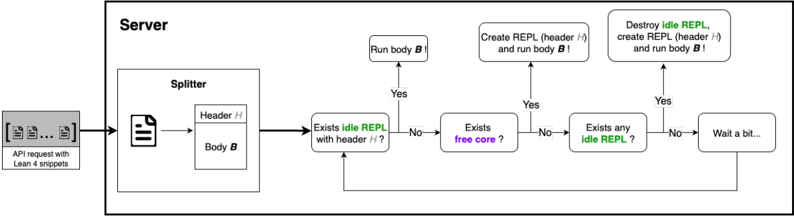
- Design: open-source Lean 4 server built on the official Lean REPL; REST API; pool of Lean REPL processes for server-side parallelization; LRU cache keyed by import header to reuse warmed REPLs; Python client with a single `check` call and infotree processing to extract non-overlapping tactics and tactic states.
- Data/sample: filtered subset of NuminaMath-LEAN, deduplicated, restricted to complete proofs, with 26 sorry proofs and 3 non-compiling proofs removed, yielding 9,419 valid, sorry-free proofs.
- Analysis: benchmarks on a GCP C4 VM with 72 vCPUs, 540 GB RAM, Lean v4.15.0, and SMT disabled; compared total verification time across 8/16/32/64 cores against leanclient and LeanInteract, and compared cached vs. non-cached modes.
Limitations
- The paper does not state an explicit limitations section.
- Evident from text: evaluation is limited to one hardware/software setup (GCP C4 VM, Lean v4.15.0) and one dataset (filtered NuminaMath-LEAN), so performance on other datasets, Lean versions, or environments is not reported.
- Evident from text: baseline comparison covers only leanclient and LeanInteract; other Lean interaction tools are discussed but not benchmarked. Caching benefit is described as particularly effective when workflows frequently reuse the same imports.
Model-written summary. Check it against the paper before relying on it.
Integrity signals
Registry
Cites
Statistics
Figures
Verification
Claims the paper makes
2 Valid · 1 Not valid · 2 Not checked · 9 Own results and interpretations
Every source the paper cites for this claim was checked and supports it.
In the paper
“Moreover, its improved efficiency has enabled its use in the large-scale training of state-of-the-art models such as Kimina-Prover [Wang et al., 2025].”
§ Kimina Lean Server: A High-Performance Lean Server for Large-Scale Verification > Abstract
What the sources say
- Supportedcites Wang et al., 2025 matched to “Kimina-Prover Preview: Towards Large Formal Reasoning Models with Reinforcement Learning” (2025) source
Section 3.1 (Inference Setup) states that Kimina-Prover's reinforcement-learning and evaluation pipelines integrate the Lean server (named 'Numina Lean Server' in our copy) as verification backend, and that its LRU-based caching and multi-CPU parallelization give a 10× speedup (up to 100 iterations/sec on 64 cores), so that during RL training 'verification does not become a bottleneck, requiring only 640 CPU cores' versus the thousands of cores prior LM-based provers needed — i.e. the efficiency is what makes it usable at training scale. The Abstract and Section 3.2.1 support the 'state-of-the-art' descriptor (80.74% miniF2F-test, pass@8192, new SotA). Only wording differs: our copy calls the server the Numina Lean Server, not the 'Kimina Lean Server'. (LLM, conf=0.85)
plainstates a cause- Asserted: passes — The authors put it forward as true.
- Checkable: passes — It can be checked against evidence.
- Load-bearing: unclear — It is unclear whether the paper’s conclusions depend on it.
- Based: passes — The paper gives a reason why it holds.
- Supported
The cited sources support only part of this claim — read each source’s verdict below.
In the paper
“The successful training of these models, which have twice achieved state-of-the-art performance on the miniF2F benchmark [Zheng et al., 2022], serves as a practical validation of our system's efficiency and robustness for neural theorem proving workflows.”
§ Kimina Lean Server: A High-Performance Lean Server for Large-Scale Verification > Parallelization and Scalability
What the sources say
- Partly supportedcites Wang et al., 2025 matched to “Kimina-Prover Preview: Towards Large Formal Reasoning Models with Reinforcement Learning” (2025) sourceExperimental — accuracy not yet measured
Split into 2 atoms — 1 confirmed, 1 partially supported, 0 disputed, 0 misattributed, 0 unverifiable. Expand the claim to see per-atom verdicts.
- Not matchedcites Zheng et al., 2022
An author–year citation the paper’s reference list doesn’t settle. We don’t search these by name.
plainstates a cause- Asserted: passes — The authors put it forward as true.
- Checkable: passes — It can be checked against evidence.
- Load-bearing: passes — The paper’s conclusions depend on it.
- Based: passes — The paper gives a reason why it holds.
- Partly supported
The cited sources that could be checked couldn’t confirm or dispute this claim.
In the paper
“For this benchmark, we used a filtered subset of the NuminaMath-LEAN dataset [Wang et al., 2025], which contains 9,419 valid, sorry-free proofs.”
- Also stated in: § B.2 Dataset Processing · plain
“This process resulted in a final dataset of 9,419 valid, sorry-free proofs.”
§ Kimina Lean Server: A High-Performance Lean Server for Large-Scale Verification > 3 Experiments
What the sources say
- Could not verifycites Wang et al., 2025 matched to “Kimina-Prover Preview: Towards Large Formal Reasoning Models with Reinforcement Learning” (2025) sourceExperimental — accuracy not yet measured
Our copy of Kimina-Prover Preview nowhere describes a 'NuminaMath-LEAN' dataset nor a count of 9,419 valid, sorry-free proofs (searched: NuminaMath-LEAN, 9419, sorry-free, filtered Lean dataset, SFT corpus). Its data sections instead describe an informal pipeline starting from the Numina 1.5 dataset with filtering and autoformalization (Appendix C.1), a 200k autoformalized + human-annotated RL problem set (Appendix C.3), a ~20K-example cold-start SFT set (Cold start), and 13-gram decontamination of the Numina Math 1.5 training set plus release of eight corrected miniF2F problems via the Numina HuggingFace repository (Sec. 3.1). Since our copy neither states nor contradicts the attributed dataset and figure, the claim cannot be checked against this source; no alternative origin is named in our copy either. (LLM, conf=0.70)
plain- Asserted: passes — The authors put it forward as true.
- Checkable: passes — It can be checked against evidence.
- Load-bearing: passes — The paper’s conclusions depend on it.
- Based: passes — The paper gives a reason why it holds.
- Also stated in: § B.2 Dataset Processing · plain
A result the paper reports from its own data — it cites no other source for it, so there is none to check. The quote shows it is in the paper.
In the paper
“Scaling from 8 to 32 cores reduces the total time from 42:40 to 11:33, a nearly 4x speedup.”
- Also stated in: § Parallelization and Scalability · boosted
“The results in Table 2 show a strong correlation between added cores and reduced verification time.”
§ Kimina Lean Server: A High-Performance Lean Server for Large-Scale Verification > Parallelization and Scalability
boostedstates a cause- Asserted: passes — The authors put it forward as true.
- Checkable: passes — It can be checked against evidence.
- Load-bearing: passes — The paper’s conclusions depend on it.
- Based: passes — The paper gives a reason why it holds.
- Rests on an assumption not shown here.
- Also stated in: § Parallelization and Scalability · boosted
A result the paper states — it cites no source for it, so there is none to check. The quote shows it is in the paper.
In the paper
“This produces a clean sequence of tactics and states, supporting all Lean tactics, including have and let tactics, calc mode, and conv mode, which are not always supported by the LeanREPL's Tactic mode.”
§ Kimina Lean Server: A High-Performance Lean Server for Large-Scale Verification > Data Extraction via Infotree Processing
plainstates a cause- Asserted: passes — The authors put it forward as true.
- Checkable: passes — It can be checked against evidence.
- Load-bearing: passes — The paper’s conclusions depend on it.
- Based: passes — The paper gives a reason why it holds.
1 more claim
Create a free account to see all 14 claims and every source verdict.
- It may state two separate claims as one. 2
- The quote only partly states this claim. 2
- Probably not a substantial claim. 5
Citations
Cites
MiniF2F: a cross-system benchmark for formal Olympiad-level mathematics
Zheng, K., Han, J. M., & Polu, S. (2021) · arXiv · doi:10.48550/arxiv.2109.00110 · Cited by 371
The Lean 4 Theorem Prover and Programming Language
Moura, L. D., & Ullrich, S. (2021) · Lecture Notes in Computer Science · doi:10.1007/978-3-030-79876-5_37 · Cited by 258
LeanDojo: Theorem Proving with Retrieval-Augmented Language Models
Yang, K., Swope, A., Gu, A., Chalamala, R., Song, P., Yu, S., Godil, S., Prenger, R. J., & Anandkumar, A. (2023) · Advances in Neural Information Processing Systems 36 · doi:10.52202/075280-0944 · Cited by 97
Aniva, L., Sun, C., Miranda, B., Barrett, C., & Koyejo, S. (2025) · Lecture notes in computer science · doi:10.1007/978-3-031-90643-5_6 · Cited by 32
Ren, Z. Z., Shao, Z., Song, J., Xin, H., Wang, H., Zhao, W., Zhang, L., Fu, Z., Zhu, Q., Yang, D., et al. (2025) · arXiv · doi:10.48550/arxiv.2504.21801 · Cited by 4 · cited 1×
“The successful large-scale reinforcement learning training of theorem proving models [Wang et al., 2025, Ren et al., 2025, Chen et al., 2025] highlights a community need for a highly efficient Lean server which supports large-scale verification and data extraction workflows.”
Self-citationProofWala: A Framework for Multilingual Proof Data Synthesis and Theorem-Proving
Thakur, A., Tsoukalas, G., Durrett, G., & Chaudhuri, S. (2025) · DROPS (Schloss Dagstuhl – Leibniz Center for Informatics) · doi:10.4230/lipics.itp.2026.24 · Cited by 4
Kimina-Prover Preview: Towards Large Formal Reasoning Models with Reinforcement Learning
Wang, H., Unsal, M., Lin, X., Baksys, M., Liu, J., Santos, M. D., Sung, F., Vinyes, M., Ying, Z., Zhu, Z., et al. (2025) · arXiv · doi:10.48550/arxiv.2504.11354 · Cited by 2
Self-citationSeed-Prover: Deep and Broad Reasoning for Automated Theorem Proving
Chen, L., Gu, J., Huang, L., Huang, W., Jiang, Z., Jie, A., Jin, X., Jin, X., Li, C., Ma, K., et al. (2025) · arXiv · doi:10.48550/arxiv.2507.23726
ProofWala: A Framework for Multilingual Proof Data Synthesis and Theorem-Proving
Thakur, A., Tsoukalas, G., Durrett, G., & Chaudhuri, S. (2025) · arXiv · doi:10.48550/arxiv.2502.04671
Cited by
Hilbert: Recursively Building Formal Proofs with Informal Reasoning
Varambally, S., Voice, T., Sun, Y., Chen, Z., Yu, R., & Ye, K. (2026) · International Conference on Learning Representations · doi:10.48550/arxiv.2509.22819 · Cited by 69
“We use the Kimina Lean Server (Santos et al., 2025) with Lean v4.”
InfluentialProofFlow: A Dependency Graph Approach to Faithful Proof Autoformalization
Cabral, R., Do, T. M., Yu, X., Tai, W. M., Feng, Z., & Shen, X. (2026) · International Conference on Learning Representations · doi:10.48550/arxiv.2510.15981 · Cited by 18
Wu, Y., Huang, D., Wan, R., Peng, Y., Shang, S., Cao, C., Qi, L., Zhang, R., Zhang, X.-S., Du, Z.-D., et al. (2025) · AAAI Conference on Artificial Intelligence · doi:10.48550/arxiv.2508.04440 · Cited by 22
FANS: Formal Answer Selection for LLM Natural Language Math Reasoning Using Lean4
Yao, J., Wang, R., & Zhang, T. (2025) · Conference on Empirical Methods in Natural Language Processing (EMNLP) · doi:10.18653/v1/2025.emnlp-main.158 · Cited by 9
Self-citationWu, Y., Huang, D., Wan, R., Peng, Y., Shang, S., Cao, C., Qi, L., Zhang, R., Zhang, X., Du, Z., et al. (2026) · Proceedings of the AAAI Conference on Artificial Intelligence · doi:10.1609/aaai.v40i40.40691 · Cited by 9
FormalRx: Rectify and eXamine Semantic Failures in AutoformalizationPreprint
Wang, H., Huang, B., Wan, Y., Zhu, X., Liu, X., Huang, Y., & Guo, Z. (2026) · arXiv (Cornell University) · doi:10.48550/arxiv.2607.04655 · Cited by 8
“Case 1: FormalMATH Complex.abs deprecation A case from FormalMATH (Yu et al., 2025b”
Self-citationFANS -- Formal Answer Selection for Natural Language Math Reasoning Using Lean4Preprint
Yao, J., Wang, R., & Zhang, T. (2025) · arXiv (Cornell University) · doi:10.48550/arxiv.2503.03238 · Cited by 7
Self-citationMathAtlas: A Benchmark for Autoformalization in the WildPreprint
Patel, N., Arias, N., Babayan, D., Cochran, V., Libman, T., Mahmood, H., McCarty, L., Munoz, S., Willey, L., & Flanigan, J. (2026) · arXiv (Cornell University) · doi:10.48550/arxiv.2605.14061 · Cited by 7
AXLE: A Cloud Infrastructure for Lean 4 Theorem Proving UtilitiesPreprint
Xin, J., Schneidman, A., Cummins, C., Ram, K., Ganesh, S., & Limperg, J. (2026) · arXiv (Cornell University) · doi:10.48550/arxiv.2606.26442 · Cited by 7
FormalML: A Benchmark for Evaluating Formal Subgoal Completion in Machine Learning Theory
Yang, X.-W., Zhang, Z., Cao, J., Zhou, Z., Li, Z., Guo, L.-Z., Yao, Y., Chen, T., Li, Y.-F., & Ma, X. (2026) · International Conference on Learning Representations · doi:10.48550/arxiv.2510.02335 · Cited by 6
Automating Formal Verification with Reinforcement Learning and Recursive InferencePreprint
Tan, M. (2026) · arXiv (Cornell University) · doi:10.48550/arxiv.2605.30914 · Cited by 4
Zhang, T. J., Jiang, W., Liu, R., Wang, Y., Yang, J., Wang, N., Ni, N., Huang, Y., & Sachan, M. (2025) · arXiv (Cornell University) · doi:10.48550/arxiv.2508.15878 · Cited by 4
“In our validation pipeline, we adopt the open-source Lean 4 server implementation from Kimina Lean Server (Santos et al., 2025).”
MA-ProofBench: A Two-Tiered Evaluation of LLMs for Theorem Proving in Mathematical AnalysisPreprint
Pu, L., Zhang, W., Xie, X., Fu, Z., He, B., Lyu, H., Li, X., Zhou, J., & Wang, Y. (2026) · arXiv (Cornell University) · doi:10.48550/arxiv.2606.13782 · Cited by 3
MechMath: Sorrifier-Driven Formal Decomposition Workflow for Automated Theorem ProvingPreprint
Qiu, R., Cao, Y., Liu, J., Guo, D., Gao, X.-S., Zhi, L., & Feng, R. (2026) · arXiv (Cornell University) · doi:10.48550/arxiv.2603.24465 · Cited by 3
Self-citationGödel's PoetryPreprint
Davis, K. J. (2025) · arXiv (Cornell University) · doi:10.48550/arxiv.2512.14252 · Cited by 2
“A key technical contribution of this work lies in our extension of the Kimina Lean Server [10] to support abstract syntax tree (AST) extraction from Lean 4 code.”
InfluentialFormalEvolve: Neuro-Symbolic Evolutionary Search for Diverse Autoformalization
Lu, H., Wang, W., & Liu, J. (2026) · Findings of the Association for Computational Linguistics: EMNLP (Findings of EMNLP) · doi:10.18653/2026.findings-emnlp.317 · Cited by 2
Self-citationh1: A Taste of the Bitter Lesson in Automated Theorem ProvingPreprint
Moalla, S., Rammal, A., Patel, N., Munos, R., & Kempe, J. (2026) · arXiv (Cornell University) · doi:10.48550/arxiv.2610.35962 · Cited by 2
Benchmarking Testing in Automated Theorem Proving
Kim, J., Han, H., & Hwang, S.-W. (2026) · Proceedings of the conference - Association for Computational Linguistics. Meeting · doi:10.18653/v1/2026.acl-industry.150 · Cited by 2
LeanDojo-v2: A Comprehensive Library for AI-Assisted Theorem Proving in LeanPreprint
Hsiang, R., Adkisson, W., George, R. J., & Anandkumar, A. (2026) · arXiv (Cornell University) · doi:10.48550/arxiv.2611.09048 · Cited by 2
Vamshi, B. K., & Yang, H. (2026) · arXiv (Cornell University) · doi:10.48550/arxiv.2608.28639 · Cited by 1
Yan, Z., Guo, F., Liu, X., Zhang, Y., 嘉成, 薫., Liu, Q., Huang, J., & Song, K. (2026) · arXiv (Cornell University) · doi:10.48550/arxiv.2601.06795 · Cited by 1
Distilling LLM Feedback for Lean Theorem ProvingPreprint
Narozniak, G., Biau, G., Munos, R., Rammal, A., & Marion, P. (2026) · arXiv (Cornell University) · doi:10.48550/arxiv.2605.30861 · Cited by 1
The FIL Hypothesis: Inductive Biases Help with Kernel EngineeringPreprint
Rozanov, N., Dutta, S., Nakov, P., & Gurevych, I. (2026) · arXiv (Cornell University) · doi:10.48550/arxiv.2606.30442
Pu, L., Zhang, W., Xie, X., Fu, Z., He, B., Zhao, H., Lyu, H., Li, X., Zhou, J., & Wang, Y. (2026) · arXiv (Cornell University) · doi:10.48550/arxiv.2608.14221
LEVER: Adaptive Cost-Aware Proof Search Over AND/OR GraphsPreprint
Jain, N., Yao, S., Cicekdag, B., Zhang, Z., & Jana, S. (2026) · arXiv (Cornell University) · doi:10.48550/arxiv.2610.11862
Lehre, P. K. (2026) · arXiv (Cornell University) · doi:10.48550/arxiv.2610.35595
Learning Lean Feedback for Efficient Proof-Candidate Evaluation on GPUsPreprint
Milikić, L., Bamas, É., Abbe, E. A., & Kunčak, V. (2026) · arXiv (Cornell University) · doi:10.48550/arxiv.2610.21881
Efficient Proof Generation for Lean Statements with Multiple Candidate AnswersPreprint
Lin, P., Zhang, K., Raissi, M., & Shi, Z. (2026) · arXiv (Cornell University) · doi:10.48550/arxiv.2610.34490
Keep the Proof State Live: Snapshotting for Efficient Tactic Search in Lean 4Preprint
Shen, A., & Shi, Y. (2026) · arXiv (Cornell University) · doi:10.48550/arxiv.2605.25556
TreeThink: A Modular Tree Search Library for Mathematical Reasoning with LLMs
Akbudak, B. S., Uluşan, Z. A., Erer, C. S., & Şahin, G. G. (2026) · Conference on Empirical Methods in Natural Language Processing: System Demonstrations (EMNLP) · doi:10.18653/2026.emnlp-demos.57
AuXSpec: Learning to Autoformalize Program Specifications via Executable PostconditionsPreprint
Wang, H., Yuan, W., Hübler, F., Huang, Y., Guo, Z., Yingchareonthawornchai, S., & Kyng, R. (2026) · arXiv (Cornell University) · doi:10.48550/arxiv.2611.21421
Self-citation
Metadata
- Authors
- Santos, M. D., de Saxcé, H., Wang, H., Wang, R., Baksys, M., Unsal, M., Liu, J., Liu, Z., & Li, J.
- Affiliations
- University of Cambridge (GB)
- Moonshot AI (China) (CN)
- Venue
- arXiv
- Publisher
- arXiv
- Published
- 2025
- ISSN
- 2331-8422 (ISSN-L)
- arXiv
- 2504.21230
- OpenAlex
- W4417468671
- Semantic Scholar
- 118ad78fe354249748a67547aab7cf3a268d0ffb
- Cited by
- 31
- References
- 7
- Citations by year
- 2026: 26 · 2025: 5
- Type
- posted content
- Language
- en
- Open access
- green
- arxiv.org
- Licence
- Locations
- arXiv (Cornell University) (submittedVersion, cc-by-nc-nd)
- arXiv (Cornell University) (cc-by-nc-nd)
- Topics
- Physical Sciences › Computer Science › Software › Logic, programming, and type systems
- Physical Sciences › Computer Science › Computational Theory and Mathematics › Formal Methods in Verification
- Physical Sciences › Computer Science › Computational Theory and Mathematics › Mathematics, Computing, and Information Processing
- Keywords
- formal verification, LRU caching
About these checks
Registry, retraction, Cites and statistics results are computed, not judged, with one exception: a printed reference that no index lists is read once by a model before it counts as a citation error. Claims are extracted by a model and kept only when their quote appears verbatim in the text; each cited source is then checked, with a model’s help, for whether it says what the claim relies on. Those verdicts can be wrong — read the claim’s quote and the cited source before relying on one.
The claim verdicts this report counts are experimental: their accuracy is not yet measured.
A language model drew the claims from the paper on 2026-11-22, under version 3 of the claim definition (model deepseek-v4.1-flash, prompt extract-v3).
A second model labelled each claim on 2026-11-22 (model jev-1.13-20260917, definition revision gold-guideline-v0.2).
Cited sources are checked with a language model’s help (qwen3.8-omni-flash).
Statistics and arithmetic are recomputed, not judged.
Confidence bands are shown only for fields calibrated on our annotated test set. None is calibrated yet, so no band is shown.
What counts as a claim ›How we measure confidence ›How we check this ›
Are you an author, or do you see a problem with this page? Request a review
Data sources
Bibliographic data: Semantic Scholar, OpenAlex, Crossref.
Contains information from the Semantic Scholar Academic Graph Datasets, made available under the ODC Attribution License (ODC-BY 1.0).
Semantic Scholar’s data is described in: Kinney, R., et al. (2023). The Semantic Scholar Open Data Platform. arXiv:2301.10140.
