

Unpacking Musical Symbolism in Online Communities: Content-Based and Network-Centric Approaches
Open accessThe DOI matches its DataCite record; 15 of the 15 references it cites were found in a registry or an index; none of the 14 sources its claims cite is checked for support yet.
Abstract
This paper examines how musical symbolism is produced and circulated in online communities by combining content-based music analysis with a lightweight network perspective on lyrics. Using a curated corpus of 275 chart-topping songs enriched with audio descriptors (energy, danceability, loudness, liveness, valence, acousticness, speechiness, popularity) and full lyric transcripts, we build a reproducible pipeline that (i) quantifies temporal trends in sonic attributes, (ii) models lexical salience and co-occurrence, and (iii) profiles mood by genre. We find a decade-long decline in energy (79 -> 58) alongside a rise in danceability (59 -> 73); valence peaks in 2013 (63) and dips in 2014-2016 (42) before partially recovering. Correlation analysis shows strong coupling of energy with loudness (r = 0.74) and negative associations for acousticness with both energy (r = -0.54) and loudness (r = -0.51); danceability is largely orthogonal to other features (|r| < 0.20). Lyric tokenization (>114k tokens) reveals a pronoun-centric lexicon "I/you/me/my" and a dense co-occurrence structure in which interpersonal address anchors mainstream narratives. Mood differs systematically by style: R&B exhibits the highest mean valence (96), followed by K-Pop/Pop (77) and Indie/Pop (70), whereas Latin/Reggaeton is lower (37) despite high danceability. Read through a subcultural identity lens, these patterns suggest the mainstreaming of previously peripheral codes and a commercial preference for relaxed yet rhythmically engaging productions that sustain collective participation without maximal intensity. Methodologically, we contribute an integrated MIR-plus-network workflow spanning summary statistics, correlation structure, lexical co-occurrence matrices, and genre-wise mood profiling that is robust to modality sparsity and suitable for socially aware recommendation or community-level diffusion studies.
Overview
CoChat Summary
TL;DR
This paper combines content-based audio/lyric analysis with a lightweight lyric co-occurrence network to examine musical symbolism in 275 chart-topping songs from 2010–2020. It reports declining energy and rising danceability, pronoun-centered lyrics, and genre-specific mood differences, interpreting these as mainstreaming of peripheral codes and a commercial preference for relaxed but rhythmically engaging productions.
Key findings
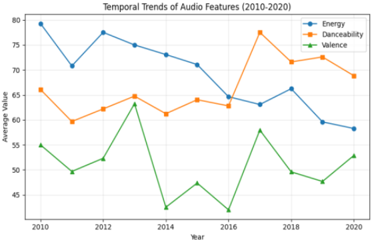
- Across 2010–2020, mean energy fell from ~79 to ~58 while danceability rose from ~59 to ~73; valence peaked at 63.2 in 2013, dipped to ~42 in 2014–2016, and partially recovered to ~52.9 by 2020.
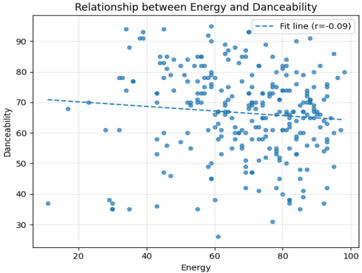
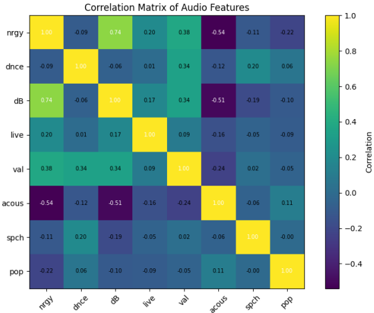
- Audio features showed strong energy–loudness coupling (r = 0.74), negative acousticness–energy (r = -0.54) and acousticness–loudness (r = -0.51) associations, and danceability largely orthogonal to other features (|r| < 0.20).
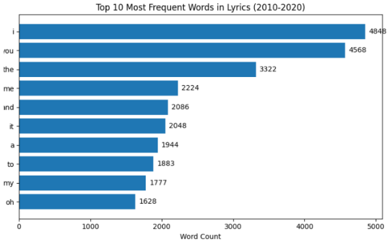
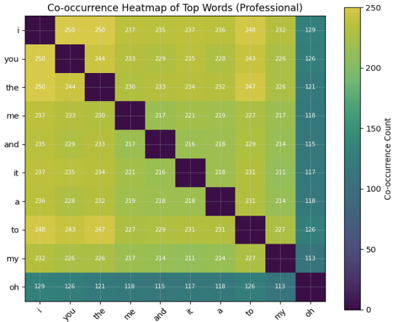
- Lyrics produced >114,000 tokens and a pronoun-centric lexicon (“I/you/me/my”); the top-10-word co-occurrence network was highly interconnected, with interpersonal address anchoring mainstream narratives.
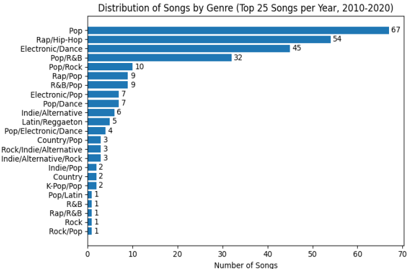
- Genre-wise mean valence was highest for R&B (96), followed by K-Pop/Pop (77) and Indie/Pop (70), while Latin/Reggaeton was lower (37) despite high danceability; Electronic/Pop was ~46.
Methods
- Used the Spotify 2010–2020 Top 25 Songs and Lyrics database: 275 songs, 25 per year, with audio descriptors (energy, danceability, loudness, liveness, valence, acousticness, speechiness, popularity) and full lyric transcripts.
- Text processing lowercased and regex-tokenized lyrics; computed word frequencies and a co-occurrence network for the top N = 10 most frequent words, deriving degree and weighted degree.
- Audio analysis computed summary statistics, annual means by release year, and Pearson correlations; implementation in Python with pandas, NumPy, and matplotlib.
Limitations
- The paper states the dataset is chart hits, mainly in English, and under-represents alternative scenes and languages outside Western nations; it also notes no user interaction data and calls for larger, more diverse datasets and ethnographic work.
- The text makes evident that genre subsamples are small (e.g., Latin/Reggaeton 5 songs, Country/Pop 3 songs), limiting genre-level inference; some reported counts/degrees in tables and text are inconsistent (e.g., co-occurrence degree values).
Model-written summary. Check it against the paper before relying on it.
Integrity signals
Registry
Cites
Statistics
Figures
Verification
Claims the paper makes
0 Valid · 0 Not valid · 12 Not checked · 56 Own results and interpretations
A result the paper reports from its own data — it cites no other source for it, so there is none to check. The quote shows it is in the paper.
In the paper
“low positive correlation with danceability (r = 0.06)”
§ Unpacking Musical Symbolism in Online Communities: Content-Based and Network-Centric Approaches Unpacking Musical Symbolism in Online Communities > 4.6 CORRELATION ANALYSIS AND MOOD BY GENRE
plainstates an association- Asserted: passes — The authors put it forward as true.
- Checkable: passes — It can be checked against evidence.
- Load-bearing: unclear — It is unclear whether the paper’s conclusions depend on it.
- Based: passes — The paper gives a reason why it holds.
- Rests on an assumption not shown here.
A result the paper reports from its own data — it cites no other source for it, so there is none to check. The quote shows it is in the paper.
In the paper
“We find a decadelong decline in energy (79 → 58)”
- Also stated in: § 4.2 TEMPORAL TRENDS · plain
“Energy reduces consistently from ~79 in 2010 to ~58 in 2020”
§ Unpacking Musical Symbolism in Online Communities: Content-Based and Network-Centric Approaches Unpacking Musical Symbolism in Online Communities > Abstract
plainstates a cause- Asserted: passes — The authors put it forward as true.
- Checkable: passes — It can be checked against evidence.
- Load-bearing: passes — The paper’s conclusions depend on it.
- Based: passes — The paper gives a reason why it holds.
- Rests on an assumption not shown here.
- Also stated in: § 4.2 TEMPORAL TRENDS · plain
A result the paper reports from its own data — it cites no other source for it, so there is none to check. The quote shows it is in the paper.
In the paper
“alongside a rise in danceability (59 → 73)”
- Also stated in: § 4.2 TEMPORAL TRENDS · plain
“Danceability varies after a low of ~59 in 2011 consistently increasing to an all-time high of ~73 in 2019 before declining in 2020.”
§ Unpacking Musical Symbolism in Online Communities: Content-Based and Network-Centric Approaches Unpacking Musical Symbolism in Online Communities > Abstract
plainstates a cause- Asserted: passes — The authors put it forward as true.
- Checkable: passes — It can be checked against evidence.
- Load-bearing: passes — The paper’s conclusions depend on it.
- Based: passes — The paper gives a reason why it holds.
- Rests on an assumption not shown here.
- Also stated in: § 4.2 TEMPORAL TRENDS · plain
A result the paper reports from its own data — it cites no other source for it, so there is none to check. The quote shows it is in the paper.
In the paper
“and loudness (-0.51)”
§ Unpacking Musical Symbolism in Online Communities: Content-Based and Network-Centric Approaches Unpacking Musical Symbolism in Online Communities > 4.6 CORRELATION ANALYSIS AND MOOD BY GENRE
plainstates an association- Asserted: passes — The authors put it forward as true.
- Checkable: passes — It can be checked against evidence.
- Load-bearing: unclear — It is unclear whether the paper’s conclusions depend on it.
- Based: passes — The paper gives a reason why it holds.
- Rests on an assumption not shown here.
A result the paper reports from its own data — it cites no other source for it, so there is none to check. The quote shows it is in the paper.
In the paper
“R&B exhibits the highest mean valence (96)”
- Also stated in: § 4.5 GENRE-SPECIFIC VALENCE · plain
“R&B songs register the highest average valence (~96)”
- Also stated in: § 4.6 CORRELATION ANALYSIS AND MOOD BY GENRE · plain
“R&B comes top with the highest at a mean valence of 96”
§ Unpacking Musical Symbolism in Online Communities: Content-Based and Network-Centric Approaches Unpacking Musical Symbolism in Online Communities > Abstract
plain- Asserted: passes — The authors put it forward as true.
- Checkable: passes — It can be checked against evidence.
- Load-bearing: passes — The paper’s conclusions depend on it.
- Based: passes — The paper gives a reason why it holds.
- Rests on an assumption not shown here.
- Also stated in: § 4.5 GENRE-SPECIFIC VALENCE · plain
27 more claims
Create a free account to see all 68 claims and every source verdict.
- It may state two separate claims as one. 26
- The quote only partly states this claim. 2
- Probably not a substantial claim. 12
Self-check
Percentages, sums and reported differences re-computed from the paper’s own numbers.
Each contradiction between two passages listed here was confirmed by an independent check.
Rated major: it would touch a result — a value a result rests on, reported and recomputed p-values on opposite sides of the significance level, two passages that conflict with no sign which is right, or a cited work retracted before this paper was published.
In the paper
§ Unpacking Musical Symbolism in Online Communities: Content-Based and Network-Centric Approaches Unpacking Musical Symbolism in Online Communities > 4.6 CORRELATION ANALYSIS AND MOOD BY GENRE
“Danceability remains weakly correlated with all variables (|r| < 0.20)”
§ Unpacking Musical Symbolism in Online Communities: Content-Based and Network-Centric Approaches Unpacking Musical Symbolism in Online Communities > 4.2 TEMPORAL TRENDS
“Danceability is positively correlated with valence (r=0.34)”
Rated minor: it would not touch a result — a value no result rests on, a p-value that stays on the same side of the significance level, or a conflict that is clerical, resolved elsewhere in the paper, or outside its own findings.
In the paper
§ Unpacking Musical Symbolism in Online Communities: Content-Based and Network-Centric Approaches Unpacking Musical Symbolism in Online Communities > 4.4 CO-OCCURRENCE PATTERNS
“Weighted degrees vary greatly, from 3,003 for "I" to 1,577 for "oh" (Table 4)”
§ Unpacking Musical Symbolism in Online Communities: Content-Based and Network-Centric Approaches Unpacking Musical Symbolism in Online Communities > 6. CONCLUSION
“| oh | 10628 | 14 | 10,577 |”
Rated minor: it would not touch a result — a value no result rests on, a p-value that stays on the same side of the significance level, or a conflict that is clerical, resolved elsewhere in the paper, or outside its own findings.
In the paper
§ Unpacking Musical Symbolism in Online Communities: Content-Based and Network-Centric Approaches Unpacking Musical Symbolism in Online Communities > 4.3 LEXICAL ANALYSIS
“Comparative frequency of "I" (4.2 %) shows the artist's own expression”
§ Unpacking Musical Symbolism in Online Communities: Content-Based and Network-Centric Approaches Unpacking Musical Symbolism in Online Communities > 6. CONCLUSION
“| I | 30838 | 0.0240 |”
Rated minor: it would not touch a result — a value no result rests on, a p-value that stays on the same side of the significance level, or a conflict that is clerical, resolved elsewhere in the paper, or outside its own findings.
In the paper
§ Unpacking Musical Symbolism in Online Communities: Content-Based and Network-Centric Approaches Unpacking Musical Symbolism in Online Communities > 6. CONCLUSION
“| I | 30838 | 0.0240 |”
§ Unpacking Musical Symbolism in Online Communities: Content-Based and Network-Centric Approaches Unpacking Musical Symbolism in Online Communities > 6. CONCLUSION
“| I | 30848 | 13 | 3,003 |”
Rated minor: it would not touch a result — a value no result rests on, a p-value that stays on the same side of the significance level, or a conflict that is clerical, resolved elsewhere in the paper, or outside its own findings.
In the paper
§ Unpacking Musical Symbolism in Online Communities: Content-Based and Network-Centric Approaches Unpacking Musical Symbolism in Online Communities > 4.2 TEMPORAL TRENDS
“Correlation analysis indicates weak positive correlation with energy and loudness (r=0.74)”
§ Unpacking Musical Symbolism in Online Communities: Content-Based and Network-Centric Approaches Unpacking Musical Symbolism in Online Communities > 4.6 CORRELATION ANALYSIS AND MOOD BY GENRE
“Energy is strongly positively correlated with loudness (0.74)”
2 more findings
Create a free account to see every finding of this check.
Citations
Cites
The Field behind the Screen: Using Netnography for Marketing Research in Online Communities
Kozinets, R. V. (2002) · Journal of Marketing Research · doi:10.1509/jmkr.39.1.61.18935 · Cited by 3,962
Content-Based Music Information Retrieval: Current Directions and Future Challenges
Casey, M. A., Veltkamp, R., Goto, M., Leman, M., Rhodes, C., & Slaney, M. (2008) · Proceedings of the IEEE · doi:10.1109/jproc.2008.916370 · Cited by 651
Music Information Retrieval: Recent Developments and Applications
Schedl, M., Gómez, E., & Urbano, J. (2014) · Foundations and Trends® in Information Retrieval · doi:10.1561/1500000042 · Cited by 267
Music Challenge Memes on TikTok: Understanding In-Group Storytelling Videos
Vizcaíno-Verdú, A., & Abidin, C. (2022) · International journal of communication · Cited by 175
Musical Communities: Rethinking the Collective in Music
Shelemay, K. K. (2011) · Journal of the American Musicological Society · doi:10.1525/jams.2011.64.2.349 · Cited by 169
Murthy, Y. V. S., & Koolagudi, S. G. (2018) · ACM Computing Surveys · doi:10.1145/3177849 · Cited by 100
Music as Collective Invention: A Social Network Analysis of Composers
McAndrew, S., & Everett, M. G. (2014) · Cultural Sociology · doi:10.1177/1749975514542486 · Cited by 81
Gamers, Surfers, Social Media Users: Unpacking the role of interest in English
Brevik, L. M. (2019) · Journal of Computer Assisted Learning · doi:10.1111/jcal.12362 · Cited by 75
Beyond the platform: Music streaming as a site of logistical and symbolic struggle
Jansson, A. (2021) · New Media & Society · doi:10.1177/14614448211036356 · Cited by 27
Unpacking the Construction of Online Identities of Hybristophilia Communities on TikTok
Williams, T. J. V., Slater, H. E., & Gómez, C. T. (2024) · Deviant Behavior · doi:10.1080/01639625.2024.2338273 · Cited by 12
Cited by
Still being checked.
Metadata
- Authors
- Ziaoddini, K.
- Affiliations
- University of Maryland, College Park (US)
- Corresponding author
- Ziaoddini, Kajwan
- ORCID
- Ziaoddini, Kajwan
- Venue
- arXiv
- Publisher
- arXiv
- Published
- 2025
- ISSN
- 2331-8422 (ISSN-L)
- arXiv
- 2510.00006
- OpenAlex
- W7084397169
- Semantic Scholar
- f972562dd0efeee4e1926ac15df93d34b862ccde
- Cited by
- 0
- References
- 14
- Type
- posted content
- Language
- en
- Open access
- green
- arxiv.org
- Licence
- Locations
- arXiv (Cornell University) (submittedVersion, cc-by)
- arXiv (Cornell University) (cc-by)
- Topics
- Social Sciences › Arts and Humanities › Music › Music History and Culture
- Physical Sciences › Computer Science › Signal Processing › Music and Audio Processing
- Social Sciences › Arts and Humanities › Music › Musicology and Musical Analysis
- Keywords
- musical symbolism, online music communities, song lyrics, audio features, danceability, valence, loudness, energy, word co-occurrence, music genres, subcultural identity, music recommendation
About these checks
Registry, retraction, Cites and statistics results are computed, not judged, with one exception: a printed reference that no index lists is read once by a model before it counts as a citation error. Claims are extracted by a model and kept only when their quote appears verbatim in the text; each cited source is then checked, with a model’s help, for whether it says what the claim relies on. Those verdicts can be wrong — read the claim’s quote and the cited source before relying on one.
A language model drew the claims from the paper on 2026-11-20, under version 3 of the claim definition (model deepseek-v4.1-flash, prompt extract-v3).
A second model labelled each claim on 2026-11-20 (model jev-1.13-20260917, definition revision gold-guideline-v0.2).
Statistics and arithmetic are recomputed, not judged.
Confidence bands are shown only for fields calibrated on our annotated test set. None is calibrated yet, so no band is shown.
What counts as a claim ›How we measure confidence ›How we check this ›
Are you an author, or do you see a problem with this page? Request a review
How to cite
Cite CoChat for the checks on this page, and the paper for its own findings.
- This page
- CoChat. (2026). Citation check: Unpacking Musical Symbolism in Online Communities: Content-Based and Network-Centric Approaches. https://app.cochat.ai/papers/10.48550/arxiv.2510.00006
- The paper
- Ziaoddini, K. (2025). Unpacking Musical Symbolism in Online Communities: Content-Based and Network-Centric Approaches. arXiv. https://doi.org/10.48550/arxiv.2510.00006
Data sources
Bibliographic data: Semantic Scholar, OpenAlex, Crossref.
Contains information from the Semantic Scholar Academic Graph Datasets, made available under the ODC Attribution License (ODC-BY 1.0).
Semantic Scholar’s data is described in: Kinney, R., et al. (2023). The Semantic Scholar Open Data Platform. arXiv:2301.10140.
