

Geometric Realism Without Angular Resolution Structural Classification of Multilayer Kubelka-Munk Theory within Radiative Transport
Open accessThe DOI matches its DataCite record; 14 of the 14 references it cites were found in a registry or an index; none of the 35 sources its claims cite is checked for support yet.
Abstract
Kubelka-Munk (KM) theory provides a two-flux description of radiative transport in layered scattering and absorbing media. Despite its wide use in the coatings, paper, paint, and textile industries, the theory has often been regarded as a phenomenological model whose connection to the full radiative transfer equation (RTE) remains unclear. Under the standard steady-state, plane-parallel, azimuthally symmetric assumptions, we show that multilayer KM theory is exactly a rank-2 Galerkin projection of the RTE onto hemispherical basis functions. The projection is idempotent with an infinite-dimensional kernel, and its rank is preserved under multilayer composition -- so no amount of layer stacking can recover angular information discarded by the projection. We derive the KM coefficients as hemispherical moments of the transport operator and compute the projection error for representative scattering media (g from 0 to 0.85), finding that the reduced optical thickness tau* = tau(1-g) governs KM accuracy. The projection-error framework explains the well-documented accuracy of compositional multilayer models in printed media and shows where higher-order methods become necessary. The result places KM theory on rigorous footing as a legitimate -- if low-resolution -- transport approximation rather than an ad hoc phenomenology.
Overview
CoChat Summary
TL;DR
The paper shows that multilayer Kubelka-Munk (KM) theory is exactly a rank-2 Galerkin projection of the radiative transfer equation onto hemispherical basis functions, with KM coefficients arising as hemispherical moments. It derives a projection-error framework in which the reduced optical thickness τ* = τ(1−g) governs KM accuracy.
Key findings
- KM transport is exactly T_KM = P T P, a rank-2 projection onto span{χ⁺, χ⁻}; the projection is idempotent, has an infinite-dimensional kernel, and its rank is preserved under multilayer composition. The KM coefficients are K = 2σ_a and S = σ_s p₋₊.
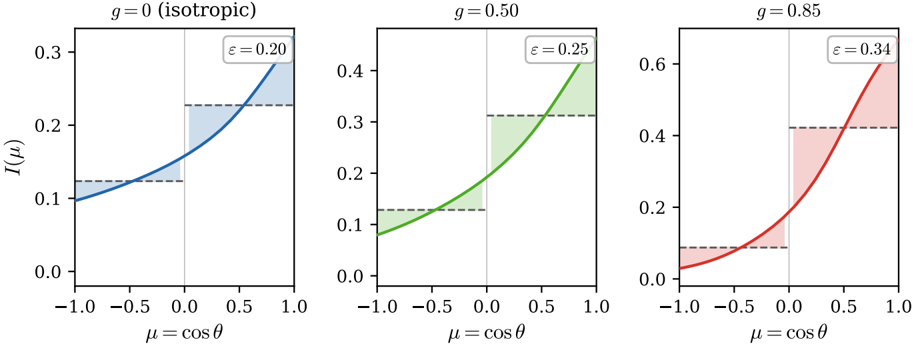
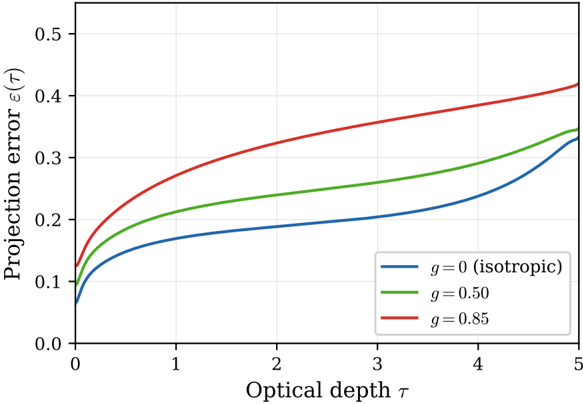
- At τ = 5 and ω = 0.9, the midplane projection error ε_mid rises with forward scattering: 0.20 for g = 0, 0.25 for g = 0.50, and 0.34 for g = 0.85. The corresponding reflectance errors |ΔR| are much smaller: 0.001, 0.021, and 0.046.
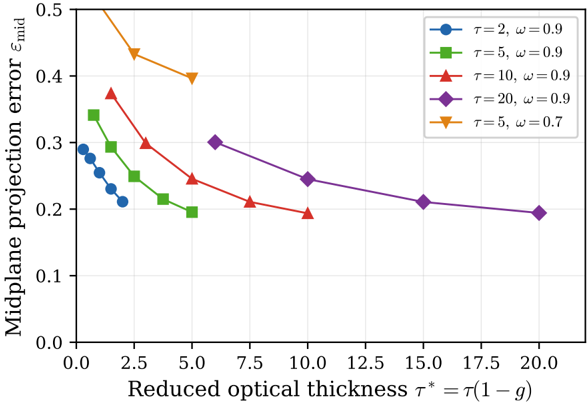
- τ* = τ(1−g) organizes KM accuracy: all computed points with τ* > 5 have ε_mid < 0.25, while all points with τ* < 1 exceed 0.30. For g = 0.85 at τ = 5, τ* falls to 0.75.
- The thin-slab ballistic estimate gives ε_ball ≈ 0.53 at t = 0.5 and ≈ 0.78 at t = 2.5, showing ε → O(1) for optically thin slabs. In a separate S₂ comparison at τ = 5, ω = 0.9, g = 0.50, KM gives R = 0.434 (error 0.021) while S₂ gives R = 0.591 (error 0.179).
Methods
- Theoretical derivation: under steady-state, plane-parallel, azimuthally symmetric assumptions with no emission, the paper defines the hemispherical projection P onto span{χ⁺, χ⁻} and derives the KM equations as a Galerkin projection of the radiative transfer operator. It analyzes the projection kernel, rank preservation, transfer matrices, eigenstructure, and inverse-problem constraints.
- Numerical illustration: reference solutions use an S₃₂ discrete-ordinates solver with Gauss-Legendre quadrature. Cases are τ = 5, ω = 0.9, and g = 0, 0.50, 0.85, with diffuse illumination from above and no light from below; KM solutions use K and S from numerically evaluated hemispherical phase-function integrals.
- Parametric sweep: Fig. 2 reports ε_mid versus τ* for τ = 2, 5, 10, 20, g = 0–0.85, and ω = 0.7 and 0.9.
Limitations
- Paper-stated: the projection discards the infinite-dimensional kernel ker(P), so KM cannot distinguish phase functions with the same hemispherical backscatter fraction p₋₊—for example, g = 0.90 versus g = 0.99 when their backscatter fractions are similar. Rank preservation means multilayer stacking cannot recover this angular information.
- Paper-stated: thin slabs are unreliable because the ballistic component dominates and ε → O(1); strongly forward-peaked media such as biological tissue (g ≈ 0.95), atmospheric aerosols, sea water, and clouds have large projection error. For n ≥ 2 layers, the inverse problem is underdetermined: 2n unknowns versus only two hemispherical measurements R and T.
- Paper-stated and evident: no rigorous proof is attempted that multiple scattering always reduces projection error; the flat L² measure is not flux-weighted and differs most at grazing angles; the numerical demonstration is limited to g ≤ 0.85 and the stated parameter ranges, and the τ* curves do not collapse perfectly because ω shifts the baseline.
Model-written summary. Check it against the paper before relying on it.
Integrity signals
Registry
Cites
Statistics
Figures
Verification
Claims the paper makes
0 Valid · 2 Not valid · 15 Not checked · 129 Own results and interpretations
A result the paper reports from its own data — it cites no other source for it, so there is none to check. The quote shows it is in the paper.
In the paper
“finding that the reduced optical thickness τ * = τ (1 -g) governs KM accuracy.”
§ Geometric Realism Without Angular Resolution Structural Classification of Multilayer Kubelka-Munk Theory within Radiative Transport > Abstract
plainstates a cause- Asserted: passes — The authors put it forward as true.
- Checkable: passes — It can be checked against evidence.
- Load-bearing: passes — The paper’s conclusions depend on it.
- Based: passes — The paper gives a reason why it holds.
A result the paper states — it cites no source for it, so there is none to check. The quote shows it is in the paper.
In the paper
“The projection is idempotent with an infinite-dimensional kernel, and its rank is preserved under multilayer composition”
- Also stated in: § 5 The hemispherical projection · plain
“its kernel is infinitedimensional, and its rank is preserved under multilayer composition.”
- Also stated in: § 7 What the projection throws away · plain
“This is infinite-dimensional.”
§ Geometric Realism Without Angular Resolution Structural Classification of Multilayer Kubelka-Munk Theory within Radiative Transport > Abstract
plain- Asserted: passes — The authors put it forward as true.
- Checkable: passes — It can be checked against evidence.
- Load-bearing: passes — The paper’s conclusions depend on it.
- Based: passes — The paper gives a reason why it holds.
- Also stated in: § 5 The hemispherical projection · plain
A result the paper states — it cites no source for it, so there is none to check. The quote shows it is in the paper.
In the paper
“KM theory, as we will see, uses a different two-dimensional subspace that captures angular sign structure-forward versus backward-but no gradient.”
§ Geometric Realism Without Angular Resolution Structural Classification of Multilayer Kubelka-Munk Theory within Radiative Transport > 4 Comparison: the diffusion (P 1 ) approximation
plain- Asserted: passes — The authors put it forward as true.
- Checkable: passes — It can be checked against evidence.
- Load-bearing: passes — The paper’s conclusions depend on it.
- Based: passes — The paper gives a reason why it holds.
A result the paper states — it cites no source for it, so there is none to check. The quote shows it is in the paper.
In the paper
“Under the standard steady-state, plane-parallel, azimuthally symmetric assumptions, we show that multilayer KM theory is exactly a rank-2 Galerkin projection of the RTE onto hemispherical basis functions.”
- Also stated in: § 1 Introduction · plain
“In the present formulation, the two-flux Kubelka-Munk equations correspond to a projection onto the hemispherical subspace spanned by the indicator functions {χ + , χ -}, which retain only the directional sign of the radiance (forward versus backward) while discarding all finer angular structure.”
- Also stated in: § 5 The hemispherical projection · plain
“The Kubelka-Munk transport operator is exactly the rank-2 Galerkin projection of the radiative transfer operator onto the hemispherical subspace span{χ + , χ -}: T KM = P T P.”
§ Geometric Realism Without Angular Resolution Structural Classification of Multilayer Kubelka-Munk Theory within Radiative Transport > Abstract
boostedstates a cause- Asserted: passes — The authors put it forward as true.
- Checkable: passes — It can be checked against evidence.
- Load-bearing: passes — The paper’s conclusions depend on it.
- Based: passes — The paper gives a reason why it holds.
- Also stated in: § 1 Introduction · plain
A result the paper states — it cites no source for it, so there is none to check. The quote shows it is in the paper.
In the paper
“its rank is preserved under multilayer composition-so no amount of layer stacking can recover angular information discarded by the projection.”
- Also stated in: § 5 The hemispherical projection · plain
“its rank is preserved under multilayer composition.”
§ Geometric Realism Without Angular Resolution Structural Classification of Multilayer Kubelka-Munk Theory within Radiative Transport > Abstract
plain- Asserted: passes — The authors put it forward as true.
- Checkable: passes — It can be checked against evidence.
- Load-bearing: passes — The paper’s conclusions depend on it.
- Based: passes — The paper gives a reason why it holds.
- Also stated in: § 5 The hemispherical projection · plain
74 more claims
Create a free account to see all 146 claims and every source verdict.
- It may state two separate claims as one. 60
- Probably not a substantial claim. 7
- The quote only partly states this claim. 1
Self-check
Percentages, sums and reported differences re-computed from the paper’s own numbers.
Each contradiction between two passages listed here was confirmed by an independent check.
Rated major: it would touch a result — a value a result rests on, reported and recomputed p-values on opposite sides of the significance level, two passages that conflict with no sign which is right, or a cited work retracted before this paper was published.
In the paper
§ Geometric Realism Without Angular Resolution Structural Classification of Multilayer Kubelka-Munk Theory within Radiative Transport > 13 Multilayer transfer matrices
“M (d) = cosh(γd) + K + S γ sinh(γd) S γ sinh(γd) - S γ sinh(γd) cosh(γd) - K + S γ sinh(γd) .(23)”
§ Geometric Realism Without Angular Resolution Structural Classification of Multilayer Kubelka-Munk Theory within Radiative Transport > Step 4: Assembling the KM equations
“dI + dz = -(K + S) I + + S I -.(15) An identical computation for the backward hemisphere (projecting onto χ -) yields dI - dz = (K + S) I --S I + .(16)”
Rated minor: it would not touch a result — a value no result rests on, a p-value that stays on the same side of the significance level, or a conflict that is clerical, resolved elsewhere in the paper, or outside its own findings.
In the paper
§ Geometric Realism Without Angular Resolution Structural Classification of Multilayer Kubelka-Munk Theory within Radiative Transport > 9 Forward-peaked scattering and the loss of g
“The δ-function term, being perfectly forward-peaked, has zero hemispherical backscatter and therefore lies entirely in ker(P).”
§ Geometric Realism Without Angular Resolution Structural Classification of Multilayer Kubelka-Munk Theory within Radiative Transport > 7 What the projection throws away
“ker(P) = f ∈ L 2 ([-1, 1]) : 1 0 f dµ = 0 and 0 -1 f dµ = 0 .”
Rated minor: it would not touch a result — a value no result rests on, a p-value that stays on the same side of the significance level, or a conflict that is clerical, resolved elsewhere in the paper, or outside its own findings.
In the paper
§ Geometric Realism Without Angular Resolution Structural Classification of Multilayer Kubelka-Munk Theory within Radiative Transport > Additional information
“The interface matrix is therefore 2 × 2 and diagonal, and its product with any KM layer matrix remains 2 × 2.”
§ Geometric Realism Without Angular Resolution Structural Classification of Multilayer Kubelka-Munk Theory within Radiative Transport > Additional information
“Interfaces redistribute energy between the two hemispherical channels but do not create angular structure within either hemisphere.”
Rated minor: it would not touch a result — a value no result rests on, a p-value that stays on the same side of the significance level, or a conflict that is clerical, resolved elsewhere in the paper, or outside its own findings.
In the paper
§ Geometric Realism Without Angular Resolution Structural Classification of Multilayer Kubelka-Munk Theory within Radiative Transport > 5 The hemispherical projection
“Under the transport-weighted measure ⟨f, g⟩ µ = |µ| f g dµ-which makes the streaming operator self-adjoint-the hemispherical basis functions are not orthogonal, and P would not be an orthogonal projection.”
§ Geometric Realism Without Angular Resolution Structural Classification of Multilayer Kubelka-Munk Theory within Radiative Transport > 5 The hemispherical projection
“χ + (µ) = 1, µ > 0, 0, µ ≤ 0, χ -(µ) = 0, µ ≥ 0, 1, µ < 0.(4)”
Citations
Cites
New Contributions to the Optics of Intensely Light-Scattering Materials Part I
Kubelka, P. (1948) · Journal of the Optical Society of America · doi:10.1364/josa.38.000448 · Cited by 2,681
The Delta-Eddington Approximation for Radiative Flux Transfer
Joseph, J. H., Wiscombe, W. J., & Weinman, J. A. (1976) · Journal of the Atmospheric Sciences · doi:10.1175/1520-0469(1976)033<2452:tdeafr>2.0.co;2 · Cited by 1,080
Wiscombe, W. J. (1977) · Journal of the Atmospheric Sciences · doi:10.1175/1520-0469(1977)034<1408:tdmrya>2.0.co;2 · Cited by 503
Applicability conditions of the Kubelka–Munk theory
Vargas, W. E., & Niklasson, G. A. (1997) · Applied Optics · doi:10.1364/ao.36.005580 · Cited by 335
Multiple Scattering Calculations for Technology
Mudgett, P. S., & Richards, L. W. (1971) · Applied Optics · doi:10.1364/ao.10.001485 · Cited by 298
Calculation of the Color of Pigmented Plastics*
Saunderson, J. L. (1942) · Journal of the Optical Society of America · doi:10.1364/josa.32.000727 · Cited by 296
Light dosimetry in optical phantoms and in tissues: I. Multiple flux and transport theory
Star, W., Marijnissen, J. P. A., & van Gemert, M. J. C. (1988) · Physics in Medicine and Biology · doi:10.1088/0031-9155/33/4/004 · Cited by 168
Reflectance and transmittance model for recto-verso halftone prints
Hébert, M., & Hersch, R. D. (2006) · Journal of the Optical Society of America A · doi:10.1364/josaa.23.002415 · Cited by 48
Compositional reflectance and transmittance model for multilayer specimens
Hébert, M., Hersch, R. D., & Becker, J.-M. (2007) · Journal of the Optical Society of America A · doi:10.1364/josaa.24.002628 · Cited by 40
Multilayer four-flux matrix model accounting for directional-diffuse light transfers
Simonot, L., Hersch, R. D., Hébert, M., & Mazauric, S. (2015) · Applied Optics · doi:10.1364/ao.55.000027 · Cited by 38
Comparison of the DORT2002 radiative transfer solution method and the Kubelka-Munk model
Edström, P. (2004) · Nordic Pulp & Paper Research Journal · doi:10.3183/npprj-2004-19-03-p397-403 · Cited by 35
Mazauric, S., Hébert, M., Simonot, L., & Fournel, T. (2014) · Journal of the Optical Society of America A · doi:10.1364/josaa.31.002775 · Cited by 31
Two‐Flux and Multiflux Matrix Models for Colored Surfaces
Hébert, M., & Emmel, P. (2015) · Wiley eBooks · doi:10.1002/9781118798706.hdi055 · Cited by 28
(1931) · Medical Entomology and Zoology
Research works printed but not linked: 1
- C. Zeller and R. Cordery, "Motzkin polynomial representations of Henyey-Greenstein scattering and Cauchy kernel asymptotics," arXiv preprint (2025).
Cited by
Still being checked.
Metadata
- Authors
- Zeller, C.
- Affiliations
- Claude Zeller Consulting LLC
- Corresponding author
- Zeller, Claude
- Venue
- arXiv
- Publisher
- arXiv
- Published
- 2026
- ISSN
- 2331-8422 (ISSN-L)
- arXiv
- 2603.09139
- OpenAlex
- W7134968846
- Semantic Scholar
- 4b11d589f8f5e45695d77b05cdd6f8997095bfca
- Cited by
- 0
- References
- 14
- Type
- posted content
- Language
- en
- Open access
- green
- arxiv.org
- Licence
- Locations
- arXiv (Cornell University) (submittedVersion, cc-by)
- Topics
- Physical Sciences › Engineering › Computational Mechanics › Radiative Heat Transfer Studies
- Health Sciences › Medicine › Radiology, Nuclear Medicine and Imaging › Optical Imaging and Spectroscopy Techniques
- Physical Sciences › Physics and Astronomy › Atomic and Molecular Physics, and Optics › Random lasers and scattering media
- Keywords
- Kubelka-Munk theory, radiative transfer, layered media, Galerkin projection, angular resolution, projection error
About these checks
Registry, retraction, Cites and statistics results are computed, not judged, with one exception: a printed reference that no index lists is read once by a model before it counts as a citation error. Claims are extracted by a model and kept only when their quote appears verbatim in the text; each cited source is then checked, with a model’s help, for whether it says what the claim relies on. Those verdicts can be wrong — read the claim’s quote and the cited source before relying on one.
A language model drew the claims from the paper on 2026-11-24, under version 3 of the claim definition (model deepseek-v4.1-flash, prompt extract-v3).
A second model labelled each claim on 2026-11-24 (model jev-1.13-20260917, definition revision gold-guideline-v0.2).
Statistics and arithmetic are recomputed, not judged.
Confidence bands are shown only for fields calibrated on our annotated test set. None is calibrated yet, so no band is shown.
What counts as a claim ›How we measure confidence ›How we check this ›
Are you an author, or do you see a problem with this page? Request a review
Data sources
Bibliographic data: Semantic Scholar, OpenAlex, Crossref.
Contains information from the Semantic Scholar Academic Graph Datasets, made available under the ODC Attribution License (ODC-BY 1.0).
Semantic Scholar’s data is described in: Kinney, R., et al. (2023). The Semantic Scholar Open Data Platform. arXiv:2301.10140.
