

The DOI matches its DataCite record; 46 of the 46 references it cites were found in a registry or an index; none of the 35 sources its claims cite is checked for support yet.
How Supply Chain Dependencies Complicate Bias Measurement and Accountability Attribution in AI Hiring Applications
Open accessAbstract
The increasing adoption of AI systems in hiring has raised concerns about algorithmic bias and accountability, prompting regulatory responses including the EU AI Act, NYC Local Law 144, and Colorado's AI Act. While existing research examines bias through technical or regulatory lenses, both perspectives overlook a fundamental challenge: modern AI hiring systems operate within complex supply chains where responsibility fragments across data vendors, model developers, platform providers, and deploying organizations. This paper investigates how these dependency chains complicate bias evaluation and accountability attribution. Drawing on literature review and regulatory analysis, we demonstrate that fragmented responsibilities create two critical problems. First, bias emerges from component interactions rather than isolated elements, yet proprietary configurations prevent integrated evaluation. A resume parser may function without bias independently but contribute to discrimination when integrated with specific ranking algorithms and filtering thresholds. Second, information asymmetries mean deploying organizations bear legal responsibility without technical visibility into vendor-supplied algorithms, while vendors control implementations without meaningful disclosure requirements. Each stakeholder may believe they are compliant; nevertheless, the integrated system may produce biased outcomes. Analysis of implementation ambiguities reveals these challenges in practice. We propose multi-layered interventions including system-level audits, vendor guidelines, continuous monitoring mechanisms, and documentation across dependency chains. Our findings reveal that effective governance requires coordinated action across technical, organizational, and regulatory domains to establish meaningful accountability in distributed development environments.
Overview
CoChat Summary
TL;DR
This paper argues that AI hiring systems are assembled through multi-vendor supply chains, so bias emerges from component interactions and accountability fragments across actors who each lack end-to-end visibility. It proposes coordinated technical, regulatory, and organizational interventions such as system-level audits, vendor fairness disclosure, continuous monitoring, and dependency-chain documentation.
Key findings
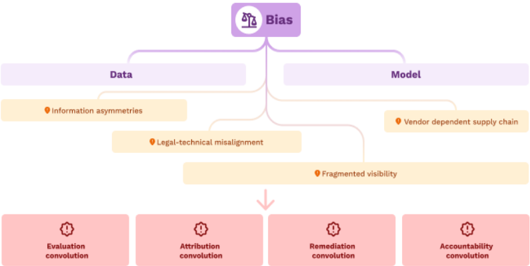
- Supply chain dependencies create four “convolutions”: evaluation convolution (components cannot be assessed in isolation), attribution convolution (no party can identify the causal component), remediation convolution (legal responsibility and technical control sit with different actors), and accountability convolution (no single actor has both visibility and control to ensure fairness).
- Regulatory frameworks assign responsibility in ways that do not match multi-vendor pipelines: NYC Local Law 144 places all obligations on employers and produced “null compliance,” with only 5% of employers posting required reports; analysis of 116 filed audits found under-reporting through missing demographic data, opaque methods, and misaligned metrics.
- Bias can arise even when each component appears compliant: a resume parser, ranking algorithm, and employer threshold may each satisfy different fairness definitions, yet the integrated system discriminates. The paper cites the fairness impossibility theorem and notes that over 250 commercial HR AI tools span the hiring pipeline.
- The paper proposes multi-layered interventions: system-level audits of integrated deployments, vendor guidelines requiring fairness approach disclosure, continuous monitoring, contractual responsibility allocation, and detailed documentation across dependency chains.
Methods
- Structured literature review across Web of Science Core Collection, Scopus, and SSRN, combining search terms for AI hiring systems, bias/fairness, and accountability; limited to English-language publications with no date restriction, screened by title and abstract, plus references from highly relevant works.
- Regulatory analysis of three frameworks: the EU AI Act, New York City Local Law 144, and Colorado’s Artificial Intelligence Act, focused on how each assigns responsibility across supply chain actors and where gaps arise in multi-vendor deployment.
- Practitioner and policy literature on AI governance in hiring, including regulatory impact assessments, audit reports, and industry analyses, was also reviewed.
Limitations
- The paper states it focuses primarily on AI hiring systems in the United States and European Union, so accountability dynamics may differ in other regulatory contexts.
- The paper states its emphasis on resume screening reflects where algorithmic hiring has received the most scrutiny, though other hiring stages pose their own challenges.
- The paper states its proposed interventions are overarching normative mechanisms, not empirically validated recommendations, and more specific guidance would require access to proprietary contracts, system architectures, and deployment data.
- Evident from the text: the illustrative example in Section 5.6 is explicitly fictional, and the analysis is based on literature and regulatory review rather than original empirical testing.
Model-written summary. Check it against the paper before relying on it.
Integrity signals
Registry
Cites
Statistics
Figures
Verification
Claims the paper makes
0 Valid · 1 Not valid · 23 Not checked · 39 Own results and interpretations
In the paper
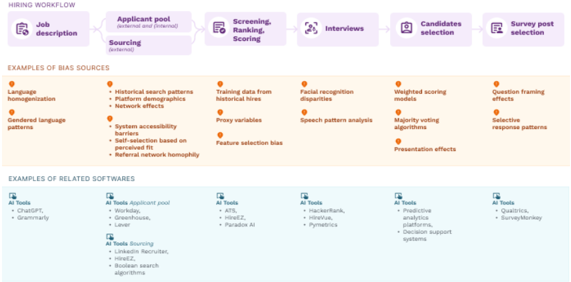
“Modern AI hiring systems exist within complex supply chains (Figure 1) where different stakeholders contribute training data, foundational models, fine-tuning services, and deployment infrastructure.”
§ HOW SUPPLY CHAIN DEPENDENCIES COMPLICATE BIAS MEASUREMENT AND ACCOUNTABILITY ATTRIBUTION IN AI HIRING APPLICATIONS > 1 Introduction
What the sources say
- Not matchedcites [1]
Couldn’t be matched to a paper in Crossref, so it can’t be checked.
plain- Asserted: passes — The authors put it forward as true.
- Checkable: passes — It can be checked against evidence.
- Load-bearing: passes — The paper’s conclusions depend on it.
- Based: passes — The paper gives a reason why it holds.
- Not matched
The paper states this without a source or data behind it here, so there is nothing to check it against. The quote shows it is in the paper.
In the paper
“Yet these insights have not been connected to the specific legal obligations and regulatory frameworks that govern high-stakes automated decision-making.”
§ HOW SUPPLY CHAIN DEPENDENCIES COMPLICATE BIAS MEASUREMENT AND ACCOUNTABILITY ATTRIBUTION IN AI HIRING APPLICATIONS > 1 Introduction
plain- Asserted: passes — The authors put it forward as true.
- Checkable: passes — It can be checked against evidence.
- Load-bearing: passes — The paper’s conclusions depend on it.
- Based: unclear — It is unclear why the paper says it holds.
A conclusion the paper draws from its own results — it cites no other source for it, so there is none to check. The quote shows it is in the paper.
In the paper
“First, bias emerges from component interactions rather than isolated elements, yet proprietary configurations prevent integrated evaluation.”
§ HOW SUPPLY CHAIN DEPENDENCIES COMPLICATE BIAS MEASUREMENT AND ACCOUNTABILITY ATTRIBUTION IN AI HIRING APPLICATIONS > Abstract
plainstates a cause- Asserted: passes — The authors put it forward as true.
- Checkable: passes — It can be checked against evidence.
- Load-bearing: passes — The paper’s conclusions depend on it.
- Based: passes — The paper gives a reason why it holds.
In the paper
“Evidence shows these systems harm job seekers, particularly marginalized groups [13]”
§ HOW SUPPLY CHAIN DEPENDENCIES COMPLICATE BIAS MEASUREMENT AND ACCOUNTABILITY ATTRIBUTION IN AI HIRING APPLICATIONS > 1 Introduction
What the sources say
- Not matchedcites [13]
Couldn’t be matched to a paper in Crossref, so it can’t be checked.
plainstates a cause- Asserted: passes — The authors put it forward as true.
- Checkable: passes — It can be checked against evidence.
- Load-bearing: passes — The paper’s conclusions depend on it.
- Based: passes — The paper gives a reason why it holds.
- Not matched
A conclusion the paper draws from its own results — it cites no other source for it, so there is none to check. The quote shows it is in the paper.
In the paper
“First, bias emerges from component interactions rather than isolated elements, yet proprietary configurations prevent integrated evaluation.”
§ HOW SUPPLY CHAIN DEPENDENCIES COMPLICATE BIAS MEASUREMENT AND ACCOUNTABILITY ATTRIBUTION IN AI HIRING APPLICATIONS > Abstract
plainstates a cause- Asserted: passes — The authors put it forward as true.
- Checkable: passes — It can be checked against evidence.
- Load-bearing: passes — The paper’s conclusions depend on it.
- Based: passes — The paper gives a reason why it holds.
27 more claims
Create a free account to see all 63 claims and every source verdict.
- Probably not a substantial claim. 11
- It may state two separate claims as one. 22
Citations
Cites
The publisher hasn’t deposited this paper’s reference list.
Research works printed but not linked: 22
- NATALIE SHEARD. Algorithm-facilitated discrimination: a socio-legal study of the use by employers of artificial intelligence hiring systems. Journal of Law and Society, 52(2):269-291, 2025.
- Ben Eubanks. Artificial Intelligence for HR: Use AI to Support and Develop a Successful Workforce. Kogan Page, London, UK, 2nd edition, 2022.
- Lan Li, Tina Lassiter, Joohee Oh, and Min Kyung Lee. Algorithmic hiring in practice: Recruiter and hr professional's perspectives on ai use in hiring. In Proceedings of the 2021 AAAI/ACM Conference on AI, Ethics, and Society, AIES '21, page 166-176, New York, NY, USA, 2021. Association for Computing Machinery.
- European Parliament and Council of the European Union. Annex III: High-risk AI systems referred to in article 6(2). regulation (EU) 2024/1689 of the european parliament and of the council on artificial intelligence (artificial intelligence act). Official Journal of the European Union. https://eur-lex.europa.eu/legal-content/ EN/TXT/HTML/?uri=OJ:L_202401689, 2024. Accessed: 2026-01-05.
- Dennis F. Thompson. Moral responsibility of public officials: The problem of many hands. American Political Science Review, 74(4):905-916, 1980.
- Helen Nissenbaum. Accountability in a computerized society. Science and Engineering Ethics, 2(1):25-42, March 1996.
- Monideepa Tarafdar, Irina Rets, Lindsey Zuloaga, and Nathan Mondragon. How hirevue created "glass box" transparency for its ai application. MIS Quarterly Executive, 24(1):47-65, 2025.
- Changmao Li, Elaine Fisher, Rebecca Thomas, Steve Pittard, Vicki Hertzberg, and Jinho D. Choi. Competence- level prediction and resume & job description matching using context-aware transformer models. In Bonnie Webber, Trevor Cohn, Yulan He, and Yang Liu, editors, Proceedings of the 2020 Conference on Empirical Methods in Natural Language Processing (EMNLP), pages 8456-8466, Online, November 2020. Association for Computational Linguistics.
- XiaoWei Li, Hui Shu, Yi Zhai, and ZhiQiang Lin. A method for resume information extraction using bert-bilstm- crf. In 2021 IEEE 21st International Conference on Communication Technology (ICCT), pages 1437-1442, 2021.
- Gurushantha Murthy G R, Shinu Abhi, and Rashmi Agarwal. A hybrid resume parser and matcher using regex and ner. In 2023 International Conference on Advances in Computation, Communication and Information Technology (ICAICCIT), pages 24-29, 2023.
- Elisabeth K. Kelan. Algorithmic inclusion: Shaping the predictive algorithms of artificial intelligence in hiring. Human Resource Management Journal, 34(3):694-707, 2024.
- Zhisheng Chen. Collaboration among recruiters and artificial intelligence: removing human prejudices in employment. Cognition, Technology & Work, 25(1):135-149, 2023.
- Equal Employment Opportunity Commission and U.S. Department of Justice and Office of Personnel Management and U.S. Department of Labor and U.S. Department of the Treasury. Questions and answers to clarify and provide a common interpretation of the Uniform Guidelines on Employee Selection Procedures, March 1979. Federal Register, Vol. 44, No. 43, Friday, March 2, 1979. Citation: Title VII, 29 CFR Part 1607.
- Ifeoma Ajunwa. An auditing imperative for automated hiring. Harvard Journal of Law & Technology, 34(1), 2021.
- European Parliament and Council of the European Union. Article 10: Data and data governance. Regulation (EU) 2024/1689 of the European Parliament and of the Council on Artificial Intelligence (Artificial Intelligence Act), 2024. Official Journal of the European Union.
- Marissa Kumar Gerchick, Ro Encarnación, Cole Tanigawa-Lau, Lena Armstrong, Ana Gutiérrez, and Danaé Metaxa. Auditing the audits: Lessons for algorithmic accountability from local law 144's bias audits. In Proceedings of the 2025 ACM Conference on Fairness, Accountability, and Transparency, FAccT '25, page 29-44, New York, NY, USA, 2025. Association for Computing Machinery.
- Jonathan Lynn, Rachel Y. Kim, Sicun Gao, Daniel Schneider, Sachin S. Pandya, and Min Kyung Lee. Regulating algorithmic management: A multi-stakeholder study of challenges in aligning software and the law for workplace scheduling. In Proceedings of the 2025 ACM Conference on Fairness, Accountability, and Transparency, FAccT '25, page 547-572, New York, NY, USA, 2025. Association for Computing Machinery.
- Lara Groves, Jacob Metcalf, Alayna Kennedy, Briana Vecchione, and Andrew Strait. Auditing work: Exploring the new york city algorithmic bias audit regime. In Proceedings of the 2024 ACM Conference on Fairness, Accountability, and Transparency, FAccT '24, page 1107-1120, New York, NY, USA, 2024. Association for Computing Machinery.
- Reuben Binns. Fairness in machine learning: Lessons from political philosophy. In Sorelle A. Friedler and Christo Wilson, editors, Proceedings of the 1st Conference on Fairness, Accountability and Transparency, volume 81 of Proceedings of Machine Learning Research, pages 149-159. PMLR, 23-24 Feb 2018.
- Derek Leben. Normative principles for evaluating fairness in machine learning. In Proceedings of the AAAI/ACM Conference on AI, Ethics, and Society, AIES '20, page 86-92, New York, NY, USA, 2020. Association for Computing Machinery.
- Giovanni De Toni, Stefano Teso, Bruno Lepri, and Andrea Passerini. Time can invalidate algorithmic recourse. In Proceedings of the 2025 ACM Conference on Fairness, Accountability, and Transparency, FAccT '25, page 89-107, New York, NY, USA, 2025. Association for Computing Machinery.
- Holli Sargeant and Måns Magnusson. Formalising anti-discrimination law in automated decision systems. In Proceedings of the 2025 ACM Conference on Fairness, Accountability, and Transparency, FAccT '25, page 181-194, New York, NY, USA, 2025. Association for Computing Machinery.
Cited by
Still being checked.
Metadata
- Authors
- Sharma, G., & Molamohammadi, M.
- Affiliations
- Mila - Quebec Artificial Intelligence Institute (CA)
- Venue
- arXiv
- Publisher
- arXiv
- Published
- 2026
- ISSN
- 2331-8422 (ISSN-L)
- arXiv
- 2604.22679
- OpenAlex
- W7155902789
- Semantic Scholar
- da11d2d5dee4f1d233b9e5fb00016fee71d52948
- Cited by
- 0
- References
- 0
- Type
- posted content
- Language
- en
- Open access
- green
- arxiv.org
- Licence
- Locations
- arXiv (Cornell University) (submittedVersion, cc-by)
- arXiv (Cornell University) (cc-by)
- Topics
- Physical Sciences › Computer Science › Artificial Intelligence › Ethics and Social Impacts of AI
- Social Sciences › Business, Management and Accounting › Organizational Behavior and Human Resource Management › AI and HR Technologies
- Social Sciences › Law › Digitalization, Law, and Regulation
- Keywords
- algorithmic bias, supply chain dependence, algorithmic discrimination, resume parsing, bias assessment, information asymmetry, algorithmic governance, EU AI Act, continuous monitoring, algorithmic transparency
About these checks
Registry, retraction, Cites and statistics results are computed, not judged, with one exception: a printed reference that no index lists is read once by a model before it counts as a citation error. Claims are extracted by a model and kept only when their quote appears verbatim in the text; each cited source is then checked, with a model’s help, for whether it says what the claim relies on. Those verdicts can be wrong — read the claim’s quote and the cited source before relying on one.
A language model drew the claims from the paper on 2026-11-11, under version 3 of the claim definition (model deepseek-v4.1-flash, prompt extract-v3).
A second model labelled each claim on 2026-11-11 (model jev-1.13-20260917, definition revision gold-guideline-v0.2).
Statistics and arithmetic are recomputed, not judged.
Confidence bands are shown only for fields calibrated on our annotated test set. None is calibrated yet, so no band is shown.
What counts as a claim ›How we measure confidence ›How we check this ›
Are you an author, or do you see a problem with this page? Request a review
Data sources
Bibliographic data: Semantic Scholar, OpenAlex, Crossref.
Contains information from the Semantic Scholar Academic Graph Datasets, made available under the ODC Attribution License (ODC-BY 1.0).
Semantic Scholar’s data is described in: Kinney, R., et al. (2023). The Semantic Scholar Open Data Platform. arXiv:2301.10140.
